

Aó! (yo!) Let’s do something fun: Put your hand on a supermarket shopping cart… the one at the local market with the front-left wheel that always, inexorably makes it derail to one-side… yes, like the one that last week started a real brawl with me about the foundations of physics. Limortacci sua!
Seriously, here’s the fight: Put your hand on the cart when it’s loaded heavy and give it a push. Before it moves at all… in that raw, first millisecond… something refuses. Not the wheel; the wheel’s complaints come later when they pull left (damn them to hell!).
Not friction, and not gravity either. Push straight up and gravity answers, but this is different. Something inside the cart itself objects to changing whatever the hell it was doing.
That objection has a name: inertia.
Physics has been measuring it magnificently for three hundred years. Even using shopping carts. Well, at least I did, especially when my son used to ride inside sometimes… which changed the measurement considerably.
And here is what physics has to say about why the objection exists in the first place:
Niente. Absolutely nothing.
Pensaci! Think about it for a second.
The most visceral force-feeling in the universe… the exact feedback in your fingers every time you slam a car door shut… and the official explanation on file is just a definition wearing a lab coat. Newton defined mass as “the measure of a body’s resistance to acceleration.”
Ma che davero? (For Real?)
Fine. So why does the body resist? Because it has mass. And what is mass?
The measure of the resistance.
Listen to me… I’ve spent twenty-five years in tech startups, writing code, designing architecture, and shipping production systems across two continents. When I find a circular loop like that in a codebase, it means some developer at 3 AM gave up, commented out the error handling, and prayed nobody would ever inspect the function.
This particular legacy hack has been running in production since 1687, and modern academia keeps shipping it without a refactor.
If you’re the sharp kind of reader, you probably came up with an objection two paragraphs ago. So let me say it out loud for you:
“Resists changing what it was doing? Aó, Robbe’… the cart isn’t sitting still!”
Capito er problema? (understand the problem?)
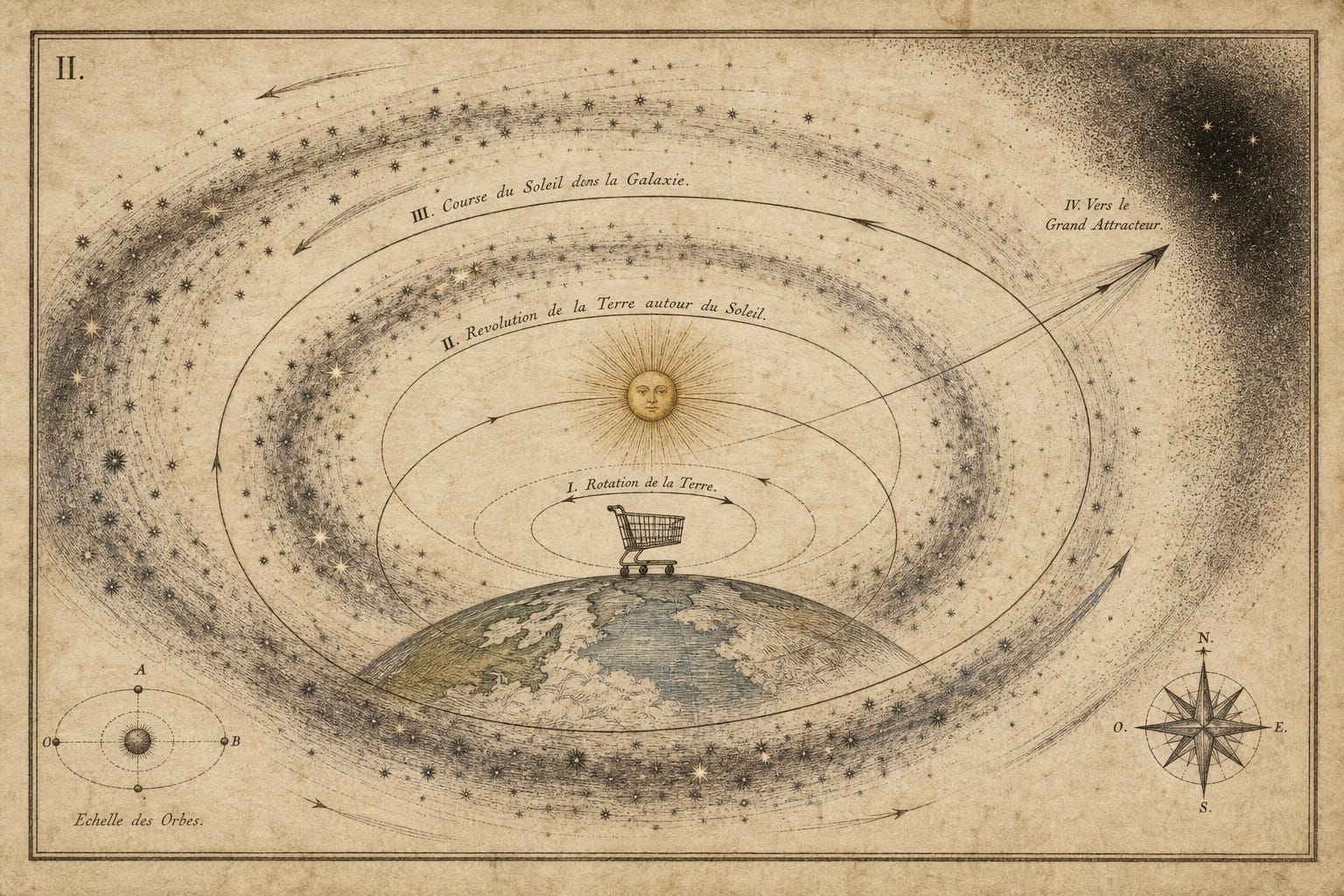
You’re right. It’s sitting on a planet spinning its equator at hundreds of meters per second. That planet is falling around the sun at 30 kilometers a second. The sun is wheeling through the galaxy at 230 km/s. And the whole damn galaxy is rushing at roughly 600 kilometers every single second toward a patch of southern sky past Centaurus… the “Great Attractor,” and whatever cosmic horror is hiding behind it. (Maybe the giant planet eating croissant-shaped monster from that old episode of Star Trek).
I did this arithmetic once, and briefly lost my mind: Your “stationary” cart is a runaway missile of stacked vectors.
So which motion, exactly, is it defending when it pushes back on your palm?
Beautiful question. Now run the experiment that answers it:
Push the cart east at noon. Push it east again at midnight. Earth’s spin has rotated you completely around by then, so “east” now points against some of that stacked velocity instead of along it. Push it in June, then push it in December, when Earth’s orbit has flipped your direction through the galaxy.
If inertia were a resistance to velocity… if the cart were stubbornly defending its 600 km/s… the push should feel different by direction, by hour, and by season.
It doesn’t. Niente. Manco ‘no spiffero.
Not to your hand, and not to the most absurdly precise instruments ever built, which have hunted this direction-dependence for sixty years and found zero variation down to one part in 10²⁷. That is a number I have to look at sideways just to digest.
Galileo figured this out first from below decks of a smoothly sailing ship: no experiment conducted inside a closed system can reveal your uniform velocity. You were born below decks of a 600-kilometer-per-second ship. Nothing in your kitchen has ever noticed, and nothing ever will (until a fat orange food-obsessed cat called Pumpkin jumps from the top of the fridge to your counter possibly…)
So here is what inertia actually resists, carefully put because everything that comes next is based on it:
Matter carries no speedometer. It carries a perfect accelerometer.
Velocity is a relationship. It only exists relative to something else, and the universe politely declines to nominate a favorite reference frame. Ask “How fast is the cart really going?” and physics merely shrugs (the famous shrug we have seen so many times so far): “Relative to what?”
But a change of velocity… speeding up, slowing down, or taking a sharp turn at constant speed… is an absolute, private fact. You can detect it from inside a room with zero windows. You stop the car too fast, and the Starbucks espresso slides across the dashboard. Your inner ear definitely makes you feel the merry-go-round with your eyes closed. The crash-test dummy doesn’t need to look out the window to know it hit the concrete. Ouch…
Inertia is the resistance to that. Not to motion, but to the changing of motion, as judged strictly by the object itself.
The cart is completely indifferent to its 600 stacked kilometers per second, because cruising is free. Being shoved into a new velocity is an event… the only kind of motion-event that belongs to the object alone… and that is the exact event matter “charges” you for.
Hold onto this, because it sets an outrageous architectural requirement for space itself. If the vacuum is any kind of physical medium, it has to be a substance you can glide through at any constant speed, in any direction, for zero cost, forever… while charging you a tax only when you turn or accelerate.
Ordinary mediums fail this test instantly.
L’acqua non perdona (water does not forgive): swim faster, and the water fights back harder, there is drag. Whatever the vacuum is, it’s a weird kind of ocean: one with no drag at any speed, and one where you pay only on CHANGE.
I would file that under the “system specs”. From a coding perspective: We’re going to need it for the refactor. Big time…

It gets more insane. The cart is hiding two separate mysteries, and the second one is my absolute favorite scandal in modern physics.
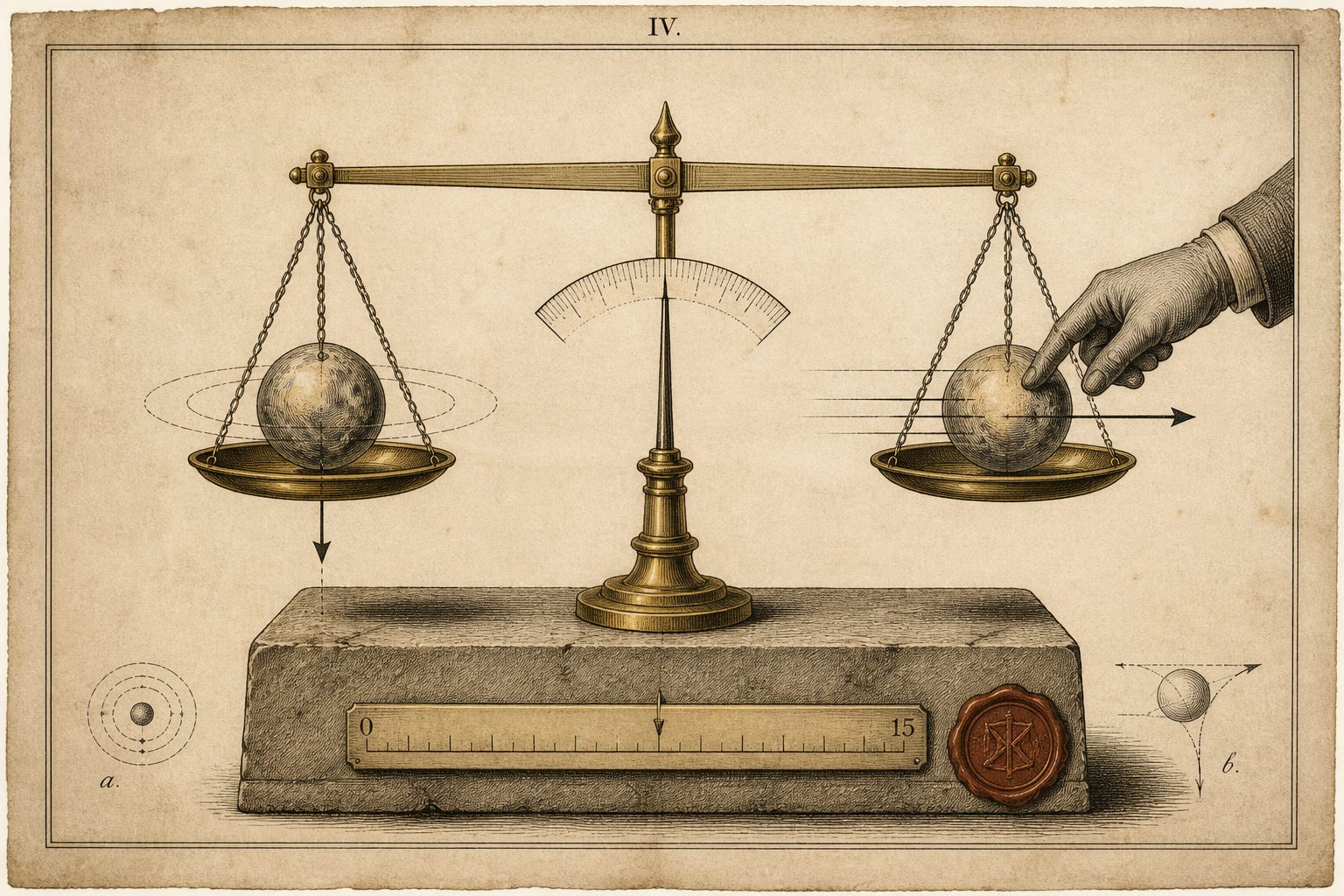
Fact One: The cart is heavy. Gravity pulls it down with a specific strength. Call this its “gravitational mass”… how loudly it talks to planets.
Fact Two: The cart is stubborn. Push it sideways… a direction gravity doesn’t care about… and it resists with a specific strength. Call this its “inertial mass”… how much it hates changing velocity.
There is no obvious logical reason these two numbers should be connected. One is about attraction; the other is about reluctance to changing direction. Completely different phenomena, tested by different apparatuses, reflecting different physical mechanisms.
Yet they are the exact same number!!!
WTF?
Not “roughly” the same… identical to fifteen decimal places, which is simply where our best experimental hardware runs out of decimals, not where the agreement stops. Drop a feather and an iron weight in a vacuum chamber, and they hit the floor in unison because each object’s loudness-to-gravity and its stubbornness-to-acceleration cancel out perfectly. Always. For every substance ever tested.
Physics noticed, of course. It gave this massive coincidence a grand title: “The Equivalence Principle”. Then Einstein built General Relativity right on top of it as a core assumption.
Read that again slowly. It took me years of self-taught digging to really hear it: it was assumed. Honored, load-bearing, celebrated… but not explained. The most precisely verified fact in all of human science is treated as an unprovable axiom.
Ma scherziamo? Ma de che stamo a parlà?
Fifteen decimal places of dead-on agreement, and academia’s official position is… drum roll…. (you guessed it): “That’s just how it is”.
My Roman soul then wants to shout to the four winds: “Ma vai a quel paese!” (or worse, but I will watch my tongue in case young ones are reading this).
You’ve probably heard this one… There’s a real physical measurement here, and then there’s a marketing story wrapped around it. They deserve very different treatment.
The measurement: In 2012, CERN found a genuine bump in their data… a sharp excess at 125 GeV, decaying in very specific channels. Five sigma. Break out the champagne, . I watched the livestream like everyone else. That bump is a physical fact, and I won’t spend a single word disputing it.
But watch the language real close. Particle detectors don’t “see” abstract particles; they count collision debris like investigators at a crash site. As an illustrator, when I look at raw data, I see it the way I look at a structural sketch: a peak is a geometric contour line, a resonance pattern. Calling it a “particle” is an interpretation added afterward by someone who already painted the frame and was desperate for an inhabitant.
The story: That this peak represents a quantum of a background field filling all space, whose job is to bestow mass on elementary particles… and that minus its blessing, electrons would be massless. This is what gets printed in headlines as “the particle that gives everything mass.” They even called it the “God particle”, how theatrical!
There are three things worth keeping in mind about that story:
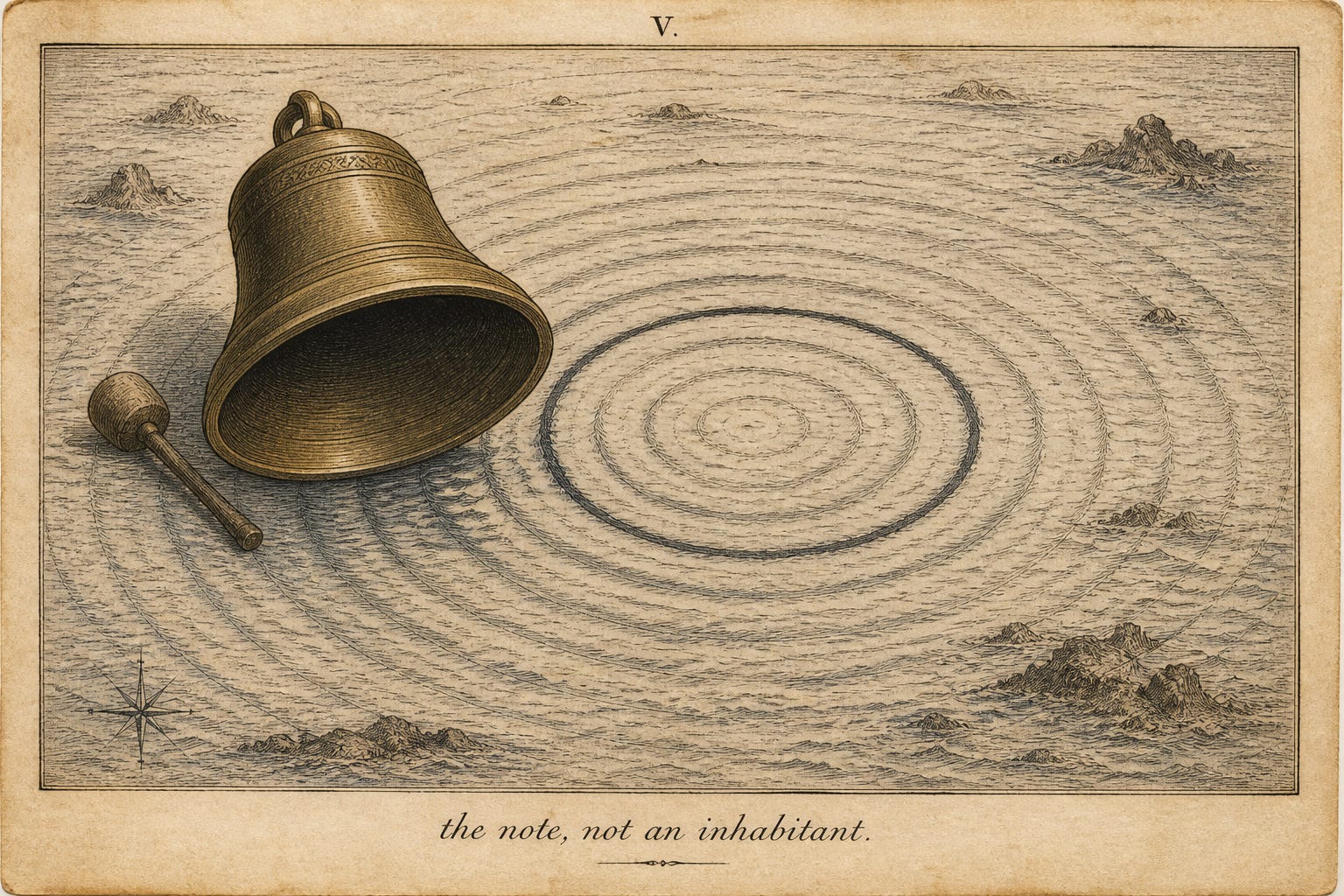
Mediums ring. There’s another thing in nature that answers at a fixed energy when struck: a physical medium. Strike a tuning fork anywhere and it rings its native note… not because a little entity called “the ring” lives inside the steel, but because the structure has natural resonances. If space has structure, 125 GeV might simply be one of its natural notes: the energy at which the sea itself gives way and rings. No new fundamental field required. (That’s a whole separate article I’ve been dying to publish but it’s going to have to wait...)
It barely covers you. Even if you swallow the standard story whole, it accounts for almost none of your actual body weight. Roughly 99% of your mass comes from the raw binding energy churning inside your protons and neutrons. Turn the Higgs mechanism off entirely, and you’d lose maybe a kilogram. The headline particle “gives everything mass” the way a sprig of parsley gives a 16-ounce steak calories. Il prezzemolo, praticamente. Ma piantatela!
It misses the point. Even for the sliver of mass it claims to account for, the theory merely assigns the amount. It does not explain the behavior. Why does mass, however acquired, blessed, or bound, resist being pushed? Why does energy trapped inside a proton push back on your palm? That question isn’t answered by the bump, the field, or the press release. It quietly remains nobody’s job. As usual… too embarrassing to ask.
E = mc²
The most famous equation on Earth (for now… eh eh). You saw it on T-shirts, posters, memes, videos…
In plain English, “an object’s energy content and its inertia are the exact same quantity, scaled by a constant factor”. Einstein published it in 1905 as a three-page afterthought, under a title that to me, in retrospect, sounds practically like a confession: “Does the Inertia of a Body Depend Upon Its Energy-Content?”
The answer was YES, and the twentieth century verified it in nuclear fire (unfortunately). But sit with how bizarre the claim actually is. Energy is the capacity to do work. Inertia is a strong refusal to be shoved. Why on Earth should the universe’s reluctance to move be identical to its stored energy???
Relativity proves they must travel together, but it never explains what either of them fundamentally are, or why they were never two different things to begin with.
Physics keeps a special drawer for questions like this, the drawer labeled “meaningless philosophy” where we hide things, lots of embarrassing things… the ones the ten-year-old me would ask (and the 52-year-old me is trying to find answers for).
Here’s a bit of history that stopped being taught in physics departments, and I have a deep soft spot for it because the people involved lost honestly.
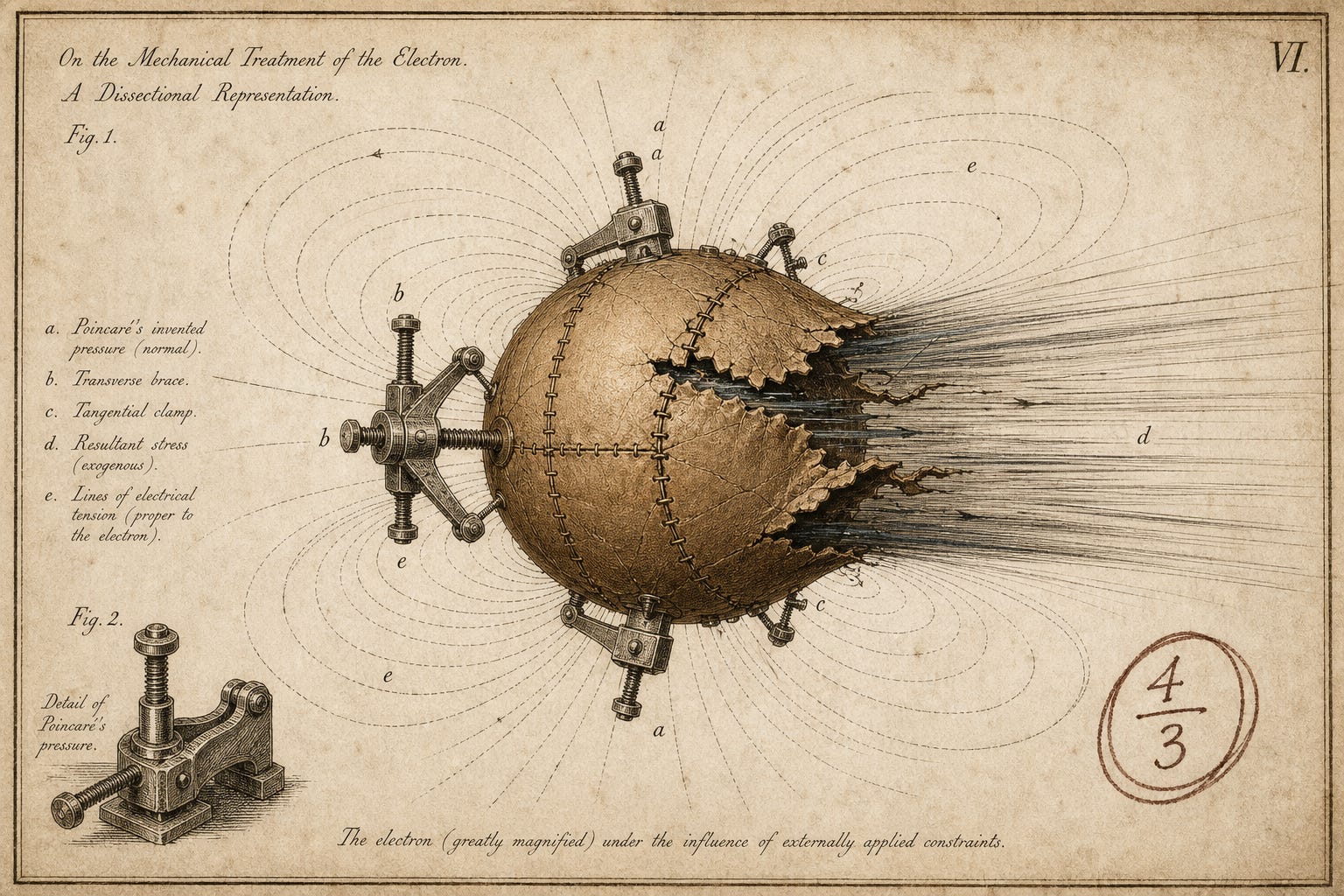
Around 1903, Max Abraham and Hendrik Lorentz… absolute giants of physics, not cranks… tried to solve this face-to-face. They proposed that the electron has no intrinsic, point-like “mass” at all. Its inertia, they argued, is entirely created by the energy of its own electromagnetic field. Push the electron, and you’re really pushing its surrounding field; the field’s stored energy pushes back; that resistance is what we call mass. Matter as pure field energy! It was the dream of a fully unified physics, fifty years early.
They sat down and did the rigorous math. And it almost worked.
Almost.. but no. Agh!
When they calculated the field’s momentum during acceleration, it came out to 4/3 · E/c² · v.
Not 1. Four-thirds.
Porca miseria!
A stubborn 4/3 factor stuck right in the middle of the arithmetic. Believe me, they tried to hack it out. Henri Poincaré eventually “fixed” the discrepancy by inventing an imaginary internal pressure to hold the electron sphere together… an unexplained force added by hand, like a bad hotfix pushed straight to production by a junior dev without code review. Oh my…have we seen that before: Dark Matter, 11th dimension and counting, etc..
The physics community took one look at the artificial patch, sighed (how rare!), and moved on. The field-energy dream was filed away, and “mass” went back to being an ingrained label that particles just… carry around.
So nice of particles to do that for us, right? Brave. Brave, particelle!
Nobody at the time could see what that extra 4/3 factor was actually screaming at them. Screaming while frothing at the mouth!
After thirty years of looking at drawing construction lines and software architecture, it’s almost painful to me: their math failed because they treated the particle as a solid shell sitting inside a separate field. It was an architectural flaw, a bad separation of concerns. The shell and the field sheared apart under a speed increase, requiring outside “glue” to keep the ledger balanced.
The 4/3 wasn’t a computational error. It was the mathematical signature of an ontological bug.
Suppose… same working hypothesis as before, no extra junk added… that space itself is a physical medium, and a particle isn’t a solid marble sitting in the sea, but a stable, localized knot of the sea. One hundred percent medium. No separate passenger. No external shell.
Now watch what happens to every single mystery sitting on the table. Allora:
Newton’s First Law becomes hydrodynamics. There’s a classical result by D’Alembert from the eighteenth century… taught in fluid mechanics, usually labeled a “paradox,” and quickly passed over… showing that a body moving through an ideal, frictionless fluid at constant speed experiences zero drag. None. It glides forever. Sounds familiar? A vacuum medium of the kind we specified… one that generates no wind… is precisely such an ideal fluid. Constant cruising is free. Newton’s first law stops being an arbitrary postulate… it is an inherited property of the darn fluid.
Newton’s Second Law becomes the price of reconfiguring geometry. Fluid mechanics also shows that when an object gains speed through an ideal fluid, it does feel resistance. Why? Because changing its speed forces the entire flow pattern around it to reconfigure, and changing that flow pattern COSTS work (energy). Engineers call this “added mass”. Submarines weigh more than their dry weight because to accelerate the hull, you have to physically shove the surrounding water out of the way.
Now delete the submarine hull…
If the particle is one hundred percent medium, there is no solid object being dragged through a fluid. The particle is the structured energy pattern. Accelerating it doesn’t mean pushing a marble through water; it means reconfiguring an energy-bearing wave pattern. And the price of that reconfiguration is directly proportional to… the total energy stored in the pattern.
“Added mass” stops being a minor hydrodynamics correction. It becomes the entirety of mass.
Inertia is simply what stored energy feels like when you force it to change its state of motion. The shopping cart resists your hand because it is, all the way down, made of energy patterns… and energy patterns have an acceleration toll.
E = mc² ceases to be a mysterious identity between two different physical properties. They were never two properties! Energy and inertia are the same ledger item, read from two different angles. Like shade and illumination in a Caravaggio painting… chiaroscuro. They aren’t two separate substances: they are one spatial geometry defined by the shape.
And what about that pesky 4/3 error that broke Lorentz’s heart? It completely dissolves. Yup (as they used to say in Vermont).
When you close the bookkeeping properly… no separate shell needing outside glue, no particle-versus-field split… the math yields a factor of exactly 1. If you deliberately re-open the books and force a split model, the old 4/3 pathology reappears on demand, and you can track the exact line where the accounting leaks. Their century-old error wasn’t a failure of electrodynamics; it was a diagnosis of a wrong ontology.
Suddenly, those fifteen decimal places of the Equivalence Principle stop looking like a miracle. In this frame, gravity pulls on the energy locked inside the medium’s patterns… and inertia is the reconfiguration cost of those exact same patterns. Gravitational mass and inertial mass are ONE single ledger consulted by two different physical actions. Space cannot keep two sets of books for one pool of energy. This basic Equivalence Principle isn’t a rule we have to enforce; it’s a mathematical impossibility; you just can’t disagree with it. It’s like saying, 2+2=5.
Roba da matti (crazy stuff), honestly! Three hundred years of “that’s simply how mass behaves,” when the entire structure, the whole scaffold, was sitting one basic hydrodynamics course away. Here we go again!
If you are following from my first articles, you are probably starting to get a feel for where this is going…

I will keep this disciplined, because precision is worth a lot more than hype, and as is my principle, I would rather you trust the reasoning than blindly agree with any points I make here:
This doesn’t outright prove a medium exists. What it establishes is narrower, and far more damning for the “don’t ask forbidden questions” doctrine: the forbidden question has a clean, zero-cost answer.
Flux Theory’s medium framework reproduces Newton’s laws, derives E = mc² instead of assuming it, resolves a 120-year-old electron paradox, and transforms science’s greatest coincidence into a physical necessity… all without breaking a single working calculation in modern physics. Read that again.
One honest condition to put on the table: this entire derivation relies on the existence of stable knots in the medium. Why such knots form, how the sea ties itself into the persistent structures we call protons and electrons, is its own mathematical problem, and that’s where the real heavy lifting is getting finalized now in Flux Theory’s theoretical side (not published yet).
I won’t pretend that part is finished. But the core theorem is clear, parameter-free (as the rest of Flux Theory), and waiting: for whatever stable knots exist, their inertia is equal to their stored energy, with zero freedom to be anything else.
This isn’t an unfalsifiable bedtime story either; it’s exposed on many experimental fronts. A medium with fine structure could, in theory, cause inertia to vary by tiny fractions depending on your direction of motion. And as we saw, physicists have hunted for that exact directional bias for sixty years, reaching sensitivities of 1 part in 10²⁷ and hearing absolute silence.
The framework I’m describing doesn’t dodge those tests by luck; it survives them for definite structural reasons… and it pinpoints the exact physical scales where the first directional whisper is hiding. That gives us a concrete target to aim at.
The previous article ended with a precise system specs sheet: a medium that produces no wind, detects rotation, conforms to its sources, carries waves at one universal speed, and stays transparent while possessing rich internal structure. Interesting… interesting.
We can now add today’s line to the engineering requirements document:
Its internal patterns must resist acceleration in exact proportion to the energy they store… and for no other reason.
Every single requirement on that list is doing real work now. The specification isn’t getting vaguer as the questions get heavier; it’s getting tighter. And there is still exactly one kind of structure I know of that checks every single box at once.
We will get there… eventually.
No posts
Comments
Nothing yet. Say the first thing.
Sign in to join the conversation.