
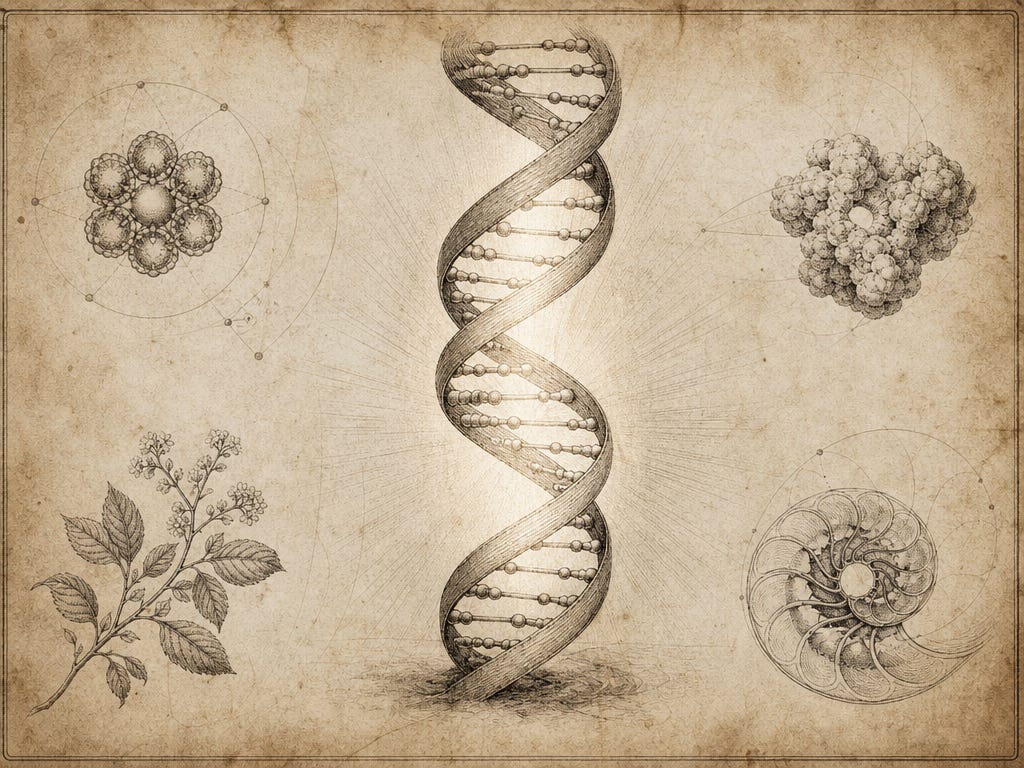
Here’s a fact that should make you want to flip a table.
We can take a vial of your blood and hand you your entire genome by dinner. Three billion letters, sequenced in an afternoon, for less than the price of a decent laptop. We’ve gotten so absurdly good at reading the code that nobody’s impressed anymore.
And yet. Point at almost any single letter in that sequence and ask the only question that matters... why does this one behave the way it does?... and the honest answer, most of the time, is a shrug with a p-value stapled to it.
One mutation gives you cancer. The one sitting right next to it does nothing at all. One tiny stretch of sequence cranks a gene’s output through the roof. Another, barely different, nearly switches it off. We can see all of this. We’ve cataloged mountains of it, petabytes of it. What we mostly cannot do is tell you why, from the ground up, in the language of the matter itself.
Let me make that personal, because it is. There’s a spot in a gene called MTHFR, position 677, where the textbook has a C and I have a T. One letter. I’m hardly special for it: something like four in ten people around you carry that same swapped letter, and roughly one in ten carry it on both copies. And here’s the whole argument of this piece in miniature: that single changed letter makes the enzyme the gene builds come out a little less sturdy, a little less able to hold its shape when things warm up, so it does its quiet job in your folate chemistry a bit less well.
One letter. A measurable change in the stability of a physical protein. We’ve been able to read that letter for years. We are still, right now, arguing about exactly what it does and to whom.
E questo mi rode. That gnaws at me. It has for years…
So let me tell you what I think is sitting on the other side of that shrug.
The best tools in modern biology are, underneath all the sophistication, gorgeous machines for pattern-matching. Feed them enough examples and they’ll tell you, with spooky accuracy, that a sequence looks like other sequences that once did a certain thing. Modern AI does this at a scale that would’ve read as pure science fiction back when the closest thing I had to a thinking machine was an MSX I’d programmed, in middle school, to recite the periodic table. I’m not here to sneer at it. It works, and it’s saved real lives.
But strip off the sophistication and the promise underneath is always, always the same sentence:
We’ve seen something similar before.
Which is a magnificent trick, right up until biology hands you something it has never once seen. And biology does that all day long, because the space of possible sequences isn’t merely large. It’s obscene. There are more possible proteins than there are atoms in the observable universe. More possible promoters and regulatory regions and genomes than every experiment humanity will ever run, multiplied by every experiment it could run, would so much as graze. We will only ever observe a rounding error of what physics permits.
You cannot learn from examples that have never existed. No pile of data fixes that. It isn’t a funding problem or a bigger-model problem. It’s a wall. And every purely data-driven approach, no matter how clever, eventually walks face-first into it.
So maybe, senti, maybe we’ve been asking the wrong question this whole time. Not what has biology already done? But what does the physics of matter allow it to do?
Say you wanted to understand a computer, and the only method you were allowed was watching. You observe millions of people using one. Every click, every crash, every document, every game. Given enough footage you’d get eerily good at guessing what a person is about to do next.
You’d also never once have opened the case. You wouldn’t know what a transistor is. You’d be the world’s leading expert on the behavior of a machine whose mechanism was, to you, total darkness.
Now imagine somebody hands you the laws of electronics instead. Suddenly you’re not predicting from a highlight reel of the past. You’re computing from the rules. And you can design machines nobody has ever built. Because you finally understand the thing instead of its shadow on the wall.
Biology is standing right in that doorway. We’ve spent twenty years becoming magnificent at watching the screen. The question is whether we’ve got the nerve to open the box.
This is the idea that got into my head and would not leave.
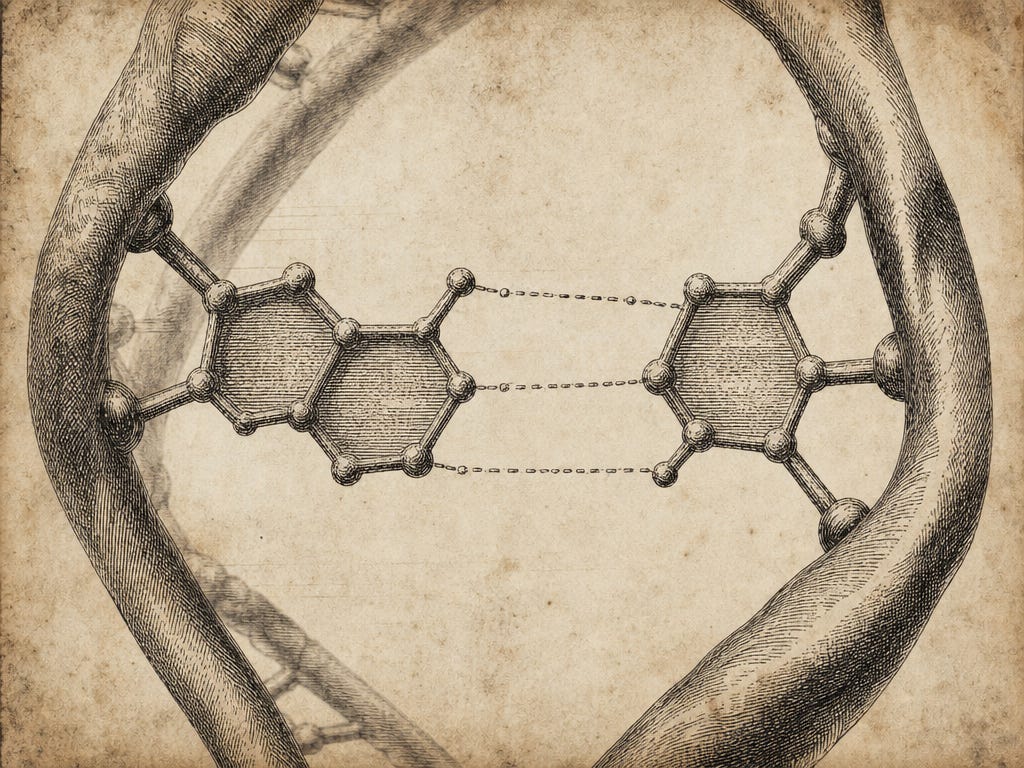
We call DNA information. We call it code, a language, a program. Those metaphors are so comfortable, so worn-in, that we’ve forgotten they’re metaphors at all. But a gene is not a sentence. It’s an object. A physical, three-dimensional pile of atoms sitting in salty water, shoved around by charge and geometry and heat, obeying the exact same rules as everything else made of atoms.
Every “letter change” you’ve ever read about is really a change in where the electrons are. Every promoter bends, twists, breathes, grabs water, and either offers or hides a surface for some protein to land on. None of that is metaphor. All of it is chemistry and physics, running whether we’ve ever seen its like or not.
A gene doesn’t contain information the way a book contains words. A gene exists because atoms arranged themselves in a wildly, improbably specific way, and its behavior falls out of that arrangement whether or not it’s ever appeared in anybody’s dataset.
Ma allora.
So here’s the possibility I can’t stop turning over in my hands: what happens if we stop treating DNA mainly as a language to be read... and start treating it as a physical system to be computed?
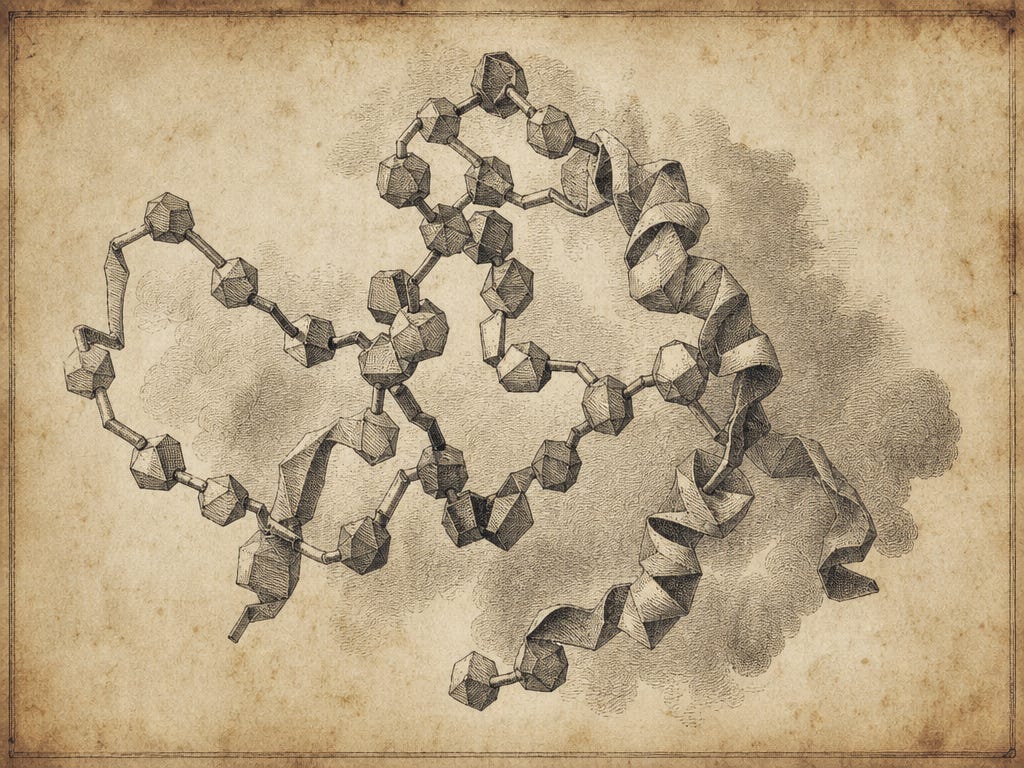
Now I get to stop saying imagine and maybe for a minute.
The engine I’ve been building already does exactly this kind of thing. Not on DNA yet. On proteins. It takes a medium-size protein and folds it in under a minute, and it’s getting sharper by the week. It does docking, working out how molecules find each other and lock together in space. And a fair bit more besides, which I’ll get into another day. This is structural biology, computed from the physics of matter rather than pattern-matched out of a database. Running at a speed that, let’s just say, does not resemble the timelines I grew up being told were normal.
E allora la domanda diventa quasi imbarazzante. Which makes the next question almost embarrassing in how simple it is.
A protein is a molecule. DNA is a molecule too. Longer, twistier, far more temperamental, certo. But the same species of object, ruled by the same physics. If the engine already computes the structure of one, then aiming it at the other isn’t a leap of faith. It’s a change of target.
Now, I’m not going to stand here and tell you a genome falls the same afternoon a protein does. It’s bigger, it’s meaner, and it drags a whole cellular circus in with it. I’ll get to exactly how that could bite me further down. But the method isn’t a hope anymore. It runs. And that changes what kind of bet this is: not “will physics ever compute biology,” but “how far up this ladder does the thing I already have keep climbing.”
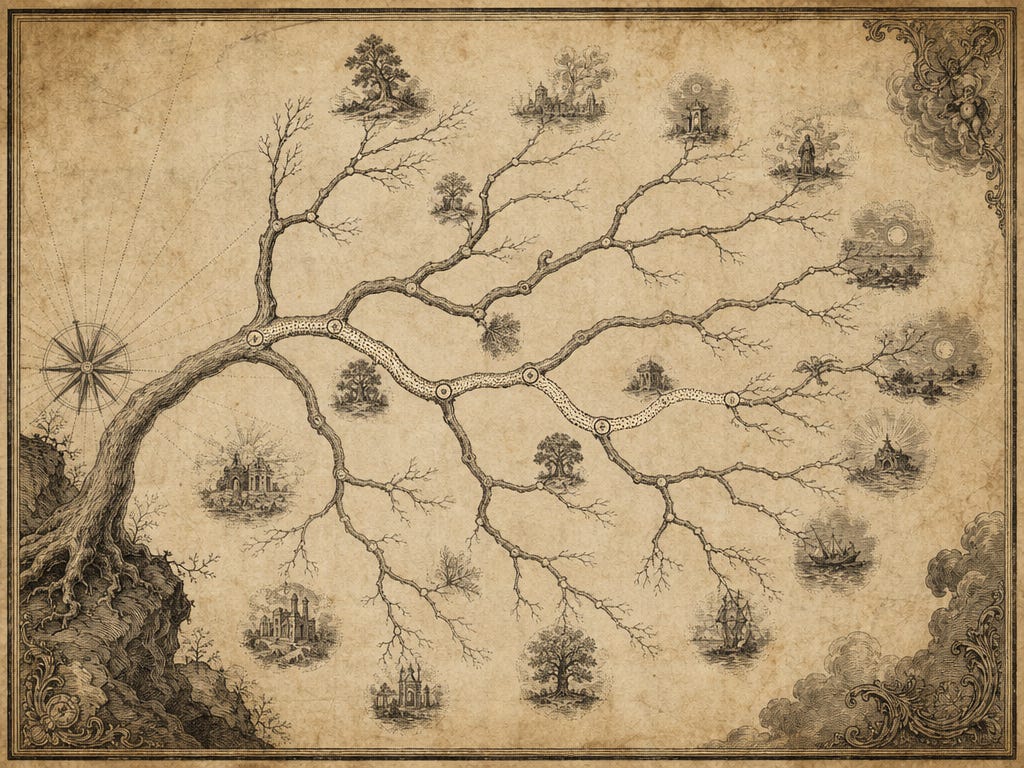
If you could calculate the physics underneath a sequence instead of only recognizing its resemblance to the past, the change in what you’re allowed to say is not subtle.
Instead of “this mutation is statistically associated with disease,” you reach for a mechanism: this change shifts the local electronic environment enough to destabilize how the region opens for transcription. Not a match against history. A cause.
Instead of screening millions of CRISPR edits at the bench to find the handful that behave, you calculate which edits are even physically plausible before anyone uncaps a pipette. Instead of testing thousands of promoters to hit some expression level, you design one predicted to land where you want it. The whole center of gravity slides from finding what already worked to computing what should work.
Now, the experiments don’t vanish in this picture, and if I let you believe they do, I’m selling you snake oil. The lab doesn’t disappear. It gets aimed. You walk in holding a short, ranked list that physics says is worth your morning, instead of a haystack you’re praying contains a needle.
Nowhere. It gets more useful, not less.
The mistake would be to frame any of this as physics versus machine learning. First-principles against data. The pure against the statistical. That’s a bar fight I have zero interest in, because it’s the wrong fight. The design space is far too enormous for physics to brute-force on its own. You still need something clever to propose candidates, prune the tree, and decide what’s even worth looking at next.
The difference is who sits in the judge’s chair. In the pure-data world, a candidate gets judged by how much it resembles things we’ve already seen. In the world I’m describing, the AI does the searching and a physical engine does the judging, asking not “does this look like a winner?” but “is this thing even allowed to exist, and if it is, how does it behave?” Search and physics, each doing the one job it’s good at. Together they leave either one alone in the dust.

Let me say the quiet thing out loud, because if I don’t, somebody might (maybe, on of my crickets?) and bravo to them, they’ll be right.
This might not work.
The move from calculating a small molecule to calculating a living genome is not a step, it’s a staircase, and a few of the stairs might simply not be there. Local physics might turn out not to govern the thing we actually care about. Solvent, salt, the sheer feral mess of a real cell. Any of it could swamp the clean signal I’m hoping to compute. It’s entirely possible the honest version of this project ends with “we got three floors up and the fourth one was missing.”
I’ve made my peace with that. A vision you can’t picture being wrong isn’t a vision, it’s a religion. And I already refused one of those, at nine years old, and I’m not signing up for a new one now. The only sane way to build this is one physical layer at a time, each one forced to earn its keep against measurements it never saw before it’s allowed to hold up the next one. Geometry before energy. Energy before binding. Binding before anybody dares whisper the word biology. Claim nothing about function until the physics under it has survived a test it could have failed. And when a layer flunks, and flunk it will, somewhere, you don’t paper over the crack. You write down that it flunked, in ink, and you go find out why.
Confident and humble aren’t opposites here, whatever the internet thinks. I believe the bet is worth making. I also think I’m probably wrong about big chunks of it. Both true at once. I’d distrust anyone who told you otherwise about something this hard.
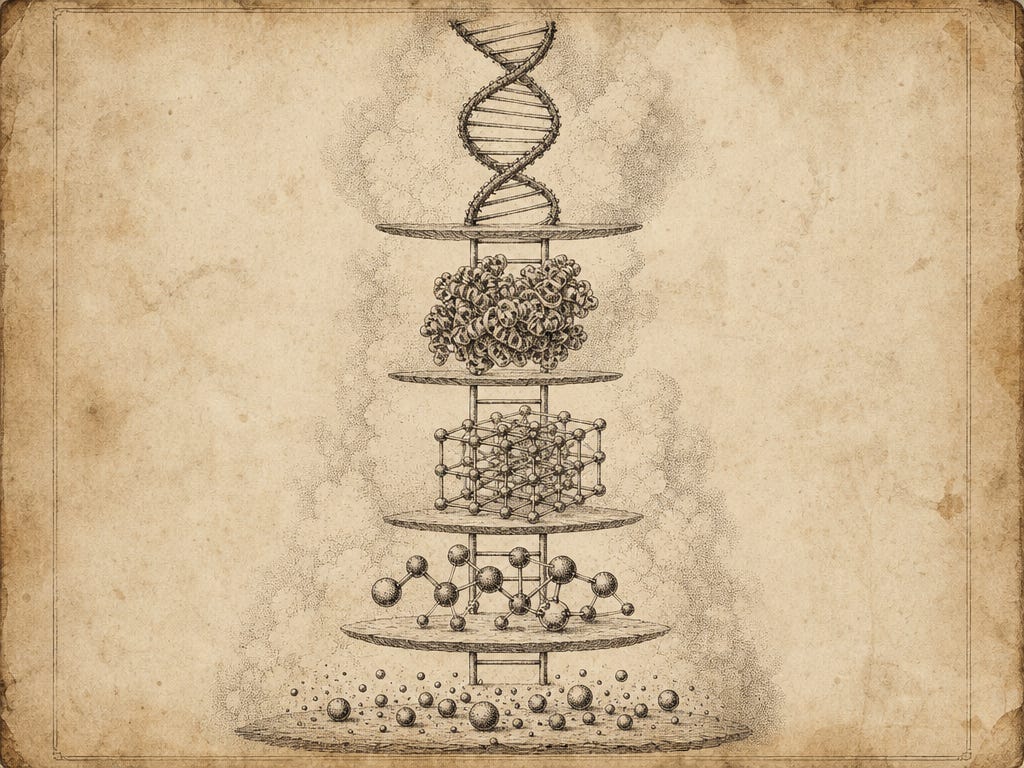
What keeps dragging me back, past every caveat, is this.
Atoms become molecules. Molecules become DNA. DNA builds proteins, proteins build cells, cells build the outrageously complicated thing currently reading this sentence. At every rung of that ladder we’ve bolted up a different field: different journals, different conferences, people who barely nod at each other in the hallway. But the same physics runs the entire climb. It never once stopped to ask which department it was filed under.
And as someone who writes code for a living, that’s exactly the pattern that makes the hair on my neck stand up. When you find a system this enormous being explored only by trial and error, cataloging outcomes it happened to stumble into, there’s usually a layer of abstraction underneath that nobody’s bothered to open. A generating function. The rules the observed behavior is falling out of. In software you learn, sometimes the hard way, that “that’s just how it behaves” is never the end of the sentence. It’s a // TODO somebody left a hundred years ago and everyone politely agreed to ignore.
eh no! I don’t want to ignore it.
If those rules can be computed fast enough, the walls between chemistry and biology and materials and medicine start to look less like natural borders and more like accidents of how we happened to organize ourselves. Maybe we don’t need a separate AI for every discipline. Maybe what we’re all circling, each from our own little corner, is a single engine for understanding matter. I’ve started calling that idea Matter Computing, and the rung of it I want to aim at DNA has a name too, Flux Genome Physics, though a name is the cheapest part of any of this. The genome is just one of the harder, more beautiful things you could ever point such an engine at.
Outrageous thing to say out loud. Lo so. I know.
It may prove incomplete. It may prove flat wrong. But if it turns out even partly right, then discovery stops being mostly an act of rummaging through what already happened, and becomes, a little, an act of computing what could.
Reading the code got us this far. Now I want to read the machine.
Stiamo a vedere.
If you want the whole thing laid out properly, I wrote it down: the foundation it rests on, the ladder from atoms up to biology, the principles that keep me honest. It’s all in the Matter Computing manifesto. This piece was the feeling. That one is the architecture.
Roberto Campus (born 1974, Sardinia) is a coder, composer, visual artist, and entrepreneur who’s spent decades at war with the parts of physics nobody ever bothered to explain. He builds things that compute matter from geometry instead of from data, and writes about it here before he’s entirely sure he’s right. He’s either onto something or he needs a better hobby. Possibly both.
Subscribe if you’d rather watch someone try to pry the box open than stare at the screen a while longer.
No posts
Comments
Nothing yet. Say the first thing.
Sign in to join the conversation.