
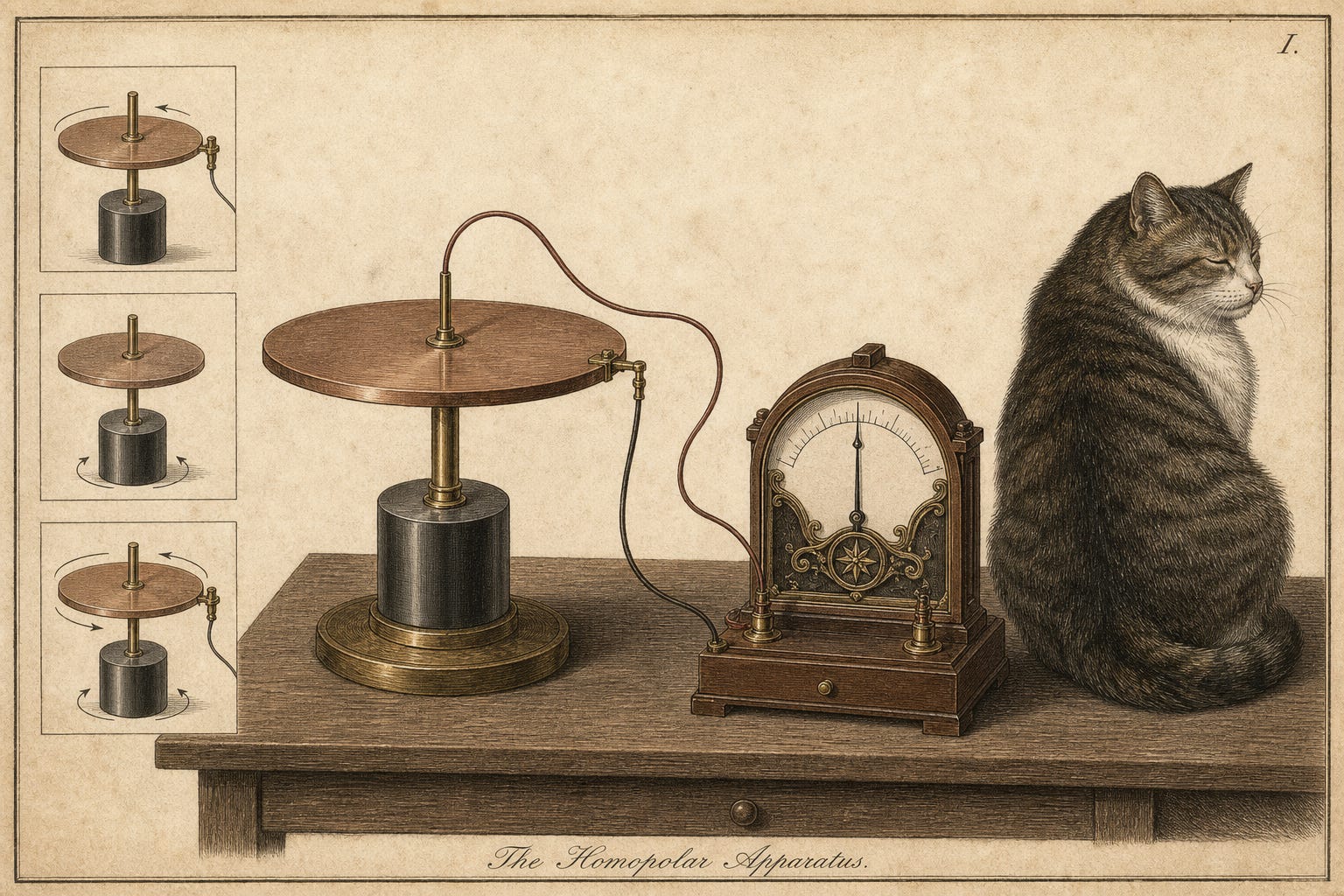
Cari grilli miei! My dear crickets, I want to tell you about the most instructive experiment you can build on your workbench for about fifty euros.
This experiment was first done in 1831, it always works, and the official explanation for why it works has a gap so old it feels like part of the furniture.
Take a cylindrical magnet, magnetized along its axis like a little battery of magnetism. Put a copper disc on the exact same axis, free to spin. Run one wire to the center of the disc and another to a brass brush sliding against the outer rim. Hook both up to a multimeter.
Now play.
Spin the copper disc while holding the magnet still, and the voltmeter jumps. Awesome! You are generating electricity.
Michael Faraday built this in 1831… the first disc generator, what we now call a homopolar generator, the great-grandfather of every humming turbine on Earth.
Now… hold the disc still and spin only the magnet.
Niente (nothing).
Absolute zero. What the heck?
The voltmeter stays completely still, like a fat cat that ignores you when you call its name.
Then: spin them both together. Lock the disc and magnet side by side so there is zero relative motion between them, rotate the whole assembly on the same axis… and the voltmeter jumps again!
Same exact reading as the first case.
Sit with that for a second…
Actually, no… sit with it for a hundred and ninety-five years. That is how long this result has been sitting on the table, working, reproducible, fifty euros a copy… and how long the question behind it has been waiting.
When the disc moves relative to the magnet, you sometimes get electricity and sometimes you do not.
But when there is no relative motion between them at all… you get electricity anyway.
Ma dai! (come on!)
What is the disc moving relative to, then? Eh?
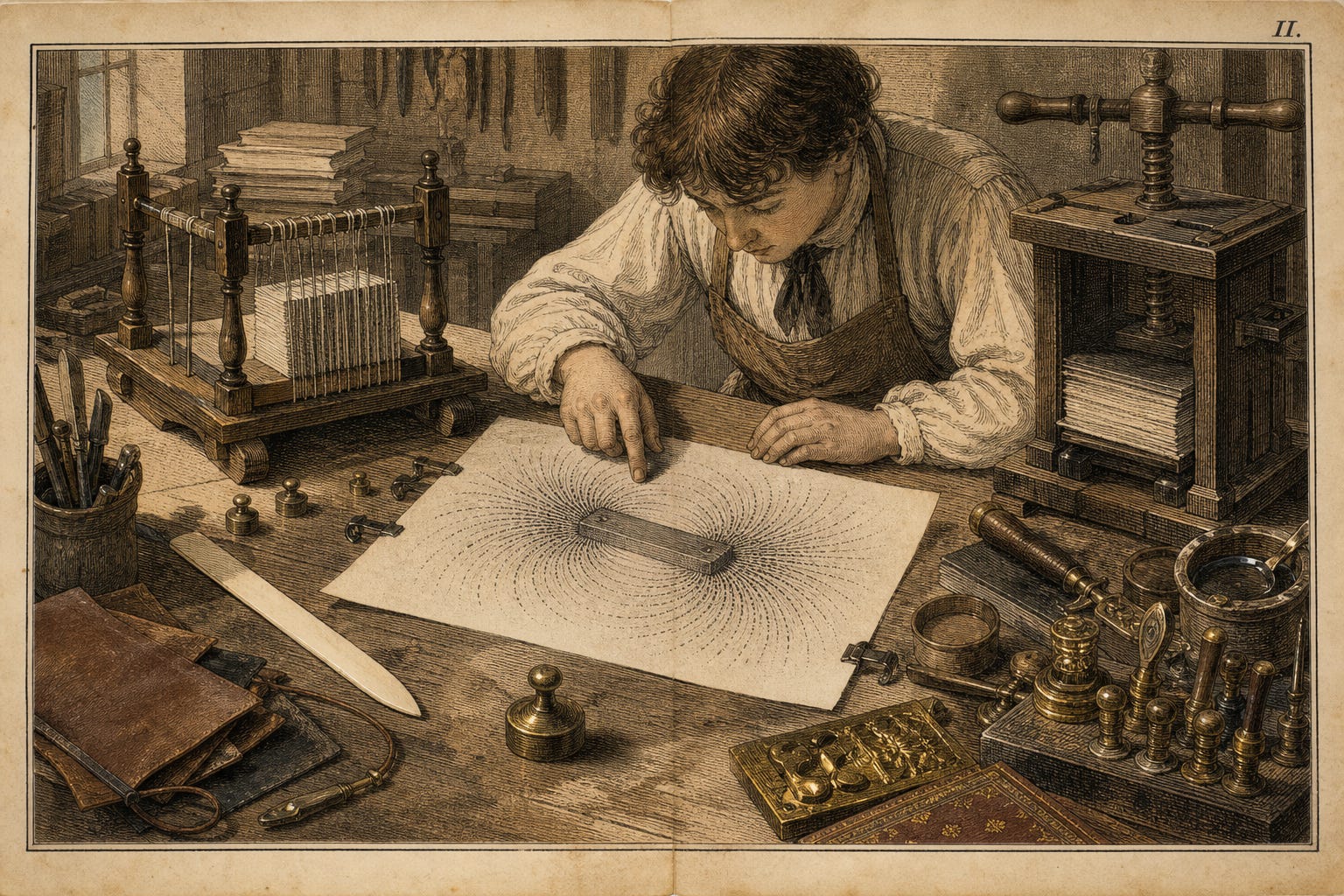
Every kid who learns about magnets takes a sheet of paper, sprinkles iron filings over a bar magnet, and watches the field lines materialize.
The best kind of magic.
Faraday himself thought in those field lines. He was a bookbinder’s apprentice with no formal higher mathematics, and visual lines in space were how he saw the invisible.
As an illustrator with years of experience making abstract ideas visible through drawing, structure, light, and shading, I feel a strong connection to Faraday. I see him as a kind of scientific ancestor, not because I think I am his equal, ma figurati, but because I understand the kind of mind that needs to see a structure before trusting the equation.
Drawing was how his brain did physics.
I believe being a visual thinker really helps with concepts that often seem like a confusing mix of symbols and are usually called too abstract to imagine.
So here is the natural question… the one a ten-year-old asks and a physics professor dreads:
When the magnet spins, do the field lines spin with it?
Think through the options.
If the field lines spin with the magnet, Case 2 is insane. The invisible lines should be sweeping through the stationary copper disc, so where the hell is the voltage?
If the lines do not spin with the magnet, then Case 2 does make sense. But now you are saying the field stays completely still while the magnet that creates it spins underneath.
Stay put relative to what?
The laboratory bench?
The faraway stars?
The fixed wallpaper of the universe?
This is not some fringe curiosity invented by a crank who has recently discovered magnets and the Caps Lock key.
Physicists argued about it for decades. It has an official name… the Faraday Paradox… and it bothered the field so deeply that when a young patent clerk sat down in 1905 to write the paper that introduced Special Relativity, the first paragraph was not about time dilation or E = mc².
It was explicitly about this family of electrodynamic puzzles: the strange asymmetry between a moving magnet and a moving conductor.
The paradox of the spinning magnet has been right at the entrance to modern physics.
Knocking… Knocking…
And then it was quietly locked outside.
Capito? (understood?)

So how do standard university textbooks handle it?
Completely and exclusively… on the numbers.
In the laboratory frame, the field of a perfectly axisymmetric magnet does not change when you rotate the magnet around its axis of symmetry. The geometry is symmetric, so spinning it changes nothing about the spatial field distribution.
The voltage comes from the Lorentz force acting on charges moving through that static field.
Disc spins… charges move through the field… voltage.
Magnet spins… the axisymmetric field remains unchanged, the charges in the disc sit still… no voltage.
Both spin… only the disc’s motion across the static field counts… voltage.
Every measurement since 1831 matches the predictions. I have no problem with the math… it works. But pay attention to what the calculation answers and what it quietly leaves out.
It tells you what the field does… how hard it pushes a charge, how it changes, what the multimeter reads.
It does not tell you what bears the field.
It does not tell you whether the field is the physical state of something.
And when the ten-year-old asks, “Okay, but do the lines rotate or not?” the answer, stripped of textbook politeness, amounts to this:
“Field lines are not physical objects. They are visualization aids. For an axisymmetric source, the field distribution does not change during rotation, so asking whether the lines themselves rotate has no physical meaning. Compute the field and stop asking.”
Stop.
Read that again slowly. S L O W L Y.
Something enormous just happened, and it was engineered to slide right past you.
A physical question was asked.
Not a question about the numbers… the numbers were never in dispute.
A question about what is actually there…
It was not answered and left open for the next generation.
It was declared defective.
Not filed as unsolved… filed as meaningless.
Refusing to answer was presented as being mathematically strict.
In my twenty-five years in software engineering, we had labels for this:
WONTFIX.
NOT A BUG.
When a core system contained an architectural flaw you could not patch without rewriting the whole stack, you closed the issue, locked the thread and explained to the client that their use case was improper.
Try this anywhere else in your life.
You go to the doctor and ask what the lump in your arm actually is. She replies that “what it is” carries no medical meaning.
“Here is the pill. It suppresses the lump. Stop asking.”
The pill might even work.
You would still change doctors.
Ti pare?
Physics has been living with this exact maneuver since before your grandmother was born. Generations of students asked the question. They were told it was naive, and the ones who kept asking learned to shut up and compute.
That is not a resolution.
It is like an army that could not capture a hill, so they erased it from the map, went home, and celebrated anyway with a victory parade!
The parade has been going for a hundred and forty years.
Not symbolically.
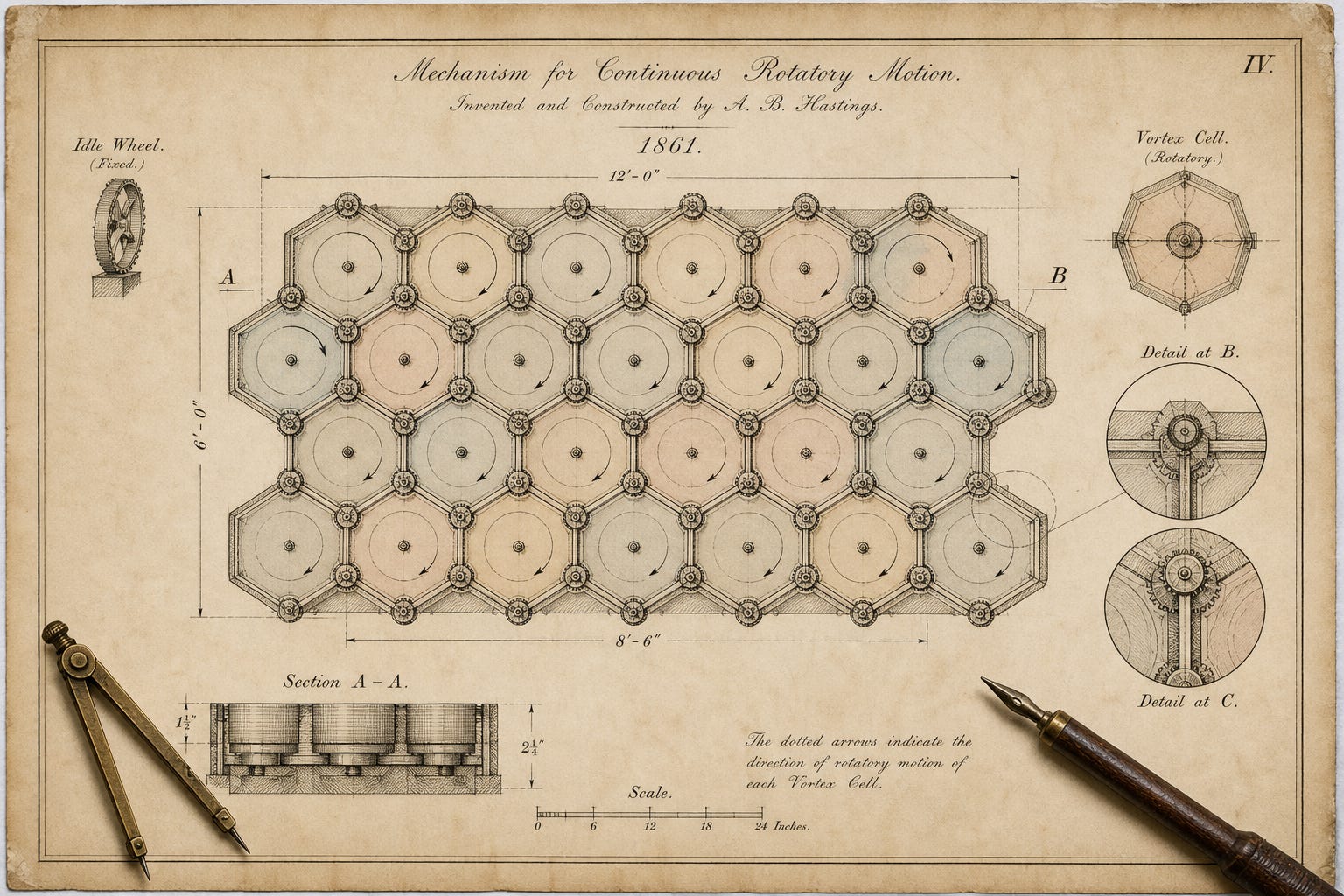
In his 1861 paper On Physical Lines of Force, James Clerk Maxwell developed electromagnetism using an explicit mechanical picture: space filled with rotating vortex cells, separated by tiny intermediate wheels that allowed neighboring rotations to coexist.
He drew the machinery!
Actual engineering diagrams.
The displacement-current term that helped reveal electromagnetic waves and connected electricity, magnetism and light emerged inside that physical framework.
The equations survived because they worked spectacularly.
The machinery did not.
Physics kept the working equations, took away the supporting ideas, and slowly stopped asking if anything real was still holding everything together.
Boh.
To me, it is very odd that people are comfortable with this. Very annoying, actually.
The textbook story, usually delivered in three confident sentences before everyone turns the page, says the 1887 Michelson–Morley experiment disproved the ether.
No.
It disproved a particular kind of medium… one that behaves like a stationary atmosphere and produces a detectable wind when Earth moves through it at constant velocity.
But look at what the Faraday Paradox is about:
Rotation.
Unlike uniform straight-line motion, rotation announces itself locally everywhere in the universe.
Water climbs the inner wall of Newton’s spinning bucket.
Your inner ear reports the merry-go-round even with your eyes closed.
Georges Sagnac measured rotation using split light beams in 1913, and the inertial navigation systems inside modern aircraft use that same Sagnac principle today in ring-laser and fiber-optic gyroscopes.
Uniform velocity hides.
Rotation screams.
The kind of medium suggested by the Faraday Paradox is precisely the kind Michelson and Morley did not exclude: one with no measurable state of uniform motion, but with physical responses to acceleration, rotation and changing source geometry.
Einstein knew the history was not as simple as the textbook funeral.
In his 1920 Leiden lecture, he said that space in General Relativity possesses physical qualities and that, in this qualified sense, an ether exists… one to which no ordinary state of motion can be assigned.
Paul Dirac reopened the question again in Nature in 1951.
This is not secret history. This is well-known history that became inconvenient… then optional… and eventually left out of what most students learn.
Based on the evidence Flux Theory has put on the table so far, I am going to state this plainly and strongly, because I would rather be disagreed with clearly than agreed with vaguely:
The equations earned their century. The ban on asking what they describe did not!
A framework that answers “What is this?” with “The question is meaningless, here is the calculation” is not giving you a physical account of reality.
It gives you a computational method that works. It is impressive and was a huge breakthrough in history. But still a procedure.
Getting the numbers right to twelve decimal places does not mean we have answered the ‘why’ and that’s what I am really after.
Of course, I am not claiming that Flux Theory is already the final word on everything.
Calma.. (Calm down)
I am claiming something narrower, testable and falsifiable:
The question the textbook forbids has a physical answer.
And in this experiment, that answer does not require us to alter Maxwell’s equations or invent an emergency menagerie to protect them.
No extra dimensions.
No mystical cosmic strings.
No new force hired specifically for the occasion.
No modified electromagnetism.
No correction hidden in an appendix and discovered after the measurement was known.
The same numbers come out.
But now my ten-year-old self finally… finally… gets an answer.
Here is the big one:
What it costs is an ontological commitment.
The electromagnetic field is the physical state of a real medium.
That commitment is not free. It cannot rely on just one nice experiment. It has to work in every situation and show where nature could prove it wrong.
We will get there…
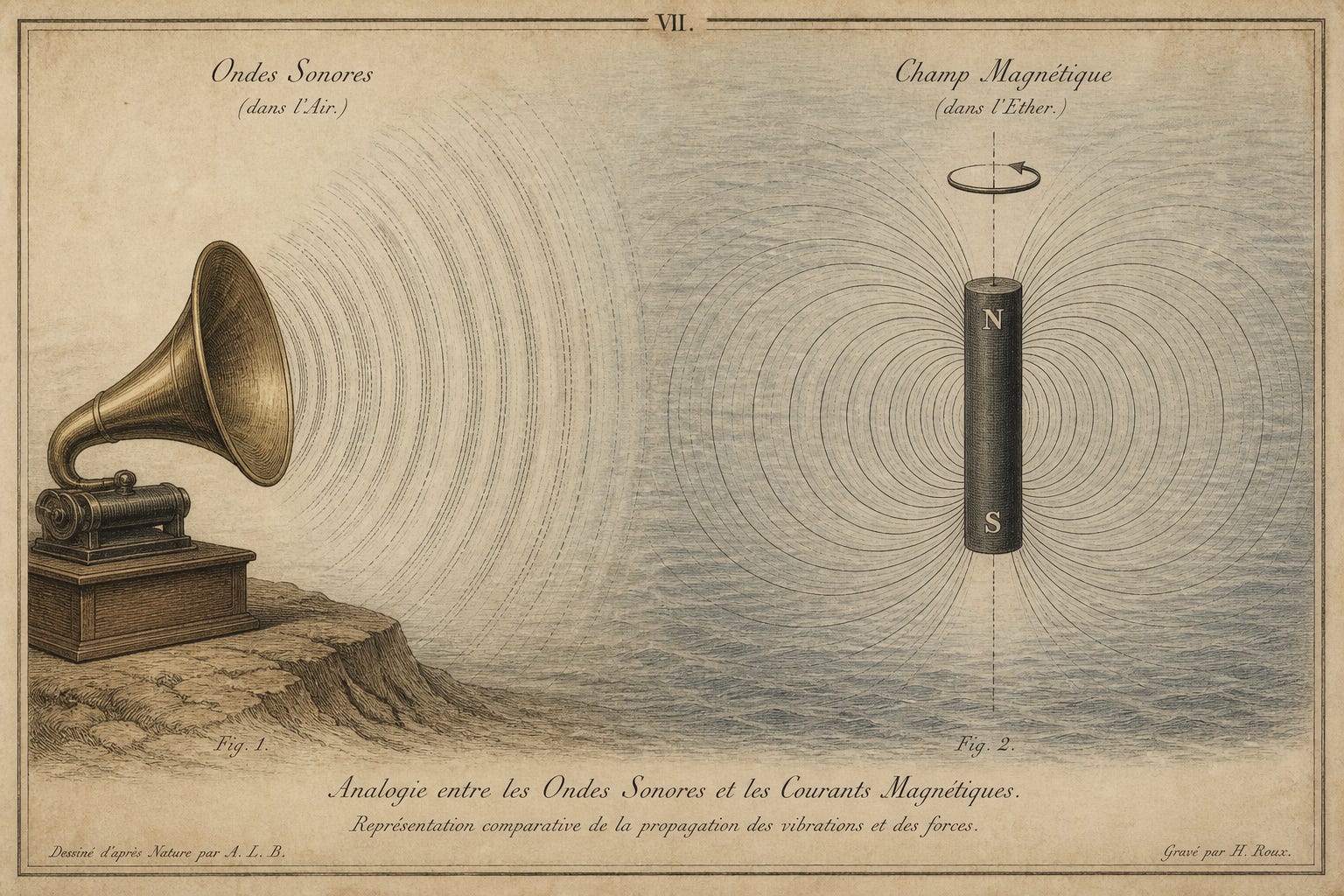
Suppose the electromagnetic field is not a conceptual grid drawn across an empty void. Suppose it is the physical state of an underlying medium, the way sound is a compression state of air rather than an abstract curve painted on nothing.
Pluck a guitar string. You already understand the difference between the vibration and the drawing of the vibration. Return that distinction to electromagnetism and the Faraday Paradox changes shape immediately.
Kaboom!
The field pattern belongs to the medium, not to the magnet as though it were painted onto the metal. The magnet sources and sustains the pattern, the way a speaker cone sustains a pressure disturbance in air.
Now rotate a perfectly cylindrical, axisymmetric magnet around its own axis.
Because the magnet is symmetric, turning it changes nothing about the boundary state presented to the surrounding medium.
The source configuration is unchanged. Therefore, the pattern it sustains remains unchanged.
Notice what this does not require: It does not require a detectable rest frame for straight-line motion. Michelson and Morley remain safely out of trouble.
It requires only symmetry.
The magnet turns, but the physical source state seen by the surrounding medium does not change.
This dissolves the question “Stay put relative to what?”
The pattern is not staying fixed relative to the laboratory bench or the distant stars. It is simply not changing… because the source state responsible for sustaining it has not changed.
Not because the field lines are imaginary ghosts.
Because there is literally nothing in this rotation for the pattern to update.
The voltage then comes from what it always came from: charges moving through the medium’s standing electromagnetic pattern.
Spin the disc and its conduction electrons sweep through the pattern… Lorentz force… voltage.
Spin only the axisymmetric magnet and the pattern does not change… the electrons remain at rest… no voltage.
Spin both together and the disc’s electrons still move through the medium’s pattern… voltage.
Same equations. Same numbers. Every case since 1831 intact.
But now “Do the lines rotate?” has a clean physical answer:
No.
The field is a standing state of the sea, not a bundle of invisible paintbrush bristles bolted to the magnet.

Allora… (well then)
If space is filled with a physical medium, why is the night sky black instead of a milky haze?
This is the objection that buried the old (to me, nostalgic) mechanical aether pictures.
Light crosses billions of light-years of intergalactic space and arrives sharp. Any structured material medium seems as though it must scatter the light traveling through it.
Glass is transparent when its optical properties remain uniform at the scale the light reads. Fog scatters because it presents contrast.
The old trap was set like this:
A medium structured enough to do anything interesting should scatter light.
A medium transparent enough not to scatter light must be too featureless to do anything interesting.
Choose!
That trap has a false floor, and it took me an embarrassingly long time to notice it.
A wave does not respond to “structure” as one undifferentiated thing.
It responds to the particular physical properties appearing in its own propagation law.
A pressure wave in water responds to the properties controlling compression and inertia. It does not hold a general census of every microscopic fact in the water before deciding whether to move.
So suppose the medium has two distinct ways of carrying stress:
A compressional response… governing squeezing, density, pressure and the rich structures that sustain matter.
A shear response… governing transverse motion and light.
If light propagates strictly through the shear sector, then it reads only the shear ledger.
All the complicated hierarchy sustaining particles, fields and matter can live in the compressional ledger.
If the shear response remains uniform, light sees no contrast.
No contrast… no scattering from that hidden structure.
You can have a richly organized substance and perfect optical transparency at the same time. Nobody had to choose between structure and transparency.
They only had to stop forcing both into the same ledger.
Roba da matti! (crazy stuff!)

There is a second, subtler objection that sharp readers will catch.
Vabbè, Robbè. The pattern stands still because the source is symmetric. Fine.
But a real medium should still feel a massive magnet rotating inside it.
Stir a spoon in honey and the honey moves.
If the vacuum is a substance, surely the spinning magnet should drag it at least slightly, smearing Faraday’s beautifully clean numbers.
Ma che cavolo! (what the heck!)
You cannot have a medium that simply refuses to be stirred.
Look closely at what stirring requires.
A spoon drags honey because its motion continuously changes the physical boundary presented to the honey. It pushes new material aside, exposes surface roughness, creates changing gradients and gives viscosity something to grip.
A perfectly axisymmetric magnet rotating on its own symmetry axis does none of those things to the relevant field-producing state.
No moving asymmetry.
No shifting gradient.
No changing boundary pattern.
No geometric handle for drag to grab.
The drag term in this exact configuration is not just small.
It is zero.
To be clear, this is not a claim that matter never couples to the medium. Matter absolutely couples to it (big time!), or nothing would ever happen.
The claim is about this motion and this symmetry:
No changing state… no coupling channel… no drag.
To this spoon, turning on its own axis, there is no honey to grip.
I have to admit: For a long time, this sat in my notes as the one unlocked door in the whole mechanism… a possible residual drag term that I expected I would have to calculate and then force below the experimental limit.
This past summer, the door closed the strong way. Not an extremely tiny coefficient. Not a cancellation balanced on six assumptions.
No term at all!
E invece niente (and so, nothing).
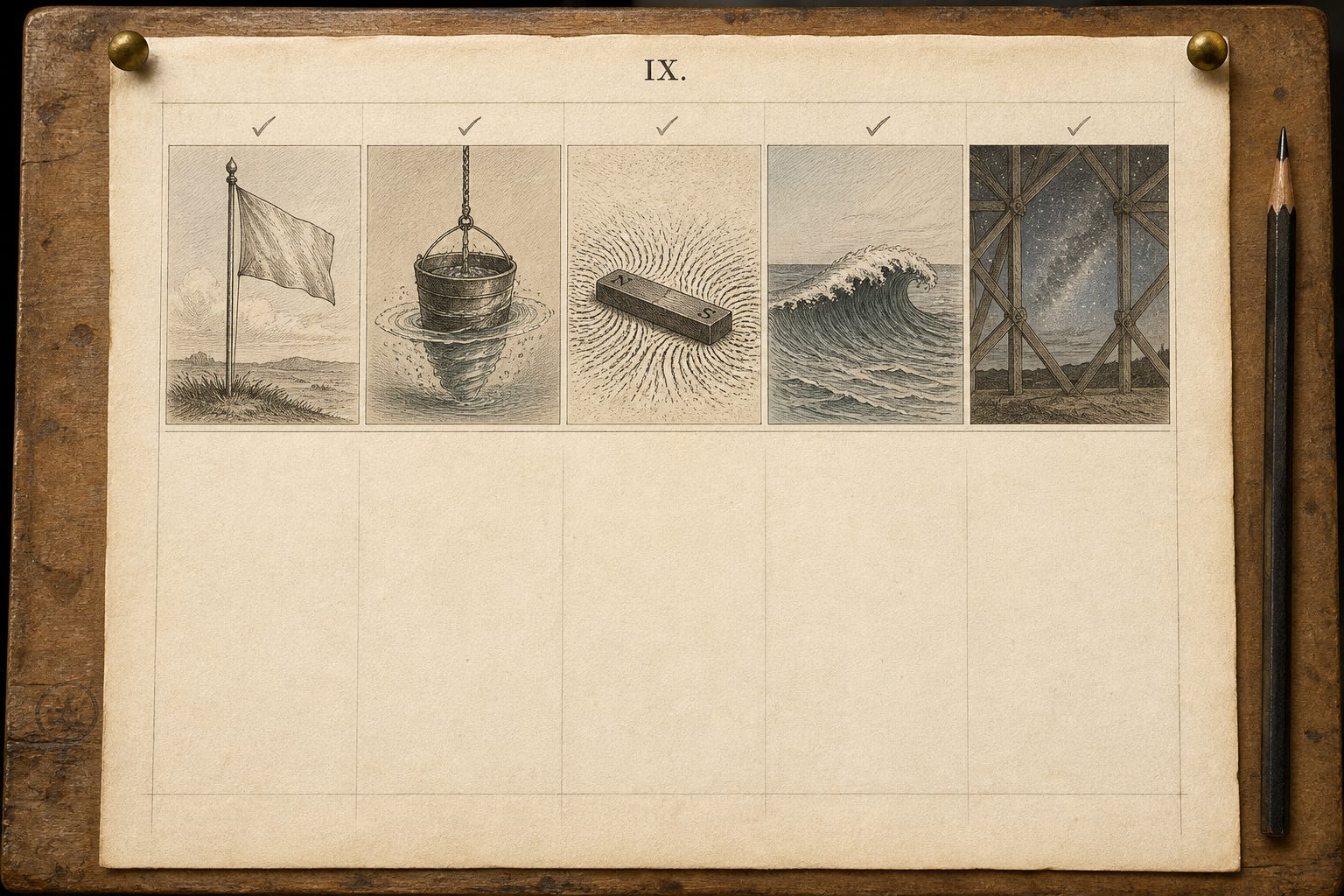
Let us end the way I would close a senior engineering design review.
Forget the proposed mechanism for one moment. Forget the sea, the knots and every image I have used to make the thing visible.
Write down only the requirements forced on us by experiments already sitting on the shelf.
Zero straight-line wind: Whatever space is, it must produce no measurable drag or preferred-frame wind under constant uniform velocity. Michelson–Morley.
Absolute rotational response: It must nevertheless allow acceleration and rotation to be detected locally. Newton’s bucket, the Sagnac effect and modern inertial gyroscopes.
State-driven field patterns: Its field patterns must follow the physical state and geometry of their sources, not simply rotate because the source material rotates. Faraday’s disc.
One invariant wave speed: It must transmit transverse waves at exactly one universal speed (c), independent of the source’s uniform motion.
Dual-ledger transparency: It must remain transparent to those transverse waves while sustaining rich structure in a sector the waves do not read.
Look at that list.
Every line is dictated by physical observations.
Taken together, they are not a vague wish list. They form a surprisingly narrow engineering specification:
A physical medium with no measurable state of uniform motion, a real response to acceleration and rotation, source-state-driven field patterns, one transparent transverse wave sector and a separate structured sector capable of sustaining matter.
I know of one mathematical architecture that satisfies those requirements together.
I am not describing a mystery anymore.
I am describing a specification.
And a specification is something you can build against.
I know… because I did.
That build became FluxMateria, a computational engine that takes the same constrained physical architecture and asks it practical questions.
Atomic properties.
Molecular properties.
Materials properties.
Bonding, solubility, carrier behavior, band structure… domains normally divided among specialized toolchains, quantum-mechanical approximations, iterative solvers and expensive compute.
The engine returns many of those answers in milliseconds on an ordinary processor, without training data and without fitting a separate model for each property.
Across benchmarked tasks, the speed difference can reach orders of magnitude… in some cases, millions compared with the traditional route.
Not because the software contains a particularly cunning shortcut hidden behind a loading spinner.
Because the architecture is doing computational work.
When your model of the sea has found the correct regularity, you do not have to simulate every drop… you read the summary.
Let me keep the books clean, because I keep these claims separate on purpose.
Engineering success is not proof of physical ontology. A useful computational engine can work because it has captured a deep regularity without yet possessing the final description of nature.
But this is the difference between a philosophy and a machine.
The specification does not merely sound coherent.
Engineering success is not physical truth… a calculation engine can be useful for reasons its author misunderstands, and I would be the first to say so. But it is the difference between a philosophy and a machine.
It compiles.
It runs.
It returns answers.
That does not mean “case closed.” It means this thing is onto something.
So go back to the workbench:
Spin the magnet.
Niente (Nothing)
Spin the copper disc and the meter moves.
Lock them together and it moves again.
The apparatus has been giving the same answer since 1831.
The question underneath was never meaningless.
It was only closed as WONTFIX.
Reopen it!
No posts
Comments
Nothing yet. Say the first thing.
Sign in to join the conversation.