

DISCLAIMER: This brief was written with events and information up to June 26, 2026; any events that have occurred since are not addressed. It aims to explore the dynamics driving events underneath diplomatic cover that often saturates MSM headlines.
TFP CONFIDENCE TIERING: The Firebrand Project labels the confidence behind every significant finding in this piece. CONFIRMED means multiple independent sources have verified it. HIGH-CONFIDENCE means the sourcing is strong with minor gaps. DEVELOPING means the indicators are credible but not yet fully corroborated. CLAIMED means a single party — often one with skin in the game — has asserted it without independent verification.
The US-Iran war ended (maybe) the same way it began — with the Strait of Hormuz still in Iranian hands and the outcome still being argued. Four pressure lines are now converging toward a window in 2027 that China’s military has already named. Before any of that can be read clearly, there is a lesson that was extracted from the fighting — not in Washington, not in Tel Aviv, but in Beijing.

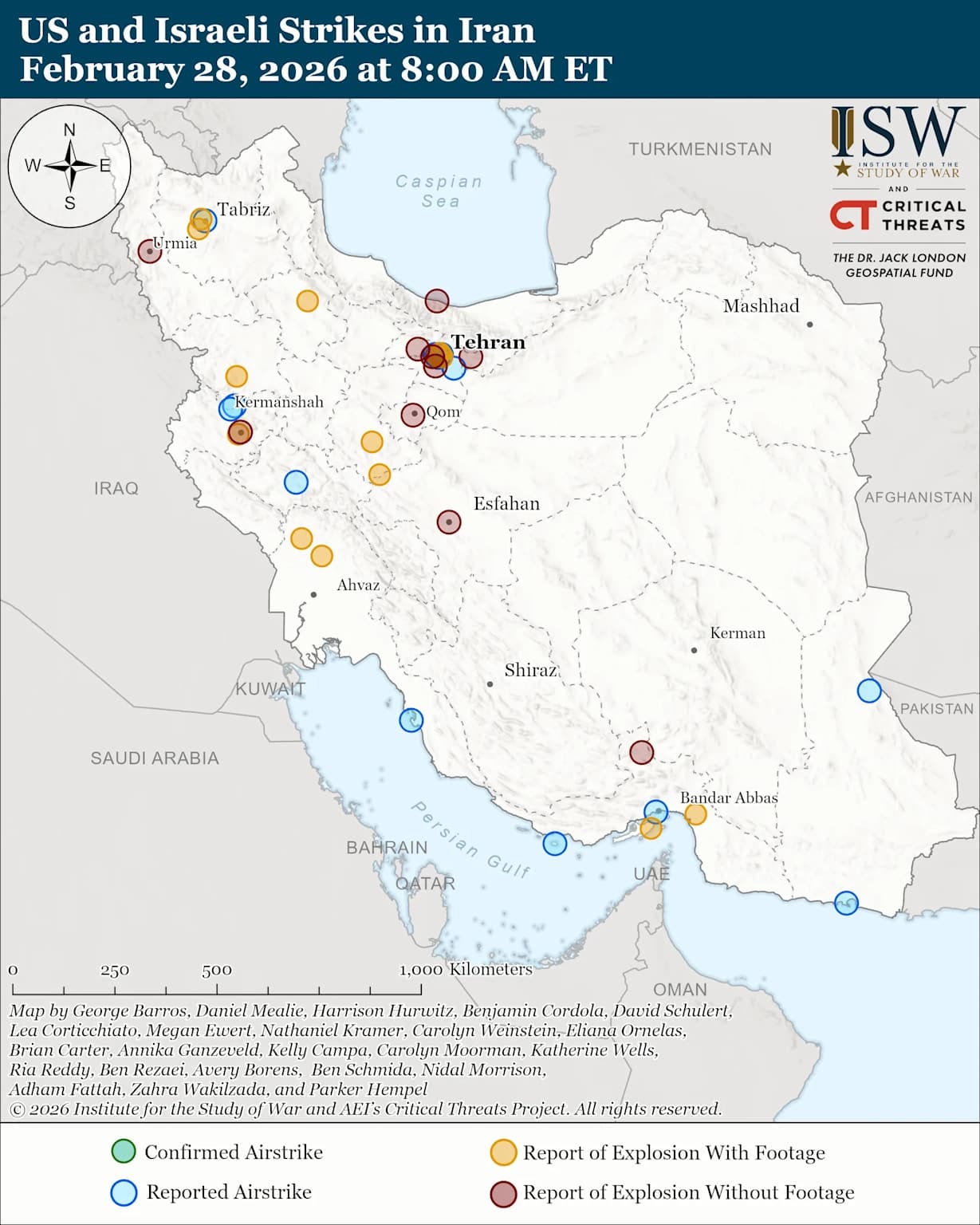
In the spring of 2026, the United States and Israel launched the most capable combined air campaign assembled since 2003. The target was Iran’s missile infrastructure and the network of sites along the Strait of Hormuz that Tehran uses to threaten global energy transit. The campaign ran for weeks. When it paused, Iran still held the strait. The US Navy could not safely escort commercial vessels through it — the single most important stated American war aim — because Iran had rebuilt access to 30 of its 33 Hormuz missile sites and retained an estimated 75% of its mobile launchers and 70% of its prewar ballistic missile stockpile. Brookings, June 2026 Iran had not won every engagement. It had made winning cost more than Washington was willing to spend.
The American ledger from those weeks is specific: 42 aircraft lost or damaged — 24 MQ-9 Reaper drones, one F-15E, one A-10, five KC-135 Stratotankers on the tarmac at Prince Sultan Air Base in Saudi Arabia, one E-3 Sentry AWACS. FDD, April 2026 A single AN/FPS-132 early warning radar at Al Udeid — a strategic sensor with no short-cycle replacement — was destroyed or heavily damaged. On June 8, an Iranian drone tracked and killed a US Army AH-64 Apache helicopter near the Omani coast. ISW, June 9, 2026 Declared US operational cost: $29 billion — before munitions stockpile replacement, radar reconstruction, or base infrastructure repair. FDD, April 2026 By June 2026, ISW assessed Iran was applying calibrated post-conflict pressure — using continued Strait friction specifically because its commanders had concluded the United States had no appetite to re-enter full hostilities. ISW, June 9, 2026
HIGH-CONFIDENCE: China’s People’s Liberation Army war-gamed cost-imposition methodology against Taiwan scenarios for over a decade. The Iran conflict did not hand Beijing a new theory. It handed Beijing a live proof-of-concept — conducted against the actual adversary, at scale, in real time — with confirmed attrition figures, confirmed munitions drawdown rates, confirmed political response patterns, and a confirmed outcome. The methodological template: destroy basing infrastructure in the opening hours, attrit air defense interceptor stocks faster than they can be replaced, hold the political cost above the threshold of commitment, reconstitute rapidly enough to sustain the threat through any pause. Iran demonstrated all four components work.
Questions
Iran’s ability to hold the Strait despite the air campaign surprised many analysts. What made the reconstitution possible — was it dispersal, speed, or something about how the campaign was prosecuted?
The Apache kill is a specific capability marker. What does that tell us about the evolution of Iranian drone doctrine, and how directly does that transfer to a PLA scenario?
The ISW assessment that Iran is now applying calibrated post-conflict pressure suggests the war has changed form rather than ended. What is Iran actually trying to extract, and is Washington in a position to resist it?
There is a counterargument that Taiwan is fundamentally different from Iran. How applicable is this template?
Iran’s reconstitution was made possible by a confluence of factors, not a single cause. Pakistan’s collaboration with China allowed Iran to move resources overland through Belt and Road infrastructure under the diplomatic cover of the negotiations Pakistan was mediating at the time. On April 10, 2026, the Pakistan-Iran transit corridor opened at the Gabd terminal and Rimdan crossing, operating under a Pakistani banking waiver that stripped away key financial paper trails and TIR-certified seals that allowed containers to cross multiple borders with minimal customs inspection. The first declared cargo was frozen meat. The subsequent manifest went dark. Pakistan had also extended its air force to escort Iranian diplomatic aircraft — JF-17 Thunder and F-16 jets tracked near Bandar Abbas — a posture that shielded the early corridor operations from interdiction risk. Layered on top of that is Iran’s Mosaic doctrine, specifically designed to counter US strategy: units operate in dispersed isolation, but when they reconstitute, command coherence is preserved. The combination — overland resupply through Chinese-built infrastructure and a doctrine built for exactly this kind of attrition — is what made reconstitution possible. It is always a confluence.
China had a direct vested interest in watching that conflict play out. Chinese entities had already been supplying Iran with drones, anti-ship cruise missiles, and dual-use components through an existing sanctions-evasion architecture that BRI and CPEC infrastructure formalized into an overland land bridge. Reuters, citing the Financial Times, reported that Iran secretly acquired a Chinese reconnaissance satellite in late 2024 and used it to help target US military sites during the war — placing China inside Iran’s targeting architecture, not merely its logistics chain. The Apache kill follows the same logic as what we saw in Ukraine: the evolution of drones finding cost-effective kill chains against platforms previously assumed safe. A Shahed drone taking down an AH-64 is shocking but not surprising. That is actionable intelligence China now holds.
This brief is not primarily about Iran, but Iran plays a part. If Iran chooses to re-engage, any US response to a Chinese move on Taiwan would be impossible at speed and scale — the assets are already drawn down. If Iran starts shooting again, that is China’s opening. Whether Iran and China are actively coordinating that timing is uncertain. It is not unreasonable, but it is probably not the most likely outcome. Either way, Washington is in a very hard place. Whether Israel lets an Iranian re-escalation stand is an open question; their posture on Lebanon, Syria, and Gaza suggests they will not. US diplomatic will under the Trump administration is genuinely unknown — their own domestic position is in jeopardy with midterms approaching, policy unpopularity is high, and geopolitical relationships have been significantly degraded. They are isolated and operating from a weakening position.
There is a counterargument that Taiwan is different. It is different — but not as different as it might appear. The Iran engagement was close to land, heavily weighted against US naval and air assets, fought against ranged opponents over time. That force structure and posture is not substantially different from what a Taiwan scenario looks like. HIGH-CONFIDENCE: the 31st Marine Expeditionary Unit — the 2,200-strong Pacific-based force that sailed to the Middle East in March 2026 and conducted the M/V Touska boarding in April — was actively committed during the conflict and will require rotation and resupply before it is available for INDOPACOM tasking. That MEU cycle is not available at speed for a Taiwan contingency. The skills and intelligence gathered in Iran are directly applicable. That decision ultimately rests with Xi Jinping. China is not short of intelligence on how to engage the modern US military in this environment.
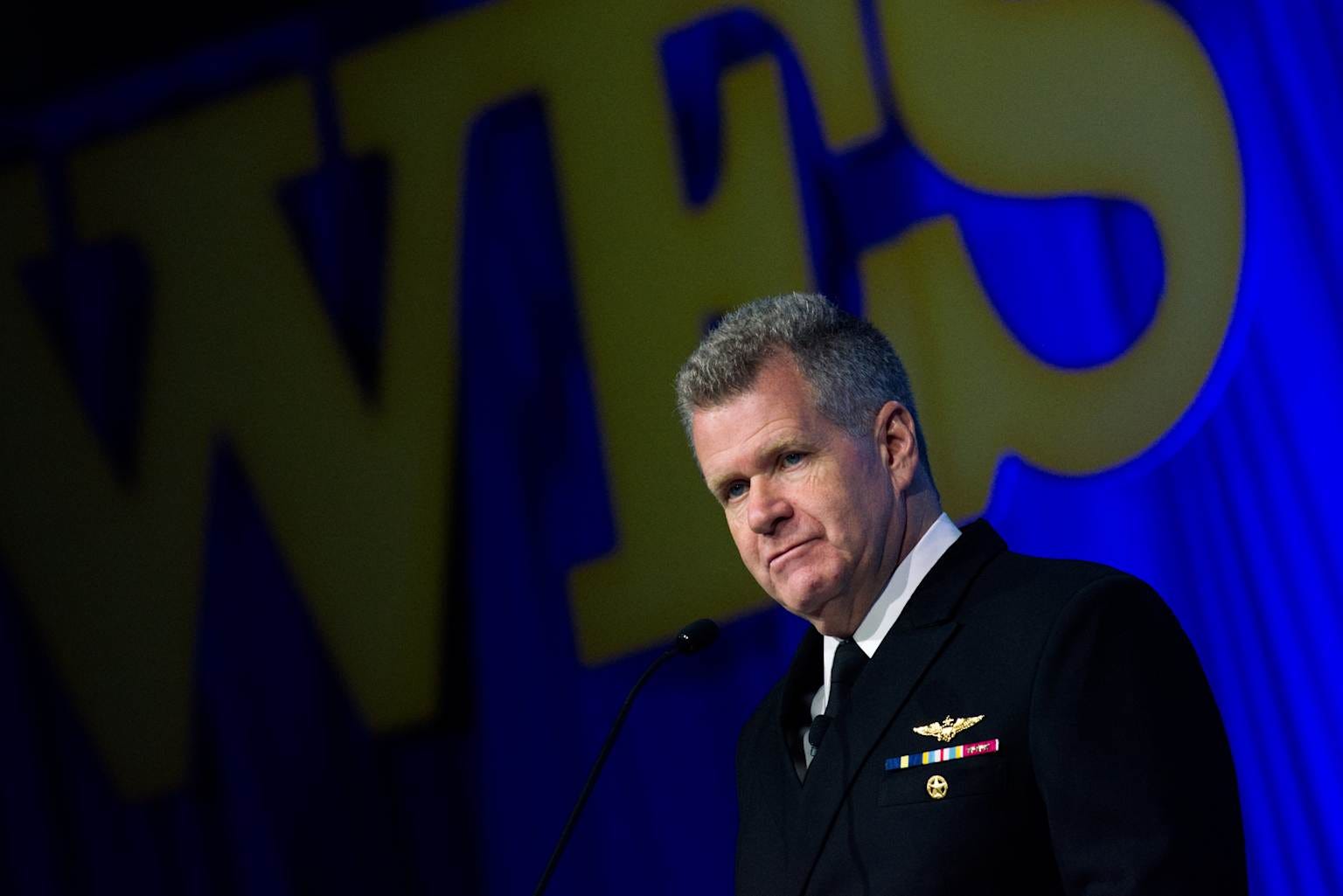
Admiral Samuel Paparo, Commander of US Indo-Pacific Command, did not use hedged language when he testified before the Senate Armed Services Committee in March 2026. He named a year. China, he told the committee, would have the military capability to execute a Taiwan contingency by 2027 — and the United States’ current Pacific posture is not configured to stop it at the speed the scenario demands. Admiral Paparo, SASC testimony, March 2026 The testimony was a budget argument as much as a threat assessment — Paparo was pressing for Pacific Deterrence Initiative funding and had institutional reasons to frame urgency sharply. That context should be held. But the structural gap he described does not depend on his framing to be real.
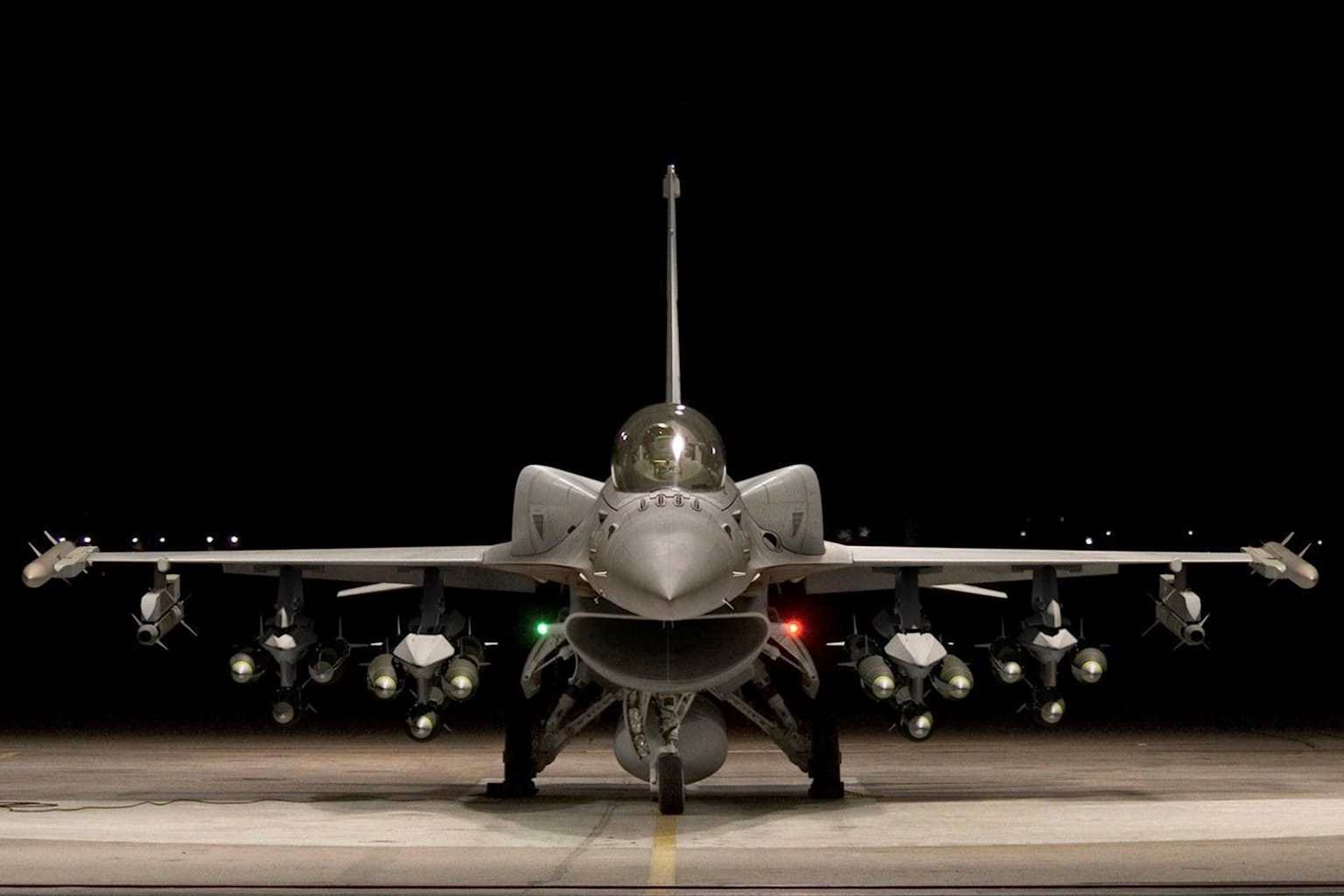
The gap Paparo identified is layered. The first layer is interceptor stockpile depth. The Iran campaign drew down US Patriot and THAAD interceptor stocks at a rate the production pipeline cannot replenish within months — a point FDD documented in April 2026, assessing that US air defense magazine depth had been meaningfully reduced by the volume of intercepts required over forty days of high-tempo operations. FDD, April 2026 The second layer is basing concentration. US Pacific strike capacity is heavily concentrated at Kadena Air Base in Okinawa, Andersen Air Force Base in Guam, and the carrier strike groups operating out of Yokosuka — a posture that is both essential and, as Iran demonstrated at Prince Sultan, vulnerable to early-strike attrition in the opening hours of a conflict. The third layer is the maritime gap. The 31st MEU is committed and rotating out of the Pacific. The carrier groups that would lead a Taiwan response are the same groups that have been running sustained operational tempo for months. ISW, June 9, 2026
HIGH-CONFIDENCE: The PDI funding Paparo requested — $9.9 billion for FY2027, covering Guam air defense hardening, forward-positioned munitions stockpiles, and distributed maritime operations capacity — had not been fully appropriated as of the brief’s data cutoff. Admiral Paparo, PDI submission, April 2026 That means the measures designed to close the gap Paparo described are not yet in place. The gap he named to Congress is the gap that exists today.
Questions
Paparo named 2027 in sworn testimony. Commanders with budget requests have incentives to frame threats sharply — how much weight should a reader actually put on that specific year, and what would make it more or less credible independent of his institutional interest?
The interceptor stockpile drawdown from Iran is the most concrete near-term constraint. Is that a recoverable problem on a 12–18 month timeline, or is the production pipeline actually the binding constraint here?
The basing concentration risk — Kadena, Andersen, Yokosuka — was a known vulnerability before Iran. Did the Iran campaign change anything about how seriously the Pentagon is treating dispersal, or is the posture fundamentally unchanged?
If the PDI funding closes the gap Paparo described, does that actually shift the calculus for Beijing — or does it just push the window, and China accelerates its own timeline in response?
I would put less weight on the year and more weight on the circumstances and whether the conditions are optimal for China to take action. Paparo likely has more than one objective — he is asking for money, and urgency is in his interest. It’s not that he’s downplaying what China is capable of. We very well could see this happen in 2026, or it could be sooner or later. The conditions in 2026 are so unstable that things could happen at any given time. There are a lot of flashpoints, and more and more often countries are moving toward conflict as a means of resolution instead of peace, as traditional mediation frameworks — the UN, or even the United States acting as a broker — are less functional than they have ever been, largely due to the degradation of US soft power and the decisions of the Trump administration. Putting a date on military readiness is one of those things institutions do to make everything appear predictable and stable, which is really not the case. Paparo is not necessarily lying so much as giving the information with the urgency he thinks will most likely get him the funding he needs. But funding is not equipment, and intent does not translate to delivery times. All of those outcomes would be well outside of 2027 — even if Congress allocated all the funds today, we wouldn’t see those funds translate into deterrence for years, potentially even a decade in some cases.
This carries over from the first question because a lot of that funding is for interceptors, and the reality is that nothing is recoverable in a 12 to 18-month timeline. While China’s fleet is projected to grow through 2030 and beyond, DEVELOPING: at current funding trajectories, the United States fleet is projected to shrink — a gap the Congressional Budget Office has documented, noting the Navy’s stated shipbuilding goals would require $40 billion per year in construction spending, well above current appropriations. Navy Times/CBO, January 2025 The physical reality is that China has the natural resources it needs domestically to surge military production, while the United States is dependent on China for a great many of those same resources. China’s prohibition on dual-use exports for US military end-uses is already in effect and has been since late 2024. HIGH-CONFIDENCE: the suspension of broader rare earth export controls expires November 10, 2026 — at which point Beijing can choose to resume full restrictions on gallium, germanium, antimony, and five additional rare earth elements, targeting the exact materials required for missile guidance, radar systems, and advanced munitions production. Reuters/MOFCOM, October 2025 As of June 2026, China had already added MP Materials and USA Rare Earth — two of the largest US domestic rare earth producers — to its export control entity list. This is more of an inevitability than a predictable timeline. Institutions just can’t admit this without showing extreme weakness.
The Iran campaign brought into stark focus just how vulnerable US bases are to attack — which really shouldn’t be a surprise. A great reason the United States based and dispersed its forces so callously is that it never expected anyone to contest it. The mere presence of a US facility was often enough to cause regional states to fall in line — just the threat of US military intervention kept the peace for a long time. What happened in Iran demonstrated that those bases are vulnerable. HIGH-CONFIDENCE: the Washington Post and CNN, citing multiple US officials familiar with intelligence assessments, reported in March 2026 that Russia was providing Iran with targeting data — including the locations of US warships and aircraft in the Middle East — coinciding with more precise Iranian strikes on US positions. Washington Post, March 6, 2026 CNN, March 6, 2026 The intelligence that allowed those bases to be targeted was Chinese as well as Russian, meaning the US is vulnerable to its peers and can see substantial damage done to forward positions — necessitating a secondary surge of manpower and resources like we saw in Iran, one that cannot quickly be replicated without seriously drawing down commitments in other theaters, including Europe.
I don’t think the PDI funding is going to close the gap. What would close the gap is a massive surge in military-industrial production — something that is not reasonable, possible, or sustainable based on the US supply chain and available resources. The US military-industrial complex is woefully inadequate to scale production to meet Chinese military production in any competitive capacity. Every month that passes, the gap widens. The decision to fight in Iran, and its apparent re-escalation, makes the current window more and more appealing to Beijing.

In late October 2025, Xi Jinping purged the general responsible for Taiwan. Lin Xiangyang, Commander of the Eastern Theater Command since 2022, was expelled from the Communist Party and handed over to prosecutors on corruption charges. Taipei Times/SCMP, October–December 2025 He was the third ETC commander in a row with direct Taiwan mission authority to be removed — predecessors Liu Yuejun and He Weidong were purged before him, with He Weidong also serving as CMC Vice Chairman before his expulsion. Vision Times, December 2025 In the same October purge, Wang Houbin, Commander of the Rocket Force responsible for China’s nuclear and conventional missile programs, was also removed — followed in January 2026 by CMC Senior Vice Chairman Zhang Youxia and Joint Staff Chief Liu Zhenli, the officer responsible for operational planning. The Cipher Brief, February 2026 The command structure responsible for a Taiwan contingency spent nine months with no confirmed commander, and the planning and operations hierarchy above it was being actively dismantled.
On December 21, 2025, Xi ended part of that gap personally — appearing at a general promotion ceremony to install Yang Zhibin as the new Eastern Theater Commander and promote him to the rank of full General. Japan Times/Bloomberg, December 22, 2025 Yang’s background is in the PLA Air Force; until recently he served as ETC vice commander. He is the fourth person to hold the Taiwan command slot since Xi’s purge campaign began. What Yang inherited immediately demonstrated: seven days after his appointment, the PLA executed its largest Taiwan exercises on record.
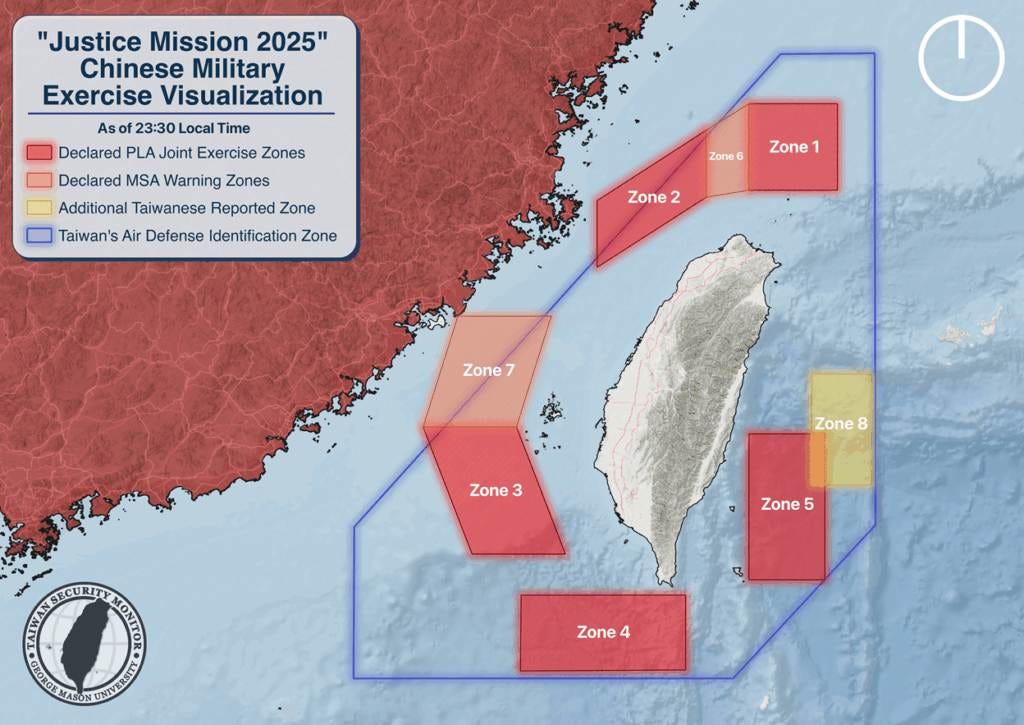
Justice Mission 2025, launched December 28, 2025, was the first PLA exercise to send naval and coast guard vessels into Taiwan’s contiguous zone in significant numbers. The exercise designated seven maritime exclusion zones around Taiwan — the most ever for a single drill — and simulated a full encirclement blockade of Keelung in the north and Kaohsiung in the south, Taiwan’s two critical deep-water ports. Chinese forces deployed 89 military aircraft, 14 naval vessels, and 14 coast guard ships in a single operational day. Ten hours of live-fire. Reuters, December 28, 2025 The Diplomat, January 2, 2026 The Diplomat assessed the exercises erased the buffer zone Taiwan had previously relied on for response time. Trump, asked about the drills, told reporters he was not worried and praised his relationship with Xi. That answer was received in Beijing as exactly what it was.
On June 6, 2026 — while the Iran ceasefire was still contested and the 31st MEU was rotating out of INDOPACOM — China and Mongolia concluded Steppe Partner 2026 in Inner Mongolia: joint exercises featuring Chinese unmanned combat systems including drone swarms and robotic ground platforms at scale. (Chinese state media is the primary source for this exercise; Bastille Post (Tier 3) provides partial corroboration. No Tier 1 or Tier 2 independent sourcing has confirmed it — the claim carries a state actor ceiling.) Drone swarm doctrine is the capability layer the US force structure has not solved. The Pentagon’s own January 2026 assessment concluded that counter-drone defense is still siloed within dedicated air defense units — that every joint force unit will need the ability to defend itself is a capability that does not yet exist at scale. Small Wars Journal/DoD, January 2026 Congressional testimony in April 2026 placed the compression starkly: PLA drone swarm systems are specifically designed to reduce adversary decision timelines from two hours to twelve minutes. ISW, April 3, 2026
HIGH-CONFIDENCE: The command structure Beijing needs to execute a Taiwan contingency has a commander. That commander has watched his force practice the mission. The purge that created the vacancy is still running — Zhang Youxia and Liu Zhenli were removed in January 2026 — but the Taiwan-facing command slot is filled, and it was filled in time to run the largest Taiwan exercises in PLA history.
Questions
Xi has now installed three consecutive ETC commanders in four years. Each one has inherited a command chain hollowed further down than the one before. At what point does the pattern stop being disruption and start being the design — and does a smaller, more loyal command chain change the escalation calculus?
The Rocket Force’s institutional answer to the purge has been discipline, not capability restoration. Zhang Shengmin is an inspector, not an operator. If the missiles work, that doesn’t matter. If the procurement chain is compromised, it matters enormously — and no one outside Beijing knows which is true. What should readers make of the silence on Rocket Force readiness?
The signature compression pattern — fewer sorties, more maritime contact — suggests the PLA shifted from visibility to presence. Justice Mission 2025 was the most visible exercise in history. Since then, the CCG has been operating in Taiwan’s waters with less visibility. Is that de-escalation, or is it normalization?
The drone timeline compression — from two hours to twelve minutes — is the number in this section that has not been adequately absorbed by US war planning. If the decision window to respond to a PLA first move is twelve minutes, what does US command architecture look like inside that window?
You can look at this both ways. When you see that much turnover in any kind of institution, particularly a military institution, there is definitely a massive loss in what I would call the brain trust — the skill and know-how attributed to the people lost. The scale and duration of this purge, in most cases, should be considered a detriment. You’re disrupting command. You’re disrupting the flow of information between units. You’re removing people who have access to important information. But it also shortens the chain of command. It removes people who might push back on objectives and decisions. Xi Jinping is acutely aware that the United States is using its intelligence and infiltration of foreign institutions to decapitate heads of state — observing what happened in Iran and Venezuela, he would be foolish not to look around and see that the same is likely within his own institutions. The United States is absolutely very concerned about the state of China, and I would not be surprised if they had invested considerable resources into the edge they likely have over China — which is not necessarily military, but the scale and skill of their own intelligence and espionage agencies, the CIA in particular. The disruption is undeniable. There has been a great deal of chaos and reorganization required. But at the same time, the reason speculated when Lin Xiangyang was removed was that he had close ties to American individuals. I do not think it’s beyond reason to look at this as a reaction — Xi insulating himself, as one would anticipate as the United States’ position gets more and more desperate going forward, not less. The lengths to which the United States is willing to use its clandestine espionage capabilities are evident — including confirmed CIA operations in Venezuela and a documented rightward shift across Latin American governments that mirrors US strategic interests, even where popular sentiment suggests otherwise. NPR, January 2, 2026 WSJ, June 22, 2026 The right institutional response in the face of a purge is discipline — to fall back on established processes that will allow for a smooth transition and reestablishment of communications.
I think it’s pretty unlikely the procurement chain is compromised. China is the primary supplier of components embedded in US weapons systems — a Government Accountability Office report confirmed in 2025 that all branches of the US military depend heavily on Chinese-origin materials, with Chinese supply chains present across 1,900 US weapons platforms covering over 80,000 individual parts. Defense News / GAO, August 2025 Oregon Group, April 2025 The United States has been actively working to reduce this dependency and has not yet eliminated it. If anything, China is in the best position to accelerate the production of missiles and drones above almost any other military. I don’t think anything will stop China’s military growth short of internal unrest, which is very hard to gauge from outside. The CCP is very tight-lipped about that, so it would just be speculation to say otherwise.
There’s really no reason it can’t be both. If you lower sorties but increase maritime contact and extend presence, normalizing that behavior allows China to have a threatening posture toward Taiwan and to stage military resources without triggering more extreme action from potential allies. It also acts as a reminder to Taiwan that China is very capable of total encirclement. It’s a veiled threat, but it’s not dissimilar to how Putin tests the waters in Europe — flying a drone across the border, or sponsoring espionage attacks on European countries by groups and individuals clearly guided by Russian intent but plausibly deniable. The same is very true around Taiwan. China is pushing to normalize its forces in the region while making it harder and harder for any foreign entity to justify coming to Taiwan’s aid, because the force buildup around Taiwan would already be so significant by the time anyone reacted. Taiwan has a lot of allies in theory. But the risk of coming to Taiwan’s aid when China is already substantially gathered and staged around Taiwan is extreme.
That window is so short, nothing can really be done. That’s really the whole thing around Taiwan — it’s not necessarily geopolitically acceptable for China to seize Taiwan, but as the United States loses influence and China gains influence, particularly with Western countries over the need for trade, and as the overall trend of countries moves away from the United States and toward China, China is finding itself in a position where it has the trade leverage and the geopolitical leverage to take Taiwan by whatever means it sees fit and not really experience any consequences. At the end of the day, there is no military in place that can effectively counter a swift move on Taiwan. It would be up to Taiwanese defense to establish how long they could delay. We don’t have any pre-existing analog for what that would look like or how effective the Chinese military would be in executing this. The question also remains: just because they’ve purged doesn’t mean the plans themselves are no longer valid. What’s drawn up can be functionally executed by the next people to come into office. We can’t say with any certainty that the purges are going to affect the efficacy of a PLA invasion of Taiwan.
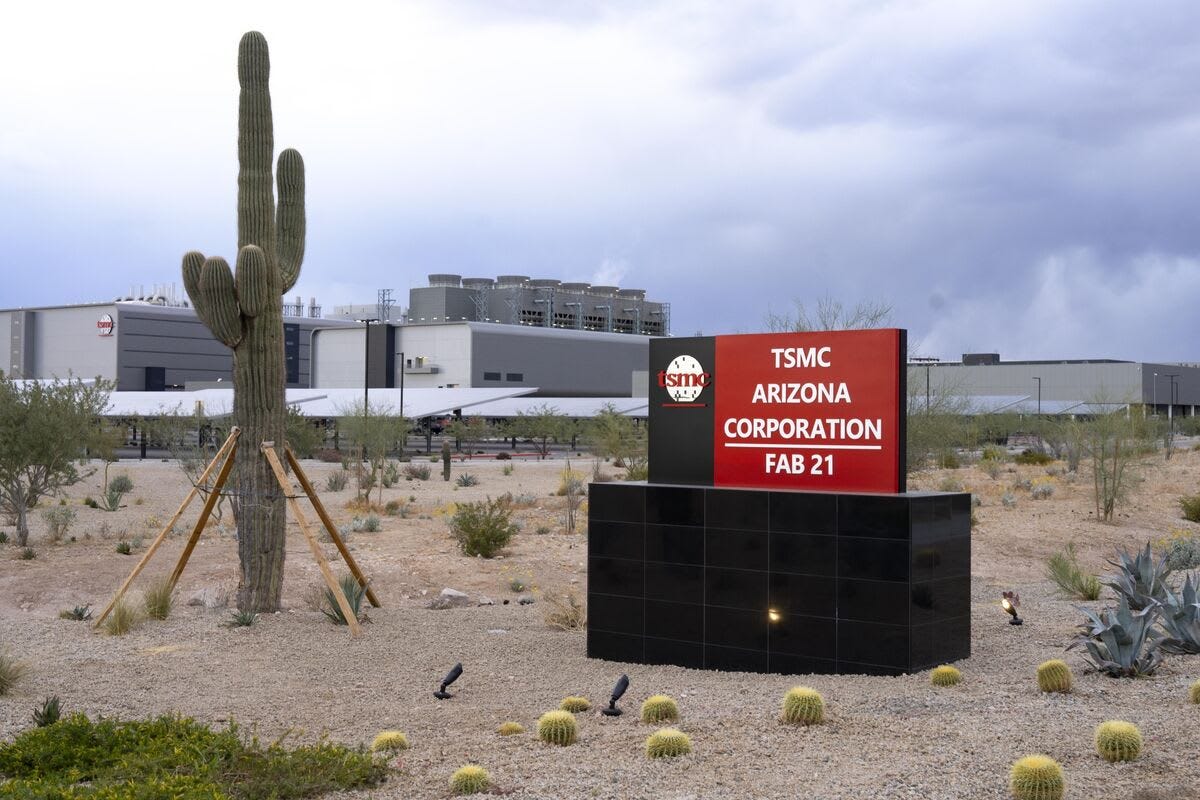
The premise that kept Taiwan safe for a generation was economic co-dependence: TSMC and Taiwan’s allied semiconductor ecosystem produce chips the world cannot replace — and any Chinese military action that destroyed those fabs would be an act of self-destruction. That logic held when China had no alternative. On January 15, 2026, the United States and Taiwan signed the Agreement on Reciprocal Trade — a $500 billion commitment to move TSMC and allied semiconductor production to Arizona. Reuters, January 15, 2026 The stated goal was to harden the shield by anchoring advanced production on US soil. The structural consequence is that it put a sunset date on Taiwan’s irreplaceability. Arizona fabs at 2nm are not operational before 2028 at the earliest — CNBC, January 2026 — which means the window between the shield beginning to lift and US domestic production taking over runs from now through at least 2028. China can read that calendar.
While one clock runs in Arizona, a second clock is running in Shenzhen. SMIC has been targeting 80% domestic chip self-sufficiency by 2030, and achieved 5nm production at limited yield in 2026. TrendForce/Nikkei, March 2026 China’s domestic semiconductor production reached 28% self-sufficiency in Q4 2025, up from 16% in 2024. CSIS, May 2026 The US export controls designed to slow this were assessed by CSIS in May 2026 to be accelerating Beijing’s domestic push rather than retarding it — every restriction is a forcing function for Chinese industrial policy to move faster. The shield is being eroded from both ends simultaneously: the US is extracting the asset, and China is reducing its need for it.
Beijing is not waiting for the clocks to run out passively. China is running a parallel talent extraction operation targeting Taiwan’s semiconductor engineers — bringing them into Chinese domestic fabs while degrading Taiwan’s production capacity from inside. Reuters, April 7, 2026 China controls 61% of global rare earth mining and 91% of refining. The Busan rare earth export truce expires in November 2026 — sitting directly alongside the Taiwan contingency timeline as an unplayed card. China added MP Materials and USA Rare Earth — two of the largest US domestic rare earth producers — to its export control entity list before the truce’s expiration, signaling what the expiration looks like. The economic coercion architecture and the military contingency timeline are not parallel operations. They are the same operation.
DEVELOPING: There is an additional dimension the brief cannot yet source to Tier 1/2 but which the structural logic of the scenario generates: if China executes a Taiwan move while US government chip contracts are in active production but undelivered, Beijing inherits the TSMC backlog and can choose to honor none of it — converting America’s own procurement pipeline into leverage. This is an OP-originated analytical finding. Firebrand cannot independently verify the current state of undelivered backlog contracts or the legal architecture that would govern them under a Taiwan contingency. Carry as DEVELOPING.
The force that would need to compensate for a degraded silicon shield is itself at a documented readiness nadir. The GAO testified before the Senate Armed Services Committee in March 2025 that the US military did not meet aircraft mission capable rate goals for 42 of 45 aircraft in FY2024 — with the F-35A running at 51.5% mission capable, the F-35B at 55.5%, and the B-52 and F-22 meeting their goals zero years out of ten. The Navy completed only 20% of carrier strike group maintenance phases on time in FY2021. GAO-25-108104, March 12, 2025 The economic erosion and the military readiness degradation are not separate risk variables. They are compounding on the same timeline.
HIGH-CONFIDENCE: Taiwan’s silicon leverage is at its structural minimum during 2026–2028. The 2027 military window sits directly inside this nadir. The shield does not disappear — but for the first time since TSMC was founded, Beijing can run the numbers on a Taiwan contingency and get a different answer than it got in 2010, or 2015, or 2020.
Questions
What does the Arizona agreement actually buy Taiwan in the near term, given the 2028 timeline?
If SMIC hits 50% self-sufficiency before 2028, does the economic deterrence calculus change materially for Beijing?
The talent extraction operation is running in parallel with the military buildup. Is that a coincidence of timing or a sequenced operation?
The GAO readiness data predates the Iran drawdown. Where does US readiness actually sit entering the 2027 window, accounting for Iran attrition layered on top of the pre-existing deficits?
Any agreement currently suggesting the United States is close to manufacturing its own chips — or really any imported military component — is on borrowed time. Even facilities currently operating in the United States are severely constrained in their ability to import the raw components required to produce at scale, and that constraint is only tightening. US imports of critical heavy rare earths never recovered to pre-restriction baselines even under the current truce — CSIS confirmed in May 2026 that yttrium imports fell from 333 tons to 17 tons in the eight months after restrictions were imposed and never recovered. There is no heavy rare earth separation happening in the United States at present. The rare earth truce expires in November, and China has no incentive to renew it — particularly if the United States takes a harder position on Taiwan. The reality is that on paper, the United States has a great deal. But the majority of the US military-industrial complex — munitions development, new weapons programs — is just paper. There is very little actual production capacity or existing munitions to point to. The same is true for semiconductors: just because a factory is producing five-nanometer chips does not mean that factory is receiving the raw inputs it needs. The severity of the US rare earth and mineral deficit is being extremely underplayed. It is one of the largest crises currently facing the United States, and it layers directly onto the drawdown and waste of resources in the Middle East — because not only are those assets expensive to replace, but the necessary inputs to replace them are not available.
The trend of US sanctions and export controls not working as intended is a symptom of the abuse of soft power and the system currently building around the world to circumvent US controls. China has been finding ways around them for quite some time. The expectation that denying access to US products and technology is a catch-all for stopping technological advancement in China — which is pulling ahead of the United States in just about every category of conventional military capacity and industrial production — is yet another latent assumption that has done the United States and the West a great disservice. Many countries previously looked upon as less developed have been able to rapidly scale and build programs with less scrutiny, simply because Western countries did not view them as capable of doing so. In China’s case, the United States made an assumption that China could not accomplish what it wanted without US technology. That assumption was wrong. The GAO’s March 2025 testimony before the Senate Armed Services Committee documented that the US military did not meet aircraft mission capable rate goals for 42 of 45 aircraft in FY2024 — with the F-35A running at 51.5% mission capable, the F-35B at 55.5%, and the B-52 and F-22 meeting their goals zero years out of ten. The Navy completed only 20% of carrier strike group maintenance phases on time in FY2021. GAO-25-108104, March 12, 2025 The nuclear deterrent remains credible — but that is not what a Taiwan contingency requires.
It doesn’t make much sense for China to lift or remove any kind of rare earth export controls. The weapons the United States would build with those materials would be used to deter China. If China withholds the inputs, it strengthens its own position on Taiwan. Alternatively, the truce can be used as leverage to deter the United States from intervening if Taiwan comes under attack or is coerced into a political accommodation with China. Either way, this is a lose-lose for the United States, and the timing tells you everything about intent. Going forward, China will control US imports — particularly those pertaining to weapons, technological development, and AI. The expiration is not an accident on the calendar. It is a positioned card.
The TSMC backlog scenario has not surfaced in mainstream analysis because running the numbers would be catastrophic to the prevailing narrative of US military and technological dominance — which at this point is more of a carried-forward belief than a verifiable reality. It would not be surprising to see China apply the controls already in place for mainland China directly to Taiwan, which would immediately upend the entire just-in-time manufacturing system the West depends on. The Taiwan Strait itself would become contested. Any contingency around Taiwan would cause such a dramatic supply chain disruption that just-in-time manufacturing across the United States, Thailand, Cambodia, and the broader TSMC Plus One supply chain would face simultaneous collapse. Taiwan hits the United States in all of the worst places at once — the tech industry, which is the only leading sector the United States still holds ground in, and which it is rapidly losing ground in as well. The chip supply underpinning US AI data centers, military procurement, and virtually every other critical process is entirely contingent on Taiwan maintaining its current relationship with the United States. Western think tanks and analysts avoid exploring that outcome because it is destabilizing to explore. The numbers, if run honestly, are catastrophic.

The United States holds an approximately $32 billion arms sale pipeline to Taiwan and has not withdrawn its security commitments on paper. What Donald Trump has done is detach the political signal layer from the military layer — and Beijing reads the signal layer. In July 2024, Trump told Bloomberg Businessweek: “I think Taiwan should pay us for defense. We’re no different than an insurance company. Taiwan doesn’t give us anything.” In January 2026, asked whether China would move on Taiwan, Trump told the New York Times: “I don’t think he’ll do that. I hope he doesn’t” — offering no statement that the United States would respond if it did.
The decoupling is operational. American Progress documented in May 2026 that Trump publicly praised Xi as a strong leader, declined to criticize the Justice Mission 2025 exercises, and framed the Taiwan arms relationship as a transactional arrangement contingent on payment rather than a security guarantee. The distinction matters because deterrence requires that an adversary believe the defending party will pay the cost of response. When the political leadership of the defending party publicly prices that response as contingent, the deterrence calculus changes even if the hardware does not.
The hardware pipeline tells a different story from the paper commitment. Of the ~$32 billion backlog, confirmed deliveries through early 2026 include HIMARS Batch 1 (11 launchers, November 2024), Abrams tanks, ALTIUS drones, and partial Harpoon missile deliveries begun in 2025. George Mason University Arms Sale Backlog Tracker, March 2026 The deterrence-critical systems remain outside Taiwan: 66 F-16V Block 70 jets, promised for 2026 and now slipped to 2027–2028 with the first aircraft completing assembly only in March 2025; the AGM-154C air-to-surface missile system, approved by Congress in 2017 and delayed to 2026 at the earliest — a nine-year authorization-to-delivery gap; and 24 submarine-launched torpedoes pushed to 2027–2028. Nikkei Asia, December 2025
HIGH-CONFIDENCE: The arms pipeline functions as a US political commitment signal. The hardware that would materially alter Taiwan’s military calculus in a near-term contingency — advanced air power, precision standoff munitions, submarine-capable weapons — remains outside the island on a delivery schedule running past the 2027 window identified by US military planners. Xi Jinping’s government reads both layers. The political-will signal from the Trump administration’s 2024–2026 public record points in one direction. The hardware signal points in another. Beijing’s planning assumption will be determined by whichever it judges more durable under pressure.
Questions
Both the 2024 and 2026 Trump statements use weak qualifiers — “I think.” Does the signal layer of those statements carry analytical weight, or should they be read as noise?
The arms pipeline is the most concrete measure of US commitment — but the deterrence-critical systems are the ones furthest from delivery. What does that gap mean for Taiwan’s actual defensive capacity entering the 2027 window?
Whether we’re looking at 2024 or 2026, the language Trump uses in both cases carries very weak qualifiers — “I think that they should pay,” “I think that he won’t do it.” No one should take a single word Trump says as a verifiable signal, whether that’s peace talks in Ukraine, a ceasefire in the Democratic Republic of the Congo, or pressure on Israel to stop operations in Lebanon. What is significant here is his unwillingness to use even his normally callous and harsh language against China’s decisions and aggression around Taiwan, whilst simultaneously stripping INDOPACOM of assets — with the USS Abraham Lincoln carrier strike group redeployed from the South China Sea to the Middle East in January 2026, CNN, January 2026 followed by thousands of additional troops and warships drawn from the Indo-Pacific region through March 2026. KUAM News, March 2026 The message Trump is sending is the one most analysts are reading: Taiwan is not a priority. Particularly looking at the state of the ceasefire — now again in jeopardy following three days of heightened tension and multiple exchanges, including strikes against U.S. installations in Oman and Bahrain — Taiwan is not the most pressing issue for Trump right now.
The $32 billion arms pipeline that still sits open for Taiwan is the best measure of U.S. defense guarantees — because U.S. forces responding at scale to a Chinese action is, at this point, highly unlikely. What would actually deter China is Taiwan having the military hardware China is concerned the U.S. could provide. The more bogged down in the Middle East the United States gets, the more its stockpiles decline, the more it loses and uses weaponry, the longer those pipelines are going to grow. The delivery of some weapons, while critical defense commitments — paid for by Taiwan and committed nowhere else — get pushed back beyond the 2027 warning window, is exactly the kind of situation that gives the impression of support when Taiwan is really just writing checks it couldn’t write elsewhere, for equipment other suppliers might actually have delivered. What Taiwan has is a fraction of what it has paid for, at precisely the moment it needs that weaponry most. That is the calculus Beijing cares about. The best deterrence is not a political commitment but the military and defensive capacity to deter an invader. The real question is whether what Taiwan has is enough to make Xi blink. If it isn’t, things aren’t looking good for Taiwan.
Closing Questions
Five pressure lines have been laid out — Iran as proof-of-concept, a named military window, a command chain that has been rebuilt and exercised, a silicon shield at its structural minimum, and a president whose public signals have decoupled from US military commitments. Taken together, they describe a situation where the conditions for a Chinese move on Taiwan are more favorable than they have ever been. The question this brief cannot answer for the reader is whether Xi Jinping has already decided. What should the reader watch for that would tell them the answer — and what would have to be true for the window to close rather than open further?
The hardest part about looking at the situation regarding Taiwan is that the risk calculus isn’t something you can assess from the outside. You can assess from the outside that the conditions are the most favorable they’ve ever been, that the United States is the weakest it has been since this tension began to develop, and that the United States cannot effectively deter China. But if nothing else, Xi Jinping is very patient. Depending on the internal state of the CCP — which could be destabilized by the ongoing purges — there could be some internal friction causing the delay in action. But you could also look at it from the perspective of: I’ve waited ten years. What’s waiting another two months for the United States to make some sort of decision, or for some development in Iran to make any military action by the United States outside of one theater effectively impossible. The weapons deliveries aren’t going to be there anytime soon. The United States doesn’t have a quick and easy answer to restoring the force posture it already has. The majority of discussions surrounding whether or not Taiwan will receive more aid or reinforcement are mostly monetary and not linked to any kind of equipment transfer in the near term. The signals to watch for — we’re already seeing them. The question that remains is: is it good enough? Or does Xi Jinping and the CCP foresee more favorable terms in the near future? To be honest, the answer to that question is probably yes. We’ll know China moved on Taiwan either after the dust has settled, or with very little notice at all. That really is the hardest part about a Taiwan contingency. It’s the ambiguity.
Vote on what we will cover next!
Note: I am committed to providing you with the best available information regarding the wider world. This work is hard, exhausting, and it does not pay.
Any support you can provide is now more important than ever. Thank you.
Find the Firebrand Project on other platforms, make donations, and support my work by visiting my link tree below.

Comments
Nothing yet. Say the first thing.
Sign in to join the conversation.