

DISCLAIMER: This brief was written with events and information available through July 13, 2026; later developments are not addressed. It explores the dynamics operating beneath the diplomatic framework that often dominates mainstream coverage.
TFP CONFIDENCE TIERING: The Firebrand Project labels the confidence behind every significant finding in this piece. CONFIRMED means multiple independent sources have verified it. HIGH-CONFIDENCE means the sourcing is strong with minor gaps. DEVELOPING means the indicators are credible but not yet fully corroborated. CLAIMED means a single party — often one with skin in the game — has asserted it without independent verification.
The ceasefire reduced the war’s peak intensity. It did not deliver the safety, withdrawal, or recovery its terms promised. Nine months later, Palestinians are still being killed, the area under Israeli military control is expanding, and Gaza’s remaining population is being compressed into an increasingly damaged and undersupplied strip of land.

The first phase produced real outcomes. The agreement took effect at noon on October 10, 2025, after Israel’s cabinet approved the US-brokered plan; Israeli forces withdrew behind the Yellow Line, and CENTCOM validated that initial withdrawal BBC. Three days later, Hamas released all 20 surviving Israeli hostages as Israel released 250 long-sentence prisoners and 1,700 Palestinians detained or reported missing after October 7, 2023 Al Jazeera. Those results matter because they show that negotiated compliance was possible when implementation carried immediate political pressure.
The same framework required a cessation of hostilities, expanded humanitarian access, and a later transition toward governance and security arrangements. Its architecture remains formally alive: UN Security Council Resolution 2803 endorsed the wider plan, but the pledged International Stabilization Force had not deployed and the National Committee for the Administration of Gaza had not entered Gaza by the June 2026 reporting period Security Council Report. The ceasefire therefore preserved institutions and bargaining mechanisms without producing the conditions those mechanisms were created to deliver.
HIGH-CONFIDENCE: The civilian consequences continued after the agreement. Independent reporting placed the post-ceasefire Palestinian death toll above 1,000 by mid-June 2026 NPR, while UN reporting counted at least 265 children killed by June 22—roughly one child per day UN News. A ceasefire can reduce the tempo of violence and still fail its central test: whether civilians can live without near-daily lethal force.
Questions
If the agreement secured the hostage exchange and an initial withdrawal, what changed after those immediate incentives were exhausted?
At what point does a ceasefire that lowers peak violence but permits persistent killing cease to function as a ceasefire in anything but name?
The ceasefire’s immediate incentives were exhausted once the hostages were exchanged and an initial withdrawal could be presented as a diplomatic success. The harder assessment is that the agreement’s wider structure was never aligned around a durable peace. Hamas was not going to disarm under the conditions offered; Israel’s conduct did not indicate an intention to permit substantial aid or surrender expanding military control; and the United States gained a political framework that reduced international pressure while creating space to market reconstruction as a business and governance project.
That concern is not speculative in its factual foundation. The publicly circulated GREAT Trust prospectus proposed at least a decade of US trusteeship, incentives for Palestinians to leave, digital tokens tied to redevelopment rights, smart cities, industrial zones, coastal resorts, and projected returns for private investors. Reporting identified Israeli-American venture capitalist Michael Eisenberg and Israeli entrepreneur Liran Tancman as leaders of the proposal. Eisenberg had also helped develop the Gaza Humanitarian Foundation model and was later selected to represent the Israeli prime minister’s office in the US-led mechanism monitoring the ceasefire. Jared Kushner’s subsequent “New Gaza” presentation carried the same commercial and technocratic logic into the formal postwar discussion. This evidence does not prove that redevelopment was the ceasefire’s sole original purpose. It does establish that people involved in designing privately managed aid and redevelopment structures also moved into ceasefire implementation and postwar planning. The remaining incentive was therefore not necessarily to implement the ceasefire fully, but to preserve its name while the political and commercial architecture around Gaza advanced.
In 2026, that distinction is not absurd; it is geopolitically useful. Calling Gaza a ceasefire allows governments to treat the conflict as lowered, contained, or partly resolved while redirecting attention toward domestic pressures and other theaters: Europe toward Russia, the United States toward hemispheric consolidation and renewed uncertainty with Iran, and the Indo-Pacific toward rising tension around Taiwan. The catastrophe is that the label is more resilient than the agreement’s substance. Foreign governments can look away because too many crises are competing for limited political attention. In practical terms, Gaza has not experienced a ceasefire. It has experienced recurring violence repeatedly renamed as one.
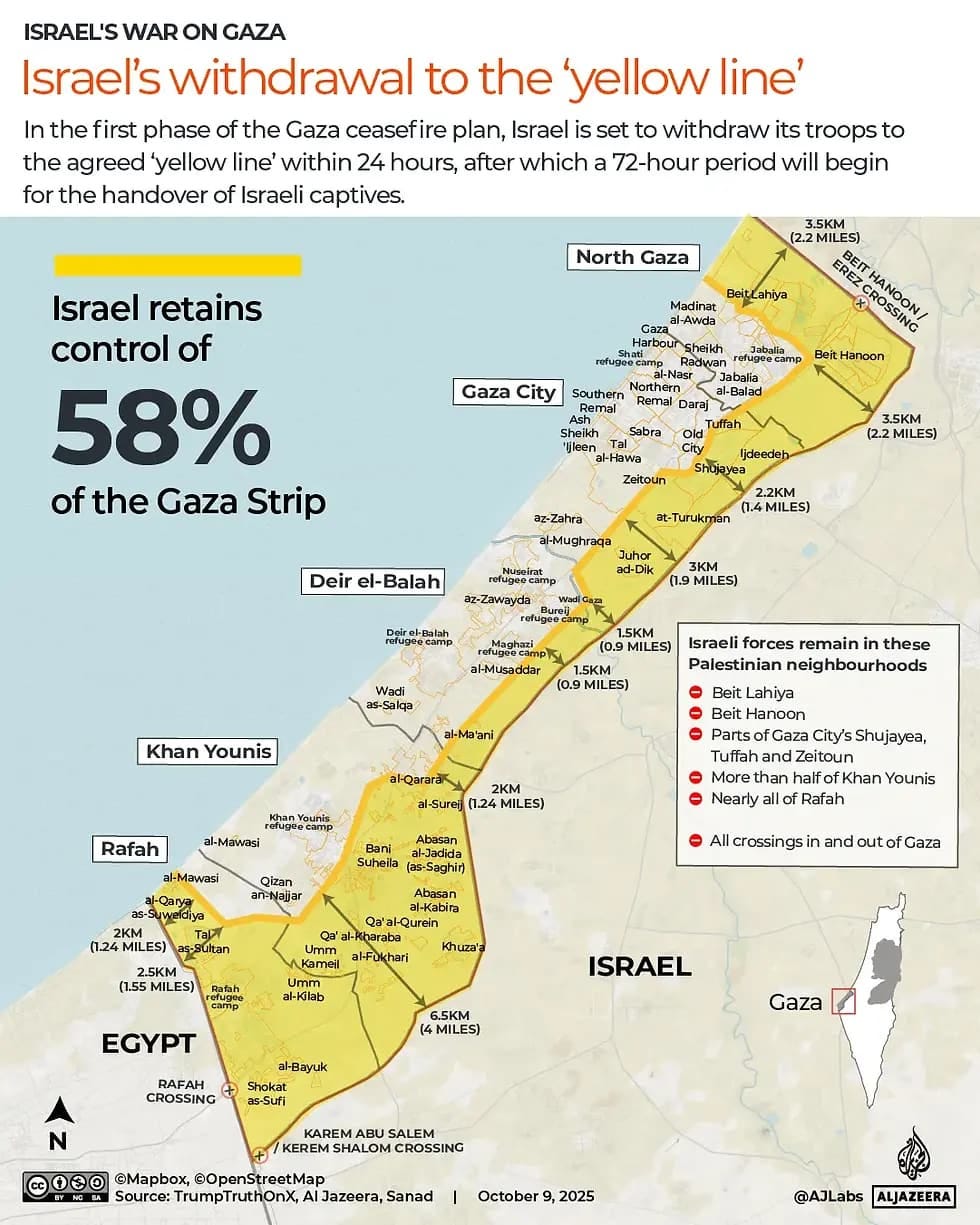
The October ceasefire established the Yellow Line as a temporary first-phase boundary, leaving 53 percent of Gaza under Israeli military control and 47 percent to its west BBC, October 10, 2025. The plan anticipated additional Israeli withdrawals during later phases but set no fixed timetable for them ABC News Australia, January 15, 2026. A line created to begin withdrawal has instead become an open-ended limit on where Palestinians can safely live and move.
HIGH-CONFIDENCE: Satellite imagery showed Israeli forces moving concrete marker blocks farther into nominally Palestinian-controlled territory in at least three locations Arab News, January 15, 2026. By February, Médecins Sans Frontières reported that 58 percent of Gaza was under Israeli military control and described the line as “dangerous, ever expanding and ambiguous” MSF, February 24, 2026. MSF documented patients shot while collecting water or firewood, approaching their homes, commuting, and visiting family near a boundary Palestinians could not reliably see MSF, February 24, 2026. One man described being shot as he stepped outside his fiancée’s tent about 100 meters from the line; his fiancée was wounded and two of her cousins were killed MSF, February 24, 2026. Between October 11, 2025, and January 21, 2026, the UN Human Rights Office recorded at least 216 Palestinians killed near the line, including 46 children and 28 women MSF citing OHCHR, February 24, 2026.
Maps distributed to humanitarian organizations in March showed a new Orange Line extending Israeli control roughly 11 percentage points beyond the original boundary Al Jazeera, May 28, 2026. On May 28, Prime Minister Benjamin Netanyahu claimed that Israel controlled 60 percent of Gaza and announced that he had directed the military to reach 70 percent; he did not rule out taking the entire Strip Al Jazeera, May 28, 2026 CNN, May 28, 2026. Firebrand cannot independently verify that Israel had reached exactly 60 percent at the time of his statement. If the announced target is reached, Gaza’s roughly 2.1 million Palestinians will be compressed into about 30 percent of its original territory Al Jazeera, May 28, 2026.
An Al Jazeera open-source investigation completed in June 2026 estimated that Israeli forces had established a de facto military presence across approximately 1,000 square kilometers of Gaza, southern Lebanon, and southern Syria combined—a territory larger than New York City Al Jazeera, June 14, 2026. In Gaza alone, the investigation documented the Yellow Line enclosing roughly 200 square kilometers and confirmed that Israeli military maps had not accurately depicted the true scope of ground control since October 2023 Al Jazeera, June 14, 2026. Cleared neighborhoods, military roads, outposts, berms, and shifting markers determine whether a family can return home, reach water, recover property, or cross an unseen threshold without being fired upon Forensic Architecture, Gaza Atlas, February 2026 MSF, February 24, 2026. The line is no longer functioning as a marker of staged withdrawal. It is functioning as a ratchet: each westward movement expands military control and establishes another territorial baseline for the outside world to absorb.
Questions
Does the Yellow Line’s westward movement represent temporary military adaptation, de facto annexation, or a deliberate method of normalizing permanent Israeli control?
What does confining roughly 2.1 million Palestinians to 30–36 percent of Gaza mean for reconstruction, self-government, and any future Palestinian state?
It is incredibly difficult to discern Israel’s actual endgame short of cultural erasure, which is my assessment when these events are subjected to critical analysis. That judgment is not based on destruction alone. Israeli officials directed the military to prepare for the “voluntary departure” of Gaza’s residents Reuters, February 6, 2025, established a government mechanism to facilitate departures to third countries CNN, March 24, 2025, and reportedly led outreach to Somaliland and other African territories about receiving Palestinians Associated Press, March 14, 2025. Somaliland publicly denied that such discussions occurred, so that specific diplomatic channel remains contested Reuters, March 14, 2025. Israel also has a documented history of annexation, particularly in the West Bank and across occupied Palestinian territory International Court of Justice, July 19, 2024. But territory Israel takes is not necessarily territory it can hold. This creates a dynamic in which permanently holding that territory would require the displacement or substantial reduction of its Palestinian population. Senior Israeli minister Bezalel Smotrich has publicly advocated reducing Gaza’s population by half and described that approach as a potential model for the West Bank Times of Israel, November 25, 2024. That is why I assess demographic removal not as a hypothetical side effect, but as a discernible policy trajectory toward a stable, annexed Gaza and West Bank.
As of right now, any future Palestinian state for the people of Gaza looks bleak. The powers required to intervene sufficiently to stop Israel’s alleged violations of international law, extensive attacks affecting civilians, widespread destruction in Gaza, and territorial consolidation across the West Bank have not done so. That makes reconstruction, viable governance, and a future for Palestine seem like a gleaming city on a hill rather than an attainable goal. The only city Palestinians see is wreathed in flames and rubble, with no end in sight. It pains me to say it, but that is what the data suggests.

Palestinians carry a body through the ruins of a Gaza neighborhood during the ceasefire period, as civilian deaths continued well after the October 2025 agreement took effect. Source: Middle East Eye.
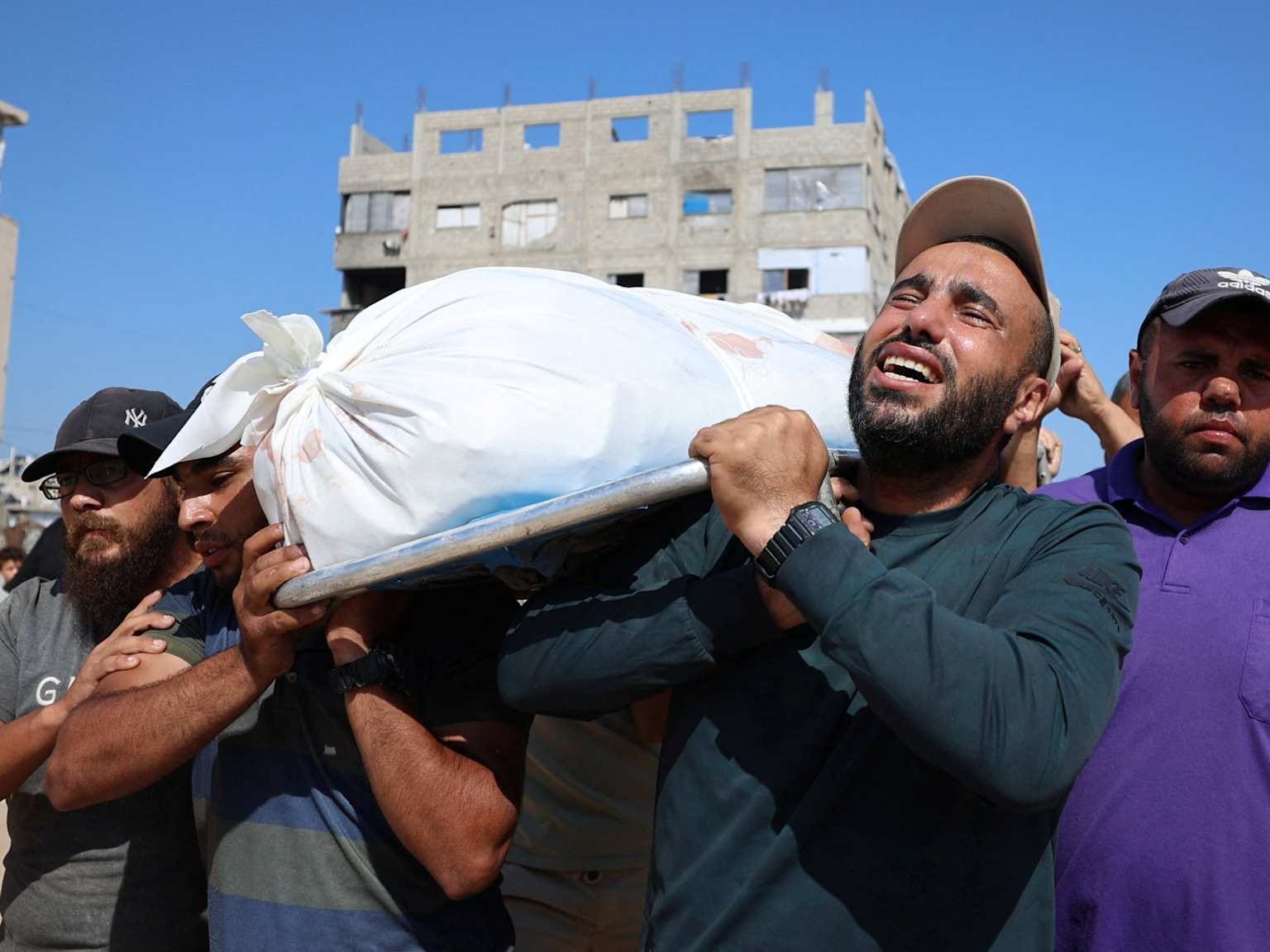
HIGH-CONFIDENCE: By June 18, Gaza’s Ministry of Health reported that Israeli operations had killed 1,005 Palestinians since the October 2025 ceasefire NPR, June 18, 2026. Independent reporting cannot verify every death or assign combatant status case by case, but the cumulative direction is corroborated: a UK government country bulletin recorded at least 733 killed and 1,913 injured by April 8 UK Home Office, June 2026, while UN reporting described nearly 1,000 killed and more than 3,100 injured by mid-June UN News, June 18, 2026. The ceasefire reduced violence from the war’s peak intensity. It did not create civilian safety.
At least 265 Palestinian children were killed during the first eight months of the ceasefire—approximately one child per day UN News, June 18, 2026. More than 400 other children were injured during the same period Al Jazeera citing UNICEF, June 19, 2026. Behind those totals are children crossing streets, gathering supplies, or living beside a boundary that can move without warning. UNICEF called the ceasefire a “deadly illusion” because it had not delivered the protection associated with its name UN News, June 18, 2026.
CLAIMED: A defensible post-ceasefire civilian-to-combatant ratio cannot be calculated from the available public datasets. Gaza’s Ministry of Health records names, ages, and sex but does not classify combatant status; Israeli combatant-kill figures are belligerent-party claims that cannot independently resolve who was a combatant at death. Estimates for the full war—not the ceasefire period alone—range from roughly four to nine civilians killed for every combatant Action on Armed Violence, January 25, 2026. Aggregate ratios describe the scale and distribution of civilian harm, but they cannot by themselves determine whether any individual attack complied with international humanitarian law Lieber Institute at West Point, March 19, 2026.
The measurement gap does not make the dead unknowable. It establishes the limit of what can honestly be claimed: more than 1,000 Palestinians were reported killed under a ceasefire, at least 265 were children, and no independently auditable evidence establishes how many of the remaining dead were actively participating in hostilities. Calling every adult man a fighter would be analytically indefensible. Calling every unidentified adult a civilian would be equally unsupported. The evidence permits a conclusion about continuing lethal harm; it does not permit a precise post-ceasefire ratio.
Questions
What does the continued killing of more than 1,000 Palestinians—including at least 265 children—say about whether this arrangement can meaningfully be called a ceasefire?
When neither belligerent provides an independently auditable combatant count, who benefits politically from forcing the death toll into a single civilian-to-combatant ratio?
This is not a ceasefire. It is a way of perpetrating violence under the cover of diplomatic agreement. It is a farce designed to obscure continued—and, in some cases, potentially escalating—action against what remains of Gaza City and the wider Gaza Strip, alongside a distinct campaign of lethal raids, camp clearances, demolitions, and displacement across the occupied West Bank. More than two million people have been displaced in Gaza UNRWA, June 2026. Hundreds of thousands of homes are rubble. People are clustered in camps and tents, running out of food and water. Those who stray near an arbitrary line that moves from day to day can find themselves under fire or their lives snuffed out, whether they are children, men, women, elderly people, or even one of the ever-elusive Hamas fighters. Israel is killing children at such a rate that one might think Hamas exclusively employed child soldiers. The UN’s verified 2025 record does not support that inference: it did not verify Hamas recruitment or use of children in the Israel-Palestine file, while limited allegations from partisan and advocacy sources cannot explain the scale of child deaths UN Secretary-General, Children and Armed Conflict, June 2026.
The ratio matters, but not because it creates a political benefit. It is a means of quantifying the severity and rate of civilian attrition caused by the IDF’s methods. A joint investigation reported that an internal Israeli military intelligence database identified about 8,900 Hamas and Palestinian Islamic Jihad fighters as dead by May 2025, when Gaza’s reported toll was approximately 53,000—implying that roughly 83 percent of those killed were not listed as militants in that database +972 Magazine, Local Call and The Guardian, August 21, 2025. More than 20,000 children have been reported killed. More than 70,000 Palestinians have been reported killed overall, while Israel’s claimed Hamas death toll almost certainly does not approach half that figure. A reasonable analyst must consider the possibility that the number of independently identified Hamas fighters killed may not even approach the reported number of children killed since October 2023. The available datasets cannot resolve that comparison conclusively. Any effective accounting of Gaza’s death toll politically harms the IDF and the United States, Israel’s primary weapons provider and backer. The political victory is the silence we see now: the world is in flames, the Middle East is at war, and Gaza’s people continue to suffer outside sustained international attention.
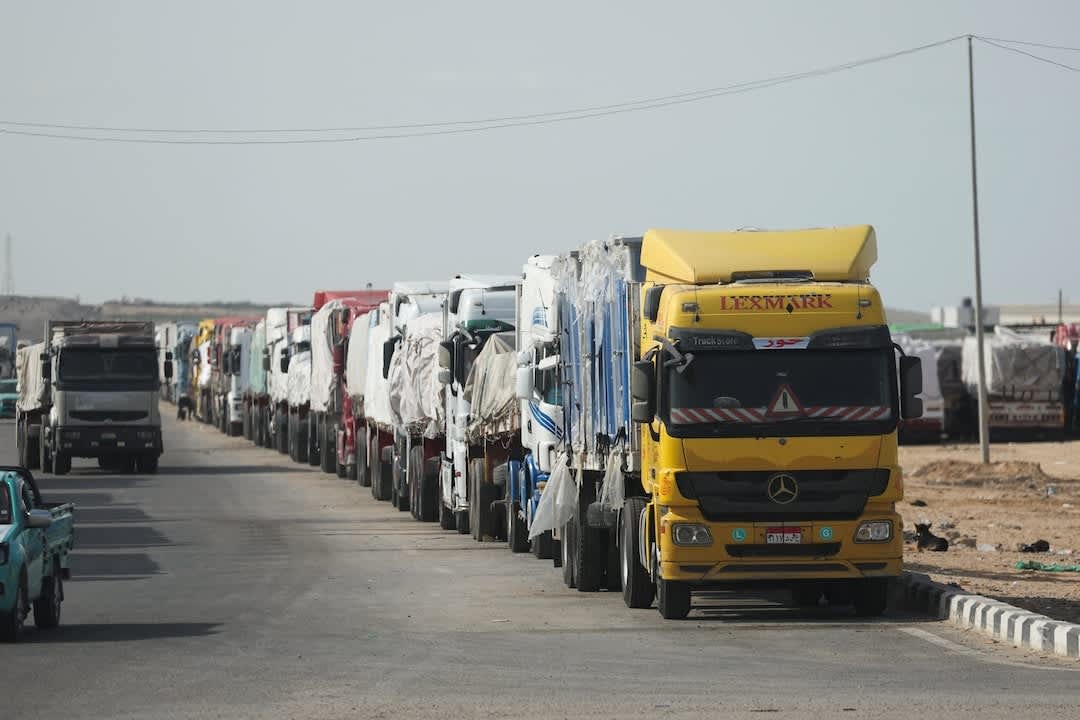
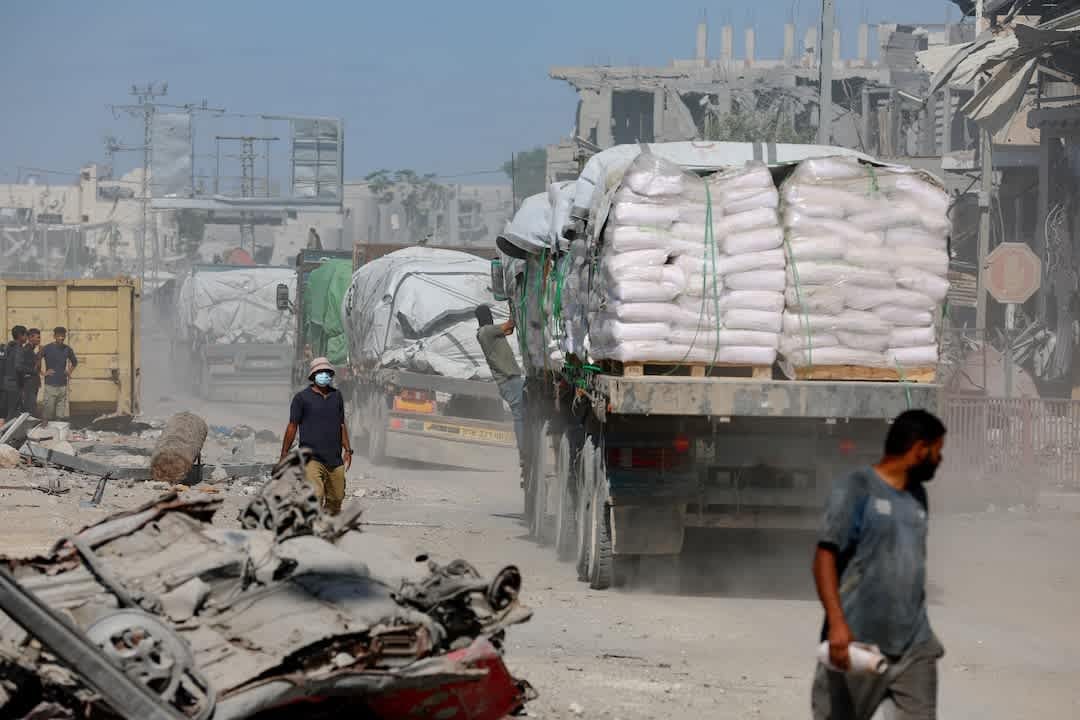
HIGH-CONFIDENCE: The ceasefire promised an aid surge of roughly 600 trucks per day, but deliveries averaged about 260 trucks per day during the early implementation period—approximately 43 percent of the stated target Al Jazeera, November 11, 2025. OCHA recorded 283,133 pallets of humanitarian cargo entering Gaza between October 10, 2025, and February 5, 2026, showing that relief did enter at scale without reaching the level or consistency required to stabilize civilian life OCHA, February 10, 2026. By May, Kerem Shalom and Zikim were the only operational entry points for humanitarian and commercial goods, while import restrictions, impeded movement, insecurity, and shortages of generators, engine oil, and spare parts continued to limit health, sanitation, debris removal, and aid operations OCHA, May 1, 2026 OCHA, May 7, 2026.
Water exposes what truck counts conceal. Gaza’s water production fell by approximately 20 percent in May compared with two months earlier OCHA, June 5, 2026. More than 70 percent of the population depended on trucked water by June, but funding gaps threatened even that emergency supply OCHA, June 12, 2026. In March, approximately 15,000 cubic metres of water were being produced per day, yet an estimated 70 percent was lost through damaged infrastructure OCHA, March 19, 2026. A ceasefire that allows flour through a crossing while pumps, generators, pipelines, and sanitation systems fail does not restore survival; it prolongs dependence on emergency distribution.
By late June, skin diseases and acute watery diarrhoea were spreading through overcrowded communities with inadequate water and sanitation OCHA, June 26, 2026. In early July, more than 9,000 chickenpox cases were reported across 130 health facilities in two weeks, while Al-Shifa Hospital’s shortage of sodium bicarbonate reduced haemodialysis capacity for roughly 240 patients with end-stage kidney disease OCHA, July 3, 2026. These are not secondary inconveniences waiting behind political negotiations. They are the daily mechanisms through which damaged infrastructure, restricted inputs, underfunding, and territorial compression become illness and preventable death.
The humanitarian system is being asked to keep more than two million displaced people alive inside shrinking terrain while operating through two principal crossings, damaged utilities, recurrent strikes, and severe funding constraints. Aid delivery can postpone collapse, but it cannot substitute for functioning water networks, hospitals, sanitation, shelter, electricity, or access to land. The ceasefire has converted an acute emergency into a managed emergency without creating the conditions for recovery.
Questions
If aid enters Gaza but water, sanitation, health care, shelter, and power continue to deteriorate, what practical distinction remains between humanitarian relief and the managed postponement of collapse?
Does a relief system built around permanent emergency distribution preserve Palestinian life, or does it normalize a condition in which survival depends indefinitely on permissions, crossings, and donor funding controlled from outside Gaza?
From an analytical perspective, this is where looking at Gaza becomes so difficult. There is no way that stable civilian life or basic infrastructure is possible in the near term, especially under current conditions. Any sustainable system that could possibly be erected would remain subject to bombing or direct attacks on the ground. Israel is severely limiting the aid allowed into Gaza, creating a situation in which people are, at best, barely kept alive—or are dying slowly. The systems that allow Gaza to function and support life are failing in a region that will experience extreme heat while access to fresh water is being curtailed and available water is dropping dramatically. Diseases that cause extreme dehydration, including acute watery diarrhoea, are another part of the cumulative crisis making the outcome for 2.1 million people increasingly perilous. There is no functional near-term solution capable of materially helping those suffering short of a full cessation of hostilities and a massive flow of foreign aid. That appears highly unlikely, particularly given the IDF’s stated intention to push farther into Gaza and acquire more territory.
Nothing is normal for the people of Gaza. Allowing some relief through permits Israel to say it is allowing aid, while admitting nowhere near enough to support or improve civilian life—only enough to delay and extend suffering amid continued bombing and civilian deaths. At the same time, native infrastructure supporting civilian life, including water and energy systems, continues to be destroyed. This creates a population dependent on foreign aid, but it also creates one unable to reconstitute, organize, or, candidly, live. This is the means through which the IDF and Israel’s political leadership seek to kill Palestinians not only through bombs but through a siege on the necessities of life: water, food, energy, and shelter. That judgment is no longer confined to outside critics. The UN Independent International Commission of Inquiry concluded that Israeli authorities deliberately inflicted conditions of life calculated to bring about Palestinians’ physical destruction in Gaza and found that the pattern of conduct demonstrated genocidal intent UN Independent International Commission of Inquiry, September 16, 2025. Israel rejects that conclusion and says its campaign targets Hamas.
In Gaza, that strategy has been taken to an extreme. Elements of the broader method—territorial entrenchment, forced displacement, home demolition, denial of access to farmland and livelihoods, and restriction of water access—have also been documented in Israeli-controlled parts of southern Syria since December 2024. Human Rights Watch described these actions as abuses and war crimes and said they drew from a playbook used in the occupied Palestinian territory Human Rights Watch, September 17, 2025. A Syrian Archive and Verify investigation documented 727 Israeli ground incursions and recurring effects on wells, networks, irrigation, and civilian access to water Syrian Archive and Verify, July 1, 2026. The scale and humanitarian effect in Syria are not equivalent to Gaza, and the evidence does not establish a uniform formal IDF doctrine across theaters. What it does establish is the recurrence of several tactics that make civilian return and self-sustaining life more difficult. In Gaza, those tactics have produced a horrific violation of basic human decency and international law—a callous disregard for human life wrapped in hatred and loathing for fellow human beings.
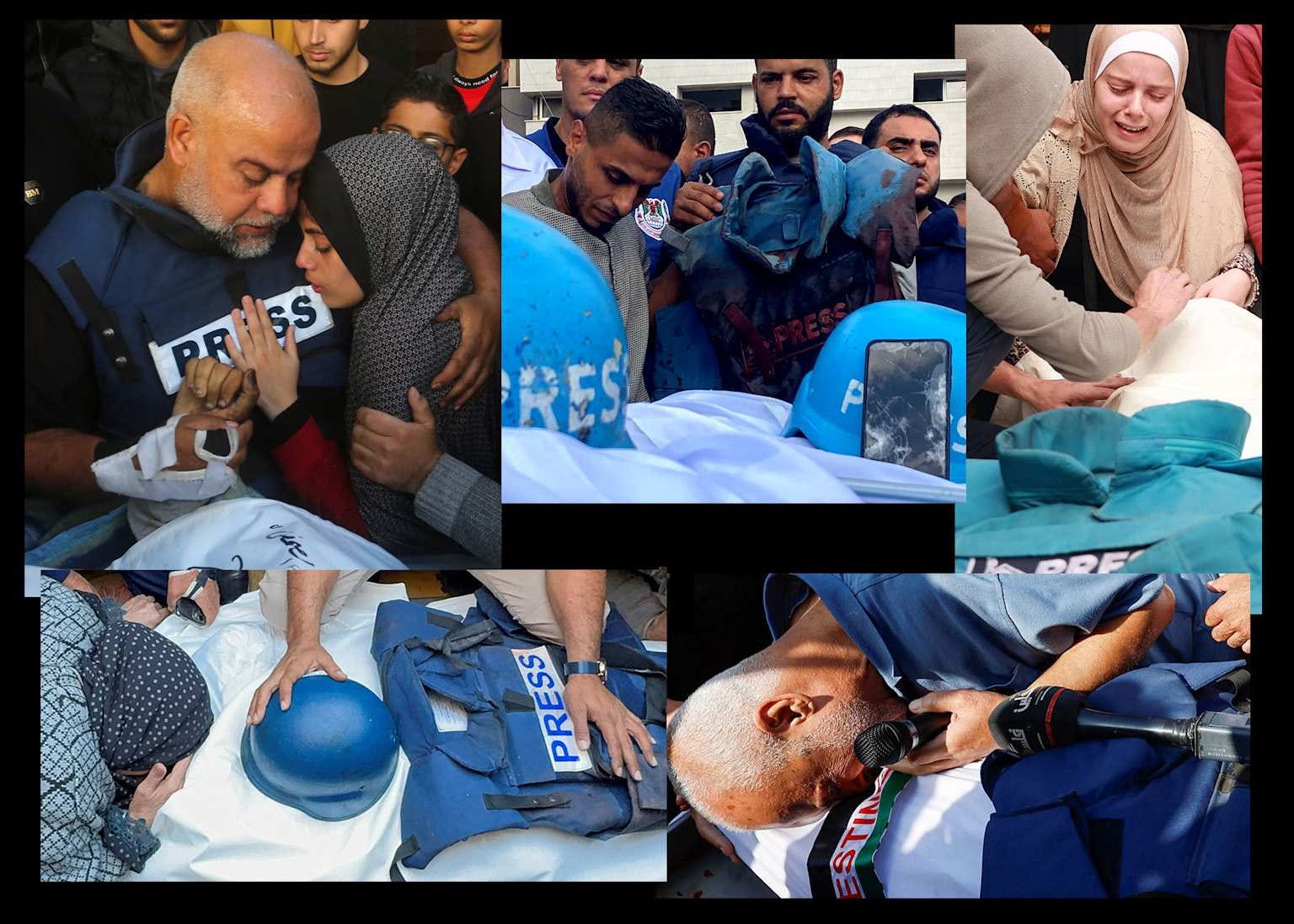
HIGH-CONFIDENCE: The October ceasefire did not end the killing of the people recording Gaza’s destruction. The International Federation of Journalists reported that at least 241 Palestinian journalists and media workers had been killed in Gaza by July 3, 2026 IFJ, updated July 3, 2026. The Committee to Protect Journalists’ broader regional accounting documented at least 263 journalists and media workers killed across Gaza, Yemen, Lebanon, Israel, and Iran between October 7, 2023, and June 11, 2026 CPJ, June 11, 2026. These organizations use different inclusion standards and geographic frames, so their totals should not be merged. They nevertheless establish the same underlying fact: Palestinian journalists in Gaza have been killed on a scale without modern precedent.
The killing continued under the ceasefire. On January 21, an Israeli strike killed photojournalist Abdul Raouf Shaat, AFP contributor Anas Ghneim, and journalist Mohammed Salah Qashta while they were working for the Egyptian Committee for Gaza Relief near Al-Zahra in central Gaza Al Jazeera, January 21, 2026. Their deaths show what the cumulative numbers can hide: Gaza’s surviving visual record depends on local reporters working without the protection, evacuation routes, institutional distance, or foreign rotation available to most international correspondents.
CPJ found that 129 journalists and media workers were killed worldwide in 2025, the highest annual total since it began collecting data more than three decades ago. It attributed 86 of those deaths—about two-thirds—to Israeli military action, with more than 60 percent of those killed identified as Palestinian reporters working in Gaza CPJ findings reported by Deutsche Welle, February 25, 2026. CLAIMED: Israel has accused some killed journalists of membership in or participation with Palestinian armed groups. CPJ and other press-freedom organizations have challenged the evidence in multiple cases, but a complete independent combatant-status audit of every name has not been completed; CPJ was still reviewing disputed entries in June 2026 The Hollywood Reporter, June 29, 2026. That uncertainty requires case-level caution. It does not erase the occupational pattern.
Gaza’s medical system has suffered the same removal of the people needed to keep a civilian population alive. Doctors Without Borders reported that more than 1,500 health workers had been killed since October 2023 MSF, accessed July 13, 2026. A reliable post-October 2025 increment could not be isolated from the available WHO and OCHA reporting at this data cutoff, so this brief does not assign a ceasefire-period figure. The verified cumulative toll, continued attacks affecting health facilities, and severe shortages documented in Section 04 establish that the remaining workforce is being asked to treat mass trauma, infectious disease, kidney failure, malnutrition, and dehydration after losing colleagues, facilities, equipment, and safe operating space.
Journalists and health workers perform different duties, but both preserve forms of public continuity that prolonged violence threatens to erase. One keeps the record visible; the other keeps bodies alive. Their deaths narrow Gaza’s ability to document what is happening, treat those who survive it, and retain the professional institutions required for any future recovery. A ceasefire that does not protect either function is not only failing to stop death—it is degrading the means by which death can be witnessed, counted, treated, and survived.
Questions
What happens to public accountability when the people producing Gaza’s visual and written record are killed faster than outside journalists can independently enter and replace them?
If journalists and health workers remain exposed to lethal attack under a ceasefire, does that indicate incidental protection failure, or the continuing removal of the institutions a population needs to document harm, survive it, and recover afterward?
Journalism, by nature, brings light to the unseen. The courageous Palestinian journalists already inside Gaza, who continued bringing visibility to the humanitarian catastrophe, the ongoing genocide, and the waste of human life, represent a profound threat to the overarching goals of the IDF and Israeli leadership. Accountability can come only after visibility. There is not an infinite number of people in any profession or region willing to risk their lives to bring light to something so awful. Many who cared enough to risk their lives reporting from Gaza may already be dead. That makes the work of analysts like me even harder. But in my mind, the absence and silencing of those trying to bring light does the opposite: the imposed darkness exposes how horrific the intent truly is. What is happening now may be worse than anyone can report.
In my assessment, the killing of journalists is not simply incidental to the campaign. OHCHR found that the pattern of apparent targeting, combined with Israel’s exclusion of foreign media, appeared to indicate a deliberate effort to restrict information leaving Gaza OHCHR, June 9, 2025. The Forbidden Stories Gaza Project—a consortium of 50 journalists from 13 organizations—investigated nearly 100 cases, contacted more than 120 witnesses, consulted approximately 25 technical experts, and identified at least 18 journalists killed, injured, or allegedly targeted by drones; at least 14 journalists were wearing press vests when killed, injured, or allegedly targeted Forbidden Stories, July 27, 2025. Its findings suggest that some journalists were targeted while clearly identifiable as press. A subsequent consortium investigation found persistent impunity, unsupported militant labels in some cases, and mechanisms that obstructed accountability Forbidden Stories, June 3, 2025. Israel rejects the allegation of systematic targeting as unfounded. Taken together, the evidence supports my inference that killing and intimidating those documenting Gaza has become instrumental to restricting visibility, even though it does not prove that every journalist’s death resulted from a deliberate strike.
Journalists retain civilian protection under international humanitarian law unless they directly participate in hostilities, while medical personnel and facilities receive specific protection. Deliberately attacking either category while protected is a war crime International Committee of the Red Cross, June 27, 2024. The continuing deaths therefore require independent investigation, not dismissal as an ordinary consequence of combat. The consistent degradation of Palestinian health services is a means of imposing further suffering and higher casualties on people wounded rather than killed outright. Across Gaza, medical services have in many places ceased completely. What is happening is a failure of the global community: the world allowing a rogue actor to impose cruel and inhumane conditions that fall well within credible findings of genocide. More than 70,000 people killed in under three years is a remarkable total. More than 20,000 children killed is a number that should go down in history as one of the most atrocious acts ever committed by a state.
The broader intent question is no longer supported only by casualty inference. The UN Independent International Commission of Inquiry concluded that Israeli authorities and security forces committed four genocidal acts and possessed specific intent to destroy Palestinians in Gaza, in whole or in part; in June 2026, it further characterized the deliberate targeting of Palestinian children as a key element establishing that intent UN Independent International Commission of Inquiry, September 16, 2025 UN Independent International Commission of Inquiry, June 23, 2026. Israel rejects those findings and says its campaign targets Hamas. Against that record, I assess that Hamas may function as the stated military target while the campaign’s broader conduct accepts—and may seek—the destruction and removal of Palestinian life as an objective. That remains my analytical judgment, not a final judicial holding.
Israel has a right to defend itself. It does not have a right to the lives of countless Palestinian children. It does not have the right to extinguish thousands of lives and futures, claim the land surrounding it, or erase Gaza’s cultural inheritance. UNESCO had verified damage to 164 cultural sites by March 24, 2026, including religious buildings, museums, archaeological sites, and historic structures representing part of humanity’s shared history UNESCO, March 24, 2026. Fighting an insurgency and erasing one of humanity’s important cultural landscapes does not happen under a ceasefire. It happens through war crimes. It happens when other countries stand by and prefer feigned innocence or half measures. This is genuinely what the worst of humanity looks like.

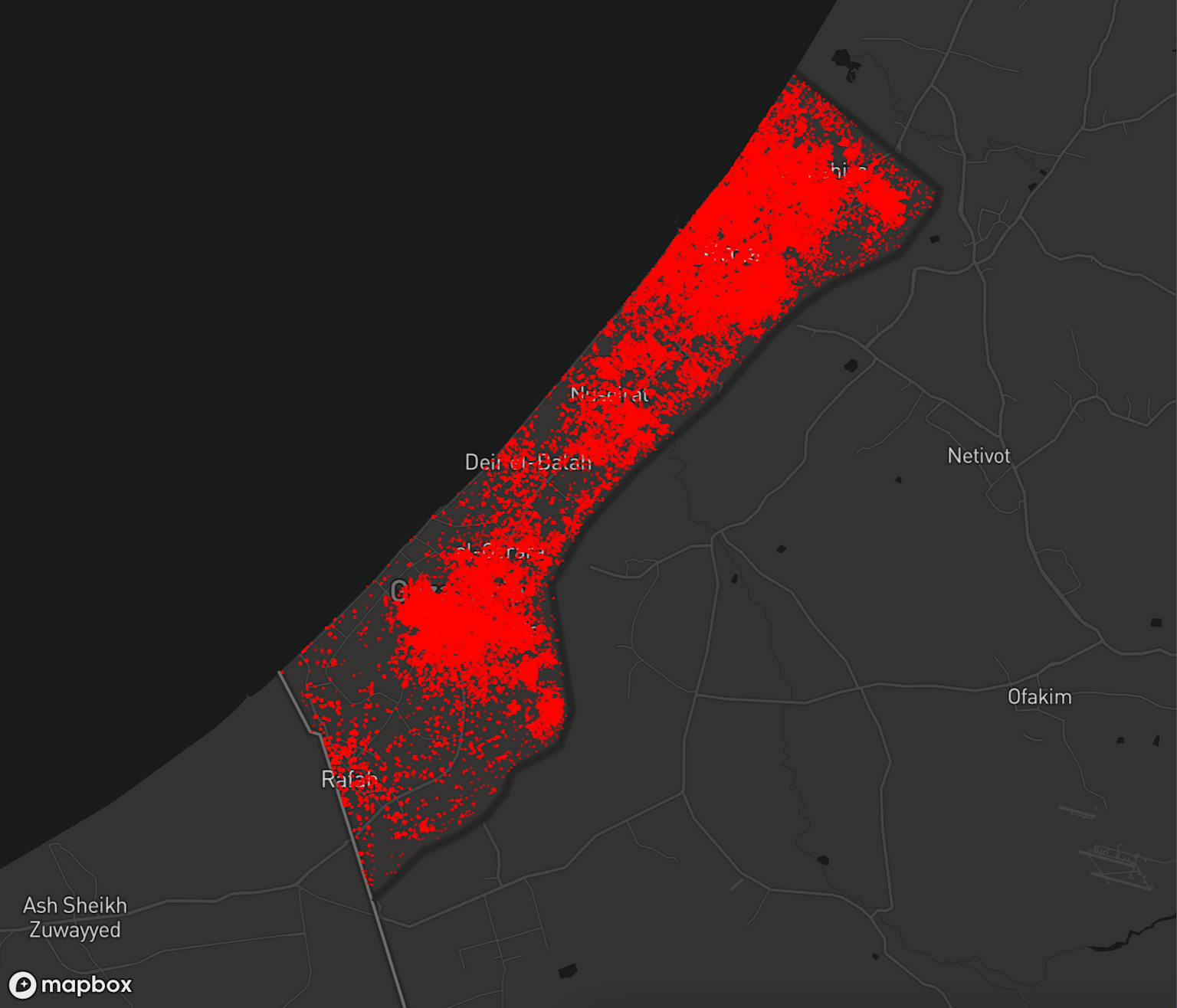
CONFIRMED: Satellite analysis shows that Gaza did not enter the October ceasefire as an intact territory waiting for reconstruction. UNOSAT compared imagery collected on October 11, 2025, with a May 2023 pre-war baseline and found approximately 81 percent of all structures in the Gaza Strip damaged. It identified 123,464 structures as destroyed, 17,116 as severely damaged, 33,857 as moderately damaged, and 23,836 as possibly damaged—198,273 affected structures in total. UNOSAT estimated that 320,622 housing units had been damaged UNOSAT, October 11, 2025.
The progression matters as much as the final percentage. UNOSAT identified approximately 30 percent of Gaza’s structures as affected in imagery from January 2024 and 35 percent by the end of February UNITAR, February 2, 2024 UNITAR, March 20, 2024. By July 2024, 156,409 structures—approximately 63 percent of the total—had been affected, including 46,223 destroyed structures and an estimated 215,137 damaged housing units UNOSAT, July 6, 2024. By October 11, 2025, the affected share had risen to 81 percent, and the number classified as destroyed had reached 123,464 UNOSAT, October 11, 2025. Destruction accumulated across successive operations and all five governorates rather than ending with the war’s opening phase.
The human consequence is not captured by the word “structure.” Each destroyed apartment block, house, clinic, school, shop, and workshop removes part of the physical network through which a population returns, earns income, studies, receives treatment, and rebuilds community life. By July 2024, the conflict had already generated approximately 41.9 million tonnes of debris—14 times the combined debris produced by Gaza’s conflicts between 2008 and 2023 UNITAR, August 1, 2024. Families entering the ceasefire were therefore not returning to functioning neighborhoods. Many were returning to rubble, damaged utilities, unstable buildings, unexploded ordnance, or land they could no longer reach.
HIGH-CONFIDENCE: The October 11 image was acquired one day after the ceasefire took effect. The 81 percent figure is therefore a ceasefire baseline, not a measurement of destruction caused after the agreement. No Strip-wide 2026 UNOSAT update was recovered by this brief’s July 13 data cutoff. Continued strikes and the clearing of neighborhoods east of the Yellow Line indicate additional post-ceasefire destruction, but assigning a new percentage would exceed the available satellite evidence. The verified 81 percent should be read as a floor.
Territorial control determines where Palestinians may live. Satellite damage determines whether the land left to them can sustain life at all. Compressing roughly 2.1 million people into a shrinking portion of Gaza while most of its pre-war built environment is already damaged makes reconstruction more than a funding problem. It makes recovery contingent on an end to destruction, reliable access to land, debris removal, functioning utilities, and the freedom to rebuild without the rebuilt structures being attacked again. The ceasefire has delivered none of those conditions.
Questions
What does “return” mean when 81 percent of Gaza’s structures were already damaged at the ceasefire baseline and more than 123,000 had been destroyed outright?
Can reconstruction remain a credible political promise while territorial access continues to contract and no mechanism protects rebuilt homes, hospitals, schools, or utilities from renewed destruction?
The data tells us there is no plan for the Palestinian people in Gaza. Eighty-one percent of a territory’s structures being damaged is an astonishing number. This is effectively the erasure of Gaza proper and the wider Strip. More than 123,000 structures are gone. That represents countless families—often multiple families per building—who have nowhere to return. Even if the ceasefire were functionally applied tomorrow, millions would remain displaced or homeless. There would be no services, no reliable roads, and no functioning urban system to receive them. You cannot return somewhere that is no longer there. Gaza, as it was, is no longer there.
Satellite imagery makes that loss visible. What Gaza was before is now unrecognizable: green courtyards reduced to dry dirt, ponds turned brown and muddy, and neighborhoods once vibrant and colorful rendered in gray dust and rubble. When 81 percent of a territory’s structures are damaged, the result approaches the annihilation of its built environment. That is the only way I can describe what is happening across the Gaza Strip.
I suppose some form of reconstruction remains possible, but under the system currently in place—the Board of Peace and its agreed actors—reconstruction risks becoming extractive. It may serve wealthy foreign interests seeking to turn catastrophe into private gain rather than the Palestinian people whose homes and communities were destroyed. The current plans emphasize investment, tourism, industrial zones, and outside oversight without credible guarantees of Palestinian ownership, consent, political authority, or right of return.
Even if a ceasefire were reinstituted and rebuilding began, reconstruction without credible guarantees that Israel would not attack again could quickly return Gaza to its present condition. Under those circumstances, rebuilding becomes a cycle in which foreign money reconstructs homes and infrastructure that remain exposed to renewed destruction. What exists now is a catastrophe for which I struggle to find a qualifier that captures the horror I experience when analyzing it.
Closing Questions
If a ceasefire preserves its diplomatic name while lethal strikes continue, military control expands, aid and essential services remain insufficient, the people documenting and treating the destruction are killed, and four-fifths of Gaza’s built environment is already damaged, what is this arrangement actually preserving—and what enforceable change would demonstrate that it protects Palestinian life, return, and self-determined recovery rather than managing permanent displacement beneath the language of peace?
The ceasefire is a diplomatic tool and a misdirect—a filter above the reality of what is happening in Gaza. Every fact on the ground points toward a worsening humanitarian situation and an Israel emboldened by the war engulfing the region, spurred onward by internal tension and actors of the most extreme caliber holding high positions in government.
As I come to the conclusion of this article, I am left with a solemn reality: the people of Palestine have had their future stolen from them. They have had their homes destroyed. They have seen their hopes and dreams turn to ash. Their children have died in their arms. Their friends have disappeared, incinerated by bombs. Children live without their parents in tattered tents. Babies starve. What is happening in Gaza is not a war. It has not been a war for a long time. I am not certain it was ever a war at all. I am certain that Gaza and its people have been failed.
Those to blame are not Hamas alone. The attacks Hamas carried out should be condemned. What also must be condemned—and should have been condemned—are the actions taken in response. The United States needs to bear a great deal of this blame. The bombs used to take the lives of tens of thousands of children were pulled from American stockpiles and sold to Israel at a premium. American-made fighter jets streaked through the skies and rained death upon the innocent people in Gaza. It is American dollars soaked in blood that have made this possible. The deniability is not plausible. The result is visible.
The actions taken by those who are taking advantage of this situation—those who seek to gain wealth at the expense of an entire generation’s right to exist—sicken me. Gaza has been destroyed. It appears that the rest of Gaza will soon follow as Israel continues to grind on in its inexorable advance, block by block, street by street, forcing the 2.1 million people of Gaza into a smaller and smaller place. The most horrific part of all of this is that the worst is yet to come.
It is my sincere hope that, if you are reading this article, you share it with someone else. We must put pressure on our governments, in whatever capacity we can, to cease interaction with Israel, condemn its actions, and cut all military support. By some miracle, perhaps the people of Gaza might reclaim some kernel of a possible future. But one thing is certain: continued silence will result in the erasure of the Palestinian people.
That is the goal. Whether it is officially stated or not, the actions themselves mandate that there is no other possible objective. A successful operation—a counterinsurgency—would have different metrics for success. It certainly would not have such a dramatic ratio of dead children to dead insurgents. I weep for the people of Gaza. I think you should too.
I need your help! The success of the Firebrand Project is driven by Firebrands like you. In the current algorithm-driven environment, your interaction is what makes this content visible.
If you have read this far, please help me reach more readers by liking, commenting, and re-stacking this post, and by sharing it on other platforms!
Burn Bright. In Solidarity.
Shane
Note: I am committed to providing you with the best available information regarding the wider world. This work is hard, exhausting, and it does not pay.
Any support you can provide is now more important than ever. Thank you.
Find the Firebrand Project on other platforms, make donations, and support my work by visiting my link tree below.

Comments
Nothing yet. Say the first thing.
Sign in to join the conversation.