
Paul Tudor Jones was recently asked on Patrick O’Shaughnessy’s podcast about the most formative moment of his development as a trader.
He did not talk about a huge winning trade or some analytical breakthrough. He talked about watching his mentor, Eli Tullis, get completely wiped out on a cotton position and still show up to lunch that same afternoon calm, relaxed, joking around like himself.
What Jones took from that moment was not some technical insight about trading. It was seeing somebody absorb a brutal loss without psychologically collapsing afterwards. Jones later said the market can smell weakness. You’ll know exactly what he means if you’ve ever managed money through a real drawdown.
That story left a deep impression on me because it captured something investors often only come to appreciate later on. Tullis was not teaching Jones a framework or a market technique that afternoon. He was showing him how someone carries himself after getting completely destroyed. That kind of knowledge is difficult to fully capture in writing. It usually has to be witnessed directly.

And this is not just about trading.
Jones admitted that he had spent years underestimating Buffett. He called himself an idiot for dismissing him. The older he became, the more respect he had for the psychological discipline required to compound capital across half a century.
Different strategy, same emotional demands. Once positions move against you, you still have to hold yourself together well enough to think clearly.
I have spent a lot of time thinking about what the equivalent looks like for ordinary investors trying to figure things out without that kind of mentorship around them. And about what I would have given, starting out, to have had something like it.
And then I thought about my own entry into this world, which looked nothing like Paul Tudor Jones’s.
Thanks for reading. Consider subscribing if you are seeking investment ideas, thematic research, and reflections like this on markets, behaviour, and long-term thinking. Your support helps sustain and deepen this work.
I trained as an engineer because it felt like the sensible path at the time. It was stable, respectable, and came with the sense that if you stayed on course, life would more or less take care of itself.
Then came the internship.
I was assigned to an air-conditioning installation and servicing company. Most days were spent working on chillers, ventilation systems, and air handling units. It was honest work, and I do not mean that dismissively. In fact, some of the people in these trades probably make better money today than certain white-collar professionals.
The harder part was the monotony, the feeling of already being stuck in a routine I could see stretching years into the future, and the growing gap between what the education had implied and what everyday reality actually looked like.
It also became obvious fairly quickly that the internship existed mainly because the school needed to place students and the company needed temporary manpower. Whether the student actually developed in a meaningful way did not seem especially central to the arrangement.
I do not think people quietly accept that kind of internship experience anymore. Younger graduates today understand much more clearly that internships can shape the direction of an entire career, and they expect to be taken seriously because of that.
I remember becoming very clear about one thing during that period. I did not want a life where most of my energy went into enduring work I already knew was draining me.

That realization eventually pushed me toward investing, although indirectly. Banking came first. Markets came later. By the time I became serious about investing, I did not have access to the kind of mentorship Paul Tudor Jones had with Eli Tullis. I did not know anyone in that world. I would not even have known how to get into those rooms.
So I did what most people outside those networks do. I went to books.
And honestly, the books helped a lot. Buffett’s letters, Graham, Munger, they shaped how I got started. These are people who spent decades working through markets and wrote down what they learned with real care.
Still, there were gaps the books could not close. That does not make the books less valuable. It just means some lessons arrive much later once real decisions, uncertainty, and emotional cost enter the picture.
Many I know arrive at investing through some version of this side door. If you ask them what draws them to markets, most will immediately give intellectually respectable answers. Curiosity. Business quality. Pattern recognition. Capital allocation as a puzzle worth solving.
All of those things are true, and perhaps usually how the interest first presents itself.
What shows up less in conversation, and what I think is the deeper motivation, is something simpler. They want more control over how their life runs. They do not want to spend decades taking direction from systems that have no real stake in them. Markets offer a path, imperfect and uneven, but still a path, toward that kind of agency, where your time and capital answer only to your own judgment.
I think Munger was speaking for more people than he intended when he said he was not trying to get rich. He was trying to be independent and overshot. I certainly didn’t overshoot, but the independence part landed. That internship made the trade-off concrete. It made the cost visible in a way it had not been before.
Paul Tudor Jones, reflecting on fifty years of trading, said he believed that roughly 70% of what makes a great trader, he believes, is nature rather than nurture. The innate traits like a Type A disposition, intense curiosity, a competitive orientation. The uncomfortable truth is that basic wiring probably matters more than most like to admit. You can refine it, but you cannot install it if it is not there to begin with.
At the same time, when thoughtful investors reflect honestly on their careers, they rarely describe long-term survival as primarily an intellectual problem. Buffett talks constantly about temperament. Munger was all about avoiding stupidity and emotional self-destruction. Howard Marks writes often about humility and understanding the boundaries of your own knowledge.
Beyond a certain point, investing stops being an IQ problem.
One of the clearest examples of this was Sequoia Fund and Valeant. Sequoia had one of the best long-term investing records in the United States. Buffett himself used to direct people there after shutting down his partnership. Then Valeant eventually grew to ~30% of the portfolio.
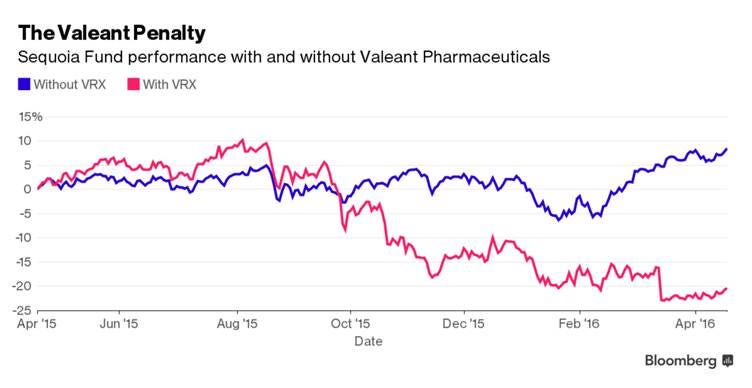
The analytical case sounded coherent for a long time. Smart people stayed with it deep into the damage. Board members resigned. The fund still struggled to loosen its grip on the thesis even as the underlying business quality deteriorated.
Intelligence was clearly not the issue here. The problem was the inability to change course once reality stopped supporting the original thesis. That is the part investing culture often seems to underrate.
The industry spends enormous effort selecting for analytical horsepower. The filters are mostly academic pedigree, fast pattern recognition, the ability to present a view with confidence. They may matter but they are closer to baseline requirements.
If temperament is doing most of the work, it helps to know where it comes from. Even if a large part is innate, the rest still needs to be shaped. You have to learn how to direct those instincts, when to press and when to wait, how to stay with a position without becoming rigid.
That is not something you can pick up from reading alone.
This is the kind of thing I’d want my own children or anyone starting out to have in mind before they begin. It’s also what I wish someone had spelled out much earlier for me, especially around which variables actually matter in an industry that so often rewards the wrong ones.
I used to think the difficult part of investing was mainly informational. Read enough. Study enough history. Learn from people who had already been through cycles. Over time the framework would show up in your decisions.
The limitation is that books can explain frameworks very well but they cannot fully transmit behaviour.
Paul Tudor Jones could have read endlessly about resilience, emotional discipline, and maintaining composure under loss. The principles already existed in books long before he saw them embodied directly in Tullis under real conditions.
What Tullis gave him was something different. Jones watched somebody he respected absorb a real financial hit and still carry himself the same way afterwards. Same tone, same posture, no visible strain. Seeing that embodied in real life probably sticks in a way words usually don’t.
Books give you the playbook. The market shows you whether you can actually run it.

Most people understand the principles before they can act on them. They know fear is not a signal. They still sell when it spikes. They know conviction should come from analysis. They still cut when it hurts and add when it feels comfortable.
And a huge amount of investing comes down to the distance between understanding a principle intellectually and still being able to follow it once real pressure enters the picture.
Understanding that earlier probably changes what you optimize for.
Investors who eventually develop good judgement through self‑teaching are rarely learning in complete isolation, even if it feels that way. The market gives you the outcomes as the ultimate feedback, but you still need some honest feedback loop that points out where you went wrong, the gap between your stated framework and how you actually behaved under pressure.
In some ways it resembles a rally driver and co-driver relationship. One person is immersed in the immediate terrain and emotional pressure of the moment. The other helps extend perception slightly further ahead, calling attention to risks, blind spots, and changes in conditions that become harder to see clearly once speed and stress narrow attention.

For some people it is a partner who knows them well enough to say: You are not exiting because the thesis changed. You are exiting because you are scared.
For others it is a written record. Investment memos written before the position goes wrong and then left untouched. Especially when they’re shared with others, they become hard to rewrite afterwards. They force you to confront what you actually believed at the time instead of the tidied up version memory produces later.
Sometimes it is just a small group of peers willing to challenge the thinking instead of automatically validating it.
Buffett had Munger. Munger had Buffett. Over decades, each became an external check on the other’s blind spots, emotional impulses, and reasoning process.
Buffett once reflected on why he and Munger endured while Rick Guerin, who they considered extremely intelligent, got forced out during the 1970s downturn. Buffett’s answer was simple: Charlie and I were never in a hurry.
It sounds simple until you watch what urgency does to decision making once markets turn against people.
That sort of learning lands differently than reading about emotional discipline in a book.
If younger people ever asked me what to look for early on, I think I would tell them to find at least one person honest enough to point out the distance between what they say they believe and how they actually behave once pressure enters the picture.
You can do a great deal on your own, but it will be slower and psychologically harder.
I should probably say this carefully because I did not personally come into investing through the kind of close mentorship relationships someone like Paul Tudor Jones had early on.
A lot of these observations came indirectly through studying investors over time, watching how people behave under pressure, and noticing which traits seem to steady judgement rather than distort it.
One thing AI may change in investing is the speed at which emotionally driven decisions can be transformed into intellectually convincing narratives.
A decade ago, there was more friction between an emotionally driven decision and the explanation constructed around it afterwards.
Now the explanation can arrive almost instantly. A position exited out of discomfort can quickly be reframed into a coherent macro view, risk-management adjustment, or thoughtful reassessment of probabilities.
The underlying psychology may remain largely unchanged while the explanatory narrative surrounding it becomes far more coherent.
AI works with the narrative you provide. It cannot independently observe the gap between your reasoning and the emotional reality underneath it.
Someone who knows you well may eventually notice that the same behavioural pattern keeps recurring beneath different intellectual explanations. Fear becomes macro caution in one cycle, risk management in another, and updated probabilities in the next.
AI is incapable of independently recognizing when the same emotional pattern keeps resurfacing underneath different intellectual explanations unless the user themselves notices and reports it accurately.
I suspect the investors who benefit most from it will be the ones who already possess fairly strong behavioural discipline and some form of honest external feedback structure outside the technology itself.
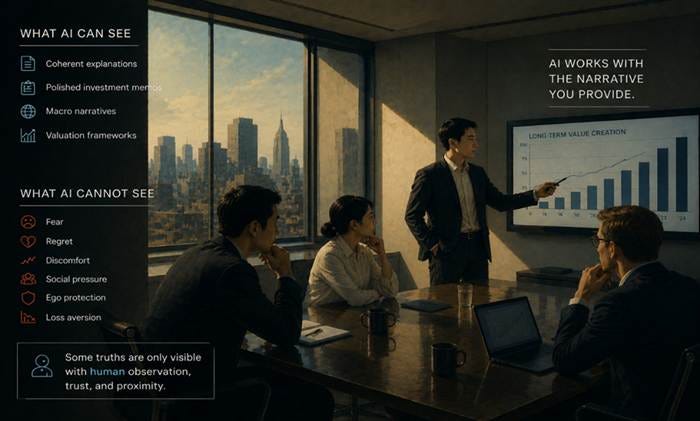
Otherwise, there is a risk that people simply become more sophisticated in narrating their own behaviour without becoming equally accurate in understanding it.
Some forms of learning still resonate more deeply through observation, trust, and proximity to another human being operating under real conditions.
If you actually want someone useful to your development as an investor, not just someone who feels good to be around, here are a few signals I believe may help.
1. The first is the ability to walk through their own mistakes in detail. Investors worth learning from usually remember their serious mistakes very clearly. Not general statements about being wrong, but what they thought at the time, what they did, and where it broke. Anyone experienced has losses. The ones worth learning from describe them without cleaning up the story.
2. The second is whether they can clearly explain what would change their mind. Every thesis has conditions under which it fails. These people usually know where those boundaries are. They can explain what evidence would force them to reassess the thesis instead of treating every contradictory datapoint as something to explain away.
3. Another thing I pay attention to now is how somebody responds to your mistakes. You want someone who points to where your thinking failed and why, not someone who turns it into a judgement about you. The useful feedback is specific and tied to decisions.
4. And the relationship should probably feel uncomfortable sometimes. The people who accelerate your development are usually not the ones constantly validating your existing worldview. They are the ones who expose blind spots you would not have noticed yourself.
5. They are clear about what they do not know. If everything fits neatly and every question has an answer, be careful. The people worth listening to are honest about the edge of their knowledge and they say so fairly openly.
6. They should also have been tested. You can hear it in how they talk about being wrong. The emotionally honest accounts sound very different from hindsight narratives. Not just the outcome, but how they behaved in it, including the times they knew and still did the opposite. That level of detail does not come from study.
And there is a harder requirement on your side. None of this works if you are not honest with yourself. If you keep rewriting your reasons after the fact, the feedback has nothing to attach to. You can read more, talk to better people, put in more hours, and still stay in the same place.
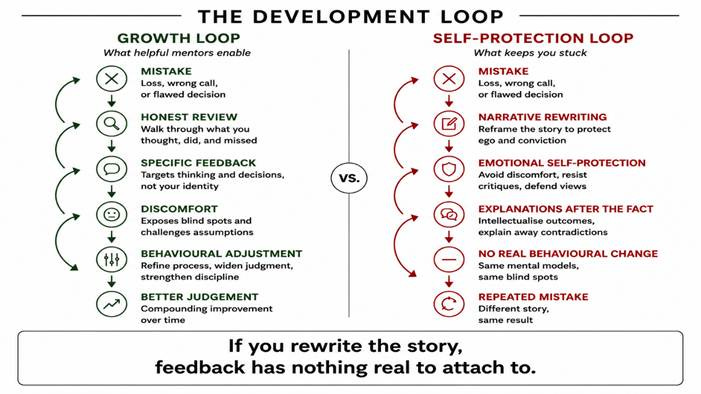
That is the real challenge, because the mind leans toward self-protection before it leans toward truth.
I would still encourage anyone starting out seriously to read widely and think independently. Some of the best investors spent decades wrestling honestly with difficult problems and left behind an extraordinary amount for younger investors to learn from.
But I would also remind them that understanding a framework intellectually is different from being able to live it consistently once real emotional pressure enters the picture.
I did not come into investing through some elite mentorship structure. I mostly found my way into it indirectly through engineering, banking, books, curiosity, and a gradual accumulation of mistakes and observations over time.
Still, I occasionally think about how valuable it would have been earlier on to watch somebody operate calmly and rationally through real financial stress instead of only reading about those qualities abstractly.
The more years I spend around investing, the more I believe that some of the most important lessons are still better transmitted person to person.
And often just by watching how someone carries themselves when things get difficult.
I’m sharing information here to educate and inform, not to provide financial or investment advice. Like any other personal financial matter, your own due diligence is paramount.
Comments
Nothing yet. Say the first thing.
Sign in to join the conversation.