
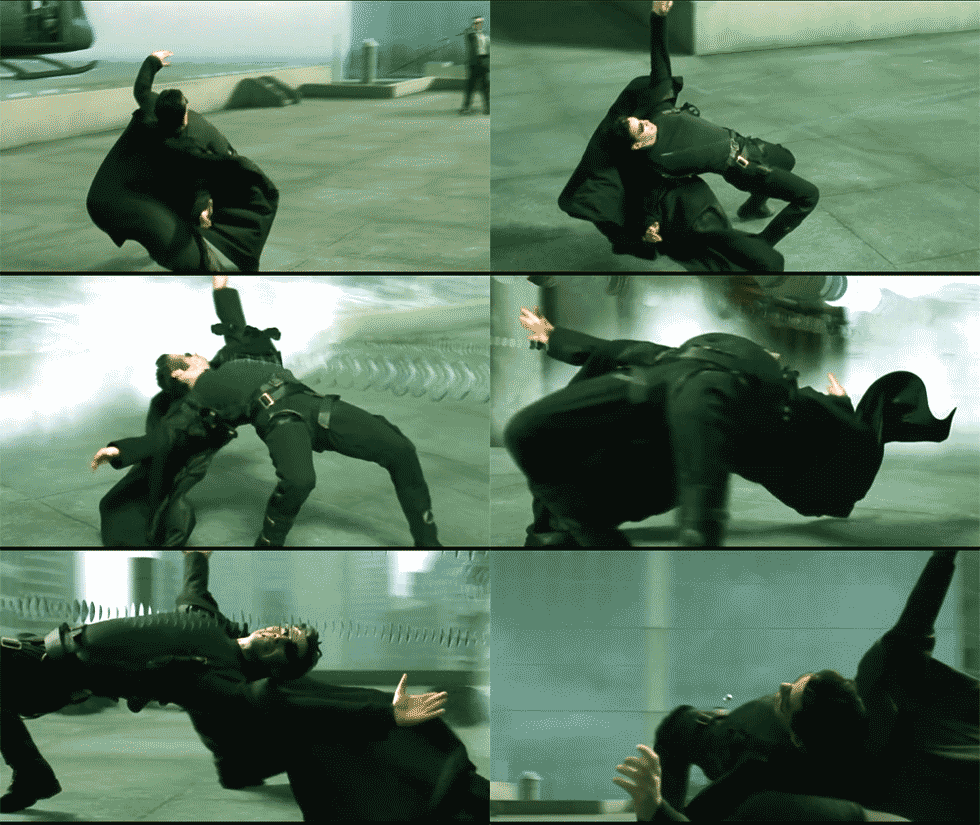
The pleasantly surprising news that Paramount, not Netflix, came out on top in the Warner Bros. sweepstakes will turn out to be one of the great cultural bullet-dodges of all time… like Neo on Agent Smith’s roof big. Most everyone here in town understands this on a gut level, though few will say so out loud because as the drama dragged on, much of Hollywood decided that known cinephile Ellison was the bad guy in this particular story.
Nevertheless, the fact is that for Netflix to have assumed control of perhaps the greatest studio film library ever built would have been the culmination of a grand mistake Hollywood made in earnest during the COVID Lockdowns, and which it has continued to make ever since. And no, I’m not talking about “going woke” or retreating to a world where we only make sequels, prequels and reboots… I’m talking about a different, more fundamental mistake.
Somewhere along the way we decided that theatrical motion pictures and “content” watched at home on a TV are the same thing and that both the audience experiences and the business models are interchangeable. They are not, and this mistake has led to a rapid and completely unnecessary collapse of the theatrical movie model.
I happen to believe, perhaps alone amongst the insider Hollywood commentariat, that this mistake is reversible. I believe this is so because in the end, audiences are getting something from streaming that is fundamentally different from the theatrical moviegoing experience, that the difference between the experiences is becoming more stark not less, and that eventually audiences are going to come to miss the latter more than they desire the former.
Not long ago, back when it seemed like a fait accompli that Netflix would win the battle for Warner Bros, conservative commentator John Podhoretz went on an interesting rant arguing that the movies are dead and just don’t know it. That they will shamble on for a while as Vaudeville and narrative radio once did, but that before long theatrically exhibited movies will inevitably become just another curiosity of our shared past.
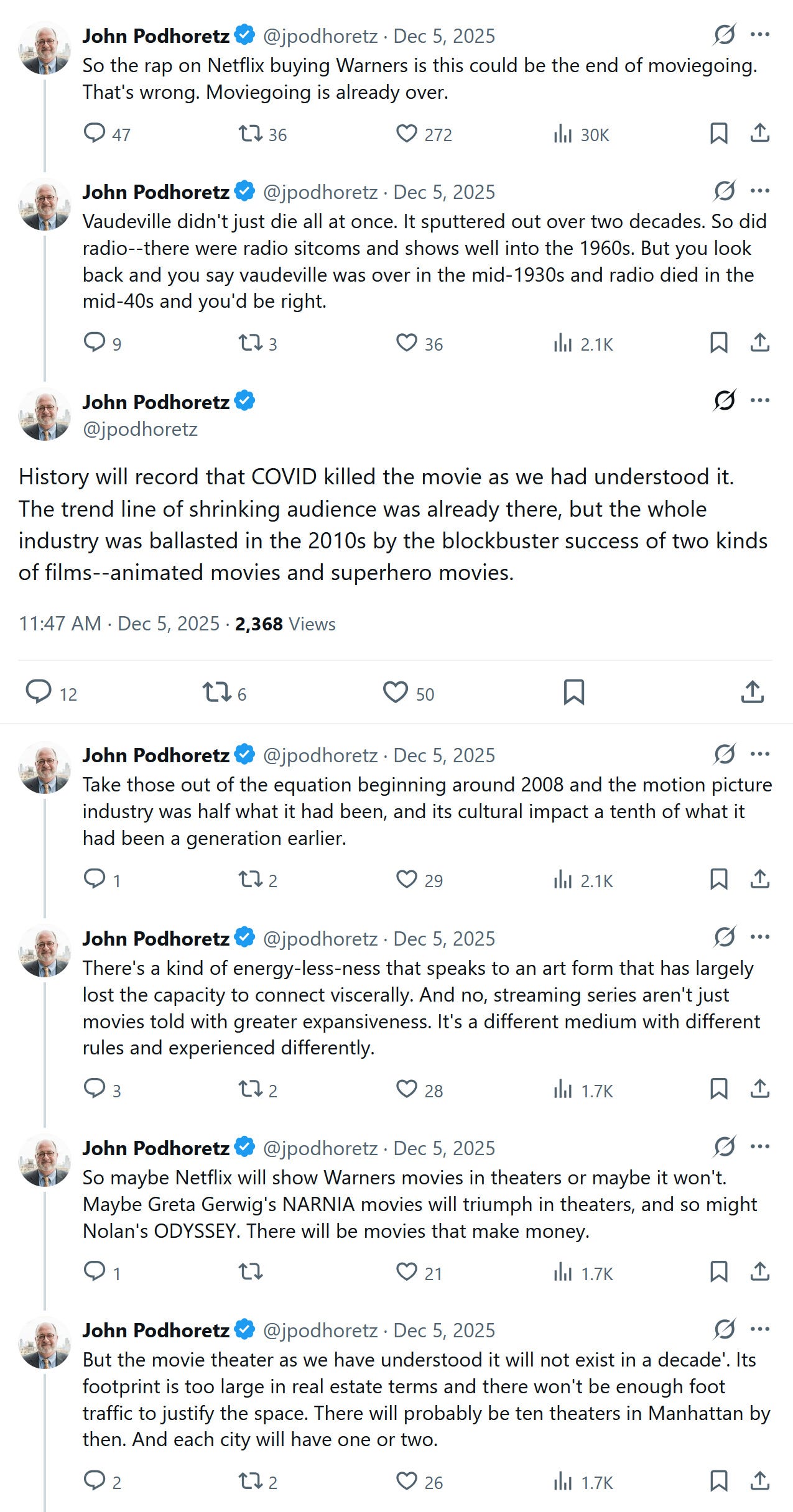
I’ve long been a reader and admirer of John’s, he’s smart, he’s a great writer and he has good insider connections to Hollywood despite his politics, but I think he’s wrong here… or at least I don’t think he’s as right as he thinks he is. Within his rant he made one critical admission that cracks the load-bearing beams of his entire argument, perhaps fatally. In his fifth tweet he describes streaming as a “different medium with different rules and experienced differently.”
To that point, it’s easy to forget that movies made exclusively for streaming platforms are a brand new phenomenon. Netflix’s first real foray into blockbuster movie making was “Bright,” a fairly traditional movie star fantasy action-thriller starring pre-slap Will Smith. “Bright” was made pretty much the way studio movies have always been made and released on Netflix in 2017, not even a full decade ago.
A lot has changed since then.
In the days since, the biggest change we’ve seen in how streaming movies are made has become known as “the second screen” concept. The idea is that streamers have admitted to themselves that the movies they produce are not the primary focus of the average streaming viewer’s attention. Rather, streaming viewers are focused on their “primary screens,” which is to say they are focused on their phones. The movies they “watch” function more like muzak… background noise which only attracts their full attention when something loud happens.
On a recent episode of the Joe Rogan podcast, Ben Affleck and Matt Damon came aboard to pitch their new Netflix original “The Rip.” During the interview they seemed to confirm that the “Second Screen” concept is changing the way streaming movies are made, including by adding “explainer” sequences to movies so that viewers who are only half paying attention can get caught up on the story via scenes in which the major characters periodically recap what has already happened.
“The Rip” is a pretty good movie, but it too suffers from this unfortunate trend of idiot-proofing movie plots for the attention-deficited. Late in the film, a handful of major characters find themselves inside an armored police vehicle where they spend several minutes recapping everything that has happened up to that point, just in case you were focused on composing a real banger of a tweet while the major plot points were being revealed in real time. That such a sequence should be necessary at all tells me much of what I need to know about the future of movies made for streaming.
There are other changes roiling the way streaming movies are made too, changes which are harder to define, but which we all feel in our bones whenever we sit down to watch an “original” movie on a streaming platform… inferior lighting and sound design, the disappearance of deep focus, soft CGI-assisted backdrops, lazy storytelling… as if filmmakers don’t expect audiences to be paying enough attention to catch plot holes in real time, cookie-cutter character development, and the mass disappearance of extreme closeups and awe-inspiring wide shots in favor of an amalgamation of milquetoast medium shots… all changes which leave us with the distinct impression that streaming originals constitute an unconditional surrender to a new reality, one where audiences watching at home are fatally distracted, watching on smaller screens and who need to have their hands held all the way to the end.
When the theatrical movie business was all-powerful and movies arrived in theaters with a certain confident swagger, the movie-going experience was designed, produced and exhibited with theatrical audiences in mind. Even as home video became a bigger and bigger part of Hollywood’s bottom line, the concept of “direct-to-video” remained the ugly step-sister Hollywood preferred not to talk about in polite company. Certainly filmmakers never, ever adjusted the way they made their movies in order to accommodate those who waited for them to show up on VHS at their local Blockbuster video. Rather, Hollywood’s message to its audience was “our product is special, it is meant to be seen in a theater on a big screen… we’ll put it on video for you eventually, but understand this, the experience is not going to be the same… it will be a lesser experience. If you want the real deal, come see us at your local theater next time.”
But here in the streaming era, it’s becoming quite common to see films in theaters which feel like they have been made with the understanding that most people will likely experience them for the first time at home. The “Direct-to-Video” business is now determining how theatrical movies are made, rather than the other way around. And this has done much to diminish the competitive advantage once enjoyed by the theatrical moviegoing experience.
All of this in less than a decade. Who knows how much different streaming movies will be another ten years from now. It’s possible that streaming films could soon be as different from traditional theatrical movies as poetry is from novel writing.
When broadcast TV first appeared in the 1950’s, there was widespread terror in Hollywood that television would eventually replace the movies as audiences opted for the ease of watching TV on the couch at home rather than going out to the theater. This didn’t happen, in large part because TV shows turned out to be very different in both form and function from theatrical movies. Seventy-five years later, episodic TV series and theatrical motion pictures exist alongside each other in a symbiotic relationship that leaves plenty of pie for everyone to slice and enjoy.
in the same way, even here in 2026 where streaming has cut deeply and bloodily into theatrical Hollywood’s dominance, audiences continue to prove to us that they still want to go to the theater. The evidence is all around us, in movies like “Housemaid,” which is not an especially original movie and which did not reinvent any wheels, but which found an enthusiastic audience anyway. In the end, “Housemaid” will wind up being one of the most profitable movies of 2025, and its performance is one of a million reasons why I believe our grand mistake is still reversible.
“Housemaid” proves that audiences are still getting something at the theater which they can’t get anywhere else, and they are sending Hollywood one hell of a market signal in the process.
Perhaps now that the WB derby is over and the good guys won, someone in this accursed town can cash in on that signal and begin to reverse Hollywood’s grand mistake. Because in the recognition and reversal of that mistake lies a profitable way forward for the theatrical movie business, and for those of us who still love the art form and wish to see it endure for another generation of moviegoers, that would be great news indeed.
Thanks for reading, and for your time and trust… if you’d like to support the work I do here, the easiest thing you can do would be to click the “like” button and share this essay on your favorite social media platform. The second easiest thing would be to subscribe for free or to upgrade to a paid subscription… perhaps one day this stack will begin to throw off some revenue and I’ll be able to formally introduce myself… a man can dream can’t he? After all, this is Hollywood… the dream factory.
No posts
Comments
Nothing yet. Say the first thing.
Sign in to join the conversation.