
(Note: This is the seventh in a series of deep dive essays into some of Hollywood’s greatest, most popular and most-enduring movies… as defined by me. The hope is that by analyzing what has worked in the past, we can help Hollywood remember how they once did it right. You can find Episode Six here)
EPISODE SEVEN: PIRATES OF THE CARIBBEAN
In many ways, the release of “Pirates of the Caribbean: The Curse of the Black Pearl” signaled the end of an era… one of the last instances in which Hollywood made a movie for the pure love of the game… for no other reason than to give their loyal customers a good time and maybe make a little money in the process.
Looking back, it seems as if 2003 Hollywood belongs more to the 1990’s than it does to 2026, as if that last great era of studio filmmaking somehow miraculously went into extra innings and gave us a few more precious at-bats. Sadly, there was no way those of us who lived through it could have known at the time how little runway we had left.
“Pirates of the Caribbean: Curse of the Black Pearl” was the perfect four-quadrant movie, which is Hollywood speak for “a movie literally everybody in the country wants to see,” but it was aimed primarily at the boys and young men who have long been Hollywood’s most reliable demographic for action-adventure movies. There was plenty in the film for the women who showed up at the theater too (more on that later), but Disney clearly had one particular target audience in mind when they greenlit “Pirates,” they understood the assignment perfectly, and they executed flawlessly.
The movie is about Will Turner, a young man rescued as a boy from a shipwreck at sea and who has grown up an orphan, searching for news of his long-lost father and feeling like he was meant for more than the lowly blacksmith’s apprentice gig he has been assigned as he waits impatiently for his real life to begin on a remote island in the Caribbean. Or at least, this is what the movie was “supposed” to be about… no one could have predicted that Johnny Depp would turn in one of the most iconic movie star performances of all-time and wind up re-jiggering the entire franchise, in the process landing his Captain Jack Sparrow smack-dab in the center of it. But for now, let’s talk about the intended hero of the story, Will Turner (Orlando Bloom) because the movie could not exist without Will’s character arc at its center.
The story of a young man who feels in his heart that he was meant for more than the lowly station assigned to him by circumstance and who eventually discovers that he is destined to become a hero, is more than just one of the oldest and most durable character tropes in the entire canon of Western storytelling. It is the story which has captured the imaginations of a thousand years worth of Western men, and sent them out into the world seeking adventure.
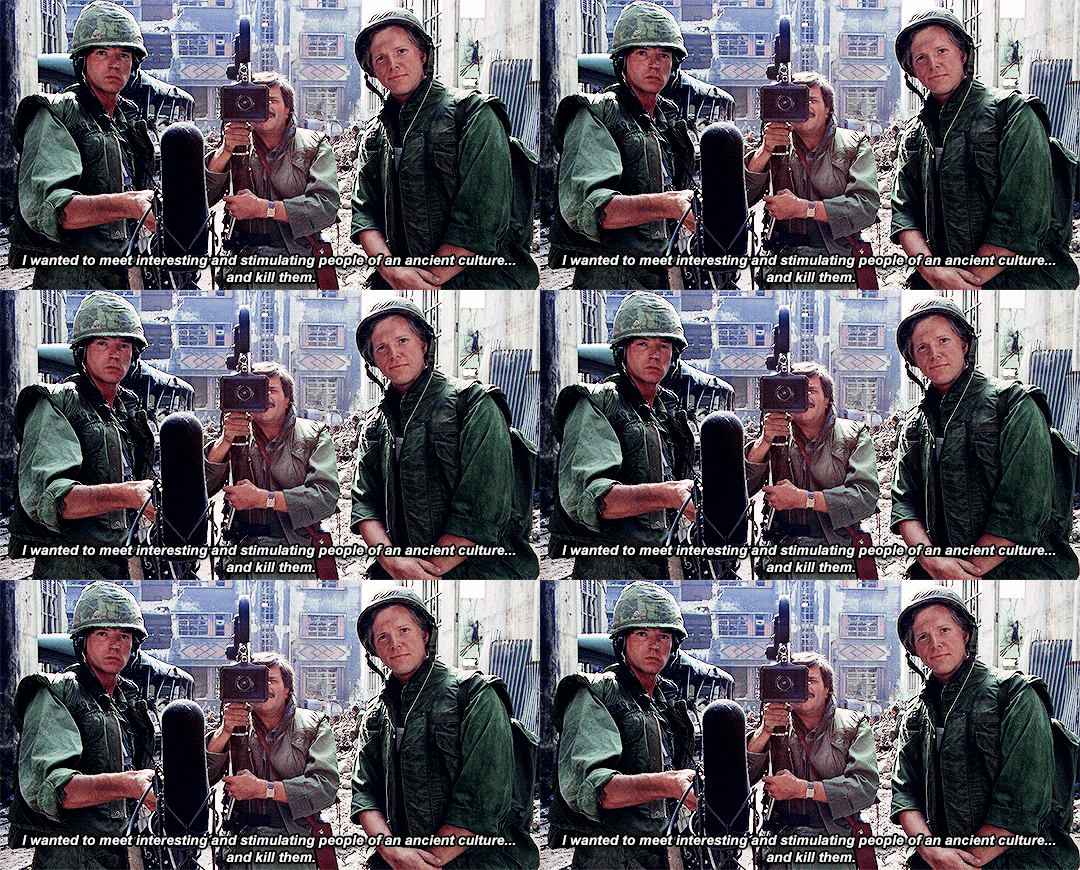
Critics will argue the nurture side of the nature versus nurture debate and suggest that men seek adventure because Western adventure stories fill their heads with nonsensical notions of heroism and fortune and send them headlong into a wild and dangerous world they don’t really understand, there to be killed or worse. But that argument isn’t just wrong, it’s insulting. Adventure stories don’t create something that isn’t already there, rather they tap into something that is immutable to most men… a wanderlust and yearning for adventure which is an inextricable part of the XY chromosome pairing, fuel which needs only a match to set it alight.
Will Turner’s fire is lit, his adventure begun, with the help of another classic story trope… the older wiser mentor figure who is at best wildly eccentric and at worst completely insane. This trope too goes back to the very beginning of Western storytelling, but we see it very clearly in many of today’s most popular mass entertainment franchises, some of which are still throwing off sequels, prequels and reboots, from “Star Wars” to “The Matrix” to “Point Break” to “Highlander.” The twist with “Pirates of the Caribbean” is that Johnny Depp did too good a job with Captain Jack Sparrow and accidentally whoopsied himself right into the lead role.
But that was merely a happy accident. Like “Star Wars” and all those other enduring movie examples which we could name, “Pirates of the Caribbean” is a classic male-oriented adventure in both form and function, and that is precisely why it worked so well.
Which brings me to the female lead, Elizabeth Swann, played by Kiera Knightley. Elizabeth is beautiful, of course, but also smart, funny and capable… she is for all intents and purposes a classic Hollywood “modern woman.” But here is the most critical piece, she is a modern woman within the context of the world in which she lives… a world that is a Georgian Era Patriarchy which exists on a distant island colony run with ruthless discipline by the officers and men of the Royal Navy. As such, the men in Elizabeth’s orbit do not cower before her superior intellect, nor are they driven to their knees by her unparalleled strength and wisdom. And she is certainly not a ninety-five pound Scarlett Johansson throwing two hundred and seventy pound men across rooms like they were Jenga blocks.
Elizabeth Swann is simply a woman, emotional and flawed and heroic, in all the ways we used to understand makes a woman, in the days before The Culture decided that being a woman was not enough.
And now I’m going to write something that should not be controversial, but which has become so here in our highly politicized “modern culture.” I’m going to write very clearly and deliberately so that I cannot be misunderstood… and yet I will be misunderstood, deliberately so, because the activists whose grift is based on pretending to misunderstand the most fundamental things about human nature can allow it to be no other way, lest their lucrative grift collapse entirely.
So, here goes… men and women are fundamentally different and often want different things from the entertainment they consume. Generally speaking, women are not as interested in adventure movies like “Pirates of the Caribbean” as men are, and are less likely to pay to see them in theaters. Notice I did not say all women are disinclined to see these kinds of movies, I said that generally speaking, men prefer them more than women do.
By the same token, the audiences for movies like “Hamnet” and “Wuthering Heights” are overwhelmingly female, something I have never heard anyone suggest is a societal problem that needs to be remedied by fundamental industry-wide changes in the way those movies are developed and made. And yet this is precisely what has happened at companies like Marvel, DC and Lucasfilm, where the stubborn refusal of women to attend action-adventure movies in the same numbers as men is treated like some kind of national emergency. When it comes to romantic dramas, on the other hand, we seem to understand that men and women want different things from the movies they consume… and that’s OK.
(Slight pause so that all those readers who have just fainted can be revived)
We good? Everyone still with me?
OK, now that we have re-established a fundamental reality we all used to understand, I note that there is an old saying in Hollywood that if you don’t know who you’re making your movie for, you’re making it for no one. And in the case of “Pirates,” Disney knew exactly who they were making the movie for… those same boys and young men who have been driving the box office for action-adventure movies for a hundred years, and for adventure stories a thousand years before that. And here’s the real magic of truly knowing your audience…. once you do, you can focus on making a great movie for that audience, and sometimes you can do that so well that you capture the imagination of other audiences as well. When that happens, you have yourself a blockbuster… one like “Pirates of the Caribbean” which would spawn four sequels which all together would pull in more than four and a half billion dollars.
…what happened next absolutely will not shock you, at all.
Friend of this ‘Stack Buck Throckmorton has written often of a peculiar modern trend in corporate America. Over the last decade, companies like Gillette, Anheuser-Busch and Cracker Barrel have decided for whatever reason that their most loyal legacy customers are embarrassing, or a cultural liability, and that those customers need to be traded in for different ones… in the process, these companies have destroyed their core businesses and exposed themselves to existential crises.
Hollywood has not been immune to this virulent corporate disease… we may, in fact, have been patient zero.
Twenty years after “Pirates of the Caribbean,” apparently driven by an intense dislike of the male-leaning audience which actually showed up for the movie, combined with an unshakeable conviction that the Studio could have traded that icky audience for a much more culturally desirable one made up primarily of women if only Will Turner had been female, a ridiculous self-negating fad theory Hollywood calls “Representation,” Disney made “Jungle Cruise.”
Unfortunately, the movie was a woke inversion of almost everything that made “Pirates” successful. The filmmakers even managed to work in a gay character who “comes out” during an awkward scene in the middle of the film and finds tolerance and acceptance from (checks notes) a 400-year-old Spanish Conquistador... and of course we all know how famously tolerant those guys were.

The results, as with “Pirates,” speak for themselves… $220 million in worldwide box office on a $200 million dollar budget, an Amazonian river cruise worth of red ink, and a single cancelled sequel.
Each new day in Hollywood seems to bring economic news that is worse than that which was delivered the day before… and yet in many ways it is so obvious what needs to be done to turn things around… for anyone with eyes to see.
Thanks for reading, and for your time and trust… if you’d like to support the work I do here, the easiest thing you can do would be to click the “like” button and share this essay on your favorite social media platform. The second easiest thing would be to subscribe for free or to upgrade to a paid subscription
No posts
Comments
Nothing yet. Say the first thing.
Sign in to join the conversation.