
One of the most frustrating aspects of the new corporate media culture in which we currently find ourselves is that the important issues of the day often get boiled down into something like a sporting event… a horserace maybe, or a football game. This has the effect of making complex stories like national elections or internecine corporate struggles easier for people to understand, yes, but it also encourages people to put on jerseys and root bitterly for one side or the other as if winning is an all-or-nothing proposition and there are no such things as unintended consequences. The media and our corporate culture do this to us intentionally because anger and division are very easily monetized.
The battle for control of Warner Bros has been handicapped in exactly this way. The story has been cast as a “justice preference” question… specifically, if the arc of history is to continue bending towards justice, which wealthy industrialist ought to “win” the battle, David Ellison or Ted Sarandos? As with almost every political or cultural conflict over the last decade, the specter of The Orange Man looms large, with Ellison cast as “MAGA-curious” and Sarandos as the virtuous “anti-Orange” option. And all across Hollywood, artists and executives are dutifully playing their pre-scripted roles.
In general, whenever the media portrays a big story in this way, we ought to instinctively put a hand over our wallets, because it is a good indication that there is some kind of a con afoot. And so it is with the fight for control of Warner Bros… if the real story of the WB deal isn’t “MAGA-curious” villain versus “Anti-Trump” savior, then what skullduggery is being done to those of us in the Hollywood rank-and-file while we are duly distracted by bread and circuses?
Quite a lot, actually, but here’s one specific thing…
For working artists in Hollywood (writers, directors, actors, producers) the movie business (mostly) continues to pay very well. But true generational wealth of the kind that pays for 10,000 square foot houses in Bel Air, second homes in Aspen and the private jet fees necessary to move seamlessly between the two is generally not made in up-front payments for services rendered. Rather, it’s made on the “backend" of successful movies.
Backend definitions, Hollywood speak for “profit-sharing”, range along a broad spectrum with “net” on one side and “gross” on the other. Thanks to creative Hollywood accounting, “net” is essentially worthless. But a Hollywood player with some form of “adjusted gross” (true dollar-one gross deals are extremely rare) can make generational money in success. (NOTE: “Backend” and “residuals” are not the same thing, though they perform some of the same functions).

When Lawyers and Agents negotiate with Studio Business Affairs Executives they often talk about backend deals in terms of waterfalls, the idea being that if a movie produces Niagara Falls, the people who made the movie ought to be allowed to stick a cup into the flow and take a little water back for themselves. Once upon a time, waterfalls sprang up all over the place every time a movie was released into the wild… network and cable TV licensing, hotel and airline licensing, video game adaptation, stage adaptations, home video, merchandising… I even know a writer who still gets a royalty check from a theme park ride based on a movie he wrote 30 years ago.
For decades, Studios and networks accepted this backend system as a fundamentally fair way for creators to benefit when they did the kind of work that produced a money-printing machine. And artists liked it because the process was transparent… the total value of the box office profit pool is printed in black-and-white every Monday morning in the trades. But all of that began to change with the conversion to streaming, where the success or failure of a film has become a corporate mystery hidden behind walls of technological secrecy. One-by-one, the waterfalls have begun to run dry, which many of us in the Hollywood rank-and-file worry was the plan all along.
In the early days of the streaming apocalypse when representatives first began to ask the studios “hey, what happens if you decide to take my client’s theatrical movie and dump it on a streaming platform?” the agreed-upon solution was euphemistically called a “Streaming Bonus”… as if you were being rewarded with a bonus for the honor of having the studio unceremoniously dump your movie into an app on people’s TV sets alongside reruns of “Bosom Buddies.” Now it’s called a “Streaming Buyout,” a much more accurate term which somehow still manages to understate how much it sucks.
What’s actually happening is that because streaming eliminates the box office profit pool, the streamers must “buy out” artists’ theatrical backends in advance. The size of the buyout depends on the career status of the artist involved and on the skill of those negotiating on the artist’s behalf, but while the buyout is always more than you would get on the backend if your movie bombs… it is significantly less than you would get if your movie is a breakout hit… like the difference between driving to the corner store for cigarettes and riding a rocket ship to Mars.
But here is the critical detail to remember. The streaming buyout only exists because the streamers still must compete with traditional movie studios who can offer artists performance based profit-sharing formulas based on real box office receipts… but what happens if studios continue to radically shrink theatrical windows, or stop releasing movies in theaters entirely?
Hollywood’s artists community ought to consider the answer to that question very carefully, because if Netflix wins the fight for WB, they will have successfully gobbled up one of their last remaining theatrical competitors. And no matter how many times Sarandos stands before Congressional Committees and pinky swears to give WB movies a 45-day theatrical window, once he’s the only game in town, he can do whatever he wants… including eliminating theatrical releases and backend deals altogether.
To be fair, Ellison could easily do the same thing, but given that Paramount already has a legacy theatrical division, it makes sense to maintain that commitment to theatrical distribution, if only as a competitive advantage over the pure streaming model. There is solid precedent for this in the Disney acquisition of 20th Century Fox.
Now, I know that almost no one reading this essay gives one single good goddamn if Hollywood artists lose their backend deals. I tell you this story anyway because I think it is instructive. It’s a window into the many ways in which our broken media and political culture “nudges” people into supporting things which are contrary to their interests for the sake of monetizing reactionary anger. And so I offer this inside baseball story as a reminder that we must all of us be aware of our own personal blindspots. Because eventually, the Long Con will come for you and your business too, as it has come for mine.
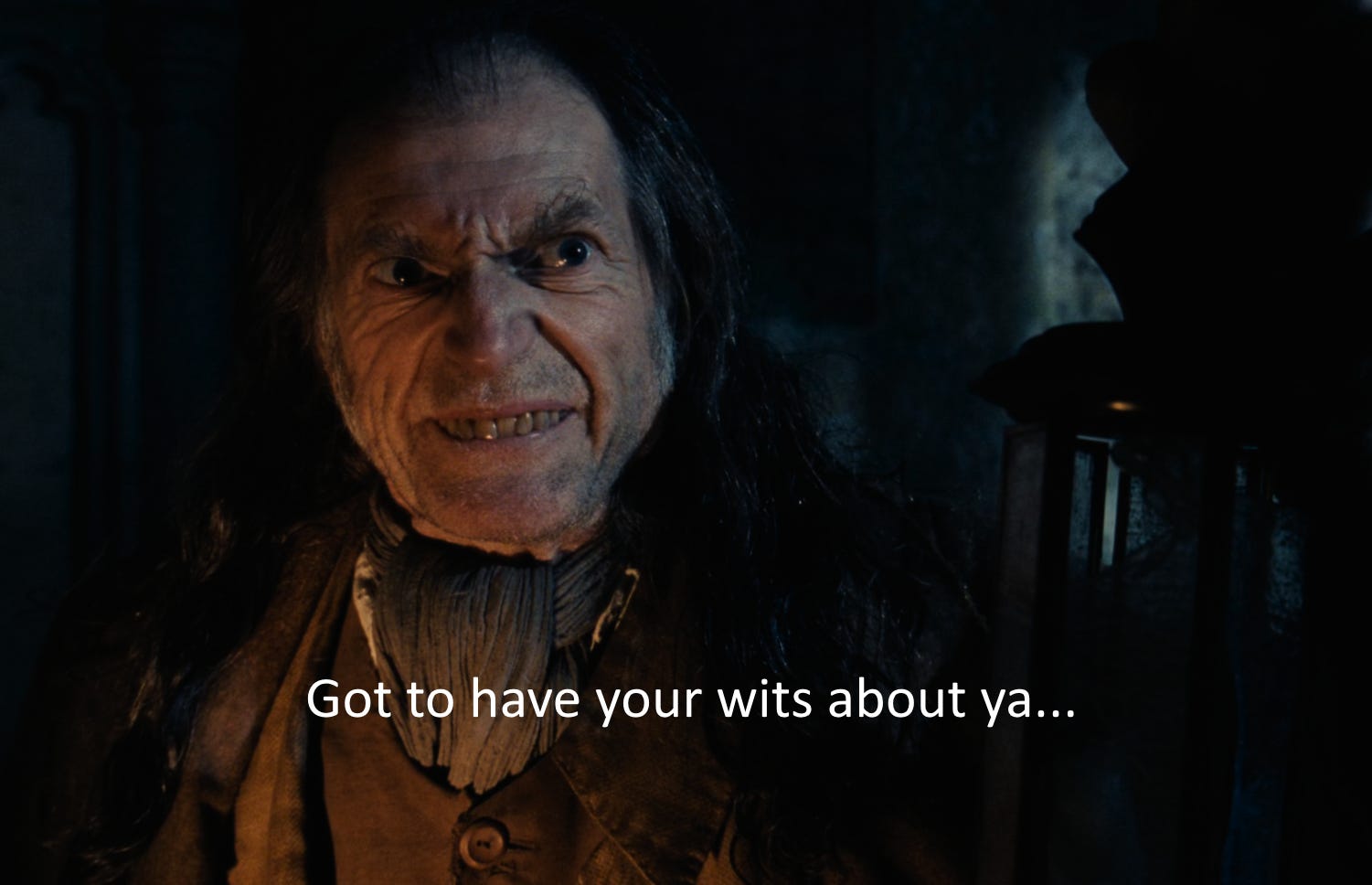
There is no good option here… Hollywood losing its most storied movie studio is bad for the movie business however you try to slice it. But when I consider the matter of Warner Bros and its two suitors Paramount and Netflix, there are only two things I care about…1) which potential buyer is more likely to treat the Warner Bros library with the respect it deserves… and 2) which suitor is committed to preserving the institution of theatrically released movies, which I still believe is good for the soul of America. What no one in Hollywood’s artist or executive community ought to be doing is rooting for one side or the other because Orange Man Bad.
Instead we ought to remember that oppositional defiance of the Orange Man was one of the main drivers of broad Hollywood support for closing movie theaters in order to protect audiences from a bad cold in 2020. Our industry was certain that we could casually press pause on a wildly successful 100-year-old business model in order to bring about a desirable political outcome, and then simply switch it back on whenever we wished without having to face any economic consequences.
How’d that one turn out?
Thanks for reading, and for your time and trust… if you’d like to support the work I do here, the easiest thing you can do would be to click the “like” button, share this essay with someone you know or on your favorite social media platform. The second easiest thing would be to subscribe for free or to upgrade to a paid subscription. I’m also on X @GMFWashington, at least until the cypto-pirates hack me.
No posts
Comments
Nothing yet. Say the first thing.
Sign in to join the conversation.