
In this issue:
How the immune system fights a virus: why the misery of being sick is the response working correctly
The off switch: the built-in brake that shuts inflammation down once the threat is cleared, and the protein that runs both the accelerator and the brake
What drives the damage: how cleanly you shut the response down, not only how much virus you had
What persists in Long COVID: the altered T-cell populations and immune mediators still circulating long after the virus is gone
Brain fog: the inflammasome, cytokine, and blood-brain barrier story underneath it
Post-exertional malaise: what’s happening in the muscle tissue itself, and why being out of shape doesn’t explain it
Next issue: the plants! I’m testing out splitting this into parts, because from the feedback I’ve been getting, smaller and more digestible posts land better, and honestly, I agree. I wish Substack had a cleaner way to organize a series, but I’ll figure something out. Next issue will get into which plants have research behind them for Long COVID, where that research is strong, and where it runs out, and I may even go a little crazy and put together some PDFs for you. It’s been a while :) I’m pretending I don’t have a lot on my plate, so please don’t told me to it lol!
* Read in a dramatic, deep, narrator-style voice *
The following is based on a true story lol
I got COVID in the summer of 2020, back when the strain going around was still fully capable of humbling a person, and it knocked me out for three horrific, agonizing weeks.
I should mention that I rarely get sick, and I mean rarely. I don’t think I’ve ever actually had the flu, I don’t get colds, and while some of this is probably immunological good fortune, a lot of it is that I am an introvert who does not particularly want to leave the house, which turns out to be a wildly underrated infection control strategy. So, three weeks of my lungs hurting, my eyeballs actively attempting to vacate their sockets, insomnia stacked on top of an exhaustion I did not know was available to me, and all of it completely alone because it was 2020 and nobody was coming inside anybody’s house, was deeply destabilizing.
My dad would drive an hour after work to leave groceries at my door, and I would stand behind the glass and wave at him like a sad Victorian orphan. My stepdad once actually came inside to bring me groceries and I cried, openly, with real tears, because a fellow human being was standing in my kitchen. That entire period was trash, and I would like to formally request that we never do it again.
Anyway.
After those three weeks I was in the clear, thankful it was behind me, hopeful that my body had learned something useful from the whole ordeal and stockpiled whatever immune cells it might need next time, and I took an enormous deep breath through my finally unobstructed nostrils and went on with my life.
For a lot of people, that is not where the story ends.
They test negative and go back to work, and then months later they are standing in their own kitchen holding a coffee mug with absolutely no memory of what they walked in there to do, or they take the dog around the block and spend the next two days horizontal, or they find themselves reaching for words that used to be automatic and coming up with nothing. Their heart races when they stand up too fast. They are tired in a way that sleep does not touch, and every lab their doctor runs comes back looking perfectly, infuriatingly normal.
The virus left, but it seems like something else stayed.
Let’s go back to the couch, back to that bus-hit feeling, and follow what’s happening inside you while you’re lying there.
Somewhere in your body a cell has just been infected, and I want you to picture how that goes down, because the virus is not kicking in the door like the Kool-Aid man. The virus is an assassin. It’s covert, it’s silent, it slips inside without your cell registering a thing, and once it’s in there it starts using your cell’s own equipment to build copies of itself. Hacker of the year. Your cell is sitting there doing its job, running its ordinary operations, with absolutely no idea that it’s equipment has been turned against it and is now churning out virus on someone else’s orders.
So, what are we supposed to do with that? How does the body track down an intruder it cannot see?
Thankfully we do have something in the arsenal, and they’re called pattern recognition receptors (Chakravarty et al., 2023). They sit inside the cell and scan for molecular patterns that have no business being there, like a blip showing up on the radar in a stretch of space that’s supposed to be empty.
What they’re looking for, essentially, is a shape. Viral genetic material carries structural features that your own genetic material doesn’t, and these receptors have evolved to recognize those features and nothing else. Your cell can’t identify the virus by name, it has no idea what it’s up against, and it technically doesn’t need to. It just needs to notice that there’s nucleic acid in here wearing the wrong outfit.
And when they do notice, they set off a signaling cascade that activates two transcription factors working together, IRF3 and NF-κB (Chakravarty et al., 2023). These two divide the labor between them, and they’re doing very different jobs, which is where things start getting good.
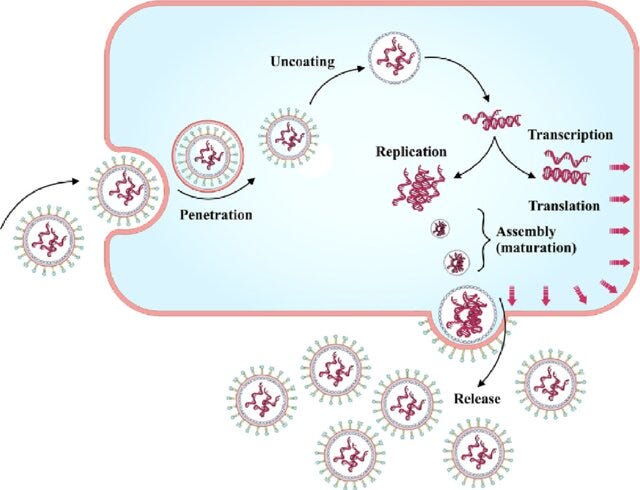
Viral replication cycle.
IRF3 is the one that goes directly after the virus, driving the production of interferons and the interferon-stimulated genes, which inhibit a huge range of viruses by making it physically harder for them to copy themselves (Chakravarty et al., 2023). NF-κB, meanwhile, is the one bringing the inflammation, switching on the genes that summon immune cells to the scene, open up the blood vessels, and turn the local tissue into somewhere no pathogen wants to be (Chakravarty et al., 2023).
And NF-κB, my friends, is the one you feel. The aching, the fever, the swelling, that specific sensation of your body having been repossessed overnight and handed over to someone with much worse taste than you. All of that misery is inflammation doing precisely what it evolved to do, and as much as it ruins your week, it’s a large part of why you eventually get better.
In COVID specifically, the acute response mobilizes substantial quantities of pro-inflammatory cytokines along with inflammatory cells like neutrophils and macrophages, and it generates virus-specific CD4+ T cells, CD8+ T cells, and B cells, all of them working to clear the pathogen and limit its replication (Bohmwald et al., 2024). So, while you’re lying there feeling like you’ve been personally cursed, nothing is broken. Your body is pouring an enormous amount of energy into a defense operation, and the misery is the price of running that operation at full throttle. (Would it kill it to be a little more discreet about the whole thing? Apparently yes.)
Inflammation feeling terrible is not the problem, then. It feels terrible on purpose, and it's supposed to. The part I want to dig into is what happens after, when the virus has been cleared and the whole thing is supposed to wind down and go home.
Inflammation cannot run forever, and your body knows it.
It earns its keep in the early days of an infection, when the threat is live and the tissue needs defending, and then those same inflammatory genes turn on you in the later stage, driving cytokine storm and cell death (Chakravarty et al., 2023). What protected you on day two starts costing you on day twelve. The body has to have some way of calling the whole thing off before it gets there, and it does, and the mechanism is a little bit delightful.
Remember IRF3? The one we just met, out there driving the antiviral response and calling in the interferons? Turns out it’s been moonlighting. It has a second job, one that Chakravarty et al. (2023) call RIKA, and the job is to grab NF-κB and refuse to let go. How romantic.
Let’s slow down for this one though: NF-κB is a transcription factor, which means it can only do anything at all if it can physically get into the nucleus, since the nucleus is where the genes live and switching genes on is the entire point of its existence. What IRF3 does is intercept it out in the cytosol, which is the fluid filling the inside of the cell, everything sloshing around outside the nucleus, and pin it there. NF-κB never makes it to the door. The inflammatory genes it was on its way to switch on stay switched off, and the cytokines it would have summoned, IL-1β and TNF-α among them, never show up in the numbers they otherwise would have (Chakravarty et al., 2023).
So, IRF3 is out here running the antiviral response with one hand and holding inflammation back with the other. The accelerator and the brake, same protein, same cell, same infection. (Multitasking icon, frankly.)
Chakravarty et al. (2023) also make a point about what drives the damage. Virus-induced inflammation causes disease on its own, separately from viral load. How sick you get, and how much damage you walk away carrying, tracks with how cleanly you shut the response down, not only with how much virus you had in you.
Two people can clear the same infection and come out of it with very different bodies, and a lot of that difference lives in the ending.
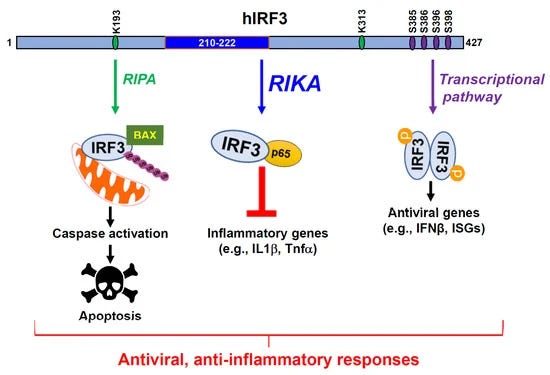
RIKA, a new anti-inflammatory function of IRF3. IRF3 is widely known for its transcriptional function involving the production of IFNβ and ISGs which antagonize various stages of viral replication
For most people, the ending goes fine. The virus gets cleared, the brake comes on, inflammation packs up its things and goes home, and you get your body back. Yay!
But for others, the response never fully stands down. :(
The rest of this one is for paid subscribers.
Below the line, we get into what that failed shutdown does once it settles into tissue: how inflammation crosses a barrier your brain spent your whole life protecting, what your microglia start doing when nobody tells them to stop, and why the muscle of someone with Long COVID looks different from the muscle of someone who simply stopped moving.
Paid subscribers keep this work possible, and it unlocks the full archive, the Body System Index, and the Materia Medica Index while you’re at it.
Comments
Nothing yet. Say the first thing.
Sign in to join the conversation.