
Welcome to the June 2026 AMA answers! Each month (hmm well, I try to, most months) I post a thread in the chat where paid subscribers can ask me anything. I let the thread sit for a little while, and at the end of the month I answer the questions there. This month’s were excellent, and because of how much depth they had, along with the feedback from subscribers, I’ve decided to post them individually, so the information is easier to digest, and you’re not hit with a wall of text.
The AMA is not, and never will be, a replacement for a consultation. I cannot and will not answer personal or individualized health questions. Where a question is specific to one person, I’ll answer the general version of it instead.
Two very different things are happening in this question, and they call for two different answers. Long stretches of sitting fixed in place do one kind of damage; intense or prolonged movement does another, and they land on the same joints and muscles from opposite directions. Let me take each one in turn!
BUT! Before we get into what goes wrong, it helps to picture what a joint actually is, so you really can get a feel of what’s going on. Most of the joints we’re talking about here, knees, hips, shoulders, elbows, are synovial joints, the freely moving kind. Two bones meet inside a capsule, and the ends of those bones are capped with articular cartilage, a smooth, slick surface that lets them glide against each other without grinding. That cartilage has no blood supply of its own, so it depends entirely on the synovial fluid inside the joint for its nutrition and lubrication. Around all of it sit the muscles, and they do quite a bit more than just move the joint. The muscles and tendons crossing a joint act like a set of dynamic ligaments, actively bracing and stabilizing it, which is why muscle strength and joint health are so tightly linked (Juneja et al., 2026).
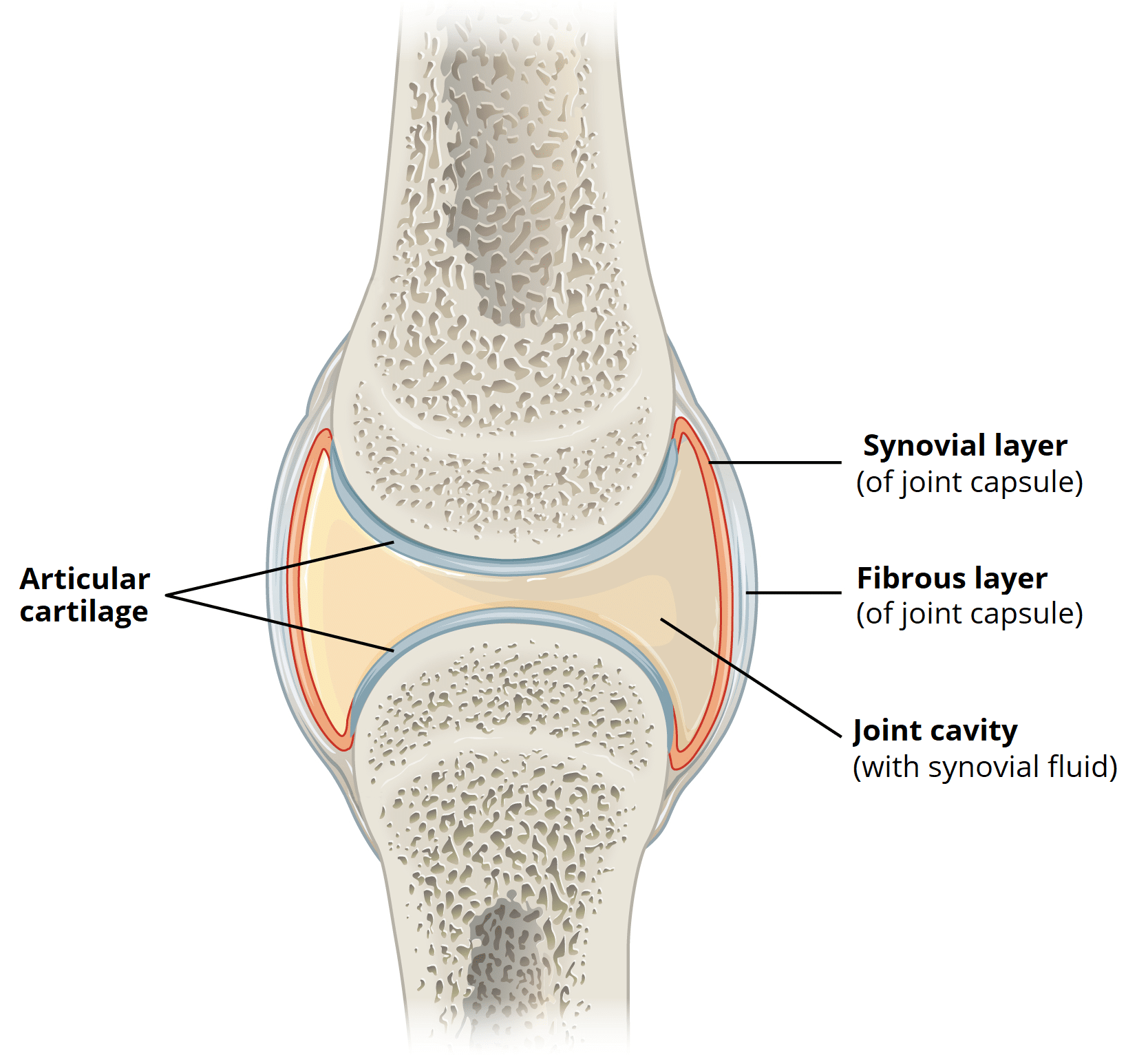
Source Unknown
The two ends of this question ask for almost opposite things, so let's look at what each one does to the body before reaching for any herbs. Prolonged stillness and hard movement wear on the same joints and muscles, just from opposite directions.
Okay so, let me start with the prolonged position/sitting. When you hold one position for a long stretch, circulation to the area drops and the surrounding muscles settle into a low, sustained tension. The joints feel it too, because the cartilage inside a joint has no blood supply of its own and relies on motion to circulate synovial fluid, the slippery stuff that lubricates the joint and moves nutrients into the cartilage. Without that movement, the fluid can go stagnant, its nutrients depleted and acidic waste building up, so the cartilage ends up underfed and the joint stiffens while the muscles around it go tight (O’Hara et al., 1990).
On the other side, intense or prolonged movement loads those same tissues hard, especially through the eccentric, lengthening-under-tension contractions that create the microscopic muscle damage behind that next-day soreness, along with the inflammatory cleanup response that follows it (Proske & Morgan, 2001). So, the tissue is moving between stagnation and overload, and a good herbal approach respects both ends of it.
For the stagnation end, I'm generally thinking about circulation. Sluggish, pooled blood is a big part of what we're fixing, and this is where the warming circulatory stimulants shine, the herbs whose whole purpose is to push fresh blood back into a stalled-out area and wake it up! Ginger is what I'd reach for here, though cayenne is the one that really gets things moving, especially rubbed on topically, where capsaicin, the compound behind that familiar heat, has a long history with achy joints and stiff muscles. The logic is thankfully pretty direct: sitting starved the tissue of good circulation, so we bring in the herbs that answer that directly.
For the overload end, I want to calm the post-exertion inflammation and ease the soreness, which is where the anti-inflammatory herbs come in. Turmeric and ginger lead here, with ginger getting to pull double duty across both ends, part of why I love it for a pattern like this. A systematic review and meta-analysis by Doma et al. (2022) pooled studies of root plants, ginger and turmeric among them, against exercise-induced muscle damage, and found that supplementation lowered the markers of muscle damage and eased soreness across the 24 to 48 hours after a hard effort, right in the window where that sit-then-move pattern leaves you aching. The inflammation itself came down at the 24-hour mark rather than holding all the way to 48, so the clearest, steadiest wins were in the muscle damage and the soreness. When the researchers compared the plants, ginger reduced muscle damage and inflammation at least as much as turmeric, part of why I turn to it so readily.
One honest note on what the research didn’t show, though: the supplements eased the damage and the soreness, but they didn’t measurably speed up the recovery of muscle strength. Just so you have the whole picture.
Muscular tightness is where I’m going to perhaps surprise you all and nooot recommend an herb. I know, I know. But hear me out: tense, cramping muscle around a joint responds so beautifully to hands-on work that it’s the first place my mind goes. Massage especially, where pressing and working into the tissue drives circulation straight to the spot that’s stuck, coaxes the muscle out of its little guarding pattern, and does it faster than waiting around for something to absorb and kick in. Acupuncture fits here too (my new fav), another way of getting into the tissue and prompting it to release. The plants still come along for the ride, because a warming liniment or an infused oil makes that bodywork even better, so they’re working alongside the hands rather than off to the side. My acupuncturist put a lovely CBD balm on my neck yesterday after the actual acupuncture session…perfection.
For the long game, meaning the supportive side rather than the soothing one, I typically turn my attention to the connective tissue itself. This is where I bring in the herbs traditionally used to nourish the structures that hold a joint together, and horsetail (rich in silica) and gotu kola both carry a long reputation for exactly that kind of support.
One small note on horsetail: it's best used in measured courses rather than taken heavily day in and day out, and it's worth sourcing from a supplier you trust, so you know you're getting the right species, properly prepared. Prolonged use can interfere with Vitamin B1, and we don’t need more things going on.
Again: these aren't your quick-relief herbs. They're the slow, patient, building kind, the ones you bring in when you want to shore up the tissue over time rather than calm a single flare. :)
When you step back, the whole picture settles into something pretty intuitive. You warm and move the circulation where sitting let it stall, you calm the inflammation where movement asked too much, you ease the muscle that’s gripping around the joint, and you nourish the connective tissue holding it all together. Each herb is answering a specific part of the story rather than treating “sore joints” as one vague thing.
And one last honest note from me, because I’d be doing you a disservice otherwise. Herbs are only ever one piece of this puzzle. A recurring pattern like this one is also asking, gently, for movement breaks, for water, for a real warm-up before you push into anything intense. So let the plants walk alongside the work rather than stand in for it! That’s why we love an integrative approach!
Alright friends, that’s it for Question 2! Later this week, we’re shifting gears into something a bit heavier: a full deep-dive on saponins, one of my favorite corners of plant chemistry to get lost in. If you’ve ever come across a root that foams like soap when you wash it or wondered why saponin-rich plants turn up again and again in traditional medicine, you’ll love this one!
And a friendly reminder before I go: this kind of work, the reading, the sourcing, the physiology-first writing, is a labor of love, and it takes time to do properly. If you’ve been getting something out of these pieces and you’re able to, consider upgrading your subscription. It’s what keeps this whole thing going, and it means more to me than I can easily say.
I’ll see you there. :)
— Agy | The Buffalo Herbalist
Comments
Nothing yet. Say the first thing.
Sign in to join the conversation.