
There is a story the crypto industry loves to tell. A visionary individual converts their savings into Bitcoin early, holds through the chaos, and emerges with generational wealth. The 100x return. The asymmetric bet that changed everything
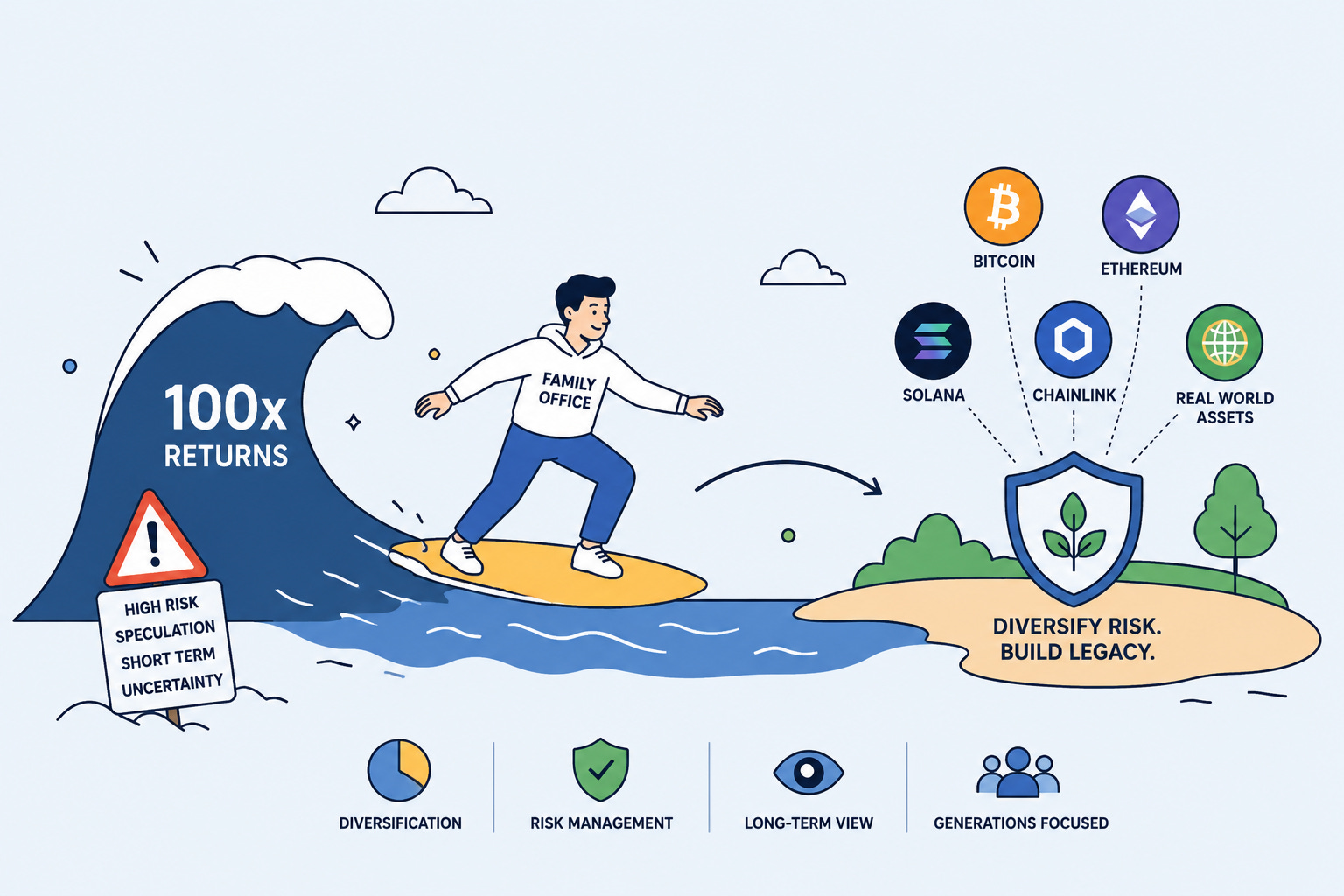
That story has almost nothing to do with how family offices actually approach digital assets.
Family offices manage an estimated $6 trillion in assets globally. They move with process, with risk frameworks, and with multi-generational time horizons in mind. When they enter crypto, they are not chasing moonshots. They are solving a portfolio problem.
The question family offices ask is not “can this make us rich?” It is “does this behave differently enough from everything else in the portfolio to be worth holding?”
Over long holding periods, Bitcoin has shown low correlation with equities, near zero correlation with bonds, and inconsistent correlation with gold. The drivers of crypto price action- protocol developments, regulatory signals, exchange events- are categorically different from what moves traditional markets. That idiosyncratic behavior is exactly what a diversification-minded allocator is looking for.
Most family offices start with 1 to 3 percent of total assets under management. The reasoning is precise. If you hold 2 percent in an asset that drops 80 percent, you lose 1.6 percent of total portfolio value. Painful but survivable. If you hold 10 percent and it drops 80 percent, you lose 8 percent from a single position. That begins to affect your ability to meet obligations and pursue other opportunities.
The small allocation is not timidity. It is arithmetic.
The overwhelming preference is Bitcoin, with Ethereum as a distant second, and rarely anything beyond that. Bitcoin offers the clearest regulatory profile, the deepest liquidity, and the longest track record. Everything below Ethereum in market capitalization requires specialized knowledge most family offices neither have nor want to develop.
Two developments unlocked institutional participation more than anything else.
First, regulated custody. Firms like Coinbase Custody, BitGo, and Anchorage Digital now provide insured, institutional-grade custody that converts a genuine operational risk into a manageable one. Several major prime brokers offer crypto custody within their existing client relationships.
Second, the approval of Bitcoin ETFs in early 2024. This gave family offices access to Bitcoin through a familiar structure, within existing brokerage accounts, without any of the operational complexity of managing digital asset positions directly.
Family offices are not buying tokens because of social media momentum. They are not rotating into new narrative sectors with each market cycle. They are not using leverage. They are not trading actively. The buy-and-hold discipline that applies to their equity positions extends to digital assets.
The investment teams that have successfully brought crypto into family office portfolios do something consistent. They lead with diversification logic rather than return potential. They frame the allocation as small and contained. They explicitly acknowledge they are not trying to capture the full upside of the asset class. They are accessing its portfolio construction properties.
That framing, disciplined and bounded, is what separates institutional crypto adoption from retail speculation, even when both end up owning the same asset.
The 100x return narrative will keep attracting attention. But the more important story is quieter. A new asset class has matured enough to fit inside a serious portfolio, not as a lottery ticket, but as a tool. The smartest capital in the room figured that out before most people were paying attention.
If you want to understand how serious money thinks about investing, not just crypto, subscribe. One post at a time, no noise, no hype.
No posts
Comments
Nothing yet. Say the first thing.
Sign in to join the conversation.