
This week brought one of the more significant crypto-terrorism-finance stories in a while, so let’s break down exactly what happened, who’s involved, and why it matters piece by piece.
On July 1, the U.S. Treasury’s Office of Foreign Assets Control (OFAC), the government body responsible for enforcing sanctions and terrorism-finance rules, updated its watchlist. This list is basically a registry of individuals, groups, and now crypto wallet addresses that are officially flagged as connected to terrorism or other illegal activity.
This particular update added 134 new crypto wallet addresses tied to ISIS-K.
For anyone unfamiliar, ISIS-K (short for “Islamic State – Khorasan Province”) is a regional branch of ISIS operating primarily out of Afghanistan and Pakistan. It’s considered one of the more active and dangerous ISIS affiliates still operating today, and it has claimed responsibility for several major attacks in recent years.
Of the 134 wallets added to the list, 131 were TRON-based wallets holding USDT (Tether’s stablecoin), and the remaining 3 were Monero wallets a privacy-focused cryptocurrency that’s much harder to trace than most.
Tether is the company behind USDT, the largest stablecoin in the crypto market. Unlike Bitcoin or Ethereum, Tether has the technical ability to freeze funds tied to specific wallet addresses, since USDT is a centrally issued token.
According to blockchain analytics firm Chainalysis, Tether froze the balances in all 131 of the newly sanctioned TRON wallets essentially right after the OFAC update. This means anyone controlling those wallets can no longer move, spend, or cash out the USDT sitting inside them
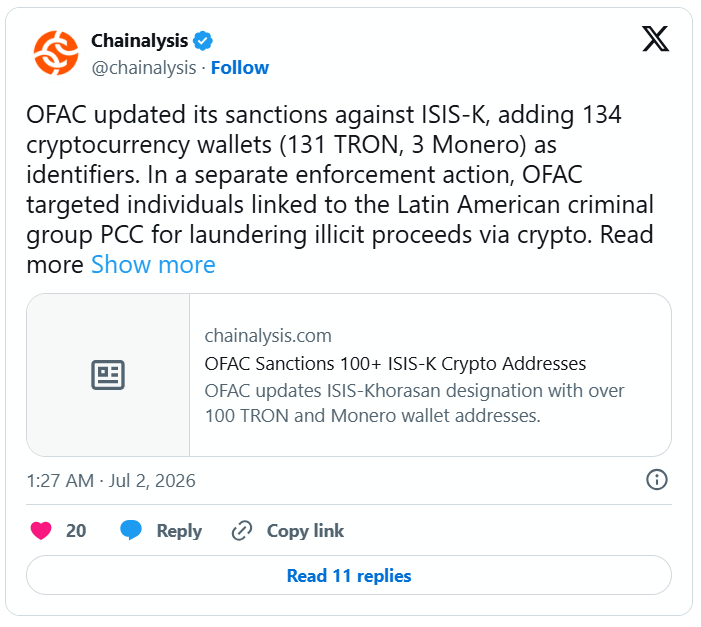
Chainalysis is a company that specializes in tracking cryptocurrency transactions and helping governments, exchanges, and law enforcement understand where crypto money is flowing. Their report is what confirmed the scale and details of this freeze.
The numbers here aren’t massive compared to some crypto scandals, but they represent a real, sustained flow of funds:
→ These 131 wallets received over $1.4 million combined since 2023
→ They sent out more than $880,000 in that same time period
That gap between what came in and what went out suggests the wallets were being actively used to move money not just sitting idle. Chainalysis also noted that some of these wallets had connections to mainstream, legitimate crypto exchanges, and a handful sent funds specifically to currency exchangers based in Syria, a region with historically weaker financial oversight.
This part is important context. According to Chainalysis, the funds were largely gathered through a media and propaganda arm of ISIS-K called al-Azaim Media Foundation. This group has reportedly used websites and encrypted messaging apps to solicit crypto donations directly from supporters.
Rather than relying on a few large transactions, Chainalysis says this fits a pattern they’ve observed repeatedly with terrorism financing: lots of small, individual donations that accumulate over time into a meaningful total. This makes the money harder to detect than one big suspicious transfer would be, since each transaction looks small and unremarkable on its own.
This wasn’t a one-off action. Tether operates something called the T3 Financial Crime Unit, a joint task force formed together with TRON (the blockchain network) and TRM Labs (another blockchain analytics and compliance company). The T3 unit was launched in 2024 specifically to identify and freeze illicit crypto activity across the TRON network, which is one of the most widely used networks for USDT transactions globally.
Since its launch, the T3 unit has now frozen a cumulative total of over $450 million in illicit funds.
And zooming out even further: in 2025 alone, Tether blacklisted more than 4,000 wallet addresses. It froze over $1.26 billion in funds, with the vast majority of that activity occurring specifically on the TRON network. This shows that TRON-based USDT has become a major focus area for both bad actors trying to move money quietly, and for compliance teams trying to stop them.
Separately, but relevant to this whole conversation, there’s an ongoing court case worth watching. Victims of terrorism linked to Iran’s IRGC (Islamic Revolutionary Guard Corps) are currently pushing a New York court to force Tether to hand over $344 million in frozen USDT connected to Iran.
This case matters beyond just this one instance, because it could set a legal precedent for what actually happens to frozen stablecoin funds long-term, whether they stay frozen indefinitely, get returned to victims through legal channels, or face some other outcome. Right now, there’s no fully established playbook for this, so the court’s decision could shape how future cases are handled.
Every time OFAC updates its sanctions list with new wallet addresses, it creates a ripple effect across the entire crypto industry. Exchanges, wallet providers, and other platforms are expected to update their internal systems to flag any exposure to these newly sanctioned addresses, meaning if you’ve ever interacted with one of these wallets, even indirectly, it could trigger a compliance review.
Chainalysis noted that it has already added the new ISIS-K-linked wallets into its tracking tools, which gives banks, exchanges, and crypto platforms a fast way to check whether they have any exposure.
The bigger picture here is that stablecoin issuers like Tether are increasingly stepping into a role that looks a lot like a financial gatekeeper, something usually associated with traditional banks. As stablecoins get more widely used, and as bad actors continue trying to exploit them, incidents like this one are likely to become more common, not less.
Thanks for reading. If you like the post, please share with crypto lovers and make this viral.
Disclaimer: None of this is financial advice. This content is strictly educational and is not investment advice or a solicitation to buy or sell any assets. Please do your own research before making any financial decisions.
No posts
Comments
Nothing yet. Say the first thing.
Sign in to join the conversation.