
On June 24, an email landed in the inboxes of millions of European crypto users. Starting July 1, Binance, the largest cryptocurrency exchange on the planet, will suspend most of its services for anyone living in the European Union. The headlines that followed were dramatic: Binance is leaving Europe. Binance is shutting down. The reality is narrower and far more interesting. Binance was not leaving on its own terms. It was locked out, and the reason has less to do with paperwork than with the company's own history.
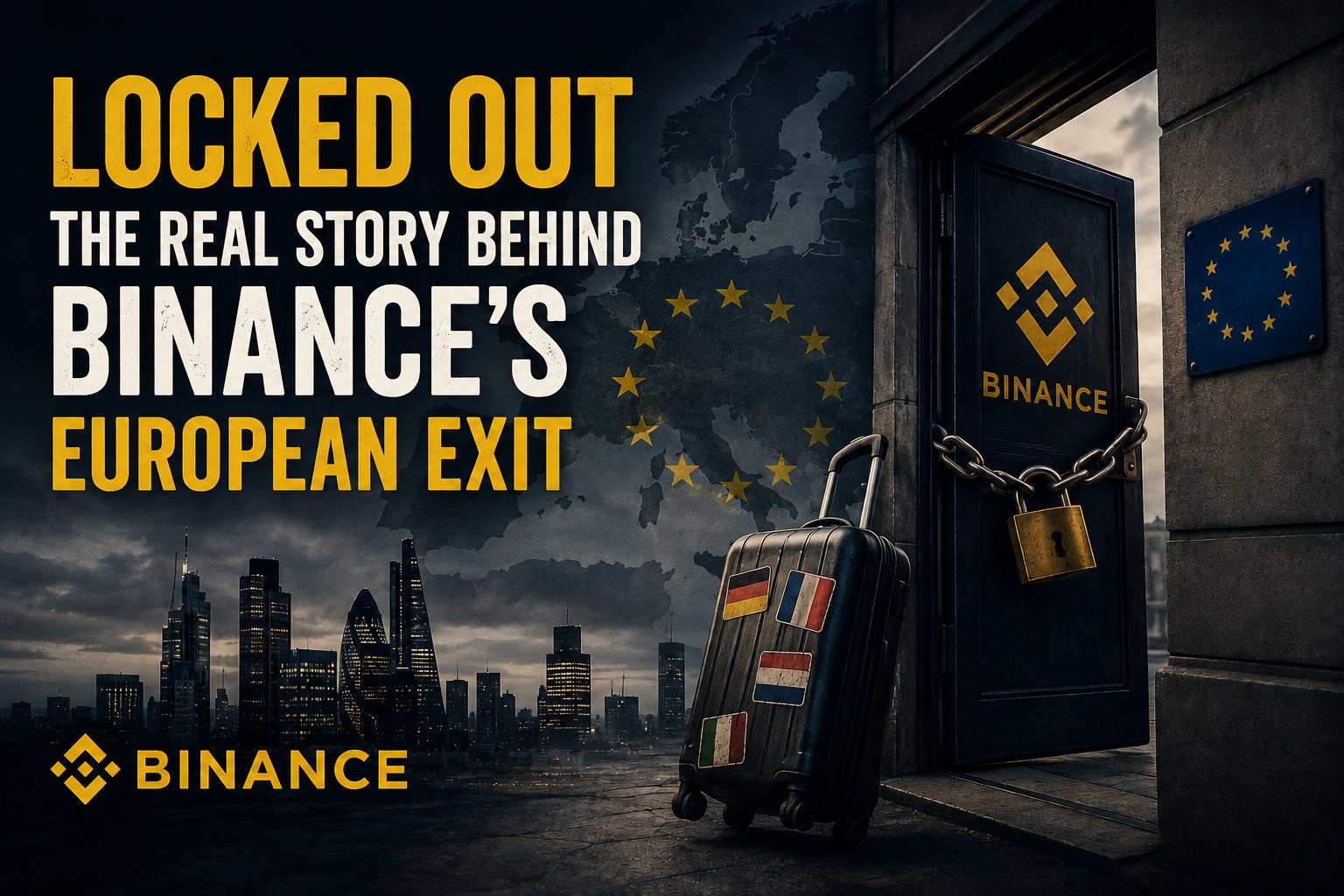
Strip away the alarm, and the sequence is simple. Binance needed a license to legally operate in the EU under MiCA, the bloc’s new crypto framework, and the deadline to hold one was the end of June. Binance pursued that license through Greece, filing its application back in January. The process stalled, and by mid-June, reports surfaced that the Greek regulator was preparing to reject it.
Rather than wait to be formally refused, Binance withdrew its Greek application on June 24. Withdrawing meant it would not hold a license by June 30, which meant it had to stop offering regulated services to EU residents starting July 1. Hence the email.
The crucial nuance the headlines missed: this is a suspension, not a shutdown. Binance says it isn’t permanently leaving, plans to apply through another member state, and expects to be back within months.
For EU users, here’s the practical breakdown. What stops: new spot trading orders, new deposits, new sign-ups, and yield products like staking and Earn. What continues: withdrawals stay active, and your funds remain safe and accessible. Nothing is being seized or frozen.
Binance says it isn’t telling users to rush their withdrawals, and is keeping a limited conversion feature available so people can wind down their positions in an orderly way. The company has also warned it will never call users by phone or ask for passwords, a reminder that regulatory confusion is exactly when scammers tend to strike.
“The reality is both narrower and more revealing than any headline framing: Binance is not collapsing, it is not seizing anyone’s money, and it is not, by its own account, permanently leaving Europe.”
MiCA, the Markets in Crypto Assets regulation, replaced Europe’s old patchwork of national crypto rules with one unified system. To serve EU customers, a firm needs a license from one member state, which then passes across the entire bloc. The rule came into force at the end of 2024, with a grandfather period for firms transitioning from old national registrations. That grace period ended June 30, 2026.
From July 1, those old national registrations carry no legal weight. The rule makes no distinction by size, only by license status. Binance, for all its scale, landed on the wrong side of that line.
Binance’s choice of Greece wasn’t random. Because a single license passport across the whole EU, companies can shop for the friendliest entry point, and Greece has granted few or no MiCA licenses yet, theoretically offering a faster, less crowded path than Germany or the Netherlands.
It didn’t work out that way. Although filed in Greece, the application was reportedly reviewed jointly with regulators in Ireland and Latvia, plus oversight from the EU’s central markets authority. That joint review raised concerns serious enough that Binance, facing a likely rejection, pulled its own application before it could be formally refused.
Here’s the part that matters most: the rejection reportedly turned on Binance’s past, not its paperwork. MiCA applies a “fit and proper” test to a firm’s owners and managers. That test put a spotlight squarely on co-founder and roughly 90% owner Changpeng Zhao.
The record regulators were weighing is substantial. In 2023, Binance pleaded guilty in the US to anti-money-laundering and sanctions violations, paying penalties exceeding $4 billion. Zhao stepped down as CEO, pleaded guilty to a criminal charge, served a prison sentence, and was later pardoned by the US president, though he still holds his roughly 90% stake. Add to that an open French investigation into possible money laundering links and a UK ban dating to 2021, and regulators had concrete grounds for concern.
This wasn’t a sloppy application. It was the company’s own history catching up with it.
While Binance was shut out, several of its biggest rivals secured the license it couldn’t get, including Coinbase, Kraken, OKX, and Crypto.com. All four can now operate across the entire bloc with a real competitive edge heading into the second half of the year.
The scale of the filtering is the real headline. Of more than 3,000 crypto firms operating across Europe, only around 210 secured full authorization, a clearance rate in the single digits. The largest exchange in the world is, for now, outside of that list.
Binance’s stated plan is to apply for a license through France instead. That’s a notable choice given French authorities have an open investigation into the company, but Binance evidently believes it can satisfy French regulators despite that scrutiny.
The complication is timing. Even a prompt French application likely resolves after July 1, leaving a real gap, potentially months long, during which Binance is locked out, and its European users have already moved on. There’s also a deeper tension here: if Greece, working with Ireland and Latvia, found Binance unsuitable, and France later approves it, that exposes inconsistency in how a supposedly unified rulebook gets applied. That’s the exact regulatory arbitrage MiCA was designed to prevent.
Step back, and this is a genuine turning point. For years, global crypto exchanges moved through the gaps between Europe’s national rules, with the largest players seeming too big to be meaningfully constrained. MiCA was built to close that gray zone. The fact that its first major casualty is the biggest exchange on earth is the clearest possible proof that the framework has teeth.
That message extends well beyond Binance. If the largest player in the industry can be shut out, everyone else is on notice that compliance, not market share, is now the actual price of admission to Europe.
Is Binance permanently leaving Europe?
No. It’s a suspension with a stated path back, not a permanent exit. Binance intends to apply for a license through another member state and expects to return within months.
Are my funds safe if I’m an EU user?
Yes. Withdrawals stay active, and funds remain accessible. What stops are new deposits, new trades, new sign-ups, and yield products like staking?
Why did the license actually fail?
Reportedly, because of Binance’s legal history and questions over whether co-founder Changpeng Zhao could pass MiCA’s “fit and proper” ownership test, not because of technical or paperwork issues.
Which exchanges got licensed instead?
Coinbase, Kraken, OKX, and Crypto.com all secured full MiCA authorization and can keep serving EU customers without interruption.
Thanks for reading keep supporting.
No posts
Comments
Nothing yet. Say the first thing.
Sign in to join the conversation.