
We’re back with a new article in our AI founders’ series. After France and Germany, we’re heading to the Netherlands.
But first, the market. The Netherlands ranks fifth in Europe in The Observer’s global AI ranking, behind the UK, France, Germany, and Switzerland. It doesn’t host companies like Mistral, ElevenLabs, or Black Forest Labs. It doesn’t produce the headline rounds you see in those countries. It doesn’t have Switzerland’s edge in physical AI. But it’s building an ecosystem of emerging vertical AI companies: Framer, Stacks (we sat down with their founder to discuss hiring and talent), Duna, Cradle, and more.
To understand where these founders come from, we reviewed 287 Dutch AI companies:
All are founded and/or headquartered in the Netherlands.
Stages from Seed to Late Series and Acquisition.
All are building core-AI products.
80% have fewer than 50 FTEs, and most are at Seed or Series A, so pre-revenue or early revenue.
In total, we identified 654 founders. We found that half of them had founded a company before, even though not necessarily in AI. Then, we traced their professional and academic backgrounds to identify the best talent pipelines for Dutch AI founders.
We also got insights from Cees Snoek, Scientific Director of Amsterdam AI and Professor of AI at the University of Amsterdam, and Geert Wissink, Business Director of Amsterdam AI and Program Manager AI at the Amsterdam University of Applied Sciences. Thank you for contributing!
This article was compiled in collaboration with the Consumer Practice at The Big Search. If you’re interested in leadership and talent trends, looking to hire a Consumer leader, or simply want to discuss the findings, feel free to reach out to sahar@thebigsearch.com or Sahar Powell (PhD).
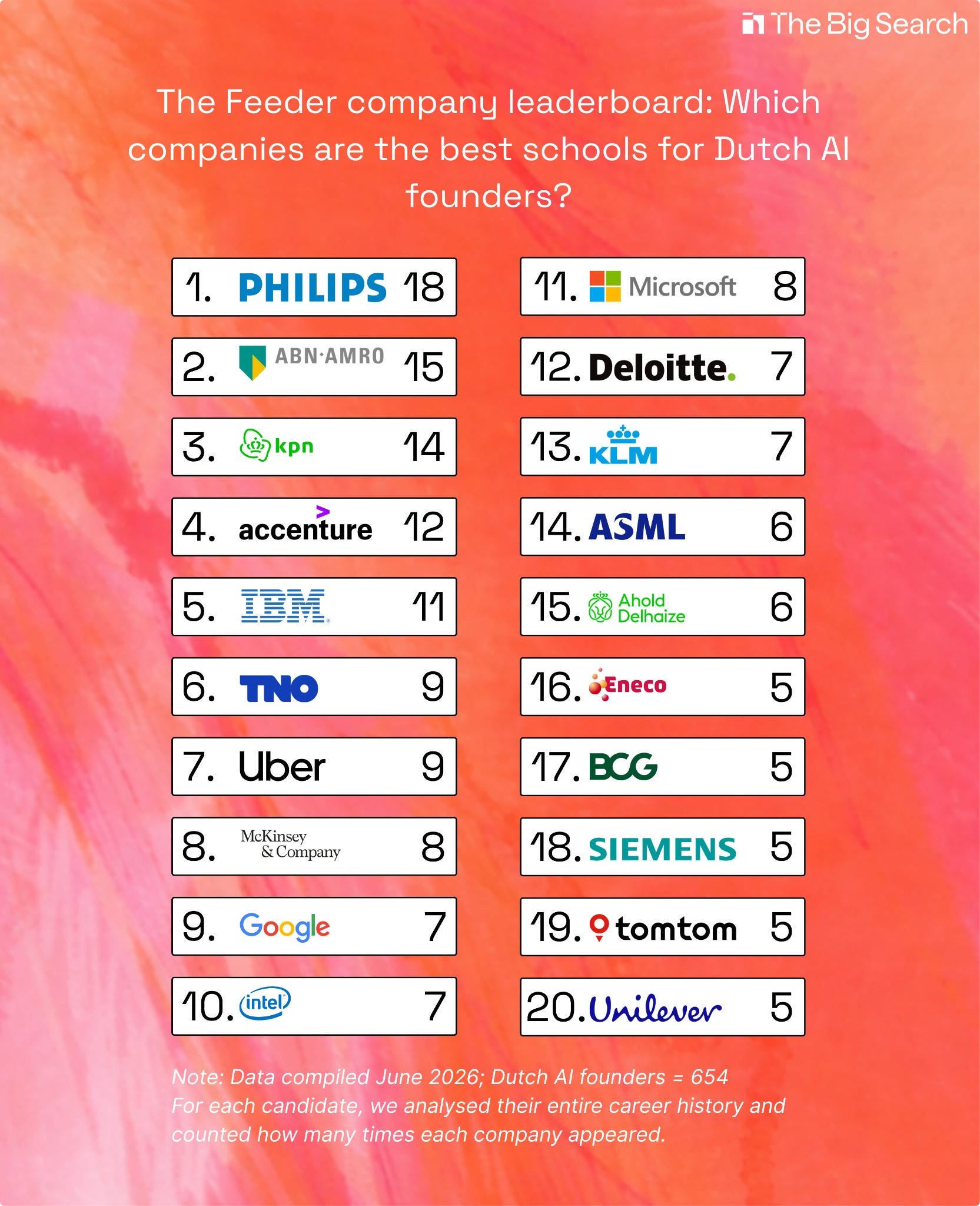
Unlike Germany (Siemens) or France (Inria), there’s no single dominant feeder in the Netherlands. Philips leads with 18 founders, and only 5 companies produced more than 10. Overall, we found that the ranking skews toward legacy Dutch organisations, and the talent pool is spread across a much wider base than we’ve seen in previous markets.
ABN AMRO’s position reflects how central finance is to the Dutch economy. The Netherlands is one of Europe’s major fintech hubs, with companies like Adyen, Backbase, and Mollie, just to name a few. ABN AMRO has produced two distinct profiles: data scientists and early-career engineers on one side, core banking and finance professionals on the other. Both flow into AI companies building financial services (e.g. Fourthline).
Across the full pool, technical founders are the most represented at 42%, followed by commercial (33%) and scientist/researcher profiles (15%).
On that researcher profile, in our previous piece on French AI founders, several research centres appeared in the top 30. In the Netherlands, TNO is the only one. Talent there works on applied problems with direct industrial applications across defence, healthcare, and data. That produces people who know how to go from research to product.
TomTom is the only global tech company born in the Netherlands present in the ranking, which makes the absence of other tech companies even more striking. Especially since Dealroom’s European AI report places Booking.com among the top AI employers in Amsterdam.
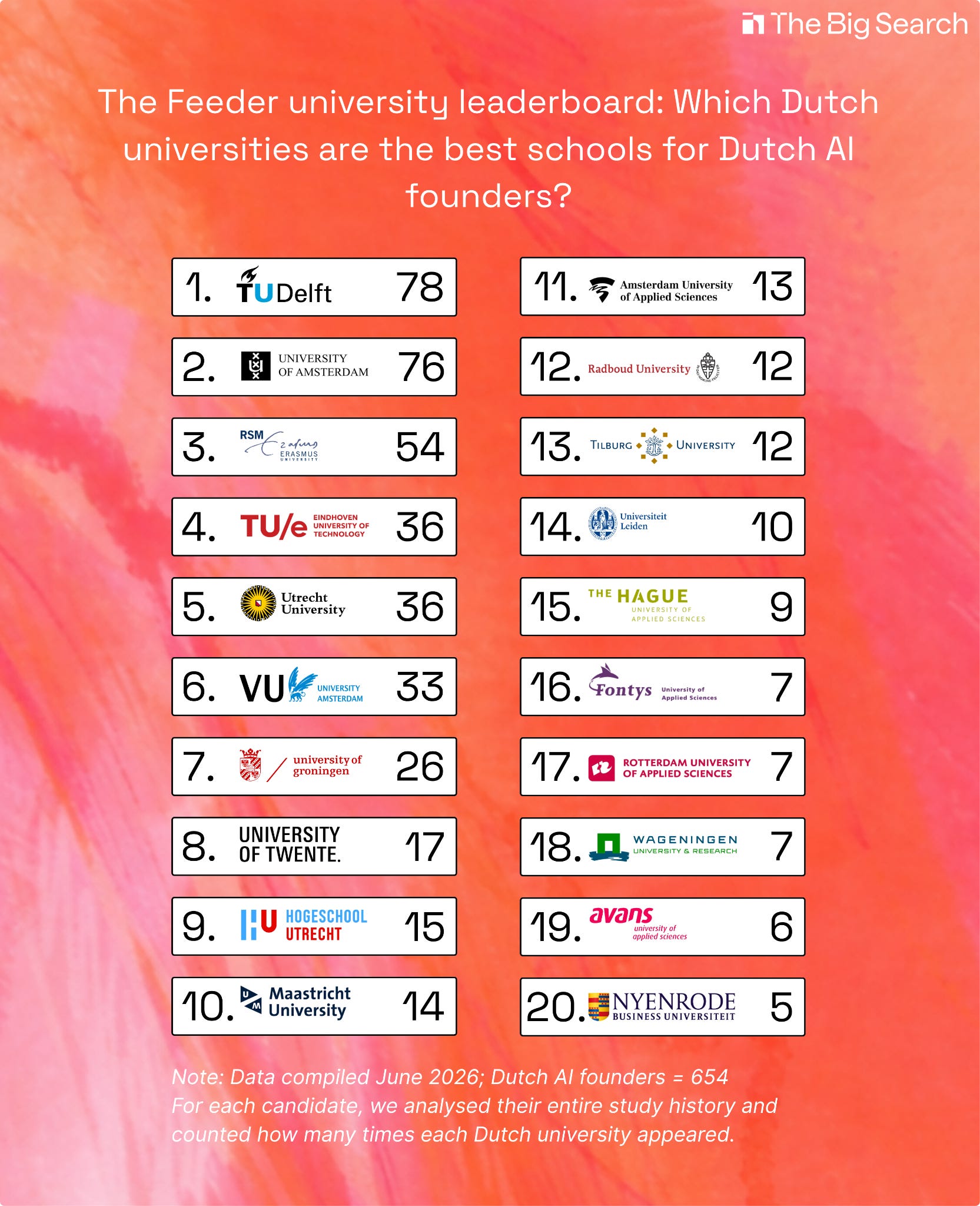
For universities, we only looked at Dutch institutions. We excluded international schools such as Harvard University, INSEAD, MIT, Stanford, and London Business School, even though they appeared frequently.
TU Delft dominates, with 78 alumni. That means 12% of all Dutch AI founders studied there. The university consistently ranks among Europe’s top technical universities; it produces technical talent and DeepTech spinouts at a rate no other Dutch institution matches, with research groups in AI, robotics, and computer science that feed directly into the startup ecosystem.
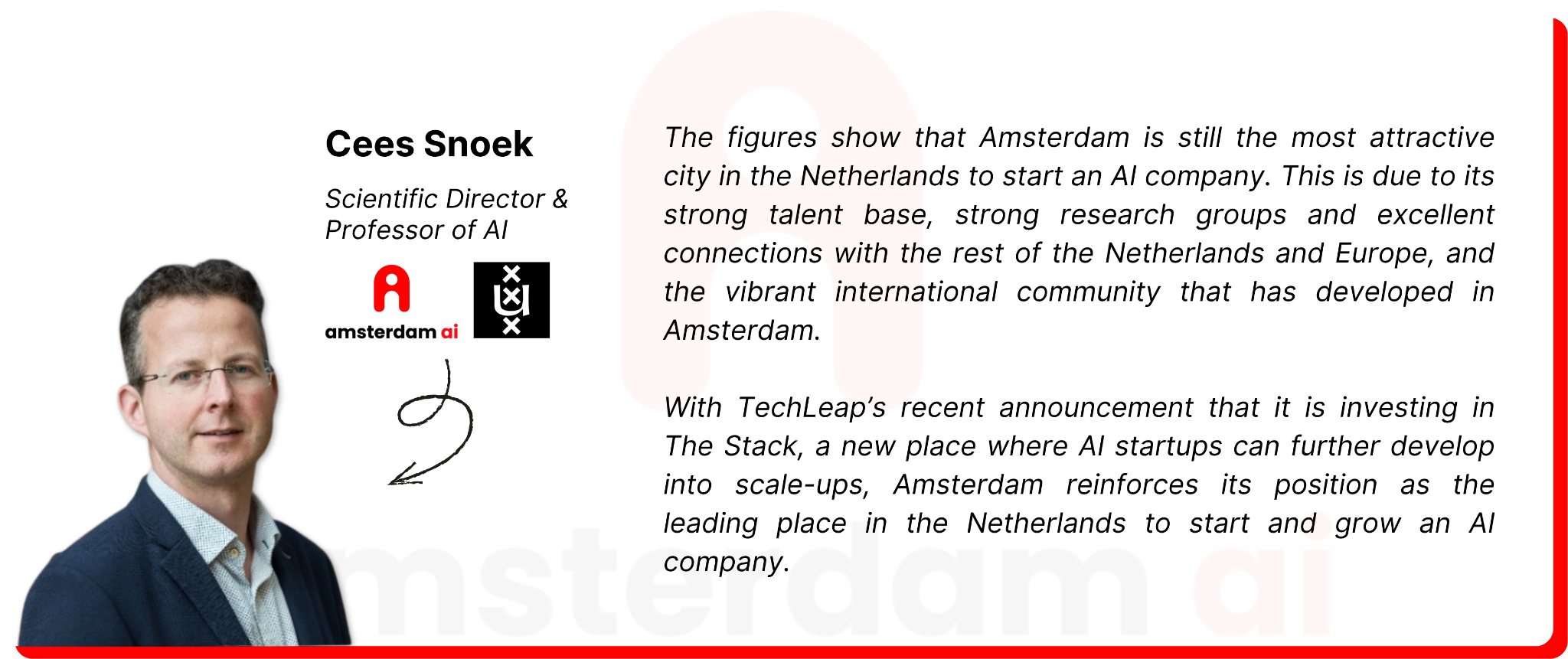
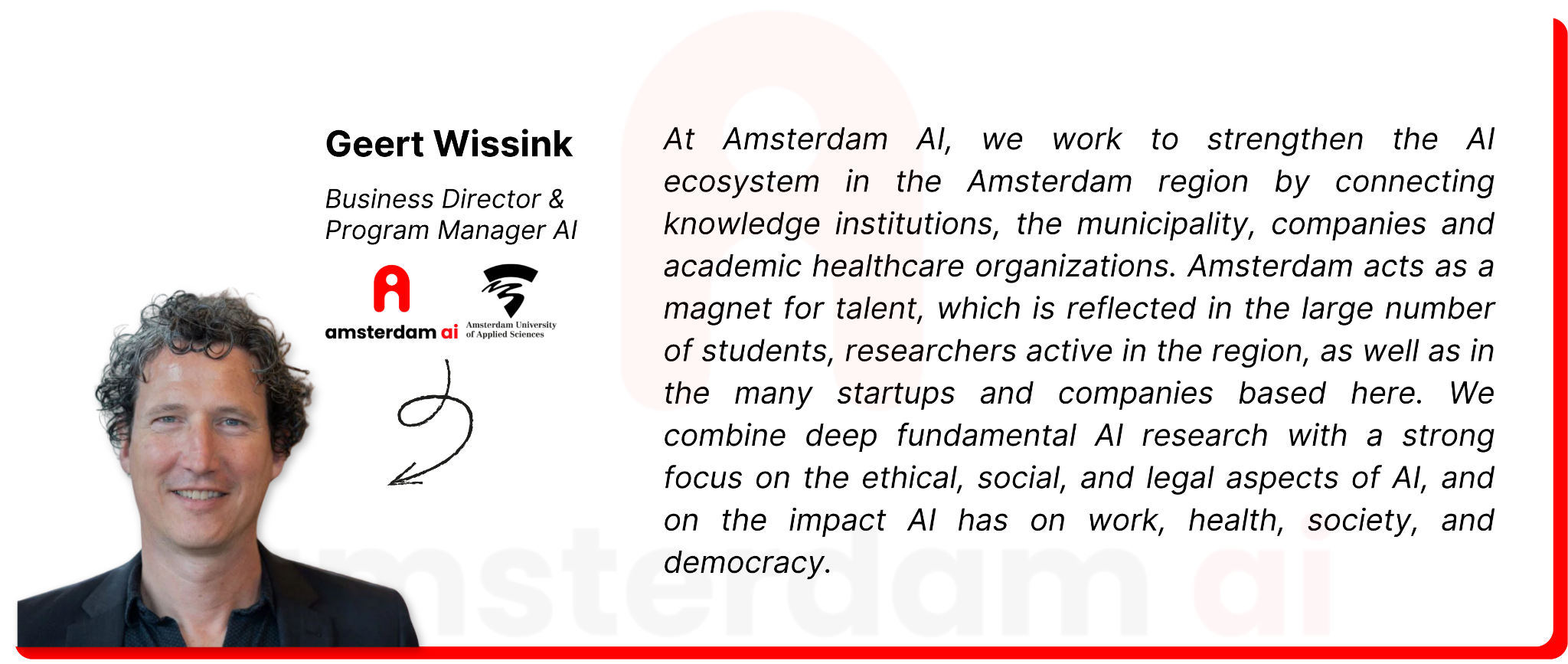
Amsterdam is the most represented city, with three institutions in the ranking: UvA, VU Amsterdam, and Amsterdam University of Applied Sciences. That concentration reflects where most talent is located. Amsterdam ranks in the top 20 globally for AI according to Dealroom’s Global Tech Ecosystem Index, scoring across VC investment, enterprise value, ecosystem momentum, unicorns, AND university linkages.
Two-thirds studied Computer Science, Mathematics/Statistics, Engineering, or Physics, and 8.5% studied AI, Data Science, or ML directly. Some also came through business administration, management, or finance. Notably, RSM Erasmus, which ranks third. That background shapes what founders build: vertical, enterprise-facing products closer to the market than the model.
For investors, this mapping is a direct tool for anticipating where the next Dutch AI founders come from. The pipelines are more diversified than concentrated: legacy Dutch companies, banks, and US tech offices, rather than one or two dominant feeders.
The Dutch AI ecosystem doesn’t generate big headline funding rounds or companies. But it’s building interesting vertical AI products. What’s missing is a frontrunner. A Lovable. A Mistral. A Black Forest Lab. One breakout company that brings the rest of the ecosystem with it.
Previous editions:
Want to see how we can support your search? Visit our website to explore our services and learn what we can do for you.
Comments
Nothing yet. Say the first thing.
Sign in to join the conversation.