
Earlier this summer, Drumbeat Capital released its Transatlantic Deep Tech Report 2026, with a section on transatlantic recruiting. As executive search consultants, it drew us in and sparked a content idea. We mapped 90 European DeepTech companies and looked at how they build their US leadership:
Across robotics, quantum, defence, AI, space, photonics, semiconductors, novel energy, and advanced manufacturing,
With a minimum of 100 FTEs,
At Series A+ stage, including acquisitions and IPOs.
We excluded life sciences, healthtech, biotech, cleantech, and medtech. We also left out companies founded in Europe that later moved their HQ to the US (e.g. Loft Orbital, Hugging Face, 1X, ElevenLabs, Darktrace, Quantinuum or Starship Technologies) since adding them would have skewed the data.
From there, we looked at US-based current and past leadership who held at least one role at these companies while in the US. In total, we identified 550 individuals across 74 companies (363 current ones). That means 16 European DeepTech companies in our pool have yet to make their first hire in the US.
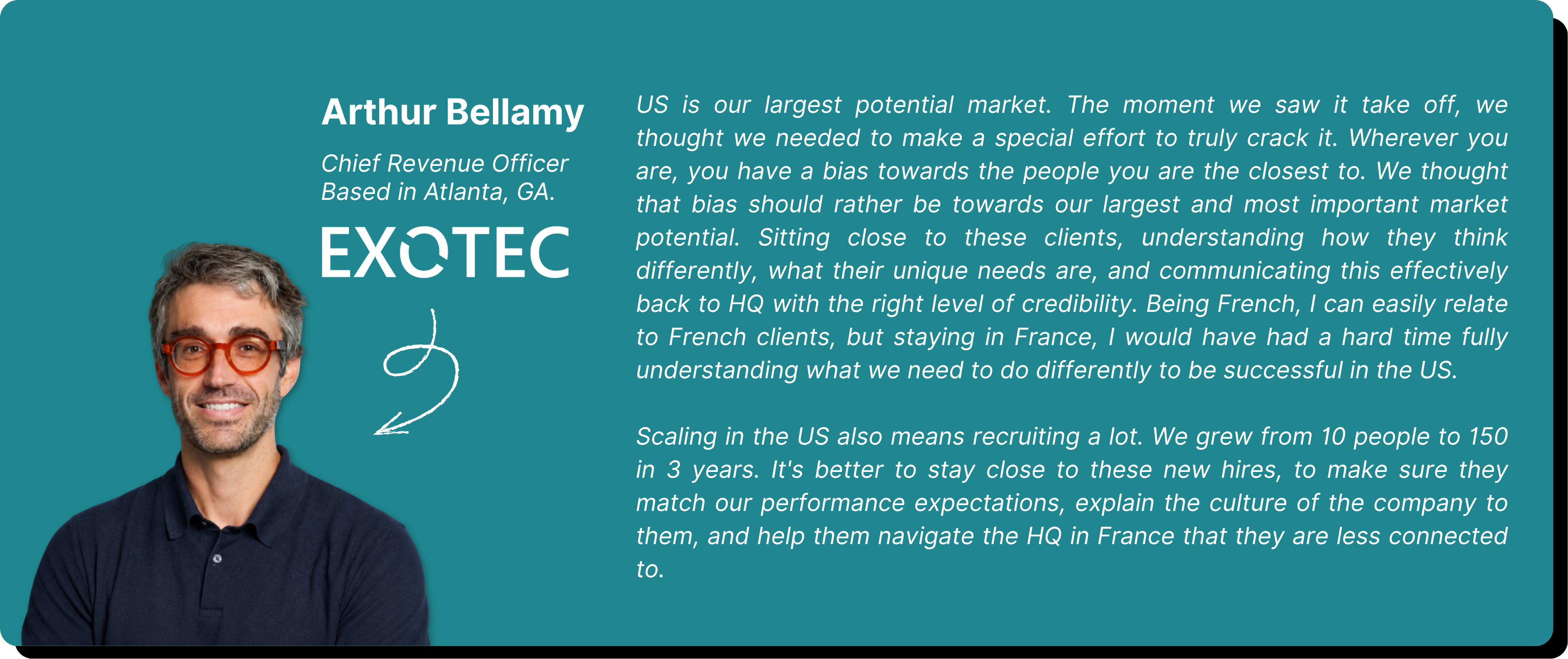
We also searched for their first US hire and what kind of profile companies hunt for when they expand there. And thank you to Arthur Bellamy, CRO of Exotec; Brian Barnett, CTO of Nyobolt; and Adam Osborn, Head of Commercial NA, for contributing!
This article was compiled in collaboration with The Big Search's DeepTech Practice. If you’re interested in leadership and talent trends, looking to hire a DeepTech leader, or simply want to discuss the findings, feel free to reach out: elena@thebigsearch.com or Elena Obukhova.
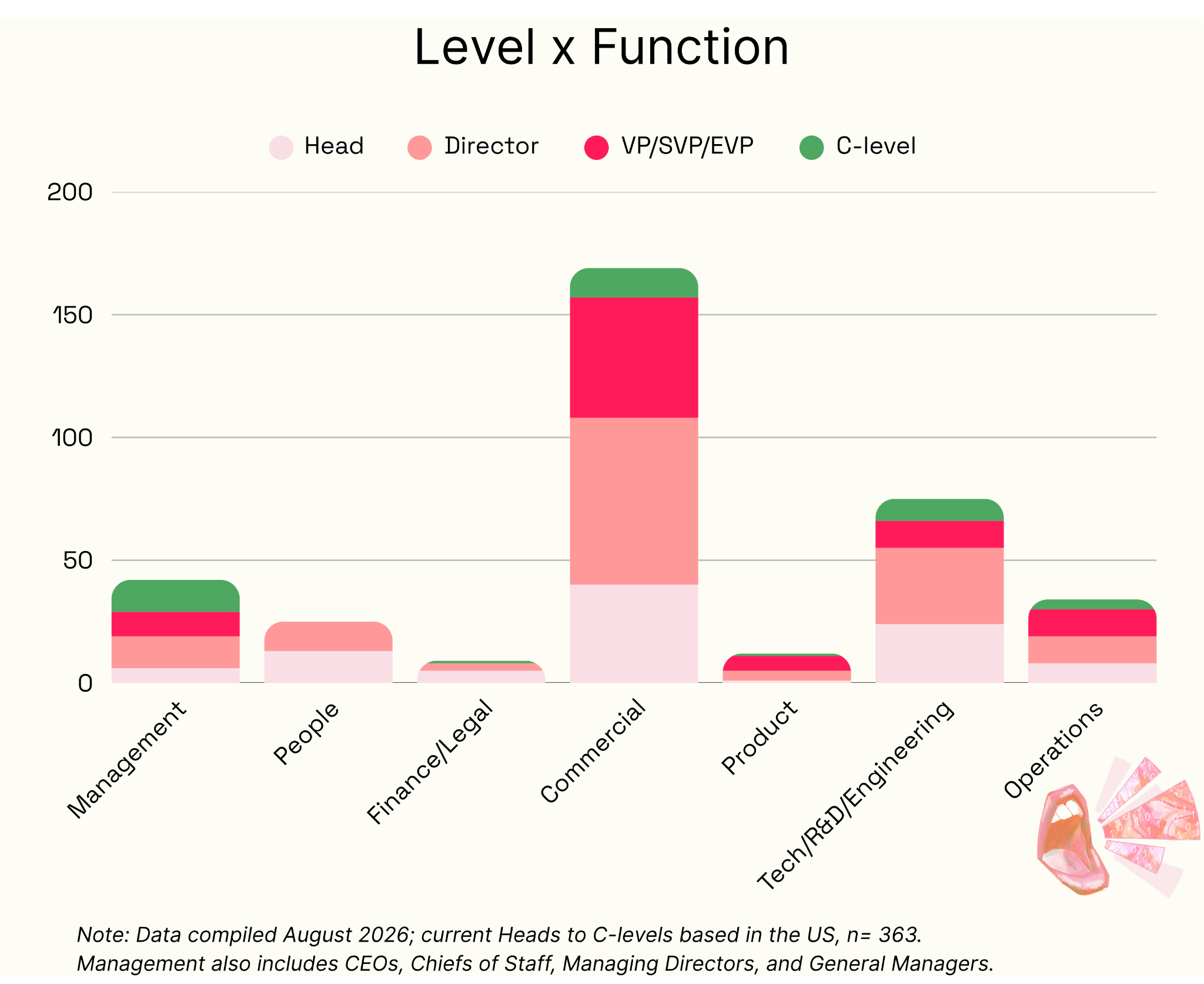
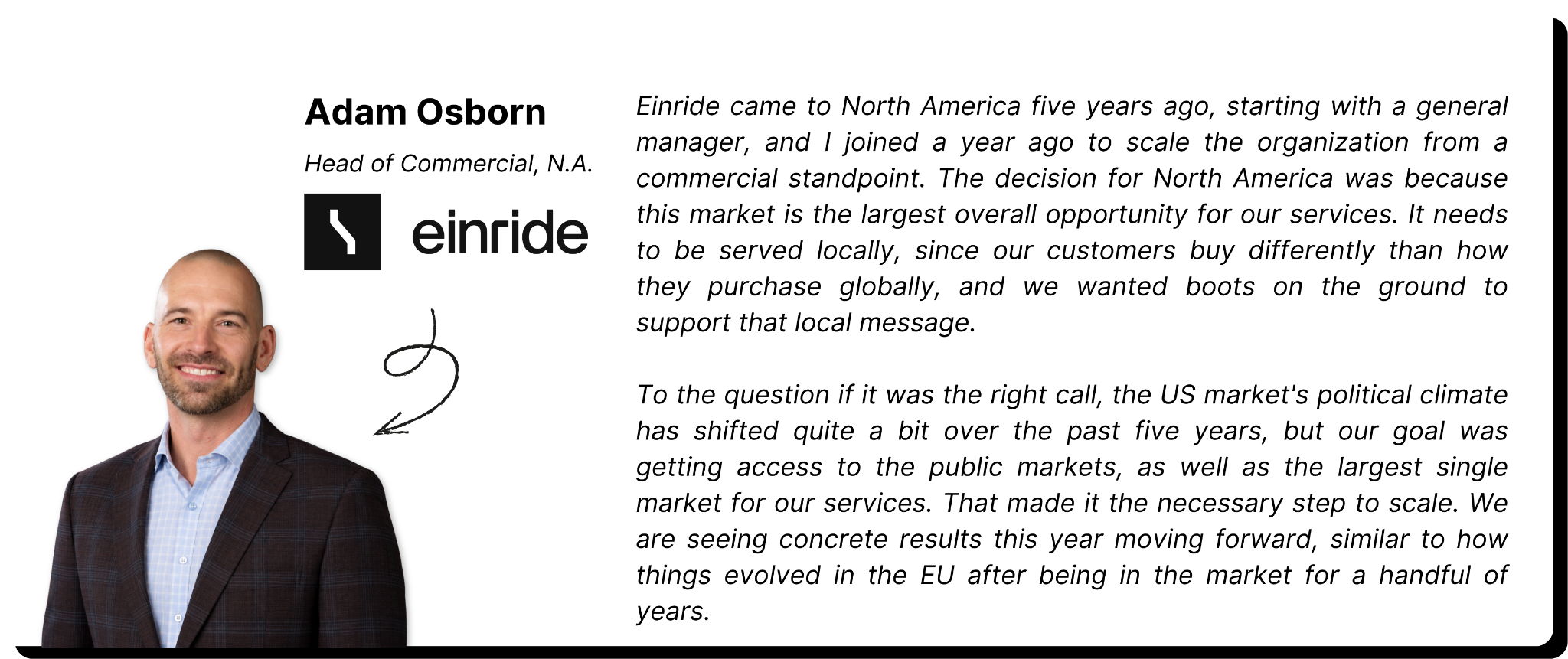
Once the technology is mature enough to resonate with business buyers, the next step is often to expand into the US. (1) It’s one of the largest markets, (2) it opens access to more capital, and (3) it allows companies to tap American talent without relocating the core team.
We found that 46% of current US-based leaders work in commercial roles (Sales, Marketing, BD, Growth, CS, etc.). Many run US sales, such as Adam Osborn, Head of Commercial NA at Einride; Andy Williams, EVP of Sales North America at Exotec; or Ryan B. Scholl, EVP - Defense US at Kraken Technology Group.
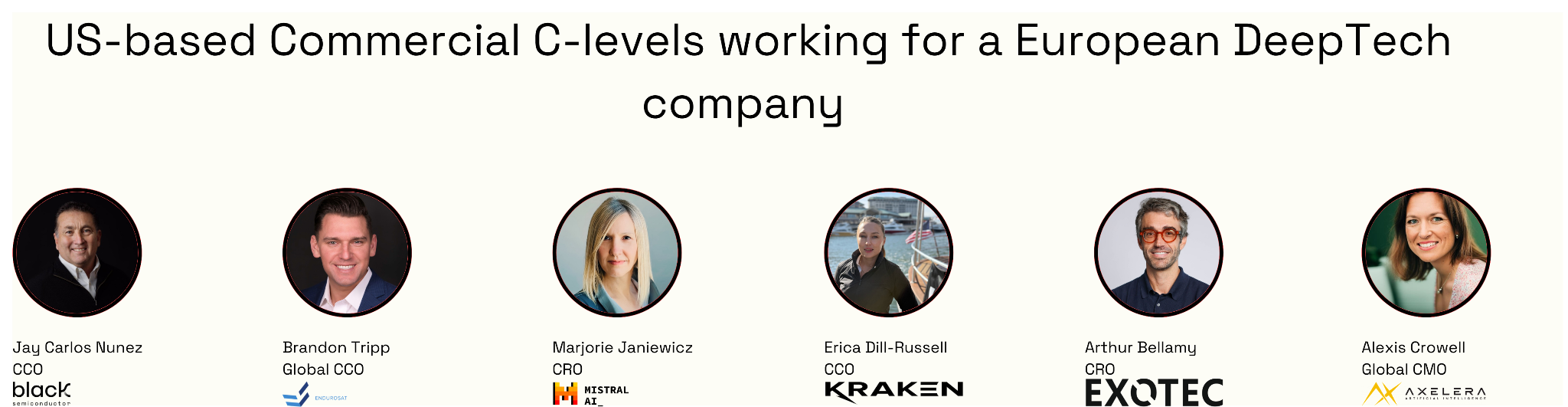
Ten companies, 13% of our company pool, also have at least one commercial C-level executive based in the US. Mistral AI, which moved most of its GTM function there, has two: CRO Marjorie Janiewicz and CMO Brian Hall (ex-VP Product Growth/Marketing at Google). In some DeepTech sub-sectors, the US talent pool is ahead of Europe in commercial maturity, with more structured CRO and VP Sales organisations already in place. That’s why some companies drop relocation as a requirement altogether to access the US commercial bench.
Tech leadership roles come second at 22% of US-based leaders. Several companies have opened R&D and tech hubs to support US expansion and tech development.
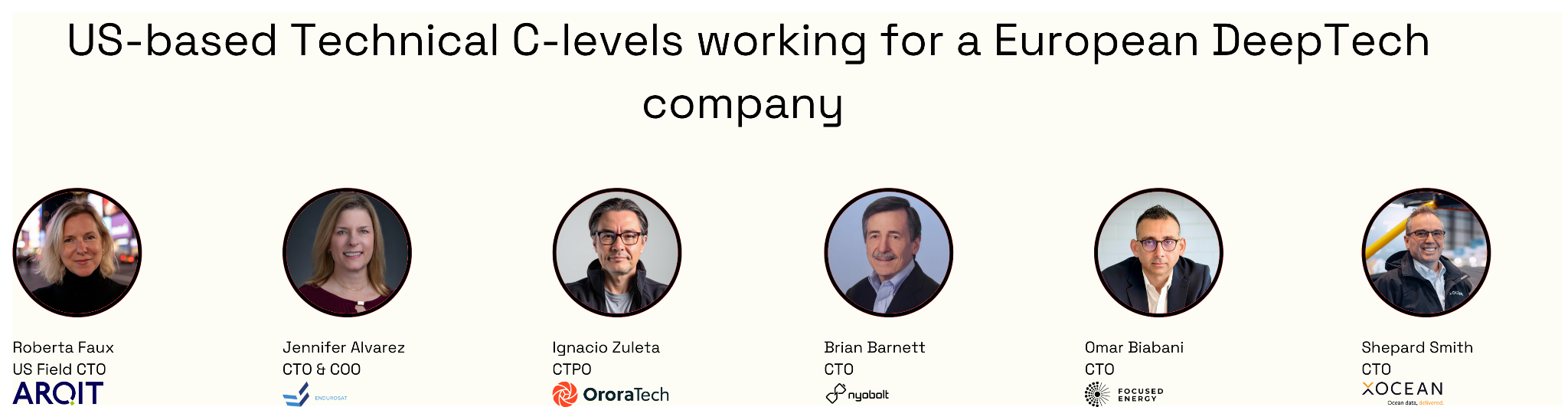
Wayve is one example. Its Sunnyvale, California office focuses on Advanced Driver Assistance Systems (ADAS) to improve driving safety and convenience. At VP level alone, its US team includes Vijay Badrinarayanan, VP of AI (ex-Magic Leap), Rob Flenniken, VP Vehicle Software (ex-Cruise and Amazon), and Brandon Basso, VP Engineering (ex-Cruise and Uber).
Stability AI follows a similar model. Its San Francisco hub anchors AI research and product engineering in Silicon Valley, with hires like Ryan Ellis, SVP and Head of Product (ex-Unity and Salesforce), and Javad Azimi, Head of Applied AI (ex-Meta and Microsoft).
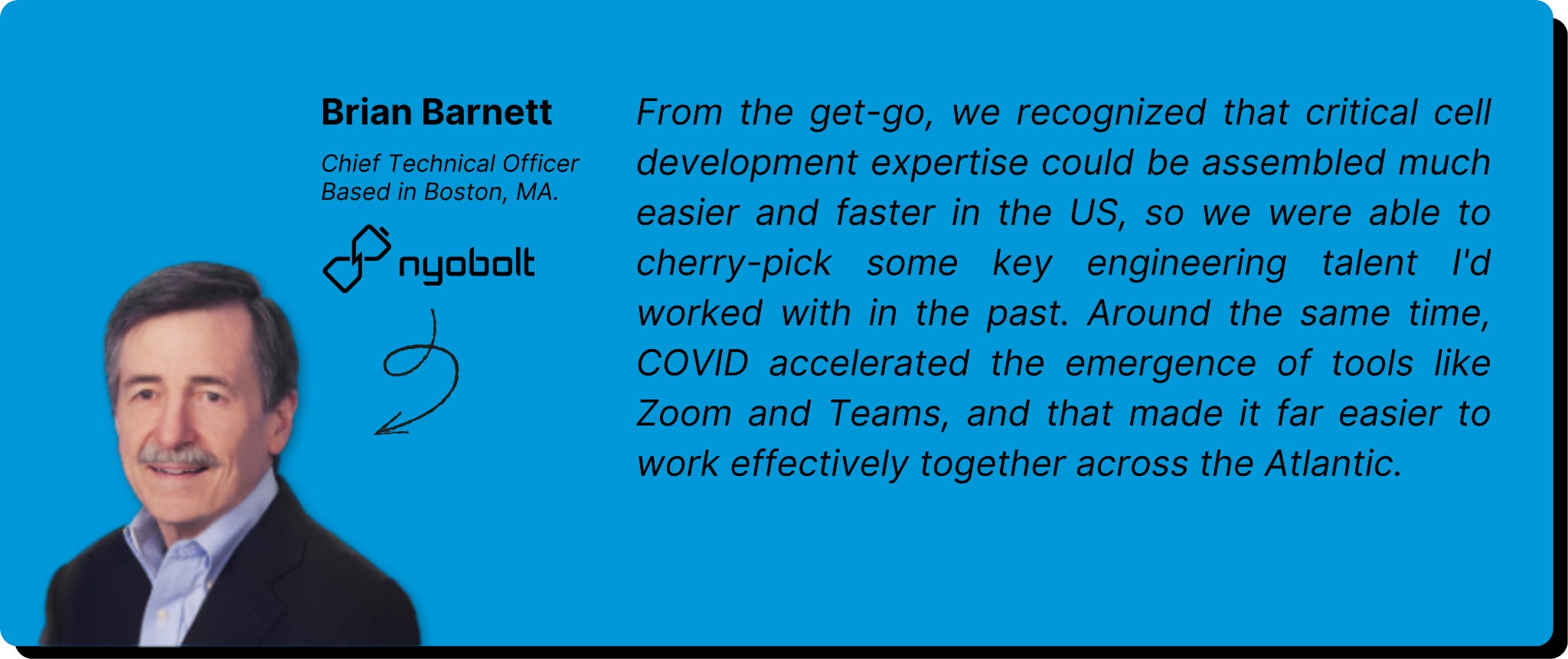
Another one is Nyobolt, which runs a Cell Development & Prototyping Hub in Bedford, Massachusetts. Its CTO, Brian Barnett, a battery industry veteran with a track record of prior battery technology development successes, established the company’s US arm, working closely with the founders. His background in both technology and market development helped target early US-based customers, where most of Nyobolt’s markets are located.
Next, we wanted to know who the first US hire is at each of these 74 companies and what kind of profile they bring in: commercial? Technical? Someone with scaling experience?
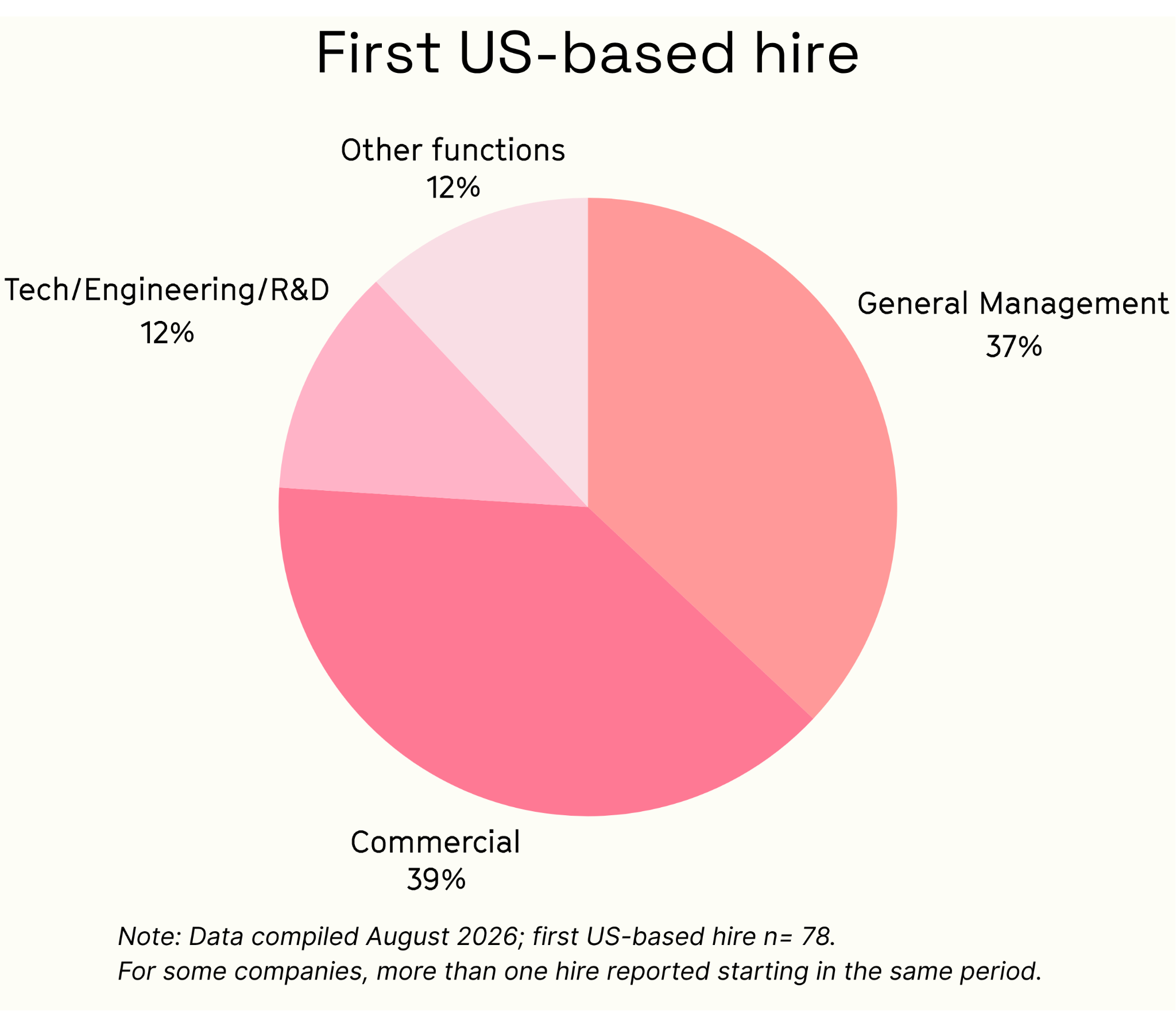
Commercial leaders represent 40% of first hires but 46% of the overall pool, so it is slightly under-indexed. General Management is 36% of first hires but 10% of the pool, a 3.6x over-index (e.g. CEO US, General Manager, Managing Director). Tech, by contrast, is under-represented among first hires at just 12% vs. 22% of the pool. So, one pattern that emerges is a country-lead figure who owns market entry end-to-end, with pure sales hires arriving later.
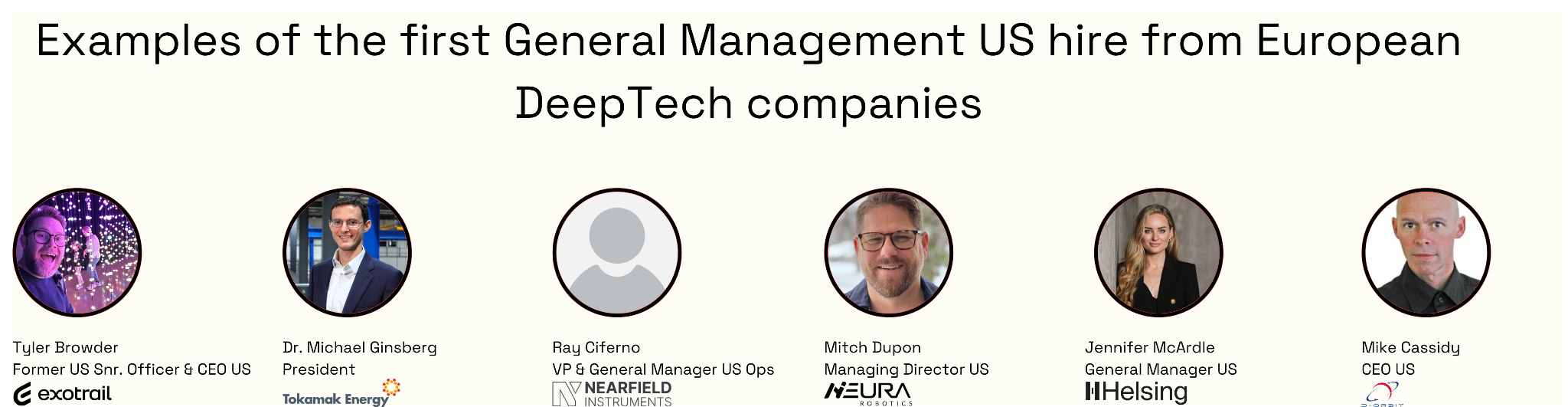
US first hires also bring scaling experience: 62% held a role at a company in a scale-up phase, either at a high-growth funding stage (Series C or later, or growth-equity backed) or during a period of steep headcount growth. European DeepTech companies are hunting for people who’ve been through a growth/production stage internally and built commercial or operational infrastructure from scratch, under resource constraints.
Devin Billings, Chief Engineer for Industrial at Humanoid, joined after more than 15 years at Boston Dynamics, where he experienced multiple acquisitions and revenue growth from zero to $100M+ ARR. Jeff Ester, SVP Sales Americas at H Company, previously ran GTM Americas at Multiverse Computing through its Series A and B, contributing to the company’s global expansion and GTM buildout.
However, ~40% have already left. First US hires churn at a higher rate than the broader leadership pool, consistent with the role itself: own market entry, build the team, generate early revenue, and land the first customers, often before being replaced by someone brought in to accelerate revenue. From what we see, the composite profile is a senior General Management or Commercial leader in their 40s or 50s, poached from a US DeepTech scale-up or Big Tech incumbent, hired to own market entry rather than hit a quota, with a meaningful chance of not staying.
Over the past few months, we’ve worked closely with European DeepTech companies going through this growth phase, and it’s genuinely exciting to be part of that journey, even indirectly. Alongside that, we get a recurring request to source US talent for relocation to Europe. There’s a common belief that US talent is somehow better, a classic case of the grass looking greener elsewhere.
The reality is more nuanced. Yes, US talent often brings more experience with growth and scale. But companies tend to underestimate two things: the cost of relocation and how reluctant some US talent is to move to Europe at all. Sometimes that talent only knows the US market. In many cases, the strongest hire is already in Europe.
The inverse move, expanding into the US without relocating anyone, gives companies access to a deeper, more mature talent bench without asking anyone to move.
But the challenge is that the best US DeepTech operators are usually already at the hottest companies, with no financial or prestige incentive to jump to an earlier-stage, lesser-known European startup. This dynamic caps how much of the top US DeepTech talent Europe can realistically capture and forces companies to get creative in how they approach it.
Want to see how we can support your search? Visit our website to explore our services and learn what we can do for you.
Comments
Nothing yet. Say the first thing.
Sign in to join the conversation.