
Night Two of the Jimmy Fund telethon at Fenway Park was not kind to Merrill Kelly. He gave up six earned runs in four innings, faced two more hitters in the fifth, and got the hook. Arizona lost. The line was ugly in the way a single bad start always looks ugly, and if that were the whole story nobody would bother writing it up. Bad nights happen to everyone.
I watched it, and I was not surprised. I had run the Contact Suppression Rate earlier in the week and his numbers were loud, in a bad way. I have always thought Merrill Kelly was a solid #2 or #3 pitcher and could hold his own. He had a long journey to the big leagues and his veteran presence was critical for the Diamondbacks. The numbers though. It was likely going to be a train wreck, and I had to see it.
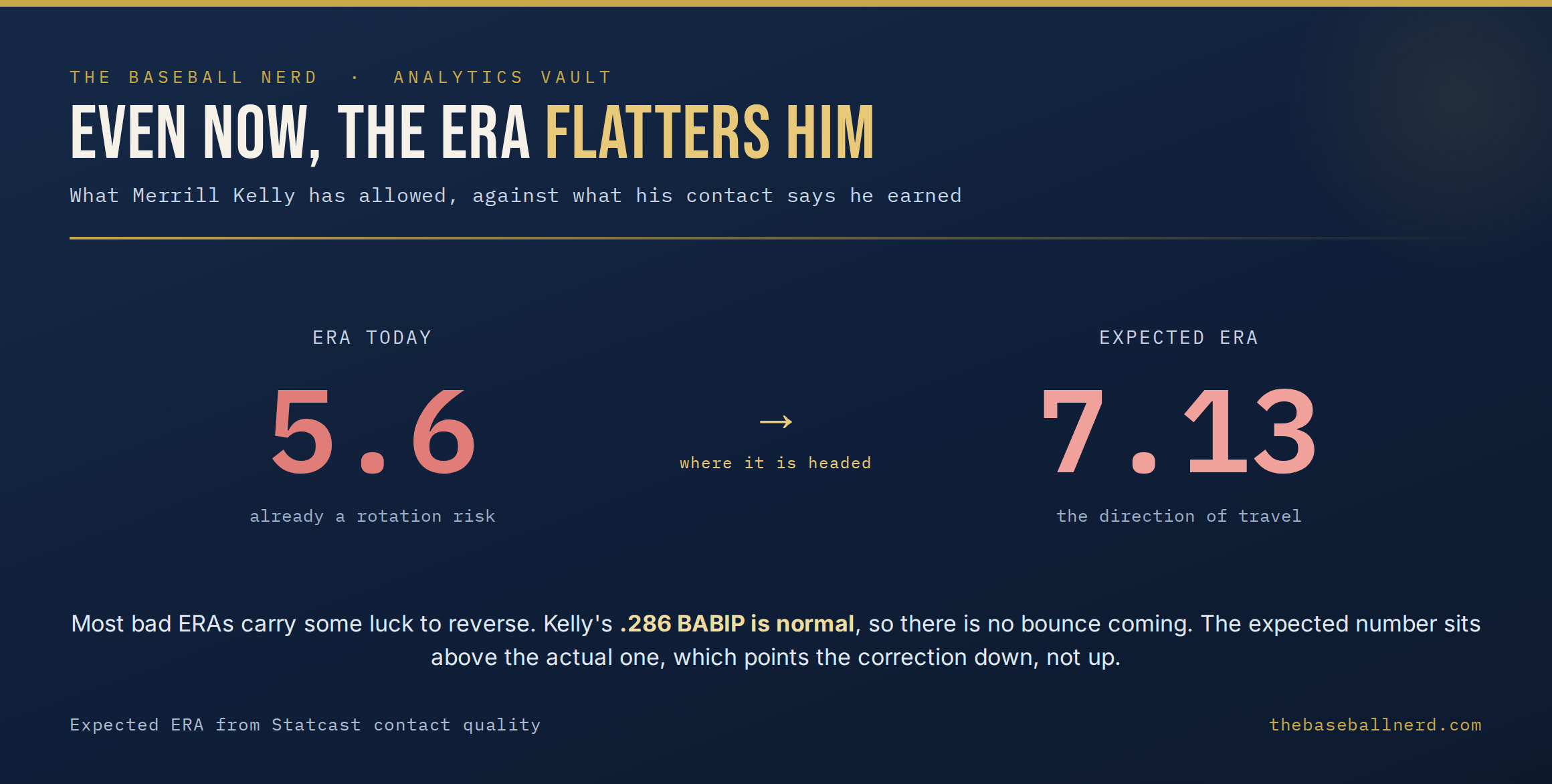
Kelly has shown the widest gap in baseball between the ERA a pitcher is posting and the ERA his skills have actually earned. His season ERA sat at 5.37 before Tuesday. It is closer to 5.6 now. That number is already bad enough to end most rotation jobs, and the expected version underneath it is far worse.
His expected ERA is 7.13. For most pitchers carrying an ugly number, the expected stats hand back a little hope, some slice of the damage written off as bad luck. Kelly gets none of that relief. The gap runs the wrong way, which means the 5.6 is closer to a ceiling than a floor. Tuesday was that gap starting to close, and it closed the way these always close, from the ERA side, in public, on a mound in front of everyone.
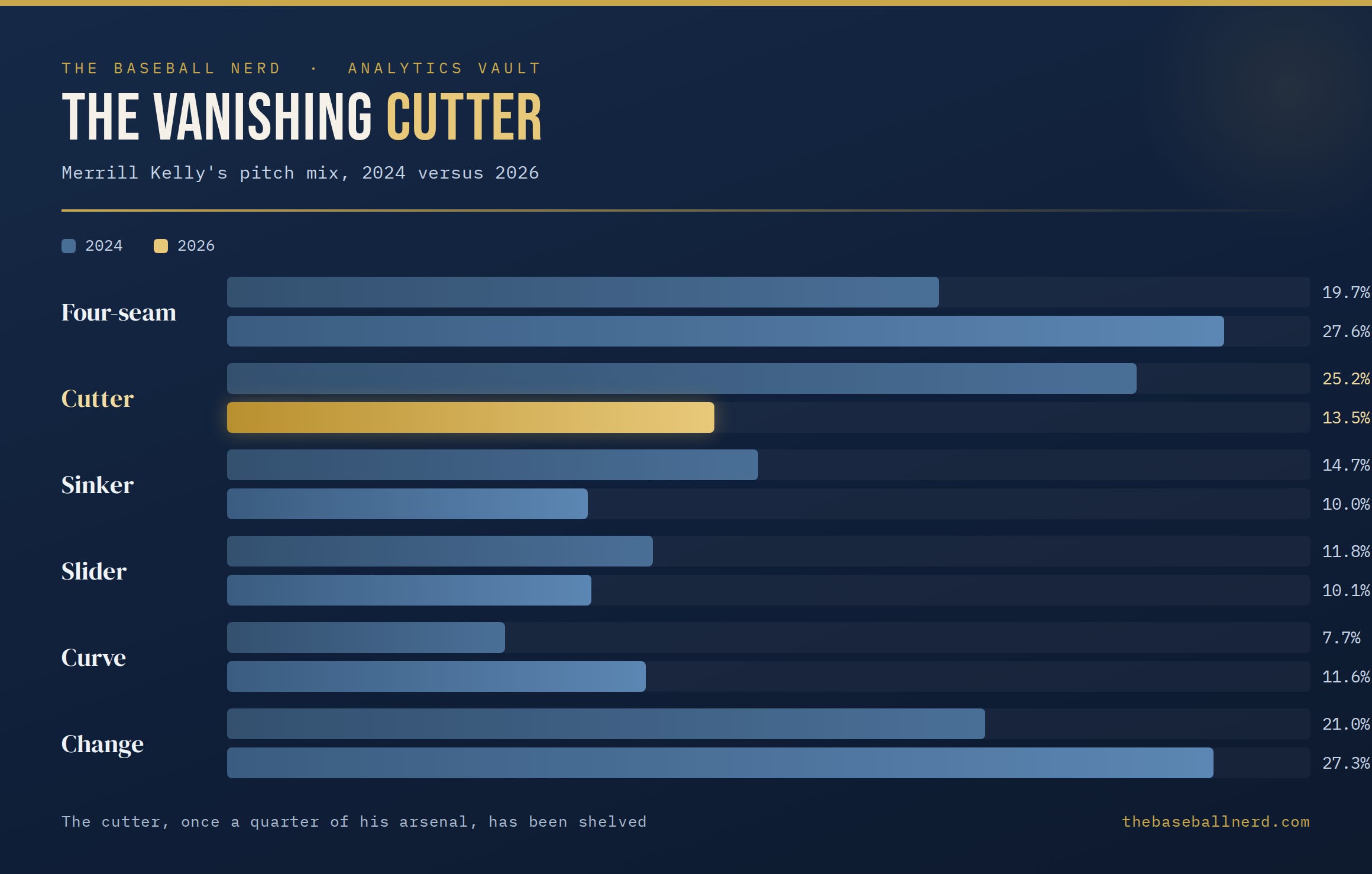
He has all but abandoned it. The cutter was more than a quarter of everything Kelly threw as recently as 2024, when he used it 25 percent of the time. This season it is down to 13.5 percent. In its place he is throwing more four-seam fastballs and more changeups, and the changeup is now his most-used pitch.
When a veteran this deep into his career quietly retires a pitch that used to anchor his mix, the reason is rarely a good one. Either the pitch stopped working or the feel for it left. The barrels say whatever took its place is not fooling anybody.
Probably not, at least not in any way the radar gun can see. His fastball still sits at 92.1, right where it has lived his entire career. A pitcher whose arm is failing almost always shows it in velocity first, and Kelly’s velocity has not moved.
So this is not the kind of decline that turns up on a gun reading, and arm health is the least likely of the explanations on the table. Whatever is happening is happening to his stuff and his command, not his arm speed. That is worse news in a way, because velocity tends to come back and feel for a pitch tends not to.
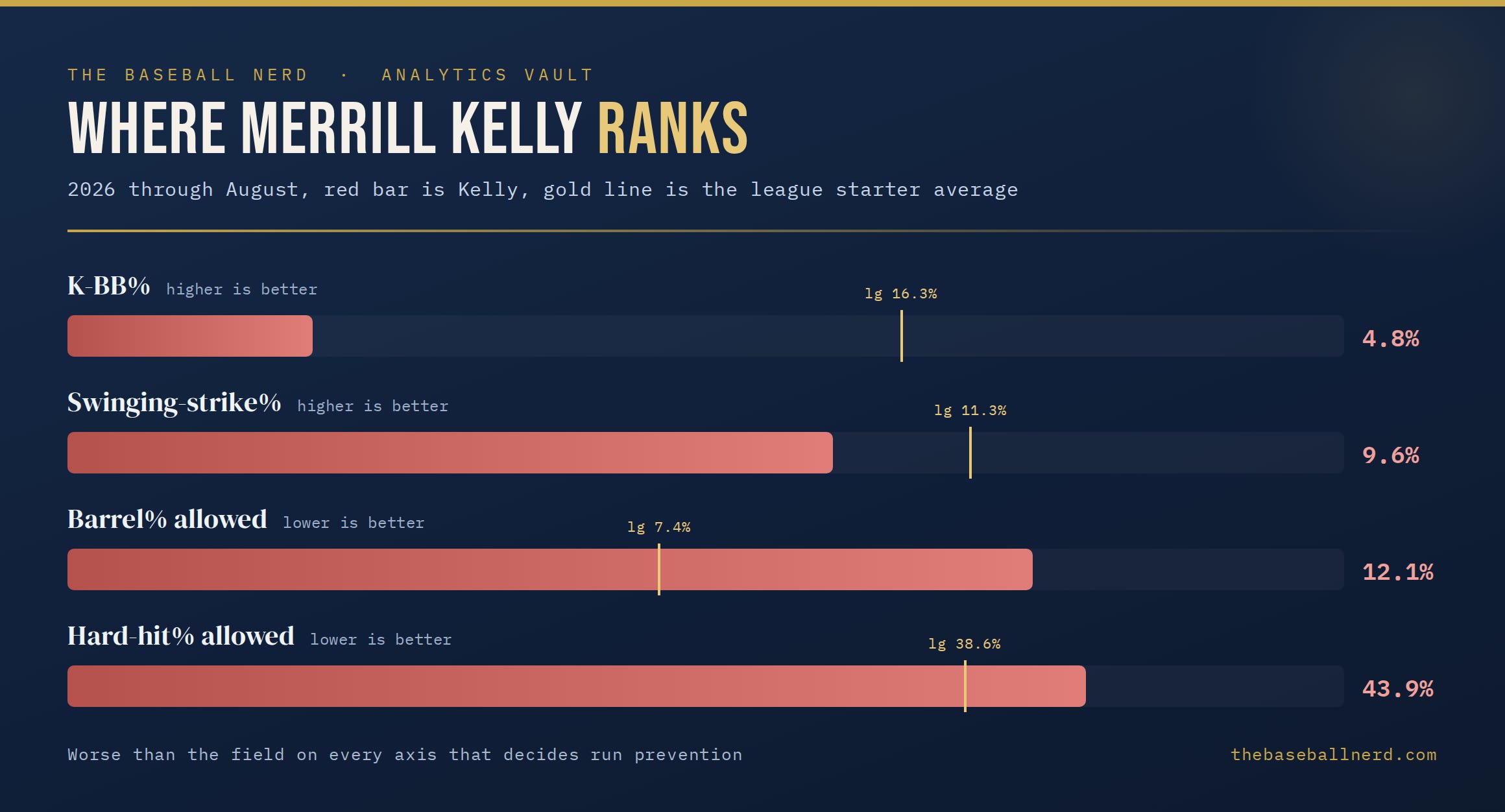
The whiffs are gone and the walks are up, at the same time, both at career worsts. Kelly’s strikeout-minus-walk rate is 4.8 percent against a league starter average north of 16, which puts him near the very floor of the pool. His strikeouts are down, under six per nine, a long-relief number wearing a starter’s uniform.
Contact with Kelly on the bump is loud. His barrel rate is 12 percent, nearly double the league mark. His hard-hit rate is 44 percent and his exit velocity sits a full click above the field. This means that he cannot end an at-bat and cannot survive the ball in play, which is a hard combination to pitch through for one start, let alone a season.
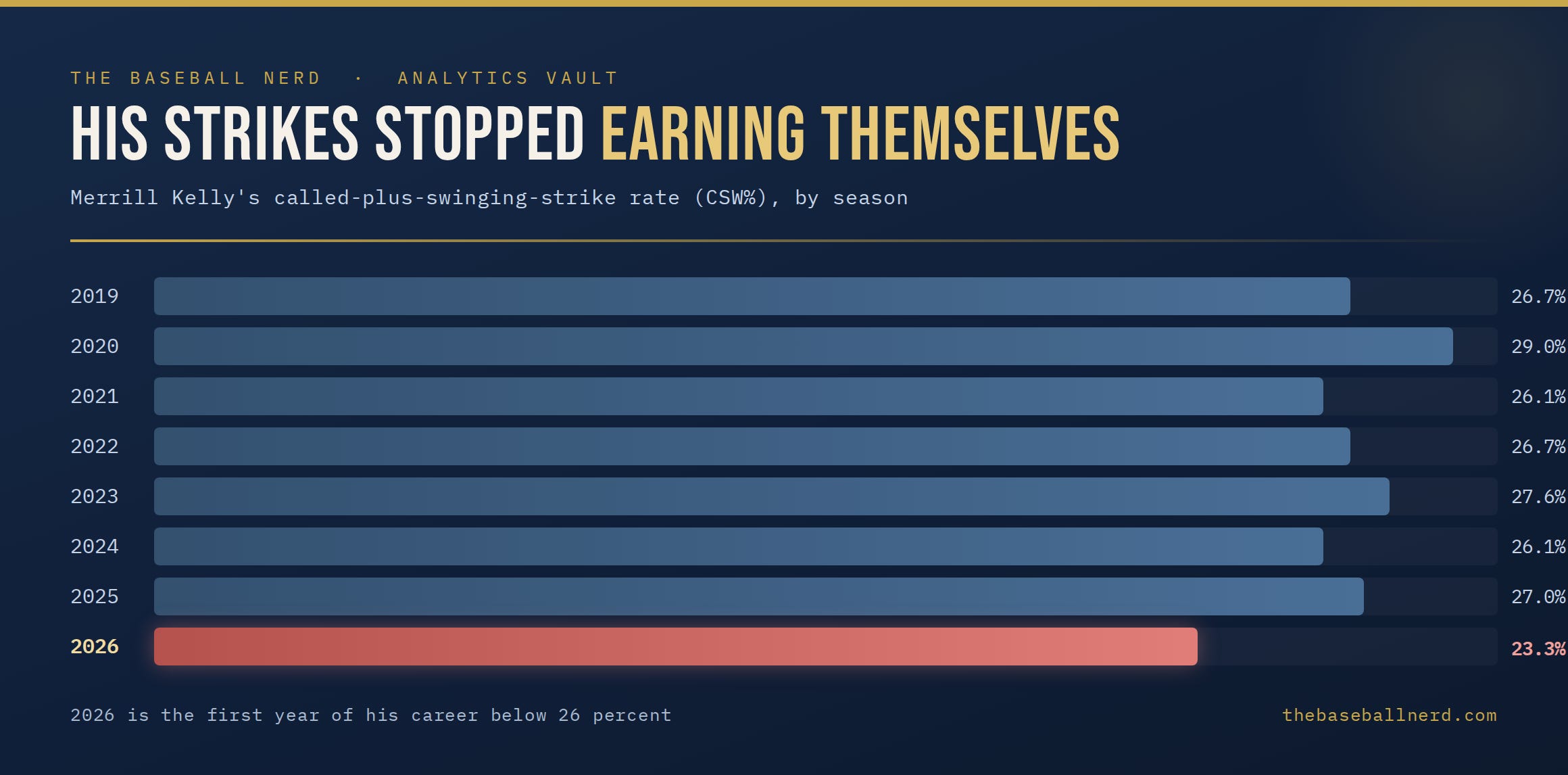
Every strike-earning number Kelly owns is parked at the bottom of his career. His called-plus-swinging-strike rate, the cleanest read on whether a pitch earns its own strike, is 23.3 percent, and he had never once finished a season under 26 before this one. His zone rate is a career low. His called-strike rate is a career low.
The chase numbers make it grimmer, not better. Hitters are actually swinging at more of his off-speed offerings than ever and making more contact when they do. So the pitches no longer steal strikes. He has backed off the plate to hunt whiffs that never come, and the walks pour out of the gap. He falls behind, he has to come back into the zone, and that makes for a long night.
Yes, and a specific kind. The mechanism from three angles proves it and it means that the effort we are watching is bigger than a slump. What Kelly has is the pitch mix, the swing-and-miss, and the strike quality all giving out together, which is what a real decline looks like when it is written on the page.
One more number closes the door on a rebound. His average on balls in play is .286, right at normal, so there is no unlucky bounce sitting in the ledger waiting to correct in his favor. His defense behind him is 9th in the league in Defensive Runs Saved. He is getting beaten by hitters.
Fenway was almost too fitting a place for it to land. A pitcher whose whole problem is that he cannot govern the quality of contact should fear that park more than nearly any other, because the big green wall in left turns a catchable mistake into a double and an ordinary hard fly into a souvenir. The profile said Kelly could not survive good contact, and Boston runs out a lineup and a ballpark built to manufacture exactly that. It did, six runs of it, in four innings.
The FADE board flagged him weeks ago as a fade with the floor still somewhere beneath him, and Tuesday the floor moved. His ERA is climbing to meet his skills, the way it almost always does in the end, and the skills are pointing at something north of seven. On a nice night for baseball next to the Charles River, the box score told the truth about a pitcher it has been protecting all summer, and the truth is not finished landing.
Comments
Nothing yet. Say the first thing.
Sign in to join the conversation.