
The Texas Rangers are three games under .500 in the middle of August, outside the wild card picture, and their manager told reporters in Anaheim that it starts with him. That is the accountability Rangers’ fans need.
This is not “the Rangers are bad at hitting with runners on,” kind of piece; you already know that. The piece is about the gap between what Rangers Manager Skip Schumaker says causes the losing and what he actually does about it, and how that gap has been sitting in plain sight in his own press conferences since April.
Schumaker took over in October with a mandate. President of Baseball Operations Chris Young called him “driven, passionate and thorough.” Schumaker himself, at his introductory presser, said the Rangers needed to find their “real identity” as an offensive team and that his focus would be “situational hitting,” “winning on the margins,” doing “the little things.” Spring training reporters wrote about a manager who threw his own batting practice, who chased down relievers in the outfield between innings, who wanted a hand in everything. Brandon Nimmo called it “different, but I think it’s good.”
The more things change, the more they stay the same.
Start with the phrase “big hit.” Ask most Ranger fans about it and you will get a guttural groan. It has a zombie-like quality that shows up in his postgame answers in April, twice in May, June, July, and August. Not similar phrasing. The words themselves.
April 5, after a sweep by the Reds: “We had a chance to win with traffic on bases… and just didn’t get that big hit.”
April 18, after stranding 16 runners against Seattle: “As long as we keep getting traffic, we’ll get the hit. I’m not concerned.”
May 5, after loading the bases with no outs against the Yankees and scoring once: “We had tons of guys on base, and again, just couldn’t get that big hit to add on.”
June 13, at Fenway: “wanting to be the guy, wanting to provide the big hit or the big RBI and… just couldn’t come through.”
July 22, in the same press conference, twice: “That was the difference in the game, and a little bit of an issue the whole year, quite honestly, in bases-loaded situations.” And then, more bluntly: “we just couldn’t get a big hit with runners in scoring position.”
August 15, after Jake Burger’s homer tied a game the Rangers still lost: “We were looking for the big hit, kind of a momentum-swinging play or change of emotion in the dugout, and Burger provided that.”
Six months, six variations on the same sentence. Shawn McFarland at the Dallas Morning News noticed it too, writing on August 1 that “the term ‘big hit,’ which has haunted the Rangers in various ways for a year-and-a-half now, was not used” that particular day, “the sentiment remained the same nevertheless.” A year and a half. That’s not a slump. That’s an identity, and not the one Schumaker promised to find back in October.
On June 18, after the Rangers get swept by the Twins and are outscored 25-7 across the series, Schumaker stands in front of reporters and says this:
“I’ve said it before: ugly losses like this, when you don’t do well, really, in all facets of the game, it starts with me. We made some fundamental mistakes throughout the game that we have to clean up, but overall, just a tough, tough loss in all facets.”
He tells you himself this isn’t new. He says the thing that fans want to hear and it becomes part of the daily discussion among Rangers fans: Skip is going to take control.
Fast forward eight weeks. August 14. The Rangers just got swept out of Anaheim, going 1-for-16 with runners in scoring position over the final three games, and Schumaker is standing in front of reporters again:
“We’ve got to figure it out. It starts with me. I’ve got to start doing something different on the road. In-division especially, we have just not been good. We have to switch it up somehow, and I have to come up with different ideas for that to happen because that series right there cannot happen.”
This statement, given to reporters after losses, twice? Shouldn’t it have only had to be said once?
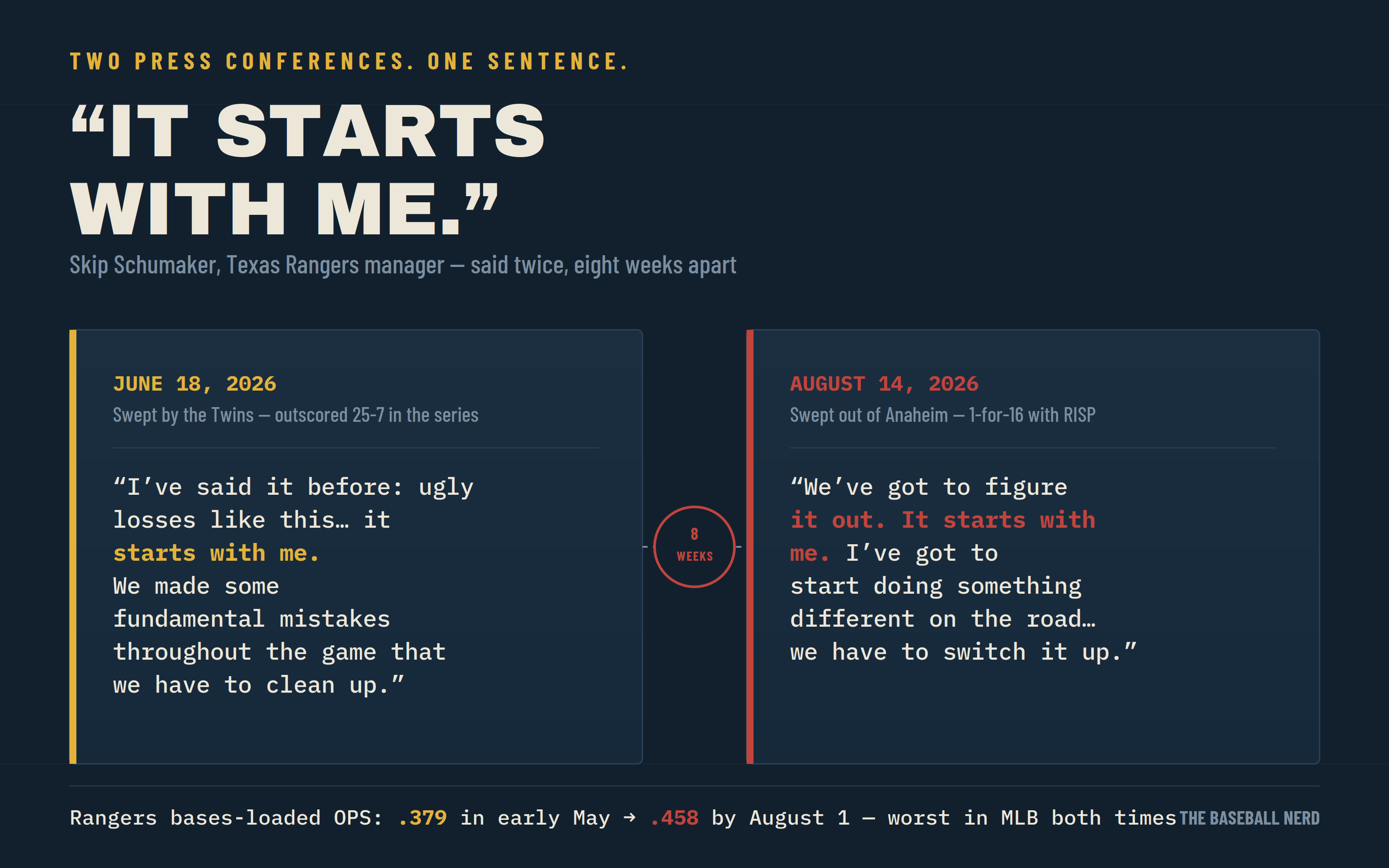
It’s the same phrase. It’s the same claimed ownership. The underlying problem of the road record, the multiple runners left on base, the first-inning shellacking, still sitting there completely unresolved. If it actually started with him in June, August should read differently.
It doesn’t.
The team’s bases-loaded OPS was the worst in baseball in early May at .379, still the worst in baseball at the start of August at .458, worse than any club had posted in that situation since the 2012 Astros, a team that lost 107 games. The number didn’t move. The sentence didn’t move. Only the calendar did.
It isn’t just the two months. On July 29 and July 30, back to back days in St. Petersburg, Schumaker used almost the identical sentence twice in a row. “But we just couldn’t get anything going offensively,” after a shutout loss on Wednesday. “The story is we didn’t get anything going offensively. It’s tough to win games that way,” after a 3-2 loss on Thursday. Two losses, twenty four hours apart, same diagnosis, same words, and nothing between them but another empty box score.
I was finishing this piece last night when the Rangers gave me one more example I did not go looking for. Washington’s Cade Cavalli struck out 10 of the first 13 Rangers he faced and finished with 13 K’s total. Texas managed four hits, all singles, drew one walk, and had a single baserunner across the final 21 plate appearances of a 6-0 loss. Schumaker’s answer in the press room after the game: “We just couldn’t get anything going, that’s just the bottom line.” Minutes later, same press conference: “We just couldn’t get anything going together today.”
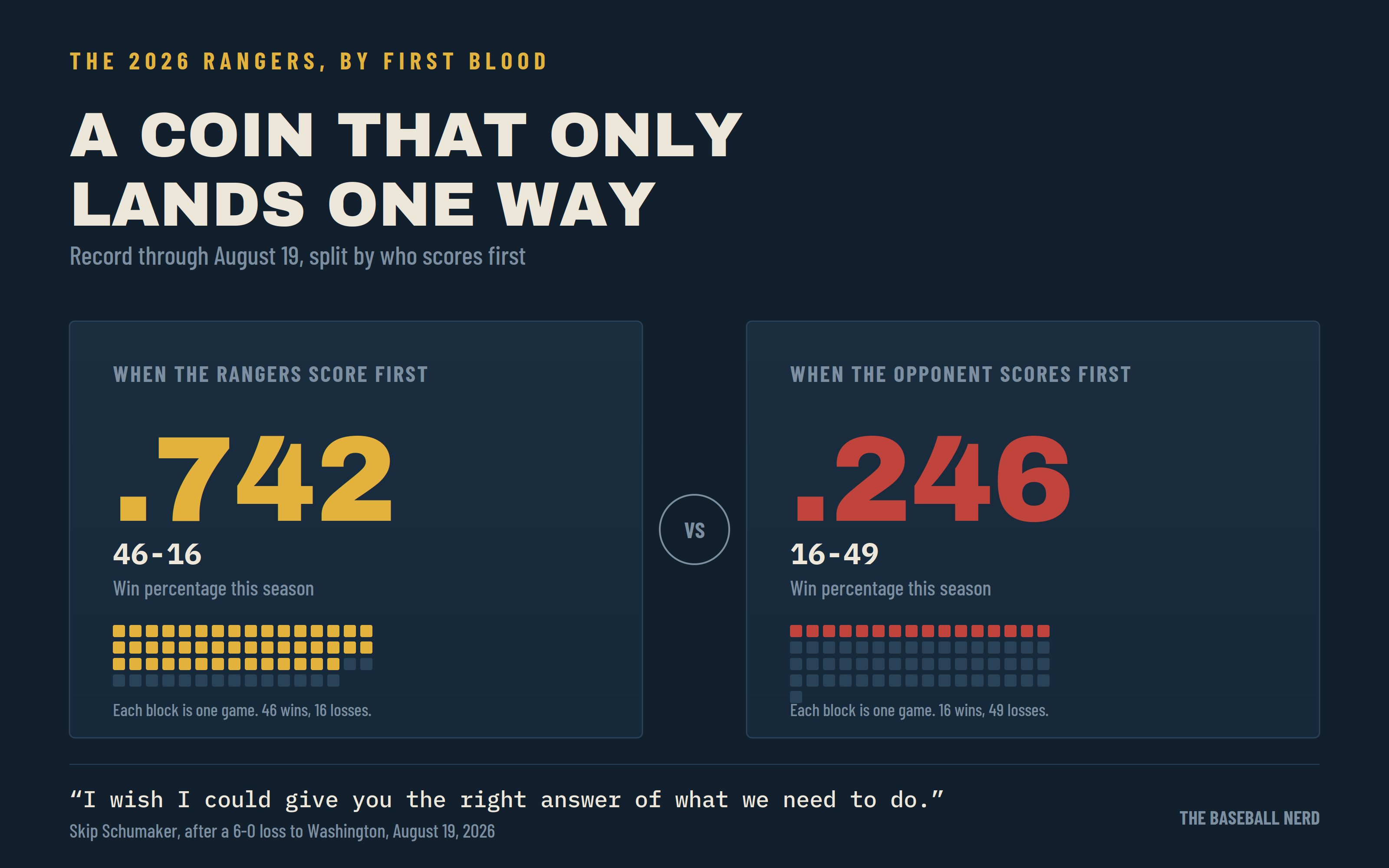
That loss put a number on something else, too. The Rangers are 16-49, a .246 winning percentage, when their opponent scores first this season. Schumaker said as much himself: “if we don’t score first, for whatever reason, it feels that we just haven’t been able to come back.” And when it came time to name the fix, this is what he offered: “I wish I could give you the right answer of what we need to do.”
That’s the whole piece in one sentence. He doesn’t have the answer, and for once he said so plainly. But “I wish I could give you the right answer” and “it starts with me” cannot both be true at the same time. One of them is the truth. The other is what gets said into a microphone.
None of this is really about Schumaker being a bad manager. He has been given a pitching staff from a cost-conscious owner that is as good as it is going to get, aside from veteran workhorses Jacob deGrom and Nate Eovaldi. He is having to piece together a lineup from a roster that is mostly broken. The record isn’t an abject disaster for a team that was expected to be .500.
The issue at hand is the pattern in how he talks about the losing, because it tells you something about how the organization is actually processing its own failures. In each loss there is an excuse, and every excuse has a shape. This one’s shape is: praise the process, admit the result, promise a change, repeat the exact same promise two months later once the process has produced the exact same result again.
“It starts with me” sounds like accountability. Said once, with something done to correct the situation, it is. Said twice, eight weeks apart, describing the same failure, is a cop-out. It’s a script to get done with the interviews and seemingly back to the same old thing. And a script isn’t a fix.
I’ll be tracking the Rangers’ bases-loaded and RISP numbers through September. If they climb back toward league average while this language disappears from his pressers, that’s a real turnaround and I’ll say so plainly. If the number stays buried and the phrasing keeps showing up, that tells its own story, and by then it won’t need my help to make the point.
Comments
Nothing yet. Say the first thing.
Sign in to join the conversation.