
The Roundhouse in Chalk Farm is a Victorian engine shed that spent most of the twentieth century being repurposed: a gin warehouse, a storage depot, an experimental theatre, before London’s punk scene found it in the mid-seventies and made it theirs. The sightlines were terrible. The acoustics weren’t much better. On July 4, 1976, the Ramones played it for the first time. The Stranglers played third on the bill. The Flamin' Groovies headlined. Somewhere near the stage stood a sixteen-year-old named Lucian Grainge.
His half-brother Nigel had overseen the UK distribution deal for Sire Records, the label that had signed the Ramones. That was how you got close to the stage in 1976. You knew someone who had made the deal.
Almost fifty years later, Bill Ackman announced a €55 billion bid for Universal Music Group, the company Grainge has run since 2011. It is the largest music company in the world, and no rival has come close to overtaking it on his watch.
Ackman's offer came with a capital allocation plan: a 2.5x leverage target unlocking €5.4 billion of debt capacity, monetization of UMG's €2.7 billion Spotify stake, dividend growth slowed to 2 percent, and approximately €15 billion of cash generation over five years available for reinvestment, acquisitions, and share buybacks — with all free cash flow after business investment directed to repurchases.
Ackman is not buying a company. He is attempting to change the rules of the system Grainge has spent fifteen years reinforcing.
Ackman has also proposed a new board chairman: Michael Ovitz, the former CAA chief who brokered MCA's sale to Matsushita in 1990 and worked Matsushita's exit to Seagram five years later.
Outside capital has arrived at the music business like this before. Matsushita. Vivendi. Terra Firma.
It hasn’t always lost. Boston Ventures made money on Motown. Len Blavatnik is up over four times his money on Warner Music Group. Sony still owns Columbia.
The pattern is narrower than outside capital versus music. It is outside capital that tries to operate the business versus outside capital that holds it and gets out of the way.
The owners keep changing. The business keeps growing anyway.
The majors survived the internet. They survived piracy. They survived the shift to streaming.
Labels now own stakes in the platforms they license to. The three largest rights holders help set the terms of a streaming economy they didn't build.
From the outside, it looks like dysfunction. Inside the business, ownership changes, formats change, platforms change. The songs hold. So does the relationship to them.
To understand what Ackman is buying, you have to start with the 1962 antitrust case that restructured MCA.
Lew Wasserman had built Music Corporation of America into the most powerful entertainment company in the United States — controlling talent, production, and distribution in a combination the government eventually moved to break up. The Justice Department’s remedy introduced competition. What it actually produced was a structural weakening severe enough that three decades later MCA needed outside capital to survive.
The outside capital arrived through Michael Ovitz.
Ovitz had built Creative Artists Agency into the most powerful talent agency in Hollywood on a philosophy he stated almost never: power is only power until you exert it. For twenty years he packaged films, collected commissions from 1,350 clients, and moved through Los Angeles with the soft-spoken certainty of a man who knew the implied threat of his involvement was more effective than its reality. He had watched Wasserman build MCA and wanted, in some deep and unresolved way, to become what Wasserman was.
His connection to Edgar Bronfman Jr. began with a favor. In 1985, Ovitz’s father David, a forty-five-year Seagram salesman facing mandatory retirement at sixty-five, was kept on after Ovitz made an appointment at the Seagram Building and asked Bronfman — whom he had never met — to make an exception. Ovitz offered to reimburse the cost. Bronfman kept David on without taking the money. David worked until he was nearly eighty and never knew why.
That favor became a relationship.
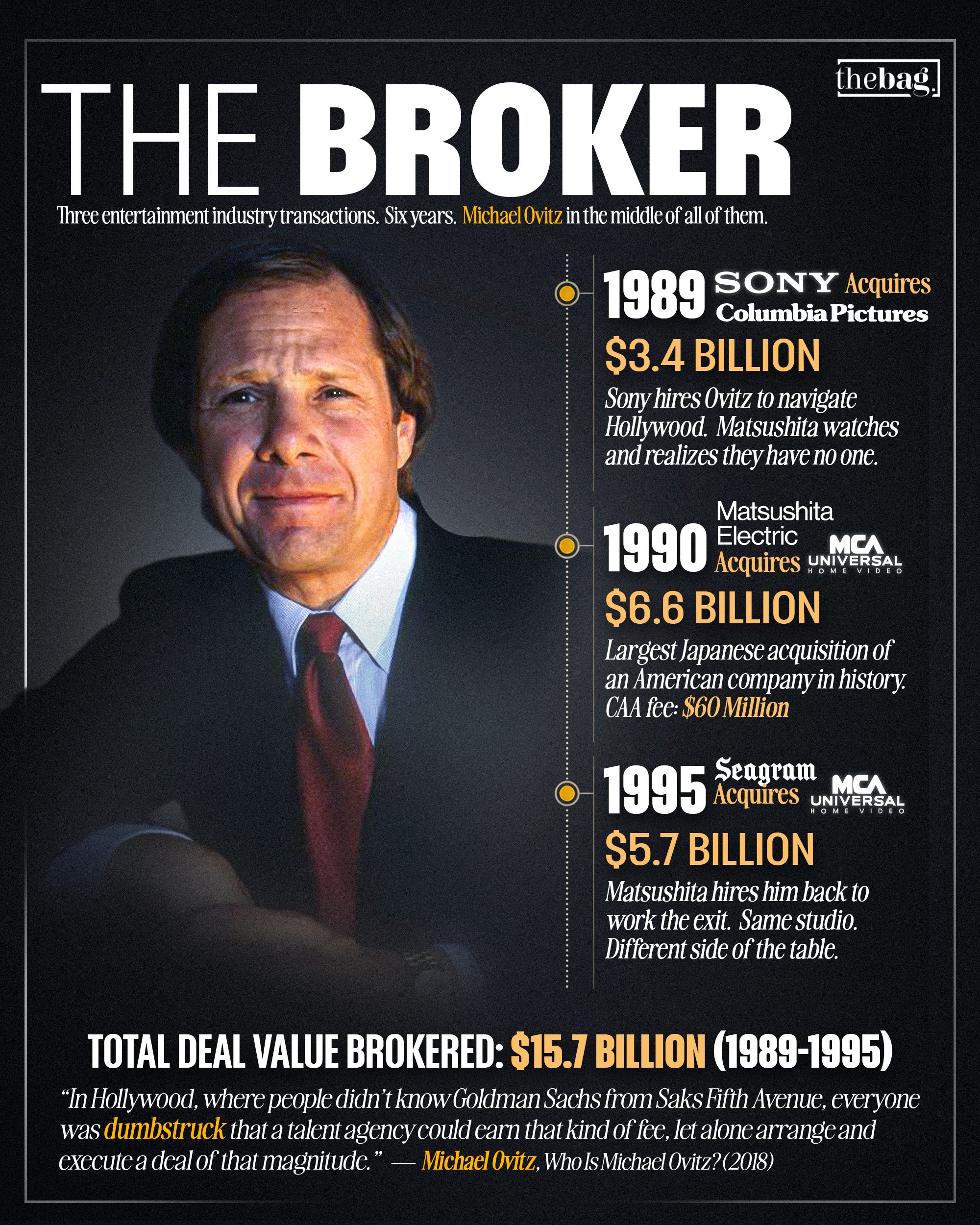
In 1989, Ovitz brokered Sony’s $3.4 billion acquisition of Columbia Pictures. Matsushita watched Sony close that transaction and understood what they had failed to see coming. Sony now owned content. Matsushita owned hardware. They had roughly $12 billion in cash and no answer.
What followed were fourteen trips to Osaka over a year, with Ovitz using the code name Mr. Nelson. A three-day staring contest at the Kahala Hilton — “We are not here to discuss business,” Ovitz told his team. “We’re going to be in a social staring contest, and we cannot blink” — ended on the last night with Matsushita's senior managing director, Masahiko Hirata, asking over chateaubriand what it would cost to help Matsushita acquire a studio. Ovitz said CAA would charge nothing unless Matsushita was happy.
If they were, he wanted a Brink’s truck loaded with gold sent to the office.
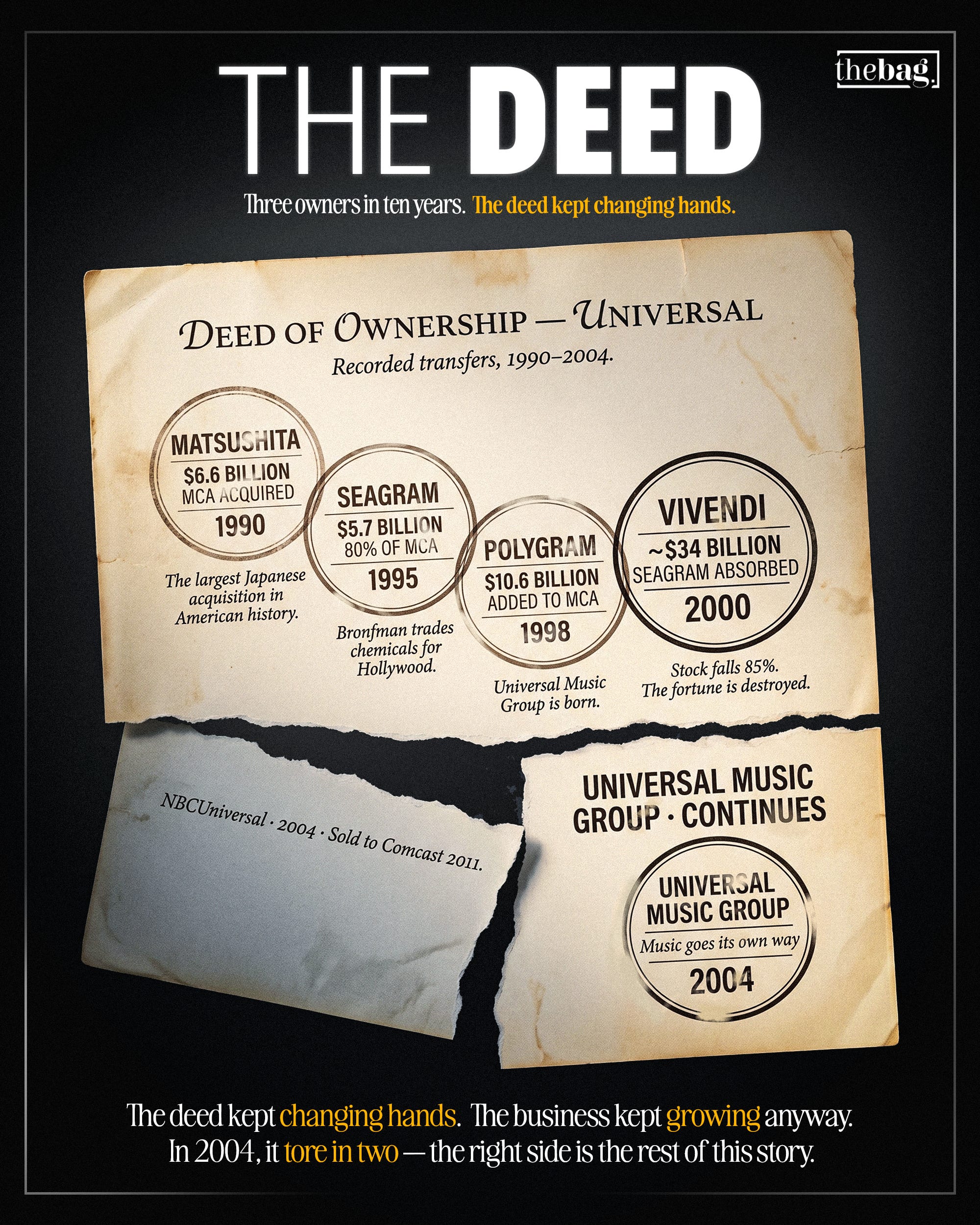
The deal closed in November 1990 at $6.6 billion — MCA Inc., including Universal Pictures, MCA Records, and the Universal Studios theme parks — the largest Japanese acquisition of an American company in history. CAA netted $60 million in fees. In a town where people didn’t know Goldman Sachs from Saks Fifth Avenue, the idea that a talent agency could execute a transaction of that magnitude was inconceivable.
Lew Wasserman, who had spent fifty years building MCA, did not thank him. When Ovitz brought the Matsushita delegation to the Universal lot to take formal possession, Wasserman and his longtime deputy Sid Sheinberg met them at the walkway, turned their backs without a word, and walked the delegation into the studio.
“He never forgave me,” Ovitz wrote later, “for saving him on someone else’s terms.”
Ovitz never spoke to Lew Wasserman again.
Five years later, Matsushita was done with Hollywood. The executives who had championed the deal had been forced out in a loan fraud scandal, replaced by a hardware executive who had never been to Los Angeles and had no interest in going.
When Matsushita decided to sell, they called Herb Allen of Allen & Company. Allen said he would not work on the sale without Ovitz. So Ovitz was back in Osaka, engineering the exit.
Edgar Bronfman Jr. had become president of Seagram in 1989 and spent the years since trying to convince his family that the future of Seagram was entertainment, not liquor and chemicals. He had wanted to be in the music business since college. The David Ovitz favor a decade earlier had made Ovitz one of the people in Hollywood Bronfman could call.
Ovitz told Matsushita what he told anyone who asked: Seagram could cut a check for the full amount. They were the only buyer who didn’t need to line up a bank. Edgar Bronfman Jr. sold Seagram’s 24% stake in DuPont — the chemical business that had underwritten three generations of family wealth — to fund the thing he had wanted all along.
The deal closed at $5.7 billion.
Ovitz had brokered a deal for the same studio twice in five years, once for the buyer and once for the seller.
Bronfman’s first choice to run the company was Barry Diller, the former Paramount and Fox chief, who turned him down. Ovitz was second. Ovitz asked for five percent of MCA’s equity, roughly $330 million. The Bronfman family fought the terms. The negotiation collapsed.
Within weeks, Ron Meyer — Ovitz’s CAA co-founder and closest partner of twenty years — took a deal to become president and COO of MCA Inc. Ovitz, suddenly without his closest ally, took a call from Michael Eisner about a Disney job he had been declining for years. This time he said yes.
He lasted fourteen months. Eisner had promised partnership and delivered a demotion. The Disney board approved a $130 million no-fault severance package. Shareholders sued. The Delaware Court of Chancery cleared Ovitz after thirty-seven days of testimony.
Ovitz had wanted to be Wasserman. He became something else.
The person who brokers the deal is rarely the one who runs the company.
While Ovitz’s departure from Disney filled the trades, Bronfman was building what he had actually come for.
For the music division, he reached into Warner Music and pulled out Doug Morris, a record executive who had just been forced out after losing an internal power struggle, who had spent fifteen years turning Atlantic into the dominant label in the Warner system, and who knew the business from the ground up. Bronfman named him Chairman and CEO of the music division in November 1995.
Edgar Bronfman Jr. had spent his adult life trying to establish himself as something other than an heir. Under the pseudonym Junior Miles, he co-wrote “To Love You More,” a hit for Celine Dion. As a Seagram executive, he told the board that satellites, high-speed cable, mobile phones, and computers would multiply the markets for entertainment.
In 1998, with Seagram weighing two acquisition targets, Bronfman asked David Geffen which one to buy.
“Do you know what the difference is between PolyGram and EMI?” he said. “The first is chicken salad and the other is chicken shit.”
Bronfman paid $10.6 billion for PolyGram, the Dutch music conglomerate, selling Seagram’s Tropicana juice business to PepsiCo for $3.3 billion to help fund it.
PolyGram owned Island, A&M, Def Jam, Mercury, Verve, and one of the deepest catalogs in the business. Absorbed into Universal Music Group, the combination became the largest music company in the world.
Napster launched the following year.
In 2000, Bronfman sold Seagram — and with it Universal Music Group — to Vivendi, the French water utility turned media conglomerate, in an all-stock transaction valued at approximately $34 billion. The Bronfman family took Vivendi shares instead of cash.
The man running Vivendi was Jean-Marie Messier, a graduate of the École Polytechnique and the École nationale d’administration who had transformed a water company into a global media empire through thirty acquisitions in four years. He had also taken to referring to himself, without visible irony, as the master of the world.
The French satirical puppet show Les Guignols de l’info gave him a nickname:
J6M, for Jean-Marie Messier Moi-Même Maître du Monde — Messier himself, master of the world.
The show aired on Canal+, which was owned by Vivendi. Messier was being mocked on a channel his own company controlled while using company funds to buy a $17.5 million apartment at 515 Park Avenue, as the company accumulated massive debt.
The Bronfman family's shares were worth $77.35 each at announcement, 106.5 million of them. Then Vivendi's stock fell 85%.
By mid-2002, the company was carrying €35 billion in debt and would report €23.3 billion in losses for the year. The fortune built across three generations of liquor distribution, preserved through chemicals and orange juice, was largely destroyed in a single media cycle.
Messier was forced out in July 2002. He tried to claim the Park Avenue apartment as part of his severance and was rebuffed. An arbitration panel later awarded him a €20.5 million severance package, which the SEC moved to block. He ultimately relinquished the claim as part of a 2003 settlement.
On January 21, 2011, a Paris criminal court convicted both men on the same morning. Bronfman, by then serving as CEO of Warner Music Group, was convicted of insider trading for exercising stock options in late 2001 ahead of a planned Vivendi share issuance. The court found he had non-public knowledge of the planned issuance; he received a €5 million fine and a fifteen-month suspended sentence. Messier was convicted of misuse of corporate funds during his tenure as CEO. He received a three-year suspended sentence.
Both appealed. Bronfman’s insider-trading conviction was upheld. Messier’s misuse-of-funds conviction was upheld; the misleading-investors count was overturned.
The two men most responsible for assembling and then selling Universal Music Group were convicted by a French court on the same day.
The conviction was the legal coda. The business consequences had played out years earlier.
Through the Vivendi years, the labels were also trying to build their own answer to Napster. The SDMI — the Secure Digital Music Initiative — was the attempt. Two hundred representatives from one hundred companies held thirty-two meetings over three years, including sessions at a Florentine villa. They spent between $5 million and $10 million and produced one encryption standard. Hackers cracked it in three weeks.
Two label-owned subscription services launched in late 2001 — MusicNet, backed by Warner, BMG, and EMI; PressPlay, by Universal and Sony. The Department of Justice targeted both on antitrust grounds, and the labels pulled back from coordinating on digital products they built themselves. The products they had managed to launch were hobbled already — files that expired after 30 days, two-track CD-burn limits, monthly fees that bought less than the free version on Napster.
Doug Morris, who ran Universal during the worst years of the digital transition, was later asked why the company hadn’t built its own response to the internet.
“We didn’t know who to hire,” he told Wired in 2007. “I wouldn’t be able to recognize a good technology person — anyone with a good bullshit story would have gotten past me.”
He said this about the company that owned the largest music catalog in the world, while Napster was dismantling the business model that catalog ran on.
What happened next was one of the most consequential transactions in the history of the music business, and it barely registers as a scandal because the industry eventually clawed its way back through streaming. In 2003, Steve Jobs came to the labels with iTunes. Ninety-nine cents a song. Seventy cents to the label. Twenty-nine cents to Apple. The labels had already demonstrated they couldn’t build the platform themselves. Apple built it instead.
Apple took its cut. The iPod and iTunes became the flywheel that turned Apple into the most valuable company in the world. The labels collected their seventy cents per song and owned no part of the platform.
The lesson was already visible. The labels owned the rights. Someone else owned the access.
Jimmy Iovine watched this happen and said:
“How Sony missed this is completely mind-boggling to me, a historic fuckup.”
Sony had the hardware. Sony had the content. Sony had the distribution. Its hardware division and music division couldn’t cooperate long enough to build the thing Apple built in its absence.
By the time Spotify arrived, the labels had learned one thing.
Take equity.
The outside capital that arrived in the meantime didn't learn the same lesson.
In 2007, Guy Hands’s private equity firm Terra Firma paid £4.2 billion for EMI, almost entirely with Citigroup debt. Hands believed the music business was a mismanaged asset class that a disciplined financial operator could rationalize. He cut costs, clashed with artists, and lost market share while carrying a debt load that left no room for error. Citigroup took EMI back in 2011. Terra Firma lost its entire equity investment.
Hands told the Financial Times in September 2021: “If we still owned EMI today we’d be a seller at nine times our money.”
Len Blavatnik, the billionaire industrialist behind Access Industries, entered the music business through Bronfman. He joined the Warner Music board in 2004 — the year Edgar Bronfman Jr., having sold off the family's industrial holdings to fund his music ambitions and watched the proceeds collapse, returned to music as the lead partner of a private equity consortium — alongside Thomas H. Lee Partners, Bain Capital, and Providence Equity Partners — that bought Warner from Time Warner for $2.6 billion. Scott Sperling, the Thomas H. Lee managing director who ran the deal, said publicly he did not expect an immediate upturn in the recorded music market.
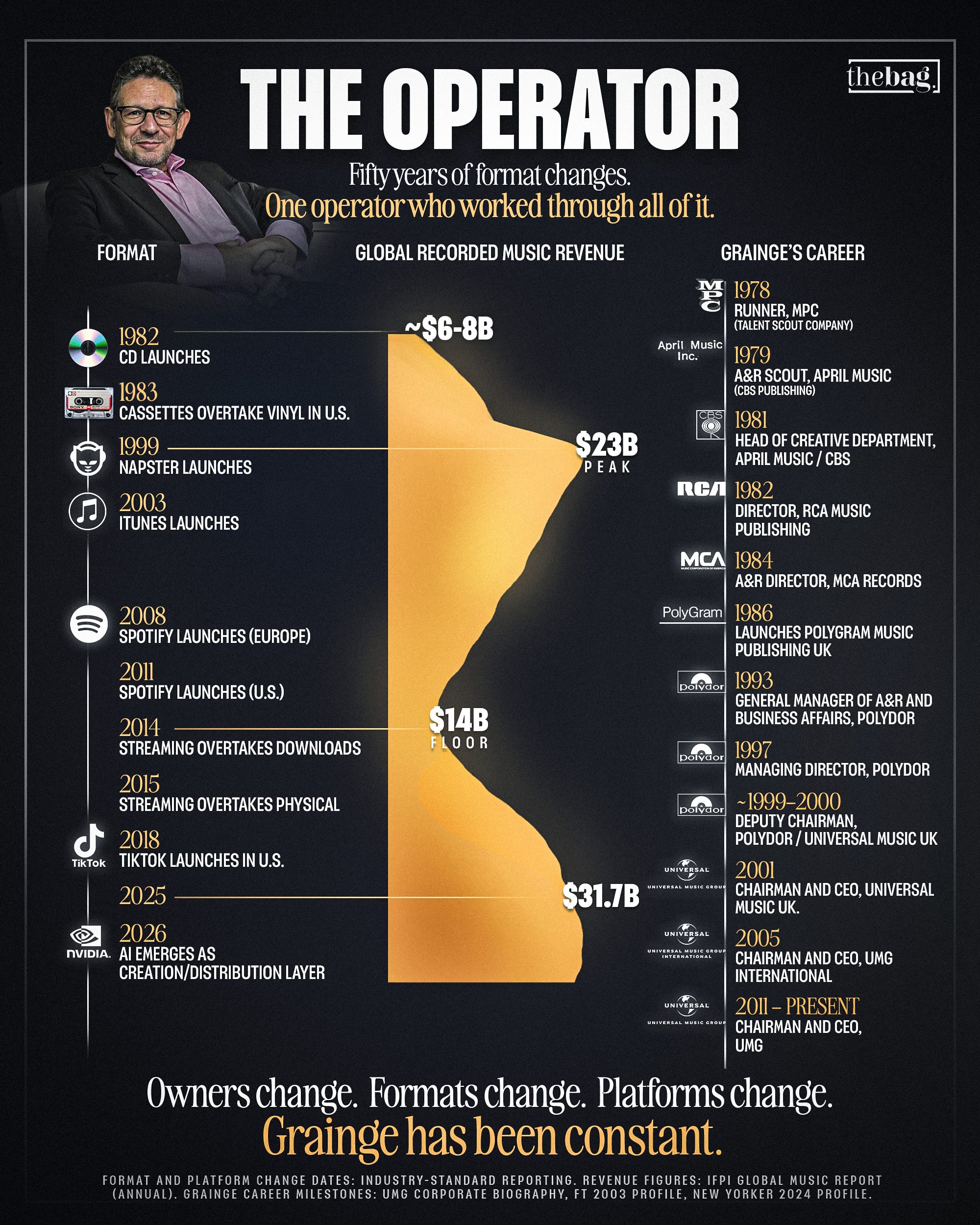
He was right. The industry was in the middle of the worst revenue collapse in its history, from roughly $23 billion in global recorded music revenues in 1999 to a floor that would not arrive until 2014.
Blavatnik stepped off the Warner Music board in 2008 but retained a two percent stake. In 2007, he had bought Bronfman’s Upper East Side townhouse for $50 million, roughly twelve times what Bronfman had paid in 1994. When he acquired Warner Music Group in 2011 for $3.3 billion, he already owned the man’s house.
He told employees: “Even though it’s the music business, it’s still business. We should be making money.” He eliminated performance bonuses and replaced them with a seven-year lockup dividend structure. More than half the executives it was offered to declined. He brought in Stephen Cooper — a turnaround executive whose previous posts included Enron and Krispy Kreme — who would become CEO.
A friend described Blavatnik’s thinking: the catalog was less a media business than “a real-estate play... a building that throws off cash. Instead of renting space, you’re renting music.”
Bill Ackman would arrive at the same underlying thesis fifteen years later — though he framed it as an annuity rather than a building. A capital-light royalty on global music consumption, in his 2021 deck. The metaphor differs. The logic is the same.
Warner went public in 2020 at an implied value of roughly $12.75 billion, about four times what Blavatnik had paid. Ken Moelis, the investment banker, said: “Len didn’t even lose when he lost.”
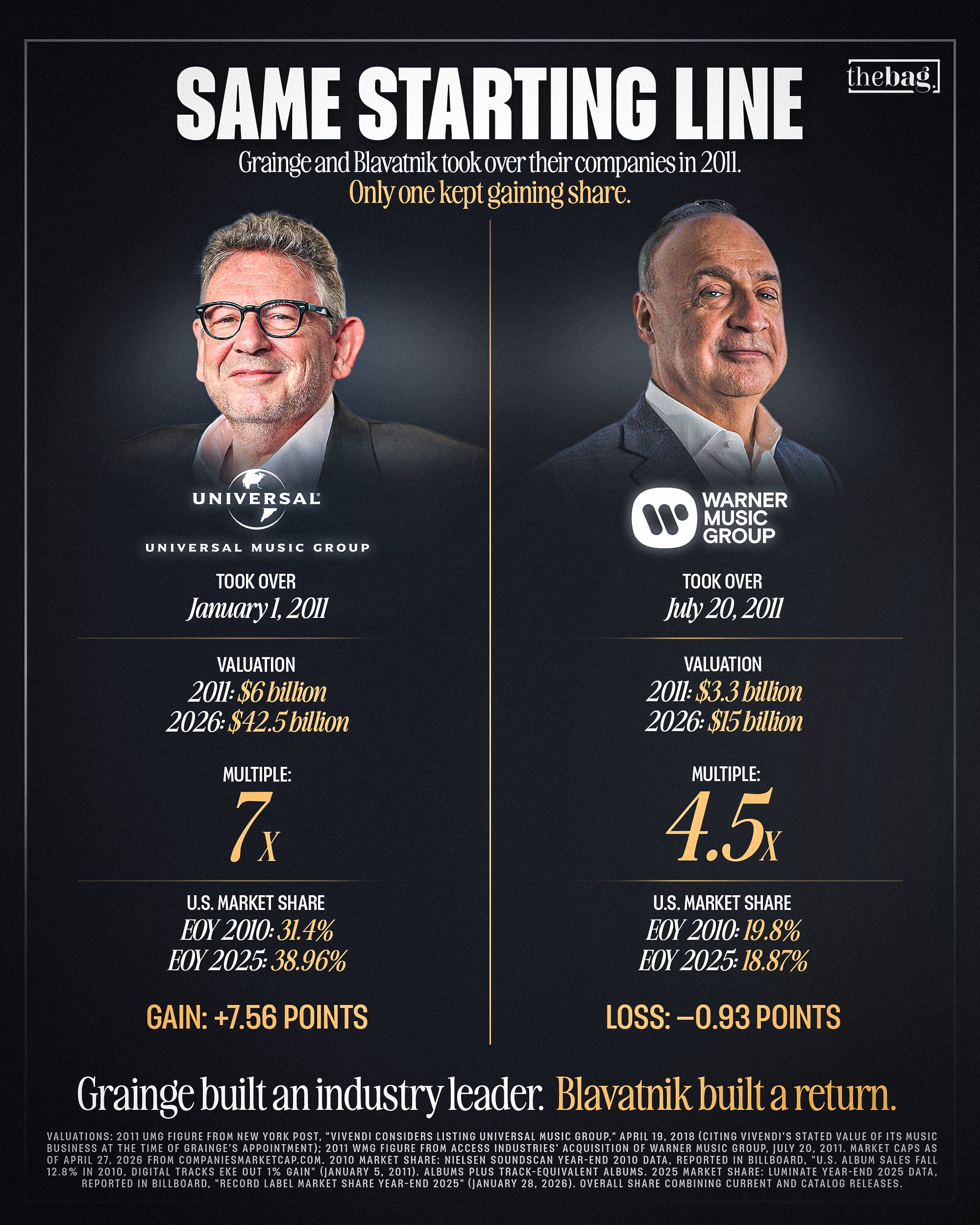
Blavatnik ran Warner as a financial discipline exercise. Grainge ran Universal as a market share exercise. The difference showed up in who each was willing to recruit.
In early 2012, Jimmy Iovine, who ran Interscope, had a meeting with John Janick and offered him an opportunity to join Interscope. Janick was running Fueled By Ramen and Elektra at Warner, where Blavatnik and Cooper had been holding executive salaries down. Universal outspent them. The hire was announced in October 2012, three days after Lyor Cohen exited Warner. Two years later, when Iovine left for Apple, Grainge made Janick CEO.
Irving Azoff, speaking to The New Yorker in 2014:
“Lucian is playing the market-share game. He’s killing it on the new artists.”
The trap, as Moelis framed it, is that you can make money in the music business while losing the position that determines who makes money from it next. Blavatnik generated a strong financial return. Grainge built the structural lead. Universal's US market share has sat near 38 percent for most of the last decade, more than double Warner's.
Universal had outside capital that didn't try to operate the company.
The Tencent consortium has held quietly for six years.
In 2020 and 2021, across two tranches — the first 10% at approximately €3 billion in March 2020, the second 10% at the same valuation in January 2021 — they acquired roughly twenty percent of Universal. The first tranche came as Vivendi was selling minority stakes ahead of a planned listing. The second came after Vivendi's February 2021 spin-off announcement.
UMG and Tencent had been operating partners since 2017, when they signed the Chinese distribution and licensing agreement, which expanded Abbey Road Studios into China.
In March 2025, the consortium distributed shares to its members. Tencent Music received a direct two percent stake. Universal and Tencent Music now hold equity in each other.
Patient capital. Non-interfering. Geographically distant.
The conglomerate around it broke apart anyway.
Vivendi, which had acquired Seagram for ~$34 billion in 2000, broke itself into four companies in December 2024. The combined market capitalization of those four companies was €7.7 billion — less than Vivendi’s own pre-breakup value, and less than one year of Universal’s revenues.
Through the years, Universal Music Group was pursued more or less continuously. Vivendi rarely solicited the approaches and mostly turned them down.
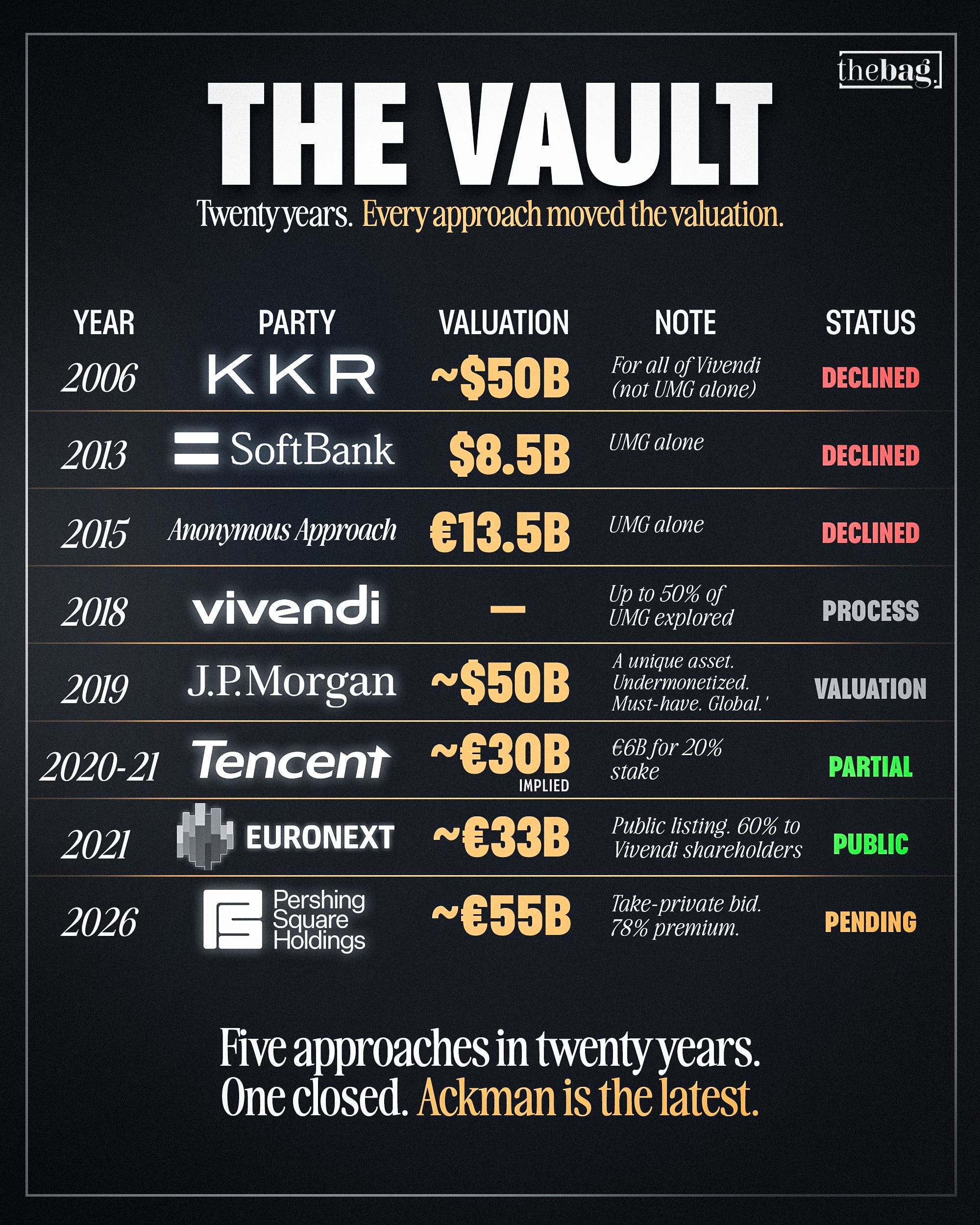
Alexander Vik, a Norwegian financier and Vivendi shareholder, pushed to break up the company in June 2006. Nothing came of it. Five months later, KKR offered roughly $50 billion for all of Vivendi — music, telecoms, pay-TV, the whole conglomerate. The board declined. In spring 2013, SoftBank offered $8.5 billion for Universal Music alone. Masayoshi Son was in the middle of his $21 billion takeover of Sprint. Vivendi reviewed the offer and rejected it within weeks. The number was nearly four times the price Citigroup had accepted on EMI the year before. In 2015, an unnamed bidder offered €13.5 billion. Rejected.
In July 2018, Vivendi announced it would explore selling up to half of UMG to a strategic partner. This was the first time it had opened the door itself. Liberty Media, KKR, and Tencent circled. JPMorgan valued the company at $50 billion in a research note that described Universal as “a unique asset” owning content that was “undermonetized, must-have, global... strategic to the tech giants and can’t be replicated.” Vivendi was explicit that whoever came in would have, in the company’s own language, very limited involvement in decision-making.
Tencent was the one Vivendi let in.
Every approach, rejected or consummated, moved the valuation. SoftBank at $8.5 billion in 2013. €13.5 billion in 2015. JPMorgan at $50 billion in 2019. €33 billion at the Amsterdam listing in 2021. €55 billion from Ackman in 2026. The catalog kept growing. So did the number of buyers who had watched the last one fail to close.
Lucian Grainge had taken over as CEO of UMG on January 1, 2011, and added the chairmanship that March, two months after the Bronfman-Messier convictions. To understand what he had built — and what Ackman was now bidding to take — you have to go back further.
Lucian Grainge was born on February 29, 1960, which means he has had, technically, far fewer birthdays than his years suggest.
His father, Cecil, ran a record shop and appliance store on the high street, the kind of place that sold kettles and singles from the same counter. The store’s logo read GrAInge — the AI uppercased, for reasons no one remembers now. Grainge would later call it spooky. His mother, Marion, was one of the first three hundred women in Britain to qualify as a chartered accountant; she later became CFO of the London Zoo, SOAS, and the British Heart Foundation.
He grew up in that shop watching which records customers pulled from the rack and which they passed over. Music was commerce, and commerce was music — not as a lesson anyone taught him but as the condition of the house he lived in. He would make regular trips away from London his whole career, visiting shops in the Midlands and elsewhere, assessing what people were wearing and what they wanted. The retail floor never stopped being his data.
His half-brother Nigel was thirteen years older and already operating in a different world by the time Lucian was a teenager. As head of A&R at Phonogram in the mid-seventies, Nigel had signed Thin Lizzy and 10cc and overseen the UK distribution deal for Sire Records, the New York label that had signed the Ramones. In 1976 he founded his own label, Ensign, which would sign the Boomtown Rats, Sinéad O’Connor, and the Waterboys. That was how a sixteen-year-old Lucian ended up near the stage at the Roundhouse in 1976. Nigel had the relationship. Lucian came along.
He was already going to gigs on his own by then. The Sex Pistols at the 100 Club. The Clash at Hammersmith Palais. Multiple Stranglers shows. He hung around a derelict house in Totteridge where the Damned rehearsed.
Punk audiences in 1976 spat at performers and at each other as a form of participation. Being gobbed on was not an insult. It was a kind of welcome.
Grainge got gobbed on.
It was just what a certain kind of London teenager did if he had a half-brother in the business and no particular fear of a room that smelled bad and sounded loud. What it taught him was harder to name than taste — what a song does to a room before anyone has decided it’s good.
His first job was as a runner at MPC, a talent agency in Soho, while still attending Queen Elizabeth’s Grammar School for Boys, a school founded in 1573 that had produced rather fewer music executives than classicists. He worked the Music Week directory, cold-calling label heads and getting dismissed until Maurice Oberstein picked up.
At eighteen, in the middle of an A-level exam, a proctor stopped the proceedings to admonish him for wearing red shoes instead of the required black.
Grainge got up and walked out.
Later that same day, he signed a producer to the agency.
His mother was furious. His father, who had left school at fourteen, was not.
In 1979, Oberstein hired him as an A&R scout on the publishing side at CBS Records UK. His first signing was the Psychedelic Furs — a publishing deal through April Music, based almost entirely on one unreleased song called “Sister Europe.”
He received £400.
He put a bumper sticker on his beat-up Mini and drove it around for two years.
“I was such an idiot,” he said later. “So uncool.”
Oberstein ran CBS Records UK in a style that left marks. He brought his dog to meetings and pretended to consult it on matters of contractual dispute. His preferred method for resolving an argument was to place his hat on the table, leave the room, and tell the assembled parties to talk to the hat.
What Grainge absorbed was not a technique. It was a demonstration that authority does not require explanation, and that the person who controls the room does not always need to speak in it.
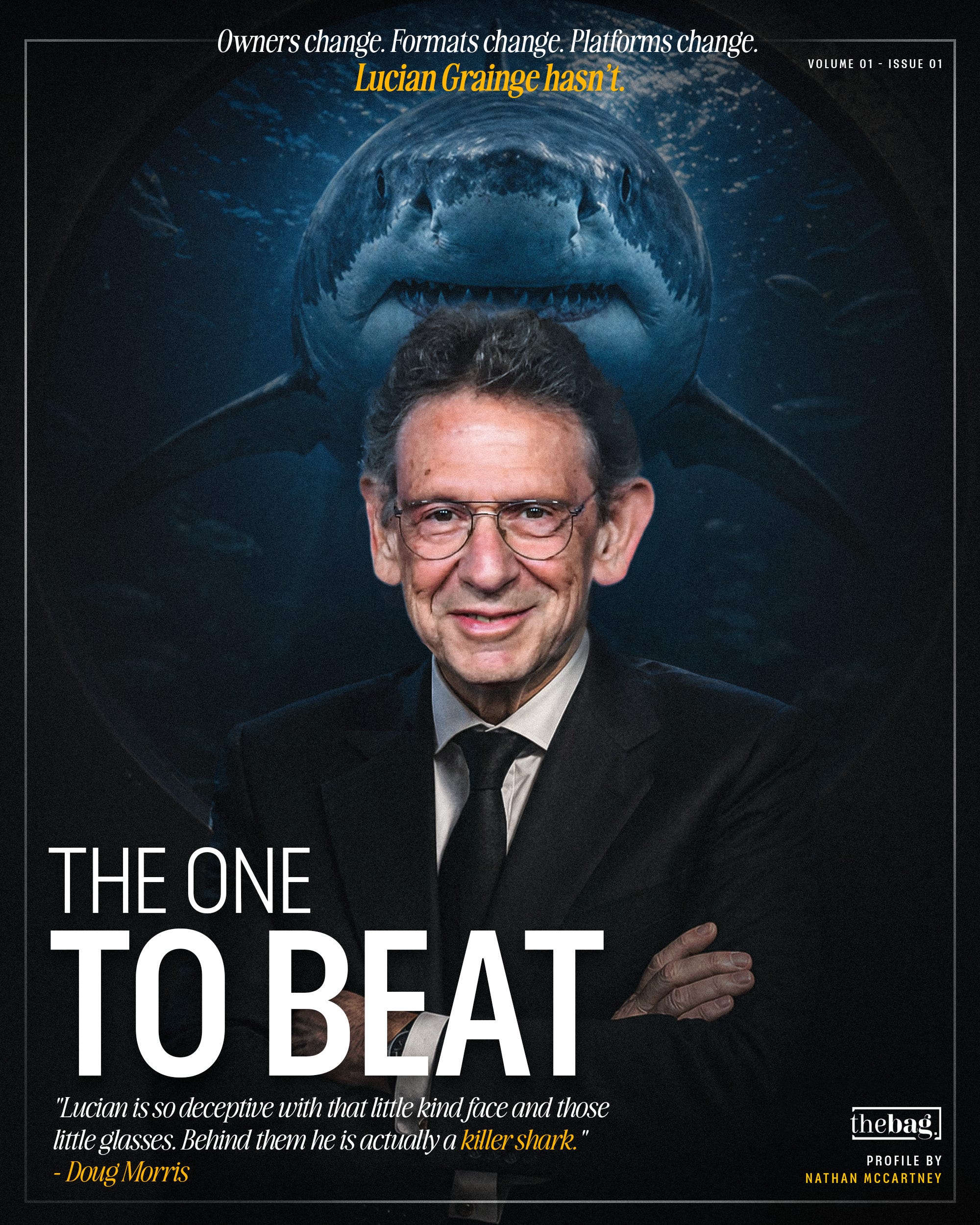
Doug Morris, who would precede him as Chairman and CEO of Universal Music Group, would later describe him as "a killer shark" behind a "deceptive… little kind face."
By 1982, Grainge was Director at RCA Music Publishing, where he signed the Eurythmics. By 1984, he was A&R Director at MCA Records. In 1986, he launched PolyGram Music Publishing UK and within five years had built it into a top-three presence in the British market. He was learning each layer of the business from the inside — publishing, A&R, label operations — and the only way to understand how they interact is to have been there when they break.
"I still see myself as a talent scout now," he said at GTC in March 2026. The career has run on knowing what the next scene will be.
The moment that revealed what that meant came in 1992.
ABBA had been finished for a decade. Their catalog was nostalgic product, the kind of thing that gets licensed for compilation albums and then forgotten. Grainge, working with John Kennedy and David Hockman, pushed for a relaunch.
ABBA Gold became one of the best-selling records in the history of the music business.
Björn Ulvaeus of ABBA: “We thought it was finished. I really believed that... I have to thank those guys. They saw something else.”
What they saw was simple. The recordings hadn't changed. The audience had. A song recorded in 1974 costs little to maintain. It can be licensed indefinitely. It can go quiet for a decade and come back larger than it left.
But it doesn’t come back on its own. Someone has to decide it should.
In 1993, he moved to Polydor, running A&R and Business Affairs, signing the Cure and the Cardigans.
That same year, his wife Samantha suffered an amniotic fluid embolism while giving birth to their son Elliot and fell into a coma.
“In the space of an hour,” he has said, “I lost my wife and became a father for the first time.”
She did not come out of it.
He raised Elliot.
By 1997, he was Managing Director of Polydor.
In 2002, Grainge — then Chairman of Universal Music UK — tried to sign Robbie Williams away from EMI. Williams stayed, signing a record-breaking £80 million deal. In a 2003 profile in the Financial Times, Sathnam Sanghera asked Grainge about it. "He's a great artist," Grainge said, "but we didn't think he was good enough for America. And he hasn't broken America."
In 2004, he called a meeting of his senior team. He arrived last. He sat in silence. Then he got up, walked to the wall, and switched off the lights.
“This is what’s going to happen to the company,” he said, “unless you get some hits and fucking fix file-sharing.”
Then he walked out.
Bono would later do an impersonation of the moment for a New Yorker reporter. Hits. Fix file-sharing. In that order.
By 2005, he had responsibility for all UMG operations outside the United States. In 2007, he made a deal with Nokia called Comes With Music. Buy the phone, get unlimited downloads for a year.
The resistance was immediate. Why give away thousands of dollars of music for a piece of hardware?
His answer was simple. The transaction model was already dead. The question was what replaced it.
Nineteen years later at the Nvidia GTC conference in March 2026, he called the Nokia deal “the equivalent of the Wright Brothers and the first aircraft of what became music in the cloud” — a subscription model that delivered unlimited access rather than selling songs by the unit. Nokia’s market was finite. The principle it demonstrated became the architecture of the industry.
He relocated to Los Angeles in 2009. The catalog and the artists and the money were in California.
The first time Daniel Ek came to see him, around 2009, Spotify was a Swedish startup that had not yet launched in the United States. Ek sought out Grainge specifically — the Nokia deal had established him as the executive who understood access models when almost nobody else in the business did. The major labels treated Ek with a combination of suspicion and contempt — understandable given what Napster had done, and strategically catastrophic given what Spotify was about to do.
Grainge, then running UMG's international operations, was the most receptive.
“I thought: OK, Sweden, interesting. European, just around the corner, anti-piracy. Fine, I’ll give it a go. I’m the hostess with the mostest. I would try anything. I’ll still try anything.”
As part of the early licensing agreements, the labels collectively took roughly 18% of Spotify's equity for a nominal sum — Sony BMG approximately 6%, UMG approximately 5%, Warner approximately 4%, EMI approximately 2%, alongside Merlin, the indie consortium. EMI's stake would later fold into Universal through the 2012 acquisition.
Then the door opened.
Alongside the licensing terms, Universal extracted a side agreement, signed in January 2011 through Ek’s holding company in Cyprus. Universal received the right to two percent of the total purchase price if Spotify was ever sold or taken public. Ek and his major shareholders signed personally.
Inside Spotify, they called it schmuck insurance.
The side agreement contemplated a traditional sale or IPO. When Spotify went public via direct listing in 2018 — issuing no new shares — the agreement appears never to have triggered.
The labels’ equity from the licensing agreements would still pay off.
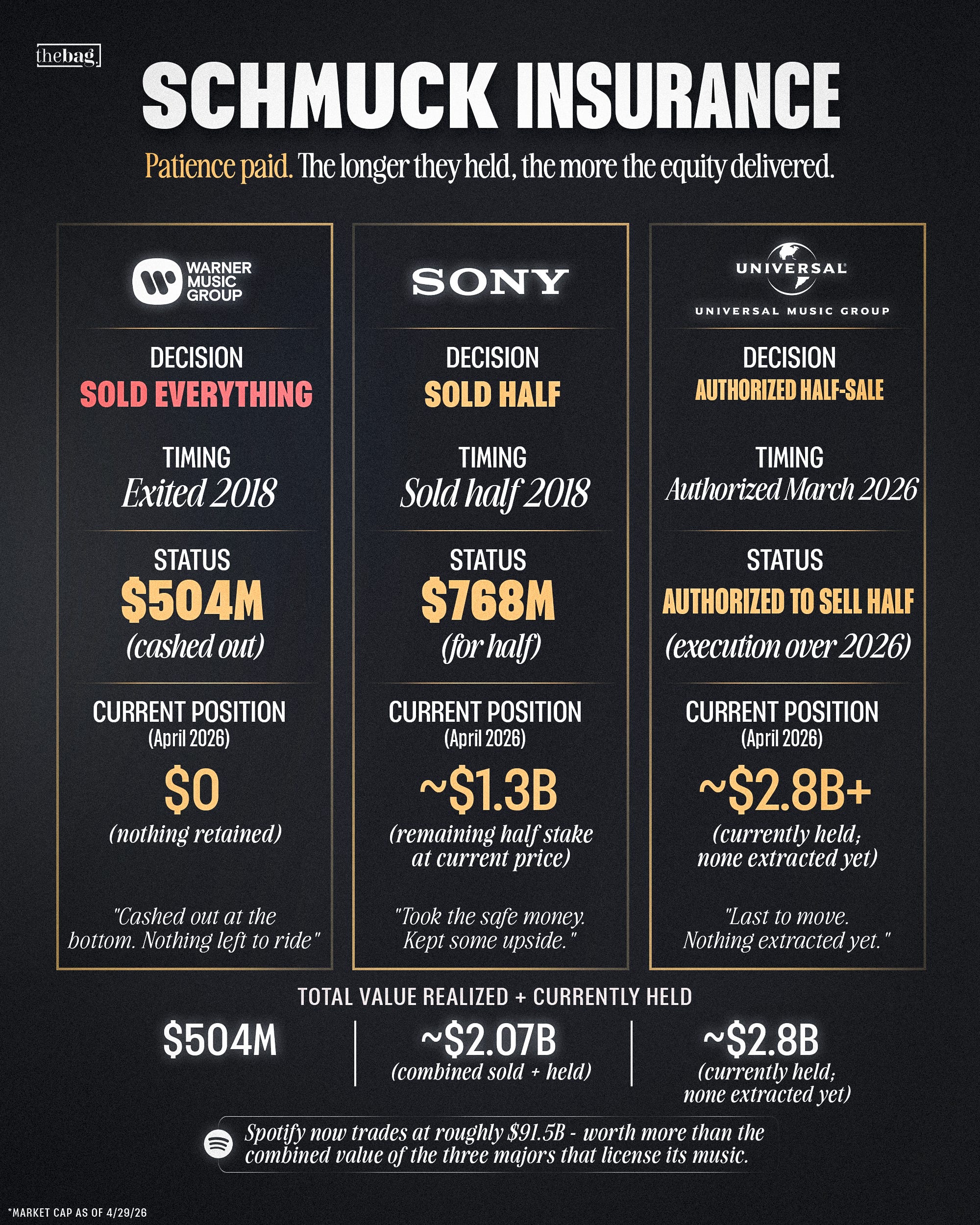
Universal’s 3.27% stake was worth approximately $3.4 billion as of April 14, 2026. Warner sold its entire stake in 2018 for $504 million. Sony sold half for $768 million and retained the rest. Universal held everything, until March 2026 — when the Board authorized monetizing half over the rest of 2026.
The side agreement never paid out. The equity did.
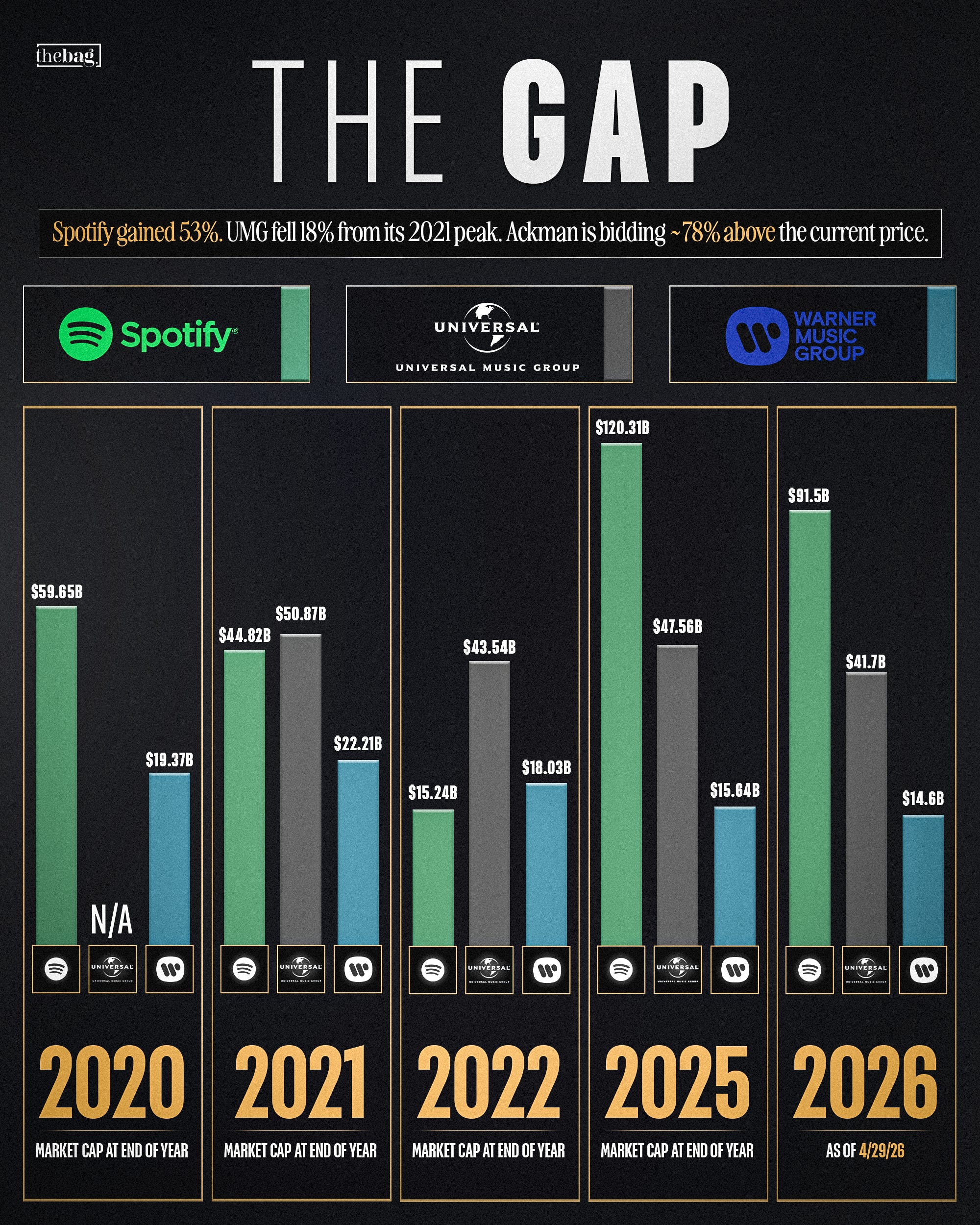
On April 28, 2026, Spotify reported Q1 earnings; the stock fell sharply. By the next day it was trading at $91.5 billion — the platform that licenses music from the three majors still worth more than all three combined.
Fifteen years before the equity bet paid off, Grainge had made the largest single bet of his career. EMI — home to the Beatles, Pink Floyd, and Coldplay — had passed through Guy Hands's disastrous leveraged buyout to Citigroup, which wanted it off its books. In November 2011, Grainge announced he would buy the recorded music division for $1.9 billion. The combined entity would control roughly forty percent of the global music market, a concentration regulators had never permitted.
George Martin, the Beatles' producer, called it "the worst thing that music has ever faced." Edgar Bronfman Jr., who had run Warner Music until earlier that year, warned it would create "one innovation-stifling dominant player."
Grainge sold off enough assets to satisfy the European Commission — Parlophone went to Warner, other labels dispersed — and closed the deal in September 2012. The nearly forty percent market share was the lever. It was also the gap Blavatnik would never close.
The mistake the labels had made for a decade was thinking the platform was the leverage. Grainge had figured out that the catalog was the leverage and the platform was the surface.
In June 2013, Ek’s partner went into labor. He was in the middle of a fraught license renewal. Grainge called and told him to go have his baby. The existing deal would renew as-is for two more months.
Ek said later,
"He had no financial reason for doing that. In fact, it would probably have been better for him to wear me out."
In March 2020, Grainge contracted COVID-19 and was admitted to UCLA’s intensive care unit. On his twentieth day there, doctors began removing him from the ventilator. He left the hospital a month later.
When he tried to stand, he fell twice.
“Like a sack of potatoes,” he would say.
Two security guards carried him home.
It took five months to recover.
“I’ve nearly died ten times,” he said afterward. “What’s there to be nervous about?”
He returned to a company navigating a pandemic that had eliminated live music revenue globally, an IPO of considerable complexity, and a TikTok relationship that would become the most significant test of his negotiating philosophy since Spotify.
On February 1, 2024, after licensing negotiations failed, he pulled Universal's entire catalog from TikTok. Artists protested. TikTok called the move self-serving. Months later, he settled on terms favorable to Universal.
When Universal removes its catalog, the platform goes silent. The copyright is the product. The platform is the surface it runs on.
If you own the best collection of music copyrights in the world, and you know how to work it — licensing it, withholding it, relaunching it, placing it in the right moment — you don’t negotiate the terms of the music business. You set them.
In March 2026, Grainge became the first music executive to appear at Nvidia's GTC conference.
"The difference that I see with AI," he said at GTC, "is it's going to also alter both creativity and creation and distribution."
Every prior shift — radio, vinyl, cassette, CD, MP3, streaming — had touched only distribution. AI can generate the recording. It can generate the artist.
The drum machine altered creativity. The Fairlight altered creation. The synthesizer altered both. AI alters all three at once. It can also generate the listener’s experience without the listener’s permission.
“I know that Taylor Swift’s voice shouldn’t be used on someone else’s music,” he said. “That’s the most important thing.”
He has been lobbying for a federal right of publicity. He has signed partnerships with Nvidia, Splice, Udio, Klay, Stability AI, BandLab, and Roland — the AI companies that have agreed to license rather than scrape. "I like two and two can equal seven," he has said of partnerships. The companies that haven’t are being sued.
"Hyper personalization," Grainge told the GTC audience, "is going to be a phenomenal opportunity."
Twenty million assets across recorded music and publishing. Four trillion minutes of audiovisual content. Music that finds you in the moment you need it.
"As you get older, you start to use your ears less," he said. "When I started I used my ears. Now I listen with my nose."
Weeks before Ackman’s bid, on the Q4 2025 earnings call, Grainge laid out the agenda. The Downtown acquisition, bringing four million creators across 145 countries into Universal’s infrastructure. Multiple India partnerships on a single slide. Direct-to-consumer infrastructure: more than 1,600 stores, Stationhead, the EVEN platform. The AI partnerships.
Four years earlier, on the Q4 2021 call, Grainge had told investors what Universal would not be:
“We’re not a financial player. We’re not a financial investor nor are we a new to the market fund on the hook to do deals of a set schedule. Further, unlike a fund, we will never sell or divest these rights.”
Ackman arrived five weeks after the 2025 call anyway. With buybacks. With leverage. With a relisting in New York.
Bill Ackman’s grandfather Herman co-wrote a song in 1926 on Tin Pan Alley. They called it “Put Your Arms Where They Belong (For They Belong to Me).” He sold his share to a music publisher for $150. It sold more than 750,000 copies.
Nearly a century later, Universal Music Group owns the recording.
When Ackman first approached Universal management about investing in 2021, he mentioned the song. Someone on the team found it in the catalog. They had two phonograph records and the sheet music mounted, framed, and sent to him.
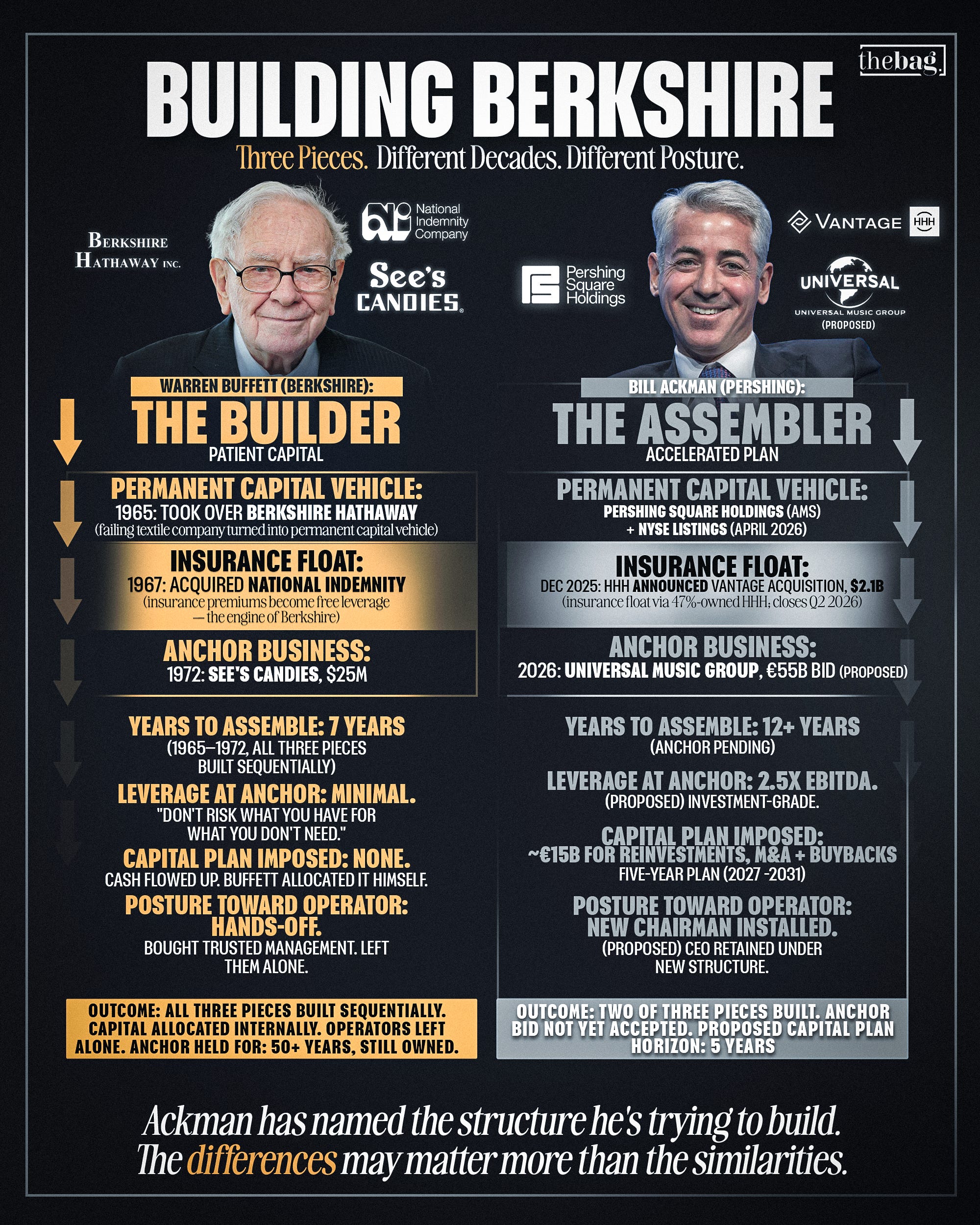
Ackman has spent the previous decade assembling what he calls a permanent capital structure — Pershing Square Holdings on Amsterdam, the Pershing Square USA closed-end fund and Pershing Square Inc. management company on the NYSE, Howard Hughes Holdings as the operating anchor, and through Howard Hughes a $2.1 billion acquisition of Vantage Insurance for the float. He has been preparing to anchor it with Universal.
He is the man who finds the misunderstood asset, constructs the thesis, takes the position, and waits. He is also the man who, when he first invested in 2021, received from the company a framed piece of his own family history.
Ackman grew up in Chappaqua, New York. His father, Lawrence, ran Ackman-Ziff Real Estate Group, a New York real estate financing firm. His mother, Ronnie, was a pianist and an active New York Philharmonic board member. Horace Greeley High School. Harvard undergraduate, class of 1988. Harvard Business School, 1992. He has been open about what his parents gave him: a $100,000 trust his father had settled on him at graduation, with his father telling him he would never inherit anything more.
The other thing his Harvard years gave him was Warren Buffett. At a HBS talk, Buffett told the room that if they wanted to be successful, they should look at the classmates they most admired and adopt the qualities they admired. Character, Buffett said, was something you could choose. Ackman has told this story for thirty years as the thing that set the arc.
In 1992 he founded Gotham Partners with his Harvard classmate David Berkowitz. By 1998 it had $500 million under management. By 2002 it was mired in shareholder litigation and had to be wound down. Berkowitz wanted out. Ackman started over.
That same year, he issued a 66-page report arguing that MBIA, the municipal bond insurer, was concealing structured-finance risk. He bought credit default swaps against its corporate debt and held the position for six years under investigation by Eliot Spitzer and the SEC. In January 2009, after MBIA’s stock collapsed in the financial crisis, he closed out for $1.4 billion in profit.
Pershing Square Capital Management launched in 2004 with $54 million. Over the next two decades it compounded at roughly 17% annually against the S&P 500's 10%. Burger King. Chipotle. Howard Hughes Holdings. He has also been wrong, publicly and expensively, on Valeant and Herbalife.
Beginning in late February 2020, weeks before global markets collapsed, he put $27 million into credit-default-swap protection on investment-grade and high-yield credit indices and unwound it for $2.6 billion. Weeks later, in the same conversation where he announced he was done with public short-selling, he gave the reason: return on invested brain damage.
What he had built by then was a structure, not a fund. In 2014 he listed Pershing Square Holdings on the Amsterdam stock exchange as a permanent-capital vehicle — 85% of his working capital, money that did not redeem monthly or quarterly. In December 2025, his 47-percent-owned Howard Hughes Holdings agreed to acquire Vantage Insurance for $2.1 billion, providing the insurance float. In April 2026 he listed both Pershing Square USA and Pershing Square Inc. on the NYSE in a combined IPO.
The pieces are not a coincidence. Ackman has said for years, in interviews and shareholder letters, that he is building a Berkshire Hathaway. Permanent capital, insurance float, an anchor investment in a business whose cash flows could be predicted with what he describes as very high confidence over a very long time.
The NYSE listing closed on April 29, 2026 — three weeks after the UMG bid landed. The IPO raised $5 billion, with a $2.8 billion cornerstone Ackman called the largest committed IPO order ever assembled. The structure wasn't aspirational by the time he knocked on Universal's door. It was three weeks from being live.
Ackman has been right about misunderstood assets before. He bought Canadian Pacific in 2011 when the rail network was the worst-performing major in North America, installed Hunter Harrison as CEO, and netted $2.6 billion when he exited in 2016.
He bought General Growth Properties out of bankruptcy and turned $60 million into $1.6 billion. The case for the bid is that Universal is mispriced for the same reason Canadian Pacific was — that operators inside a system rarely see what financial discipline imposed from outside can produce. The case against the bid is that the music business is not a railroad, and that the operator inside the system has spent fifteen years building something the discipline would dismantle.
He has named the target.
“I can’t think of an asset I’m more confident in being consumed over time,” he told shareholders in 2021. “You need food and water to live, but music comes next.”
Universal's Q4 2025 earnings presentation ran sixty-seven slides — the operating profile of a company still in the middle of a land grab Buffett built Berkshire over sixty years, one piece at a time. Ackman is doing it on a compressed timeline, with leverage, around a company whose CEO has spent the last fifteen years building.
Ackman arrived at the table in 2021, before the Amsterdam IPO, buying roughly 10% for around $4 billion. He joined the board. In March 2025 he sold part of the stake; in May he resigned from the board. Months later, he returned with a bid for the entire company.
He has seen how Grainge runs it.
He made the move anyway.
This week, on UMG’s Q1 2026 earnings call, Grainge declined to discuss the Pershing proposal directly. He said only that the Board would respond when it had made its decision. Then he disclosed what the Board had already done.
The €500 million buyback announced March 30 had been authorized alongside the monetization of half of UMG's Spotify equity to fund it — a sale UMG plans to execute over the rest of 2026. The Board has now doubled the authorization to €1 billion. The capital plan had been authorized a week before Ackman's letter arrived.
Grainge added one line, not on the proposal:
“Over the years, my management team has built what is unquestionably the most successful music company in history.”
Grainge does not have a social media account. He operates through private meetings, closed negotiations, and the accumulated authority of someone who has been doing this since 1976.
He extracted a side agreement from Spotify in 2011. He pulled the catalog from TikTok in 2024. The people inside Universal have spent their careers inside a company that works this way.
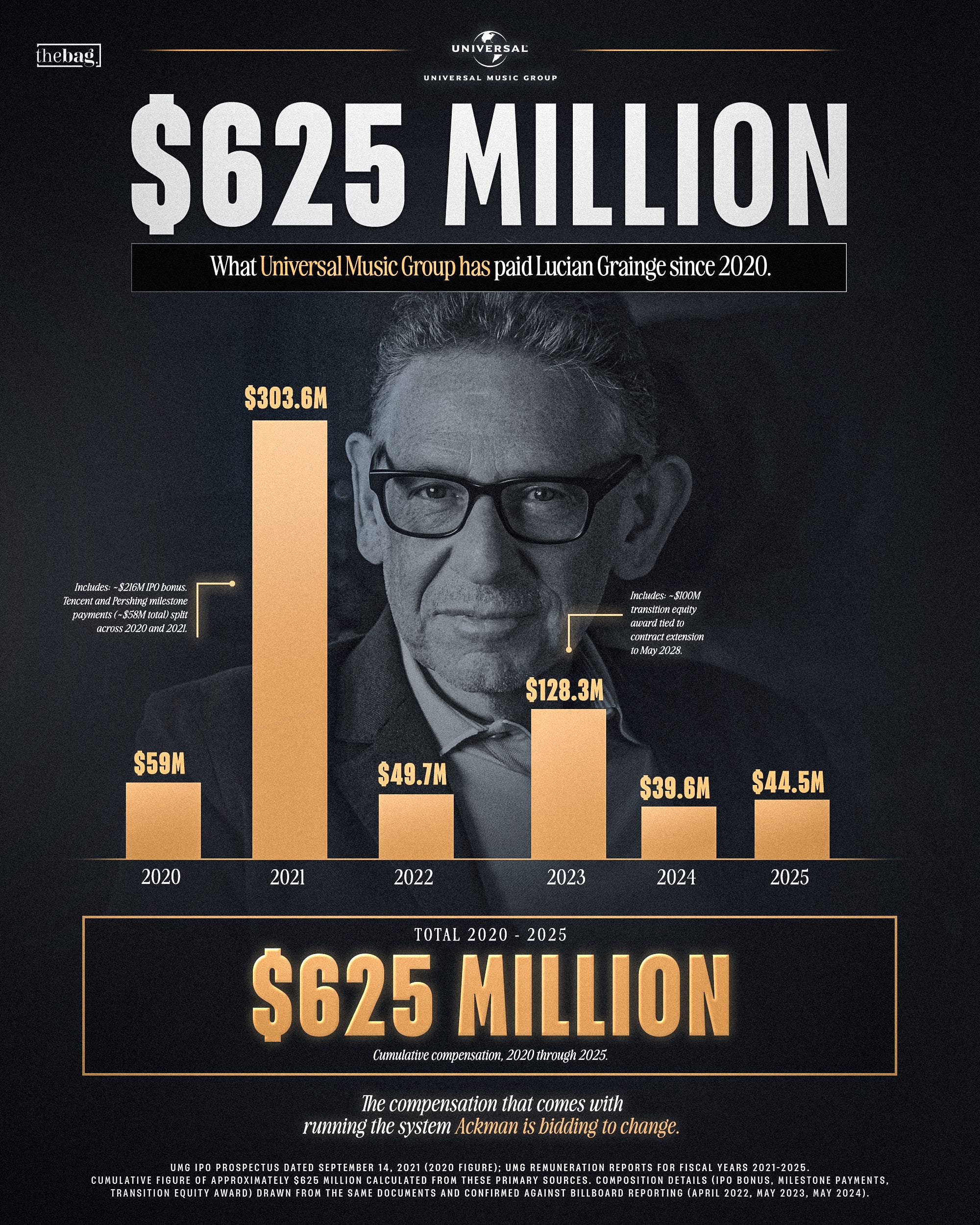
The system pays him for what it gets. Per UMG’s IPO prospectus and subsequent Remuneration Reports, Grainge’s cumulative compensation from 2020 through 2025 totaled approximately $625 million — including a one-time bonus of approximately $216 million paid by Vivendi at the September 2021 listing, milestone payments of roughly $58 million across 2020 and 2021 for delivering the Tencent and Pershing strategic investments, and a $100 million transition equity award in 2023 tied to a contract extension that runs to May 2028.
The man Ackman is proposing as his board chair has spent his career trying to be the kind of operator Grainge became.
Michael Ovitz had spent the years after Disney trying to undo Michael Ovitz. A management company collapsed. An NFL-to-Los Angeles push with Ron Burkle ended in a falling-out. An investment in Livent ended with Garth Drabinsky indicted on sixteen counts of fraud. By 2002 he was mostly out of Hollywood.
He went to Palo Alto. He invested in Palantir through Broad Beach Ventures, advised Palantir CEO Alex Karp and helped negotiate early commercial contracts. Palantir is now worth over $300 billion. He made money on Andreessen Horowitz’s fund investments and absorbed the AI thesis at close range.
In his 2018 memoir he wrote:
“I was a control freak. A shape-shifting machine. A Terminator. That was the image I took great care to project, anyway. It was an image I grew to hate.”
In Vanity Fair, after AMG’s collapse in 2002: “I’ve had it, and I don’t want to be in the center of the hurricane. I want to be creating the hurricane.”
Bernie Brillstein, the Hollywood manager asked in the same piece what Ovitz wanted more than anything: To be Mike Ovitz.
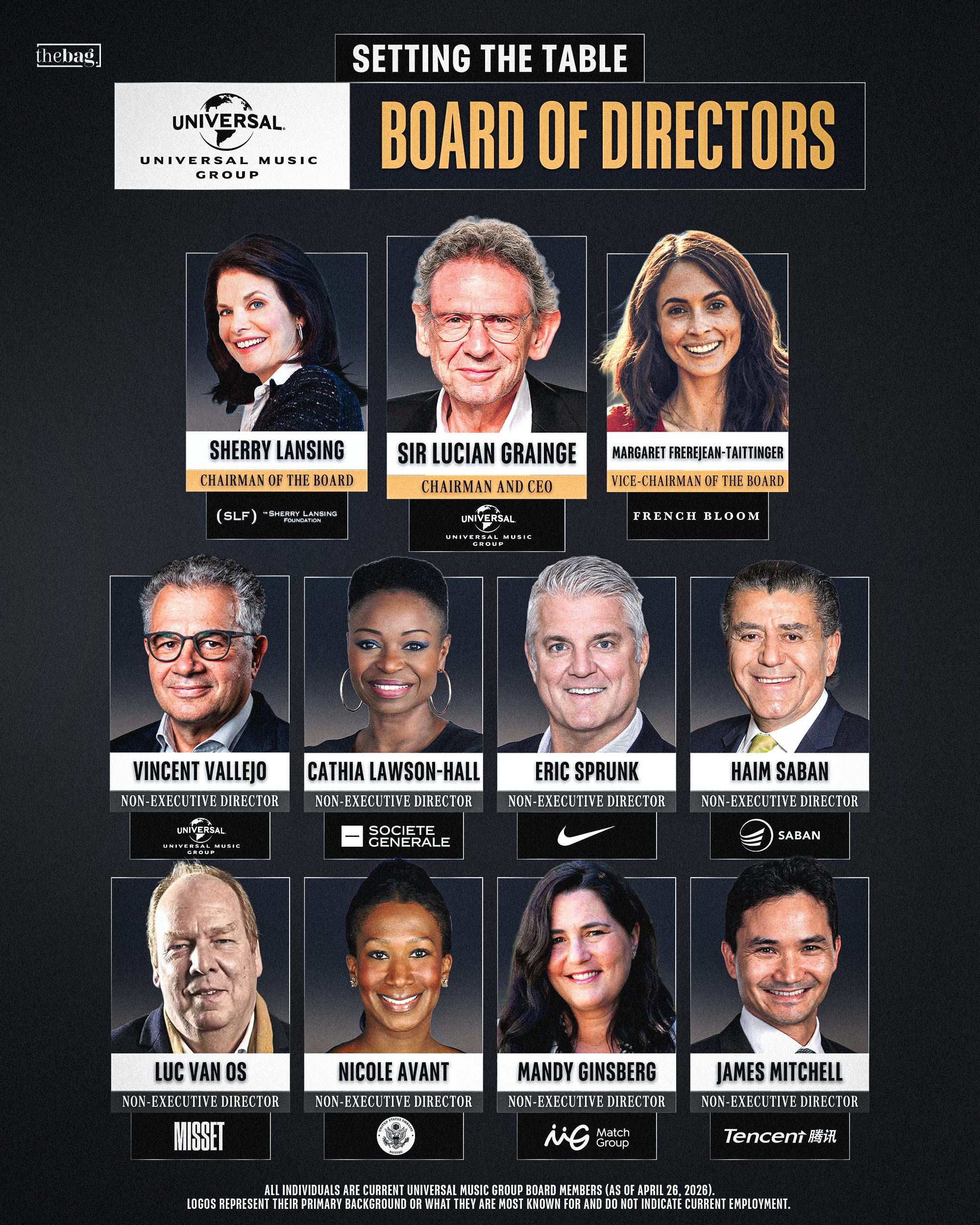
In January 2023, Sherry Lansing was named Chairman of the Board of Universal Music Group. She was seventy-eight, a former chairman and CEO of Paramount, and before that, in 1980, the first woman to head production at a major Hollywood studio. She had known Michael Ovitz longer than she had run anything.
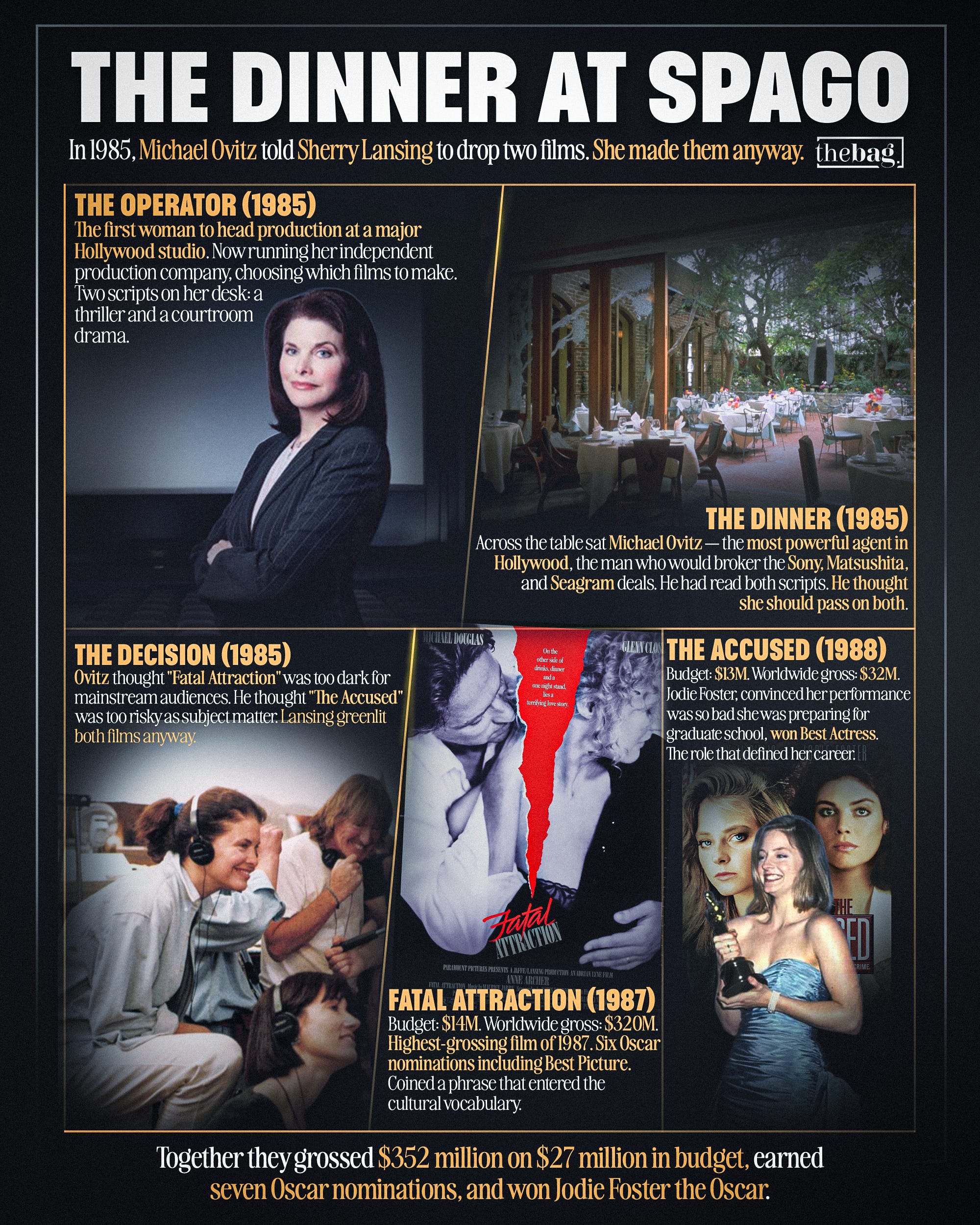
In 1985, she and Stanley Jaffe were running an independent production company at Paramount with two projects no one would green-light. Ovitz, at the peak of his CAA power, took them to dinner at Spago. He sat them in a corner booth facing the Sunset Strip, gestured at the billboards for other people’s movies, and told them to drop the projects and make an Eddie Murphy comedy. He offered Martin Scorsese as his example — a client whose instincts he had, he said, “switched around.”
The two projects were Fatal Attraction and The Accused.
Walking out of Spago, Jaffe told her he wanted to cut his throat. Lansing felt the same. They made the films anyway. Fatal Attraction was nominated for Best Picture. The Accused won Jodie Foster an Oscar. In 1992, Paramount made her Chairman. She ran it for twelve years.
She left Paramount in 2005 on a timeline she set herself. She co-founded Stand Up to Cancer. She sat on the UC Board of Regents for twenty-three years.
Lansing took the UMG chair in January 2023. Two months later, when the board extended Grainge’s contract through 2028, she said he was “just the one” to keep building UMG. In January 2026, three months before Ackman’s letter arrived, she presented Grainge with the No. 1 spot on Billboard’s Power 100 and said:
“The only thing harder than becoming No. 1 is staying No. 1.”
Sherry Lansing, asked about Ovitz by Vanity Fair in 2001 — a quarter-century before any of this — said:
“My dealings with him have always been excellent. No complaints. None whatsoever.”
In April 2026, Bill Ackman proposed replacing her with the man from Spago.
TheWrap’s Sharon Waxman has reported that it was Ovitz who proposed to Ackman that he buy the whole company. Whether or not the idea originated with Ovitz, the rest is on the record.
Ackman had been ready to sell. His 10% stake, taken from Vivendi in 2021 after the Pershing Square Tontine SPAC collapsed under SEC pressure, had sat on a stock that fell 23% from its Amsterdam debut while global indices rose 55 to 60%.
He had joined the UMG board at the IPO. In March 2025 he sold a 2.7% stake; in May 2025 he resigned from the board. He had advocated, persistently, for moving the listing to the New York Stock Exchange — arguing that the move would unlock US-indexed passive capital that currently can't hold a foreign-listed stock, forcing inflows from BlackRock, Vanguard, and Fidelity once UMG became S&P 500-eligible.
Instead of selling, he made an offer for the whole company. The pitch, whoever originated it, was structural. Buy the company. Re-incorporate in the US. Relist it in New York. Install new leadership in the chair seat. Keep Grainge.
The bid, sent to the UMG board in early April 2026, was €55 billion — a 78% premium, €5.05 per share in cash plus 0.77 shares of a new US-listed entity. The capital allocation plan from the investor call would govern the new entity. The re-incorporation would move UMG from a Dutch company on Euronext Amsterdam — where shareholders enjoy substantial protections under Dutch and EU corporate law, including the supervisory authority of the Dutch Enterprise Chamber — into a Nevada corporation listed on the New York Stock Exchange.
Nevada has no equivalent of the Delaware doctrine that requires boards in a sale to maximize shareholder price. Nevada Revised Statutes 78.138(7) sets the standard for director liability higher than Delaware’s, requiring proof of intentional misconduct, fraud, or knowing violation of law. The migration from Delaware to Nevada accelerated after the Delaware Court of Chancery’s January 2024 ruling that rescinded Elon Musk’s $56 billion Tesla compensation package. The shift, in practice, reduces what minority shareholders can challenge.
Ovitz would become Chairman of the Board, replacing Lansing. Grainge, whom Ovitz has reportedly met only a couple of times, would remain CEO.
The contrast between Grainge and Ackman extends past how they operate. It extends to how they think.
In July 2025, Ackman played tennis in the Hall of Fame Open in Newport, Rhode Island, an ATP 125 tournament held annually at the International Tennis Hall of Fame. He had arranged the appearance through X — reposted a Nick Kyrgios highlight, exchanged DMs with Kyrgios, agreed to partner with him at a tournament. When Kyrgios got injured, Jack Sock — the former world No. 8 who had retired from singles two years earlier — invited Ackman to take Kyrgios's place on Sock's wildcard entry. The day before the match, Ackman was posting about New York politics, the Middle East, and Jeffrey Epstein. He and Sock lost their first-round match in straight sets to Bernard Tomic and Omar Jasika.
Andy Roddick — 2003 US Open champion, former world No. 1 — called it “the biggest joke I’ve ever watched in professional tennis” on his podcast. His objection wasn’t the loss. It was the wildcard. ATP wildcards are scarce, fought over by tour pros and rising young Americans who need the ranking points and exposure. Ackman, a longtime donor to the Hall of Fame, had been given one.
Ackman wrote thousands of words about the experience afterward. He described his body freezing, the difference between speaking to a thousand people and playing in front of a few hundred. He argued that the pros taking it easy on him had actually made the match harder. He offered the International Tennis Hall of Fame a $10 million endowment. They declined. He redirected the money to the Junior Tennis Champions Center in Maryland, where Frances Tiafoe, the American Top 20 player and two-time US Open semifinalist, had trained as a child.
“What people are missing,” he wrote, “is that the whole thing worked out perfectly.”
Ackman’s confidence in the bid runs on the same logic. But the people who will actually decide it are not on UMG’s board.
The actual gatekeepers are the Bolloré family.
Vincent Bolloré, the French industrialist whose family company holds the controlling stake in Vivendi, took control in 2014 and spent eleven years restructuring it — separating Canal+, Havas, Louis Hachette, and the smaller industrial holdings into independent companies in December 2024.
He is not a passive holder. He is an operator who has held UMG through every approach since taking control — including the 2018 partial-sale solicitation, the Tencent tranches, the Amsterdam listing, and the 23% stock decline that followed. Whether they accept €30.40 per share now is the first question.
On April 29, Ackman told CNBC he “would not have gone forward with this transaction” without “at a minimum, a nod of interest from the French.” The Bollorés have not confirmed.
The second is whether the deal can clear a two-thirds vote of UMG’s outstanding shares. The Bolloré family’s voting stake combined with Pershing Square’s holding totals roughly a third.
The remaining two-thirds is held by Tencent, institutional investors including BlackRock, Vanguard, Capital Group, and Norges Bank, and retail shareholders. Tencent has held quietly for six years. The index funds and the sovereign wealth fund weigh ISS and Glass Lewis recommendations heavily on governance votes — and a deal re-incorporating a European company in Nevada specifically to weaken shareholder protections is exactly the kind of vote where proxy advisors push back. The math is not obviously in Ackman's favor.
Bid premiums of 78% have closed at lower thresholds before. They have also failed at higher ones. The structural critique — that the Nevada migration is the price shareholders are being asked to pay for the premium — is the argument this transaction will be about.
What Ackman is buying, if he closes, is the right to operate Universal differently than Grainge has. The bid is a wager that the system Grainge built can be converted into a financial instrument without losing what made it worth €55 billion in the first place. Nearly every prior outside investor who tried to operate it lost. Every one who held and got out of the way made money.
The man Ackman is bringing with him has spent his career on the wrong side of that line.
In 1990, Ovitz brokered the sale of MCA to Matsushita for $6.6 billion. In 1995, he brokered Matsushita's sale of MCA to Seagram for $5.7 billion. He brokered the same studio twice, five years apart, from the same seat in the middle.
Lansing called Grainge “just the one.” Ovitz wanted to be Wasserman.
The person who brokers the deal is rarely the one who runs the company.
He is now attempting to falsify it.
Ovitz is trying to become the operator at seventy-nine. Elliot Grainge grew up inside the music business in a way very few people do — not studying it, not interning in it, but living adjacent to the person running the largest version of it in the world. He absorbed what his father understood: that copyright is leverage, and leverage is the business. When he started 10K Projects in 2016, he was not starting from zero.
Len Blavatnik's son Val, on the Warner board, watched something else. He watched his father buy Warner Music Group, apply a financial framework, make money, and lose the structural race to Grainge in the same transaction.
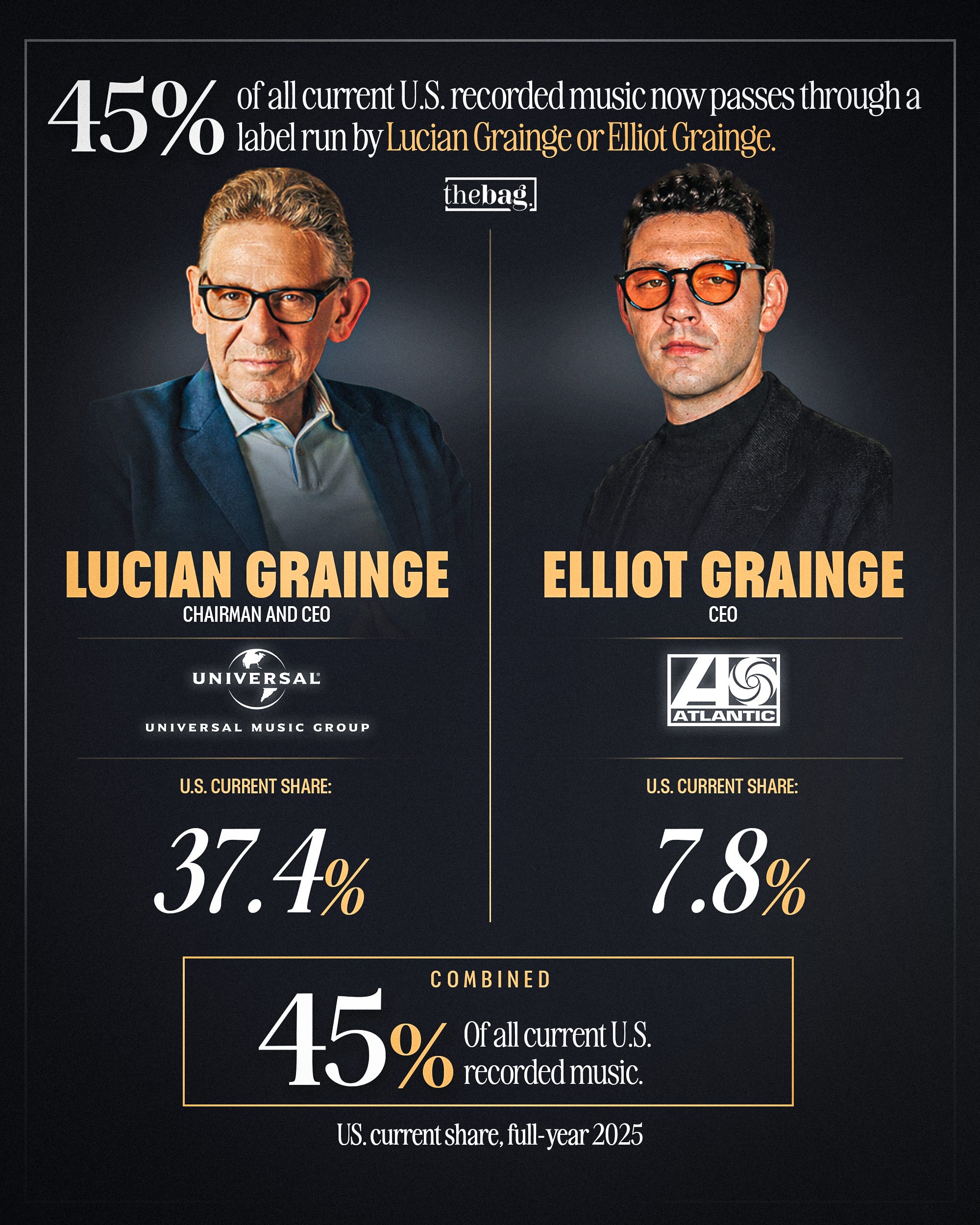
Elliot now runs the flagship label of the competitor his father’s company spent fifteen years out-performing. In 2025, Atlantic’s current share jumped from 5.7 percent to 7.8 percent — the label’s biggest single-year rise in years.
His path to Atlantic ran through his father’s IPO. Before Universal’s 2021 Amsterdam listing, UMG’s distribution relationship with 10K was a private operational matter. After the IPO, related-party transactions became disclosable — visible in annual filings, subject to audit-committee review. Warner bought 51 percent of 10K Proejcts in September 2023 for $102 million. Whether the sale was a response to the new disclosure regime or a straightforward commercial deal is not on the public record. What is on the record is the sequence.
By year-end 2025, Universal's U.S. current share was approximately 37.4 percent. Atlantic's was approximately 7.8 percent. Combined, nearly 45 percent of every U.S. current recorded music release now passes through a label run by Lucian Grainge or his son.
Billboard’s framing in August 2024:
“Never in modern history have a father and son been CEOs of a global music company and a major label music group simultaneously.”
At the 2025 Grammys, Elliot sat in Atlantic’s private box eating chicken fingers with Val while Chappell Roan used her Best New Artist speech to demand that labels provide healthcare and a livable wage to developing artists. Roan had been signed to Atlantic as a teenager and broken through as a major pop star after signing with Island, a Universal label. Atlantic had dropped her years before Elliot arrived.
Elliot and his father talk Arsenal and old records. They do not discuss the specifics of each other’s companies.
“We separate it like church and state,” he has said.
The son who grew up watching his father build the world’s largest music company now runs a division of his father’s competitor.
Nigel Grainge died in June 2017, days before Lucian received the Media Person of the Year award at Cannes Lions. He dedicated the award to his brother.
Nigel had made the deal that got Lucian close to the stage at the Roundhouse in 1976. He showed him that the business runs on relationships. And that relationships are made by people who pick up the phone.
Bono has known Grainge for decades. At a charity event, he said of him:
“He’s a ruthless fucker… but he’s got good ears.”
The ears are half of it. The other half is knowing what to do with what you hear — when to withhold the catalog, when to license it, when to relaunch it, when to take equity instead of cash. Matsushita never learned. Messier never tried. Guy Hands thought it was a cost problem. The Bronfmans built the company and sold it anyway. Len Blavatnik generated a strong financial return at Warner. Grainge built the structural lead anyway. Len and Val hired the son of the man who has both halves, betting it runs in the family.
The bet is on the operator. But the operator is betting on the catalog.
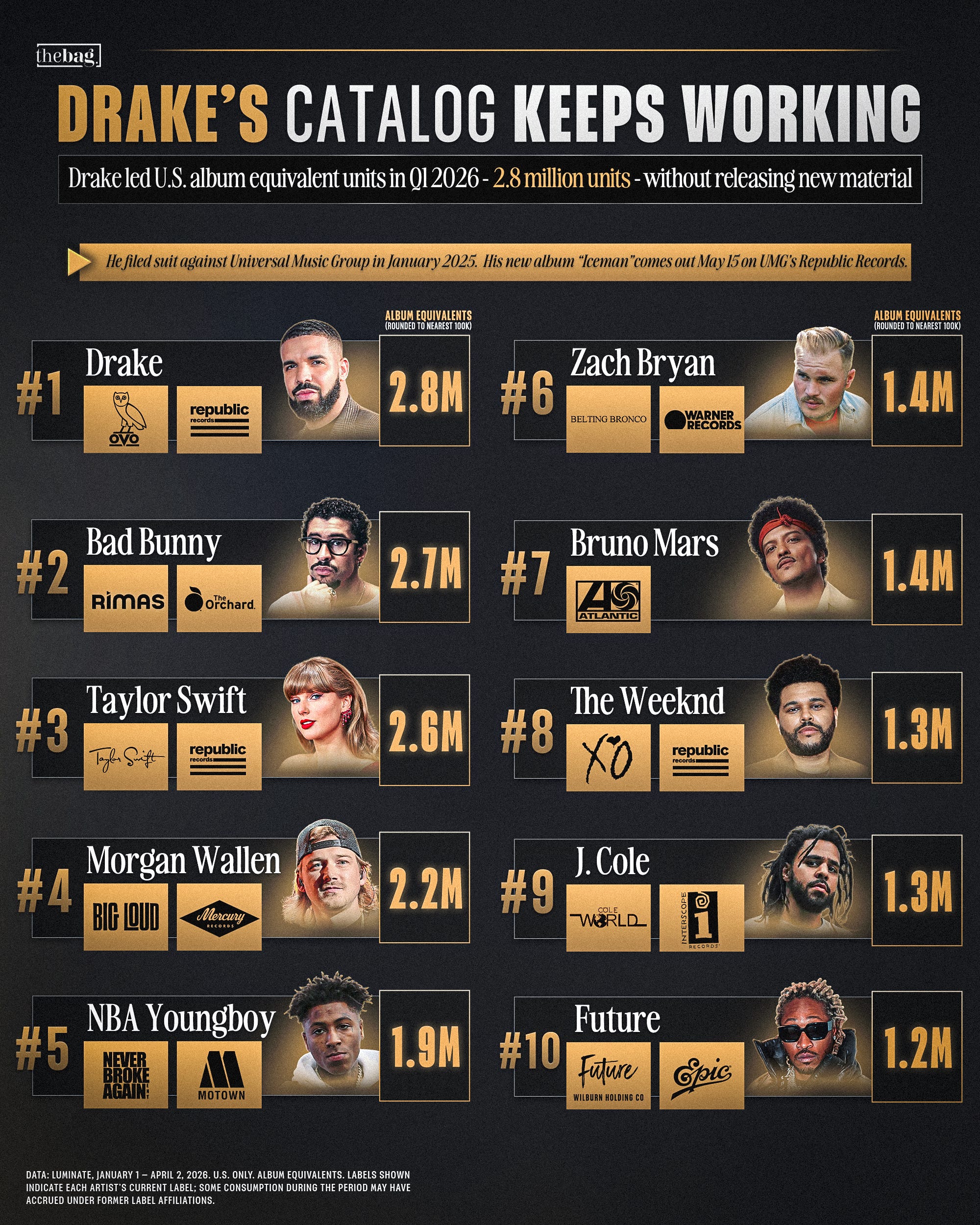
Between January 1 and April 2, 2026, Drake was the leading artist in the United States by album equivalent units — 2.8 million, according to Luminate data. He had not released a new album. His catalog was doing what good catalogs do — finding new listeners, being rediscovered by old ones, appearing in the moments that make up most of how people actually listen.
The catalog was working. The relationship was not.
In January 2025, he filed suit against Universal Music Group itself — alleging bot-driven streams for Kendrick Lamar's "Not Like Us," preferential Spotify treatment, and a payola-style influencer campaign. UMG called the suit a “misguided attempt to salve his wounds.” Judge Jeannette Vargas of the Southern District of New York dismissed the case in October 2025. Drake appealed. UMG's appellate response in March 2026 called the appeal "astoundingly hypocritical."
Through all of it, UMG said publicly it remained committed to propelling his career. For ten consecutive years, Drake had accounted for at least 1.9% of UMG's total U.S. consumption; he had reportedly signed a contract extension worth more than $400 million in 2022.
Even through the litigation, the catalog keeps growing. What “Marvin’s Room” does to someone at 2am operates independently of whatever is happening between the artist and the institution that holds the masters.
Drake sued. Ackman bid. Grainge answered.
Every buyer has believed they were different. The catalog outlasted them.
Grainge has too.
Notes on Sources
Confidence Game: How a Hedge Fund Manager Called Wall Street’s Bluff — Christine Richard (Wiley, 2010). Source for: Gotham Partners’ founding with David Berkowitz in 1992, the wind-down in 2002, and the 2002 MBIA short (the 66-page report, the credit-default-swap position held for six years, and the January 2009 close-out for $1.4 billion in profit).
Fortune’s Fool: Edgar Bronfman, Jr., Warner Music, and an Industry in Crisis — Fred Goodman (Simon & Schuster, 2014). Source for: David Geffen’s “chicken salad / chicken shit” line advising Bronfman on PolyGram versus EMI in early 1998 (p. 94); the PolyGram acquisition mechanics including the Tropicana sale to PepsiCo for $3.3 billion; the Seagram-Vivendi transaction at approximately $34 billion; Messier’s tenure, his “master of the world” self-styling, the J6M nickname, the Park Avenue apartment, and the ouster; the post-ouster severance dispute and SEC intervention; and the Vivendi-era financial collapse (~€35 billion in gross debt by mid-2002 and €23.3 billion in losses for the year).
Leading Lady: Sherry Lansing and the Making of a Hollywood Groundbreaker — Stephen Galloway (Crown Archetype, 2017). Source for: the 1985 Spago dinner with Ovitz, including Jaffe’s “cut throat” line and Ovitz’s Scorsese example about “switching around” commercial instincts; the Fatal Attraction and The Accused sequence; Lansing’s appointment as Chairman of Paramount Motion Picture Group in 1992 and her twelve-year tenure; and her 2005 departure on a self-set timeline.
Steve Jobs — Walter Isaacson (Simon & Schuster, 2011). Source for: Jimmy Iovine’s “How Sony missed this is completely mind-boggling to me, a historic fuckup” quote, said to a colleague after Jobs demonstrated an iTunes beta in 2002.
The Spotify Play: How CEO and Founder Daniel Ek Beat Apple, Google, and Amazon in the Race for Audio Dominance — Sven Carlsson and Jonas Leijonhufvud (Diversion Books, 2021). Source for: Lucian Grainge’s May/June 2011 demand for 10% of Spotify in exchange for US licensing; the resulting “Exit Payment Agreement” of January 25, 2011 — the side agreement Spotify insiders called “schmuck insurance” — entitling Universal to 2% of any sale or listing price, signed personally by Ek and his major shareholders through Ek’s holding company in Cyprus; and the source-attributed account that the agreement was never triggered when Spotify went public via direct listing in April 2018.
Who Is Michael Ovitz?: A Memoir — Michael Ovitz (Portfolio/Penguin, 2018). Source for: the David Ovitz / Seagram favor and the 1985 appointment with Bronfman at the Seagram Building; the fourteen trips to Osaka under the “Mr. Nelson” code name; the Kahala Hilton three-day “social staring contest” sequence; Hirata’s chateaubriand-table question; the Brink’s truck of gold request; the November 1990 close at $6.6 billion and CAA’s $60 million in fees; Wasserman and Sheinberg turning their backs at the Universal studio gate; “He never forgave me for saving him on someone else’s terms”; Herb Allen’s insistence on Ovitz’s involvement in the 1995 Matsushita exit; the $5.7 billion Seagram close; the MCA equity negotiation at five percent (~$330 million) and its collapse; Ron Meyer taking the COO seat; the Eisner Disney offer and the fourteen-month tenure; and “I was a control freak. A shape-shifting machine. A Terminator. That was the image I took great care to project, anyway. It was an image I grew to hate.”
Billboard — Power 100 ceremony, January 2026, with Sherry Lansing presenting Grainge with the No. 1 spot. Source for the Lansing remarks: "The only thing harder than becoming No. 1 is staying No. 1." Also: August 2024 coverage of Elliot Grainge's appointment as CEO of Atlantic Music Group, source for the "Never in modern history have a father and son been CEOs of a global music company and a major label music group simultaneously" framing.
Evening Standard — “Lucian Grainge: British pop maestro taking on the world,” April 11, 2012. Source for: Grainge’s habit of visiting record shops in the Midlands and assessing what people were wearing and what they wanted; the framing that the retail floor never stopped being his data.
Financial Times — Sathnam Sanghera, “Lucian Grainge,” FT Creative Business, November 11, 2003. Day-in-the-life profile conducted at Grainge’s home, the Universal Music UK offices in Hammersmith, and the Mercury Music Awards. Source for: the Robbie Williams quote (”He’s a great artist, but we didn’t think he was good enough for America. And he hasn’t broken America.”); and Doug Morris’s “killer shark” quote in its earliest published form (”Lucian is so deceptive with that little kind face and those little glasses. Behind them he is actually a killer shark”).
FT Magazine — Anna Nicolaou and Andrew Edgecliffe-Johnson, “The last mogul: an interview with Universal Music’s Lucian Grainge,” September 16, 2021. Conducted at Grainge’s Pacific Palisades home roughly six weeks before the September 2021 Amsterdam IPO. Source for: the COVID details (UCLA intensive care unit, twentieth day when ventilator removal began, leaving the hospital a month later, falling twice trying to stand, “like a sack of potatoes,” two security guards carried him home, five months to recover, “I’ve nearly died ten times. What’s there to be nervous about?”); Grainge’s “hostess with the mostest” quote on first encountering Spotify; Guy Hands’s “If we still owned EMI today we’d be a seller at nine times our money” quote; George Martin’s “the worst thing that music has ever faced” quote on the EMI acquisition; Bronfman’s “one innovation-stifling dominant player” warning on the EMI deal; the SoftBank $8.5 billion failed-bid figure; and Doug Morris’s “killer shark” framing of Grainge.
The Guardian — Mark Sweney, “’Ruthless but good ears’: Lucian Grainge is key architect of music industry revival,” September 21, 2021. Primary source for Bono’s “He’s a ruthless fucker… but he’s got good ears” quote, delivered at a charity event celebrating Grainge’s three decades in the industry.
HITS Daily Double — “Sir Lucian Grainge: The Architect of Change,” Rain Makers profile series, c. 2018. Source for: the cold-calling-from-the-Music Week-directory origin and Maurice “Obie” Oberstein at CBS Records UK as the first label head to take Grainge’s call; the £400 figure for the 1979 Psychedelic Furs publishing deal; Oberstein’s “talk to the hat” method as the precedent for Grainge’s lights-off meeting; Doug Morris’s “killer shark” quote in full (”He is so deceptive, with that little kind face and those little glasses. Behind them, he is actually a killer shark”); and Bob Geldof’s corroborating “He’s a ruthless fucker — but he’s got good ears” assessment. Year-end 2025 distribution and label-group market share data also from HITS Daily Double — see Industry Data below.
Hollywood Reporter / Billboard — Jem Aswad and Shirley Halperin, “Fueled By Ramen Founder John Janick Jumps Ship to Interscope Geffen A&M,” October 4, 2012, for the announcement and the three-day gap from Lyor Cohen’s exit from Warner. Tim Ingham, “’I’m an entrepreneur… and I don’t like to lose,’” Music Business Worldwide, June 20, 2017, for Iovine’s twenty-minute-meeting offer to Janick. Ed Christman and Shirley Halperin, “Life After Jimmy Iovine: the John Janick Era Begins at Interscope,” The Hollywood Reporter / Billboard, June 6, 2014, for Blavatnik and Cooper’s executive salary discipline driving Janick out of Warner and Universal outspending Warner.
Los Angeles Times — Family profile of Lucian and Elliot Grainge, April 21, 2023. Source for Elliot Grainge’s “We separate it like church and state” framing.
Music Business Worldwide — Tim Ingham reporting drawing on the December 2008 Luxembourg financial filing surfaced by MBW. Source for: the original 2008 equity grants to the four majors and Merlin in exchange for 352,176 shares at a total cost of €8,804.40 (Sony BMG 6%, UMG 5%, Warner 4%, EMI 2%, Merlin 1%, totaling 18%).
The New Yorker — John Seabrook, “Inside the Music Industry’s High-Stakes A.I. Experiments,” January 29, 2024 (print edition February 5, 2024, “The Next Scene”). Conducted at UMG’s Santa Monica headquarters in November 2023. Source for: Björn Ulvaeus’s “I have to thank those guys. They saw something else” reflection on the 1992 ABBA Gold rebranding (with John Kennedy and David Hockman as Grainge’s collaborators); the 2004 lights-off meeting in the London boardroom, with the verbatim quote “This is what’s going to happen to the company unless you get some hits and fucking fix file-sharing”; Bono’s lights-off impersonation; the 1979 Maurice Oberstein hire at CBS Records UK; the A-level red-shoes walkout and the producer signing later that day; the 1979 Psychedelic Furs publishing-deal signing motivated by the unreleased song “Sister Europe”; Daniel Ek’s account of the 2013 license-renewal call when his partner was about to give birth, with Grainge’s “Go have your baby” intervention and Ek’s “He had no financial reason for doing that. In fact, it would probably have been better for him to wear me out” reflection; Grainge biographical details including first wife Samantha Berg’s name and her years in a coma; Elliot Grainge’s “We’re not from Hollywood” / “village mentality” framing of his father; Bronfman’s “I would take ‘innovation-stifling’ out” recantation of his 2012 testimony; the Cecil Grainge “GrAInge” North London record-shop biographical detail with the spooky “AI” capitalization; “In the space of an hour, I lost my wife and became a father for the first time”; Grainge’s “I’ve always been able to smell intuitively what the next scene is… That’s all I am — a talent scout” quote; the 2007 Nokia “all you can eat” deal as an early access-model precedent; and the framing of Grainge’s relationship to AI deepfakes (”I haven’t spent forty-five years in the industry just to have it be a free-for-all where anything goes”).
The New Yorker — Connie Bruck, “The Billionaire’s Playlist,” January 20, 2014. Source for: Blavatnik’s 2004 Warner Music consortium investment alongside Thomas H. Lee Partners, Bain Capital, and Providence Equity Partners ($2.6 billion from Time Warner); Scott Sperling’s public statement that he did not expect an immediate upturn in the recorded music market; Blavatnik’s 2008 step-off from the Warner board with a retained two percent stake; the May 2011 full acquisition for $3.3 billion; the 2011 London town-hall and the “Even though it’s the music business, it’s still business. We should be making money” line; Stephen Cooper’s Enron and Krispy Kreme background and his appointment as Warner chairman and elevation to CEO; the seven-year-vesting equity structure replacing performance bonuses; the “real-estate play” friend quote; and Irving Azoff’s “Lucian is playing the market-share game. He’s killing it on the new artists” and Ken Moelis’s “Len didn’t even lose when he lost” framings.
TheWrap — Sharon Waxman, “Michael Ovitz Wants Back in Hollywood — Will It Let Him In?”, April 14, 2026. Source for: Ovitz proposing the full UMG takeover to Ackman; the structural pitch (buy the company, re-incorporate in the US, relist on the NYSE, install new chairman, keep Grainge); and Ovitz having met Grainge only a couple of times.
Vanity Fair — Bryan Burrough. "Michael Ovitz, Take Two," April 2001: source for Sherry Lansing's "My dealings with him have always been excellent. No complaints. None whatsoever." "Ovitz Agonistes," August 2002: source for Ovitz's "I've had it, and I don't want to be in the center of the hurricane. I want to be creating the hurricane" quote, and Bernie Brillstein's "To be Mike Ovitz" answer when asked what Ovitz wanted more than anything.
Variety — Chris Willman, “Bill Ackman Explains $4 Billion Stake in Universal Music as No-Brainer,” June 23, 2021, for contemporaneous coverage of the PSTH webcast and Ackman’s “I can’t think of an asset I’m more confident in being consumed over time… You need food and water to live, but music comes next” quote. Jem Aswad, “Universal Music Chief Lucian Grainge Talks Leadership, Deals, Tencent, Punk Rock and Staying No. 1,” January 23, 2020, for the Psychedelic Furs / “beat-up old Mini” / bumper-sticker anecdote, including Grainge’s “I was such an idiot, so uncool” self-description.
Wired — Seth Mnookin, “Universal’s CEO Once Called iPod Users Thieves. Now He’s Giving Songs Away,” November 27, 2007. Source for Doug Morris’s “We didn’t know who to hire. I wouldn’t be able to recognize a good technology person — anyone with a good bullshit story would have gotten past me.”
WSJ Magazine — Anne Steele, “He Comes From Music Royalty. Can He Save Atlantic Records?”, April 9, 2025. Source for: the 2025 Grammy Awards private-box scene (chicken fingers, Val Blavatnik, the Chappell Roan acceptance speech); Warner Music Group’s September 2023 acquisition of 51 percent of 10K Projects for $102 million; the Dutch securities law related-party disclosure mechanism that followed UMG’s September 2021 Amsterdam listing; Elliot Grainge’s appointment as CEO of Atlantic Records; Val Blavatnik’s position on the Warner Music Group board; Atlantic’s market share decline from 2019 levels; Atlantic’s prior dropping of Chappell Roan; and Lucian Grainge’s first wife Samantha’s coma following amniotic fluid embolism in 1993 and her death in 2007.
Grainge compensation figures — UMG IPO prospectus dated September 14, 2021, and UMG Remuneration Reports for fiscal years 2021–2025. Cumulative compensation of approximately $625 million for 2020–2025 calculated from these primary sources, including the approximately $216 million one-time IPO bonus paid by Vivendi at the September 2021 listing, milestone payments of roughly $58 million across 2020 and 2021 for delivering the Tencent and Pershing strategic investments, and the $100 million transition equity award in 2023 tied to a contract extension running to May 2028.
Pershing Square Tontine Holdings investor presentation — Bill Ackman PSTH webcast and shareholder presentation, June 23, 2021, with archived slides as SEC EDGAR 8-K Exhibit 99.2. Source for Ackman’s public thesis on Universal as a long-duration, capital-light royalty on global music consumption, and the “music comes next” quote.
Pershing Square Holdings shareholder letters (2014–2025) — Source for Canadian Pacific, Burger King, General Growth Properties, Howard Hughes Holdings, Valeant, the Vantage Insurance stake, and the Berkshire framing. Specific figures (the 17% compounded return vs. S&P 500’s 10%, the $27M to $2.6B CDS trade, the $1.4B MBIA profit, the General Growth $60M to $1.6B return, the $2.6 billion Canadian Pacific exit) confirmed against Pershing Square filings.
PSTH 8-K filing (June 2021), SEC — Source for Pershing Square’s June 2021 SPAC-distribution plan to acquire 10% of UMG for ~$4 billion at a €35 billion enterprise value, and the SEC’s blocking of the SPAC-distribution structure.
Ackman UMG bid — Pershing Square Holdings letter to the UMG board, April 7, 2026; Pershing Square investor conference call, April 7, 2026; contemporaneous coverage in Reuters, the Financial Times, Bloomberg, CNBC, and TheWrap. Source for the €55 billion valuation (€30.40/share, 78% premium); the cash-plus-equity structure (€5.05/share cash plus 0.77 shares of New UMG); the capital allocation plan (2.5x net leverage target unlocking €5.4 billion of debt capacity, monetization of the ~€2.7 billion Spotify stake, dividend growth slowed to 2 percent, approximately €15 billion of cash generation over 2027–2031 available for reinvestment, acquisitions, and share repurchases, with all free cash flow after business investment directed to buybacks); the proposed Nevada re-incorporation and NYSE listing; Ovitz as proposed chairman; Grainge's CEO role preserved; Pershing's 4.7% stake at time of bid; and the two-thirds shareholder approval requirement.
Tencent stake — Vivendi press releases: first 10% at approximately €3 billion, March 31, 2020; second 10% at the same valuation, January 29, 2021. The March 2025 distribution of consortium shares to its members, including Tencent Music’s direct two percent stake, reported by Music Business Worldwide and Billboard.
UMG bid history (pre-2026) — Compiled from: Alexander Vik’s June 2006 breakup proposal (contemporaneous Vivendi shareholder filings); KKR’s late-2006 offer for all of Vivendi (Financial Times and Reuters reporting); SoftBank’s $8.5 billion offer for UMG alone (Financial Times and Bloomberg, July 18, 2013); the 2015 €13.5 billion approach (European financial press); the July 2018 Vivendi announcement of its intent to sell up to 50% to a strategic partner; the JPMorgan valuation note characterizing UMG as “a unique asset… undermonetized, must-have, global”; and the September 2021 Amsterdam listing at €18.50 per share implying a ~€33 billion valuation.
UMG Q4 2021 earnings call — Source for Grainge’s “We’re not a financial player. We’re not a financial investor nor are we a new to the market fund on the hook to do deals of a set schedule. Further, unlike a fund, we will never sell or divest these rights” quote.
UMG Q4 2025 earnings call — Universal Music Group Q4 2025 and full-year earnings call, approximately March 3, 2026 (five weeks before the April 7, 2026 Pershing Square bid). Source for the four strategic priorities Grainge laid out; the Downtown Music acquisition figures (”more than 4 million creators in 145 countries”); the Grainge framing of Downtown as comparable to the 2012 EMI deal; the direct-to-consumer scale figure (more than 1,600 stores); the Stationhead and EVEN partnerships; the AI partnership sequence (Udio, Stability AI, Klay, Splice, NVIDIA); the India market-expansion sequence; and 2025 full-year results. The “sixty-seven slides” figure and “seven India partnerships on a single slide” detail are sourced to the accompanying Q4 2025 earnings presentation deck rather than the call transcript.
UMG Q1 2026 earnings call — April 29, 2026. Source for the doubling of the share buyback authorization to €1 billion; the disclosure that the original €500 million buyback announcement of March 30, 2026 was authorized alongside the monetization of half of UMG’s Spotify equity to fund it; Grainge’s “most successful music company in history” framing; and Grainge’s statement that the Board would respond to the Pershing Square proposal once it had made its decision.
UMG board press release on Grainge contract extension — Universal Music Group press announcement, March 2023, on the board's decision to extend Grainge's contract as Chairman and CEO through 2028. Source for Lansing's "Only the right kind of chief executive can help achieve that goal and Lucian is just the one to do it. Through his clear vision and strong execution in building UMG into the industry leader, Lucian has also essentially created a new category of music company" quote.
Ackman CNBC interview — Pershing Square Inc. and Pershing Square USA NYSE listing day broadcast, CNBC Squawk on the Street, April 29, 2026. Source for the IPO size ($5 billion total raise; $2.8 billion cornerstone described by Ackman as the largest committed IPO order ever assembled) and Ackman’s “at a minimum, a nod of interest from the French” quote.
Herman Ackman song — Title and co-authorship confirmed via University of Maine Digital Commons, Vernon Pownall sheet music collection: “Put Your Arms Where They Belong (For They Belong to Me)” (1926). The $150 sale price and the 750,000 copies sold figure are from Larry Ackman’s recollection at the 2015 Pershing Square Philanthropies “Titans of Industry” benefit, in conversation with his son Bill. The Wall Street Journal reported UMG’s discovery of the recording in June 2021, during the PSTH-UMG negotiations.
UMG-TikTok pullout — Universal Music Group open letter, “Why We Must Call Time Out on TikTok,” January 30, 2024. Source for the catalog removal effective February 1, 2024 and UMG’s stated reasons. Settlement and renewed licensing agreement (May 2024) reported by Billboard, Variety, Music Business Worldwide, and Bloomberg.
WMG IPO — Hollywood Reporter (Greene), June 8, 2020; Variety (Aswad/Halperin), June 3, 2020. Source for Warner Music Group’s June 3, 2020 Nasdaq IPO at $25.00/share for an initial market cap of $12.75 billion, and the four-times-money framing on Blavatnik’s 2011 acquisition price.
EMI acquisition — European Commission press release IP/12/999, September 21, 2012; Variety September 21, 2012 coverage; Music Business Worldwide (Stassen), October 3, 2022. Source for: the November 2011 announcement of UMG’s $1.9 billion EMI acquisition from Citigroup; the European Commission’s conditional clearance with mandated divestitures (Parlophone among them); and the September 2012 close.
Ackman 2021 stake and subsequent partial sale — Institutional Investor (Celarier) on the SPAC pivot to direct acquisition with $1.1 billion raised from outside investors on top of fund capital; Bloomberg via Music Business Worldwide (Ingham), March 13, 2025, on the sale of a 2.7% stake for $1.4 billion (50 million shares at €26.60); and Pershing Square communications on Ackman’s resignation from the UMG board in May 2025.
Bolloré / Vivendi structure — Music Business Worldwide and Fortune reporting on Bolloré’s stake-building in Vivendi from 2014 onward, his 2014 appointment as Vivendi chairman, the Florange Law’s double-voting-rights mechanism, Vivendi’s December 2024 split into four listed entities (Canal+, Havas, Louis Hachette, and Vivendi remainder), and the shareholder voting agreement aggregating Vivendi, Bolloré, and Tencent voting rights.
Disney v. Ovitz — In re Walt Disney Company Derivative Litigation, Delaware Court of Chancery, August 9, 2005 ruling cleared Ovitz after thirty-seven days of testimony.
Bronfman / Messier convictions — Paris criminal court, January 21, 2011. Bronfman convicted of insider trading; Messier convicted of misuse of corporate funds. Both appealed; Bronfman’s conviction upheld; Messier’s misuse-of-funds conviction upheld with the misleading-investors count overturned. Reported contemporaneously by Reuters, AFP, and Le Monde.
Drake lawsuit dismissal — Judge Jeannette Vargas opinion, October 9, 2025, Southern District of New York. UMG’s “astoundingly hypocritical” response from contemporaneous statements.
Tornetta v. Musk — Delaware Court of Chancery, C.A. No. 2018-0408-KSJM (Del. Ch. Jan. 30, 2024). Chancellor Kathaleen St. J. McCormick’s opinion rescinded Elon Musk’s $56 billion Tesla compensation package.
Nevada Revised Statutes 78.138(7) — Statutory text accessible via the Nevada Legislature website. Sets the standard for director liability higher than Delaware’s, requiring proof of intentional misconduct, fraud, or knowing violation of law.
Market share data — Universal’s US overall market share of 38.96% for 2025 (37.4% current), and Atlantic Music Group’s current share rising from 5.7% to 7.8% in 2025, sourced from HITS Daily Double year-end 2025 distribution and label-group market share report. Universal’s ~40% global market share following the 2012 EMI acquisition confirmed against IFPI annual reports. The “nearly 45 percent” combined Universal-plus-Atlantic figure is calculated from the same year-end 2025 HITS current-share data.
Drake album equivalent units — Luminate data covering January 1 through April 2, 2026 (2.8 million album equivalent units), and Luminate full-year 2024 U.S. data showing Drake accounting for at least 1.9% of UMG’s total U.S. consumption in each of the ten years preceding the 2024 measurement.
Drake $400 million UMG re-signing — Variety (Aswad), May 4, 2022.
Spotify market capitalization — $91.5 billion as of April 29, 2026, the day after Spotify’s Q1 2026 earnings release, sourced from NYSE closing price data.
UMG stock performance — Down approximately 23% from the September 2021 IPO price (€18.50) against global index returns of 55–60% over the same period. Sourced from Euronext Amsterdam closing price data and MSCI World Index returns.
Universal’s Spotify stake — Approximately $3.4 billion at April 14, 2026 trading price, calculated from Universal’s 3.27% stake against Spotify’s market capitalization on that date.
Sony and Warner Spotify share sales — Sony’s half-sale for $768 million reported in Sony’s public filing (May 2018); Warner’s full sale for approximately $504 million reported in Warner Music’s earnings call (May 2018) and contemporaneously in Variety.
Knowledge Project Podcast Episode #82 — Shane Parrish, “Bill Ackman: Getting Back Up,” Farnam Street (fs.blog), April 2020. Interview recorded April 13, 2020. Source for: Ackman’s “return on invested brain damage” coinage (in the specific context of short-selling, where Ackman credits himself with originating the phrase); the Buffett-at-HBS character-emulation anecdote (”look around the room and think about the classmate or classmates you most admire... and just decide to adopt those qualities”); and Ackman’s account of the COVID-era CDS hedge construction and unwind ($71B notional, ~$27M premium spent, $2.6B realized, March 12–18, 2020).
Nvidia GTC fireside chat — Lucian Grainge in conversation with Richard Kerris, Nvidia GTC 2026, March 17, 2026. Source for: the Nokia “Comes With Music” recollection and the “Wright Brothers and the first aircraft of what became music in the cloud” framing; “The difference that I see with AI is it’s going to also alter both creativity and creation and distribution,” with the drum machine / Fairlight / synthesizer historical sequence; “I know that Taylor Swift’s voice shouldn’t be used on someone else’s music”; “Hyper personalization is going to be a phenomenal opportunity,” with the 20 million assets and 4 trillion minutes figures; “I like two and two can equal seven” partnership philosophy; and “When I started I used my ears, now I listen with my nose.”
Ackman Newport tennis episode — Hall of Fame Open, Newport, Rhode Island, July 2025 (ATP 125 event held annually at the International Tennis Hall of Fame). Doubles partner Jack Sock identified as former ATP world No. 8, retired from singles in 2023. Opponents Bernard Tomic and Omar Jasika. Andy Roddick’s “biggest joke I’ve ever watched in professional tennis” quote from his Served with Andy Roddick podcast, July 2025. Frances Tiafoe credentials per ATP and US Open records. The “what people are missing is that the whole thing worked out perfectly” reflection, the $10 million endowment offer, and the Junior Tennis Champions Center redirect sourced to Ackman’s own published X thread and Pershing Square communications following the match.
No posts
Comments
Nothing yet. Say the first thing.
Sign in to join the conversation.