
It’s been a while since I published. I’m grateful to everyone who stayed locked in and kept supporting.
The Bag started during Covid as pure curiosity. I wanted to know how the music business really works. The deeper I went, the more I realized most outlets were recycling surface-level stories. The mechanics of how money moves and how deals get done were buried in long podcasts, dense text, or outdated examples.
I set out to make that information clear. Rich graphics. Concrete examples. Stories that make the business feel alive. When I stepped back from longform newsletters, I shifted to Instagram. The page grew from 1k to more than 55k in just over a year. The audience now includes top executives, investors, and talent across music, sports, and entertainment.
My background shaped this perspective. I’ve worked at Fortune 50 companies. I’ve worked alongside music moguls. I’ve been an entrepreneur who raised capital from some of the best investors in the world. That mix lets me see angles most people miss.
The spirit of The Bag has never been to chase popularity or bend data to fit a narrative. It’s always been about letting the information guide the opinions. Too many talking heads. Too many false narratives. Not enough truth. The Bag exists to correct that.
This next chapter will do it in sharper, more impactful ways. The newsletter will now publish multiple times a month. I’m launching new video products. The scope is expanding into sports and entertainment alongside music. I want to follow my curiosity and share stories that matter.
If you want to see where The Bag is headed, share feedback, or explore ways to work together, reach out.
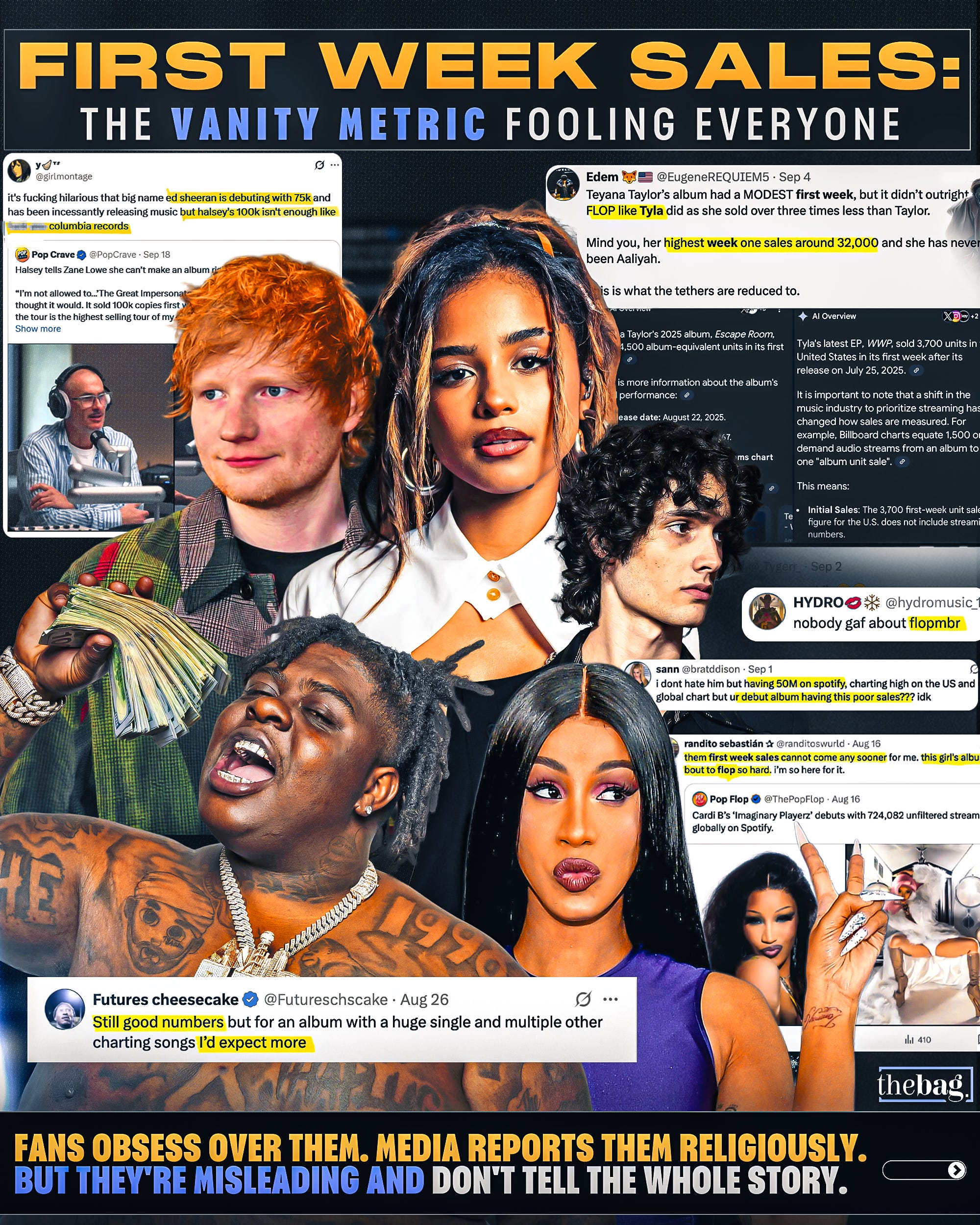
Art is now judged by performance before it is even consumed. Fans, critics, and media personalities weigh in on first week sales and pass judgment without ever listening to the music.
Years ago you needed a SoundScan account or an insider email to even see the numbers. Today they are everywhere and they have turned into ragebait.
There is a class of so-called superfans who are not fans at all. They do not celebrate their favorite artist. They tear down anyone else who wins. This is not fandom. It is obsession that metastasizes into hate. I call it being Oppsessed.
And one of their favorite weapons is first week sales. Numbers without context mislead. Most who push these narratives do not understand how the numbers are calculated. First week sales are a vanity metric from another era. In today’s business the engine is catalog, not frontline. Which makes first week sales a poor way to measure success.
What follows is a breakdown of how the game works. How SoundScan and first week sales became public. How sales are calculated now. The levers labels pull to game the system. Why first week sales are a fight for relevance for superstars while discovery for new artists takes time. Why some slow starts go on to win big. How Drake, the biggest streaming artist of all time, compares week one to his totals. And what funds, labels, and investors actually look at when they value a catalog.
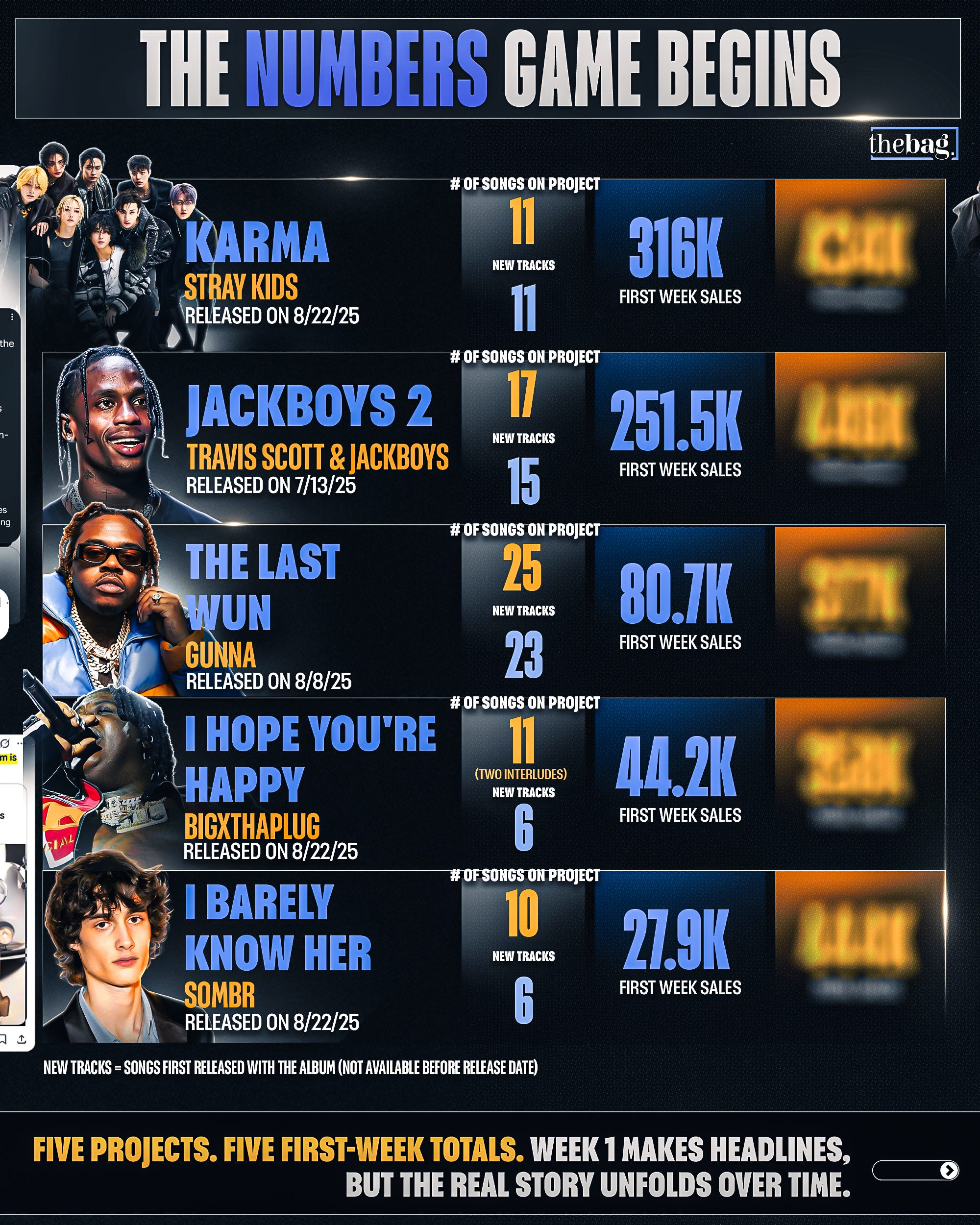
In the past few months Stray Kids, Travis Scott and Jackboys, Gunna, BigXThaPlug, and Sombr all dropped new projects. Each one was judged by the same metric: first week sales. The headlines made it clear who had the strongest debut, and for some that was enough to crown the best album. On week one the scoreboard looks final. In reality it is only the opening scene.
Stray Kids Karma – 316k
Travis Scott & Jackboys Jackboys 2 – 251.5k
Gunna The Last Wun – 80.7k
BigXThaPlug I Hope You’re Happy – 44.2k
Sombr I Barely Know Her – 27.9k
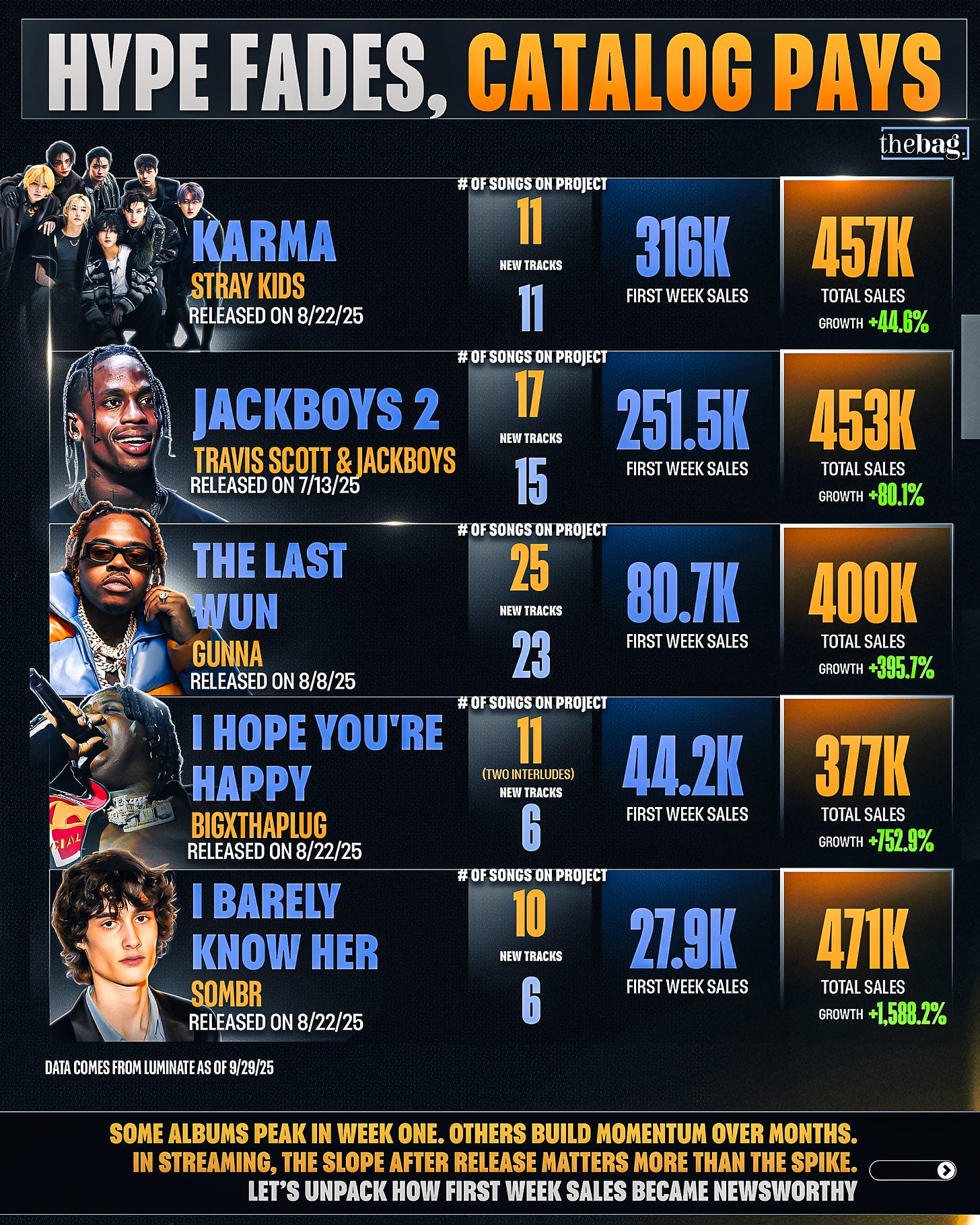
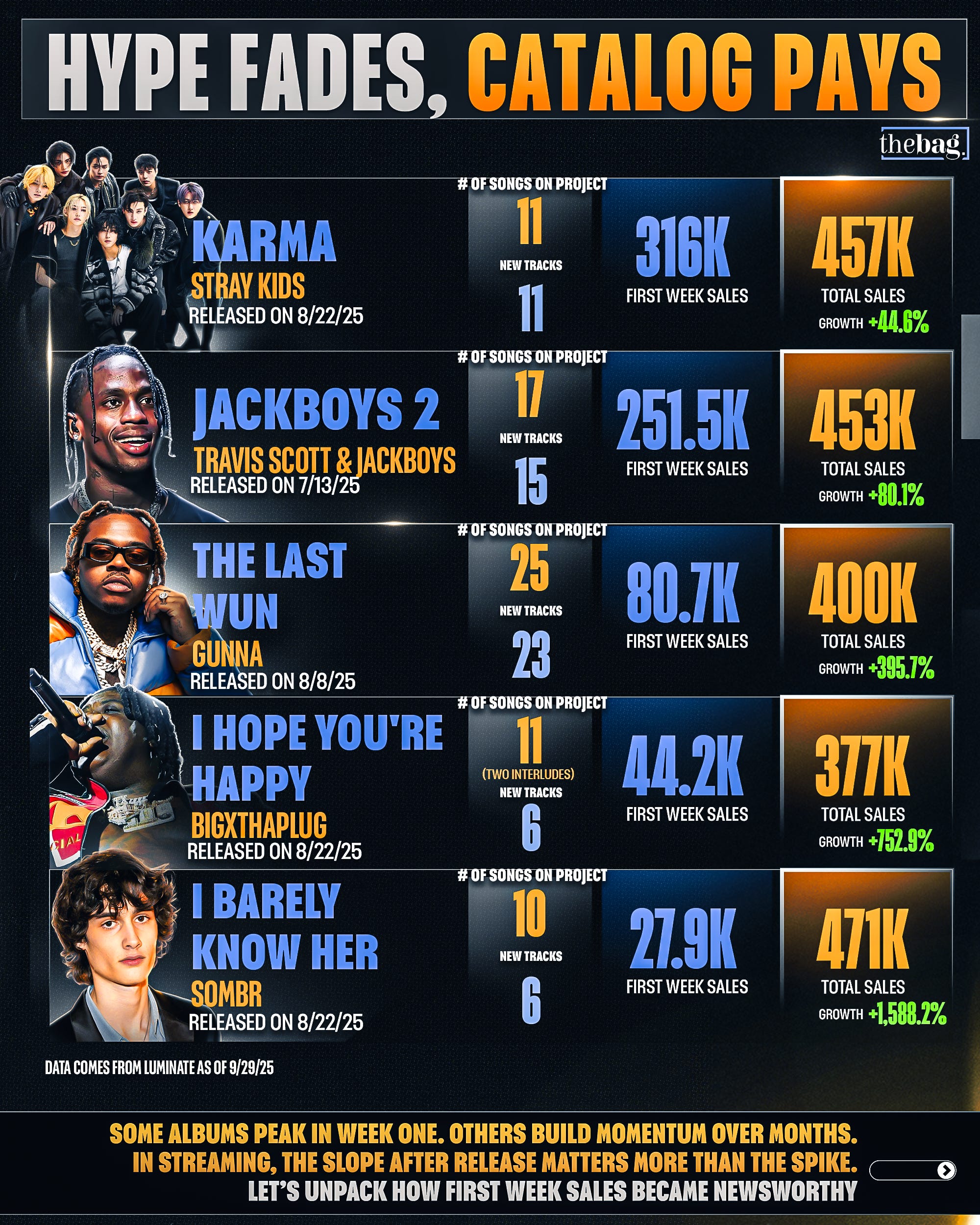
Once the headlines faded and the charts rolled over the story shifted.
Stray Kids Karma – 457k total (+45%)
Travis Scott & Jackboys Jackboys 2 – 453k total (+80%)
Gunna The Last Wun – 400k total (+396%)
BigXThaPlug I Hope You’re Happy – 377k total (+753%)
Sombr I Barely Know Her – 471k total (+1,588%)
Some projects peak in week one. Others climb for months. In the streaming era momentum compounds. Word of mouth, playlists, and discovery stretch an album’s life long after release. First week shows who makes the loudest entrance. Total sales show who can last.
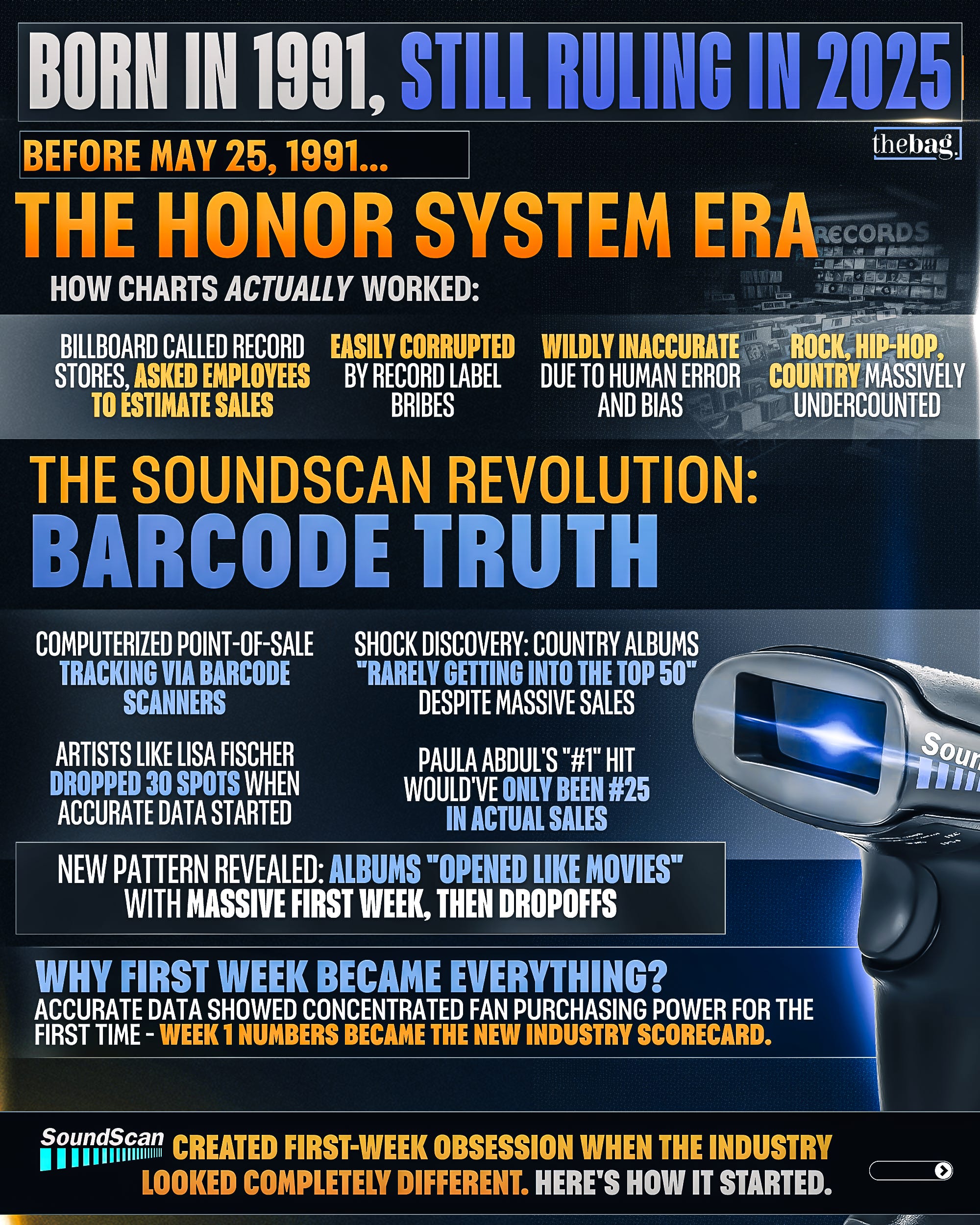
Before May 25, 1991 charts were built on phone calls. Billboard called record stores and asked employees to estimate sales. Labels influenced results with bribes. Human error and bias made the numbers unreliable. Rock, hip hop, and country were consistently undercounted.
Then came SoundScan. Barcode scanners at the register brought computerized tracking. For the first time the data was hard proof. The revelations were immediate. Country albums that rarely appeared in the top 50 surged. Lisa Fischer’s record dropped 30 spots overnight. Paula Abdul’s number one single would have landed at number 25 in actual sales.
SoundScan revealed that albums opened like movies. Massive first weeks followed by steep drop-offs. Concentrated fan energy showed up instantly. For the first time the industry could measure it. Week one became the scorecard.
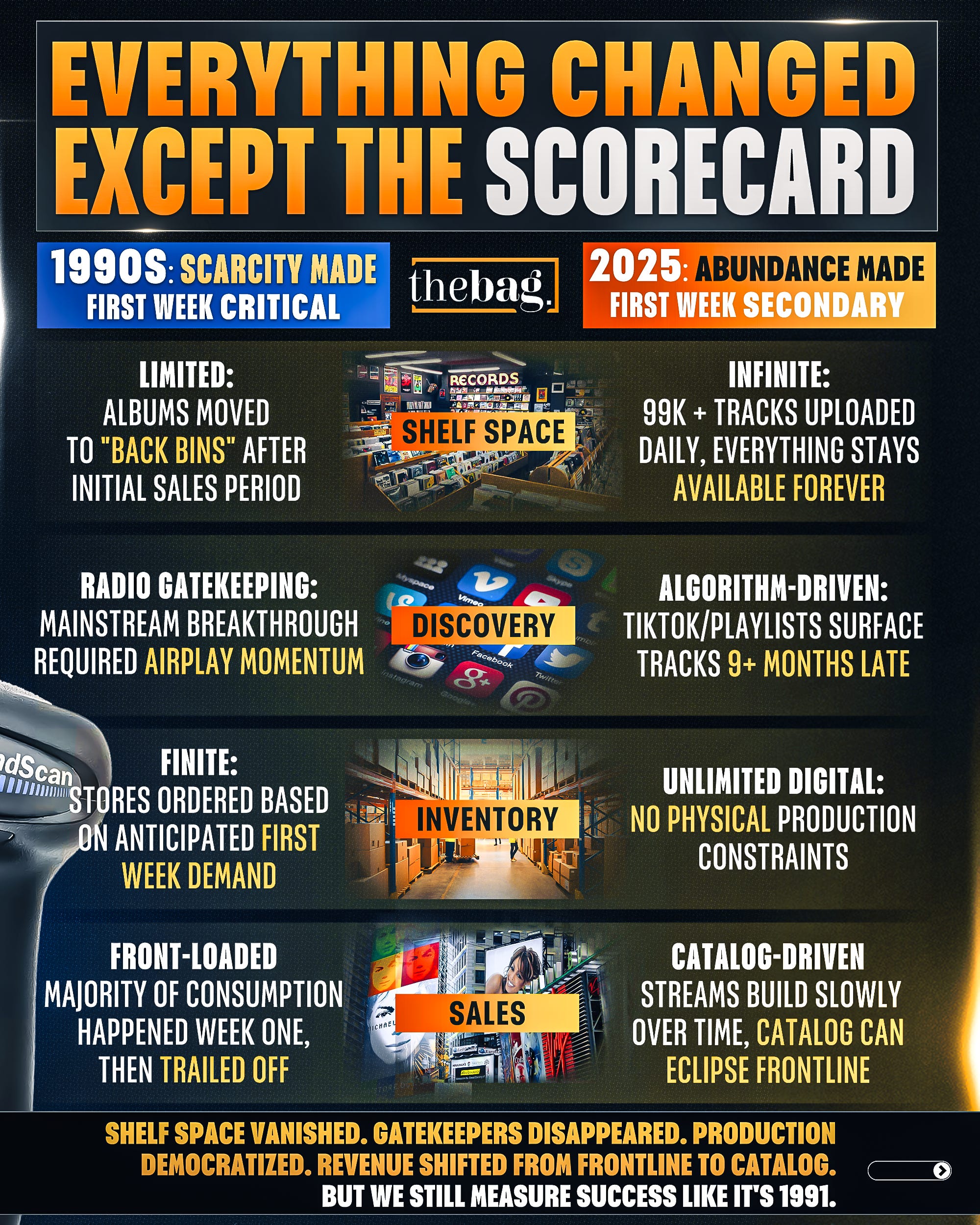
In the 1990s scarcity made first week critical. Shelf space was limited and albums were pushed to the back once the first rush passed. Radio controlled discovery. Inventory was finite. Sales were front-loaded into release week and dropped off quickly.
In 2025 abundance makes first week irrelevant. Shelf space is infinite with more than 99,000 tracks uploaded every day. Discovery is algorithmic and songs can break months after release. Inventory is unlimited. Streams build slowly and catalog often outperforms frontline. Revenue has shifted from new releases to catalog, yet we still measure success like it is 1991.
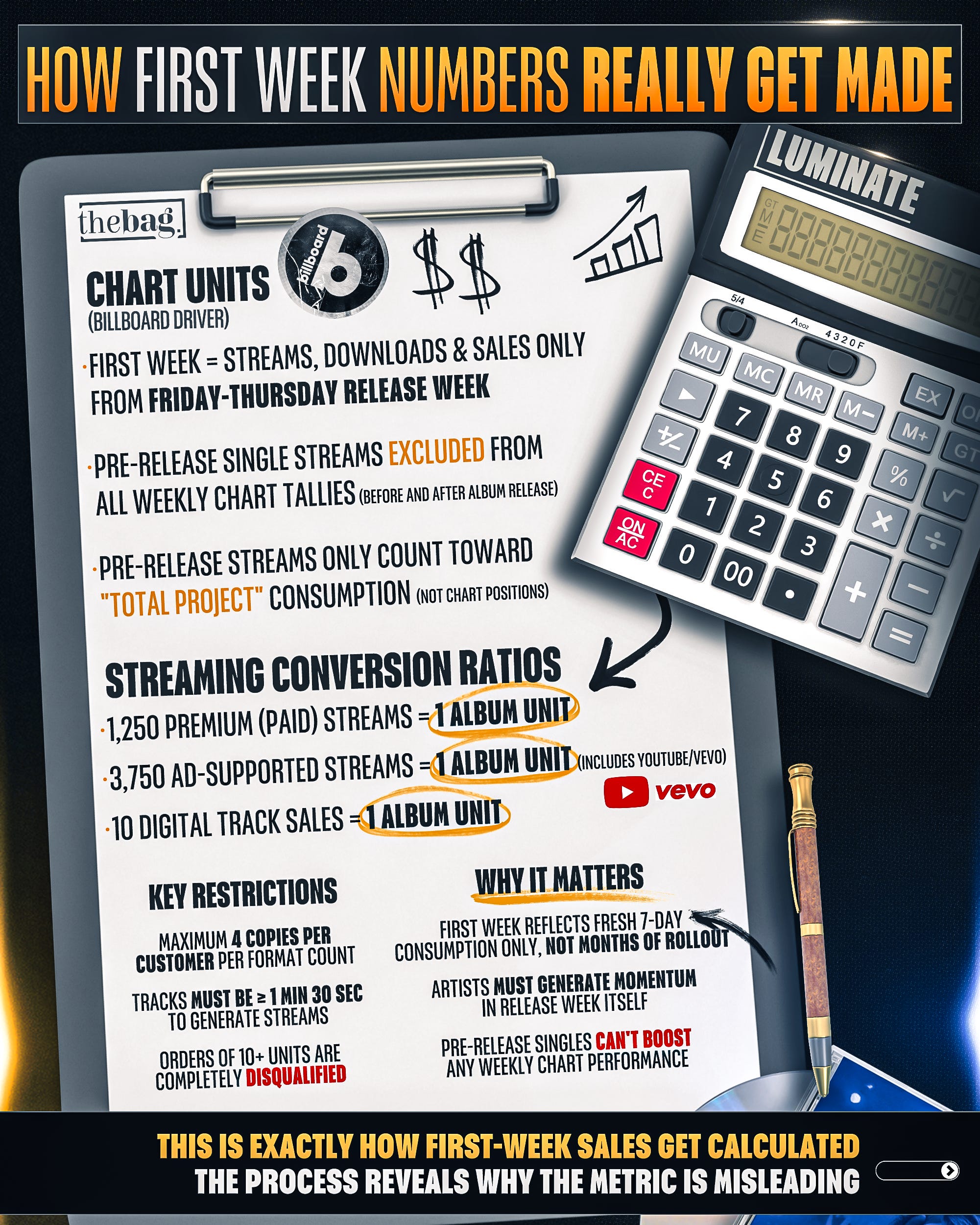
Chart Units
First week is defined as streams, downloads, and sales from Friday through Thursday of release week. Pre-release singles do not count toward the charts. Those streams only apply to total consumption, not first week positions.
Streaming Conversion
1,250 premium streams = one album unit
3,750 ad-supported streams (including YouTube and Vevo) = one album unit
10 digital track sales = one album unit
Restrictions
No more than four copies per customer per format count
Tracks must run at least ninety seconds to generate streams
Orders of ten or more units are disqualified
Why It Matters
First week only measures fresh consumption over seven days. It ignores months of buildup. Artists have to pack momentum into release week, and pre-release singles cannot help boost the chart.
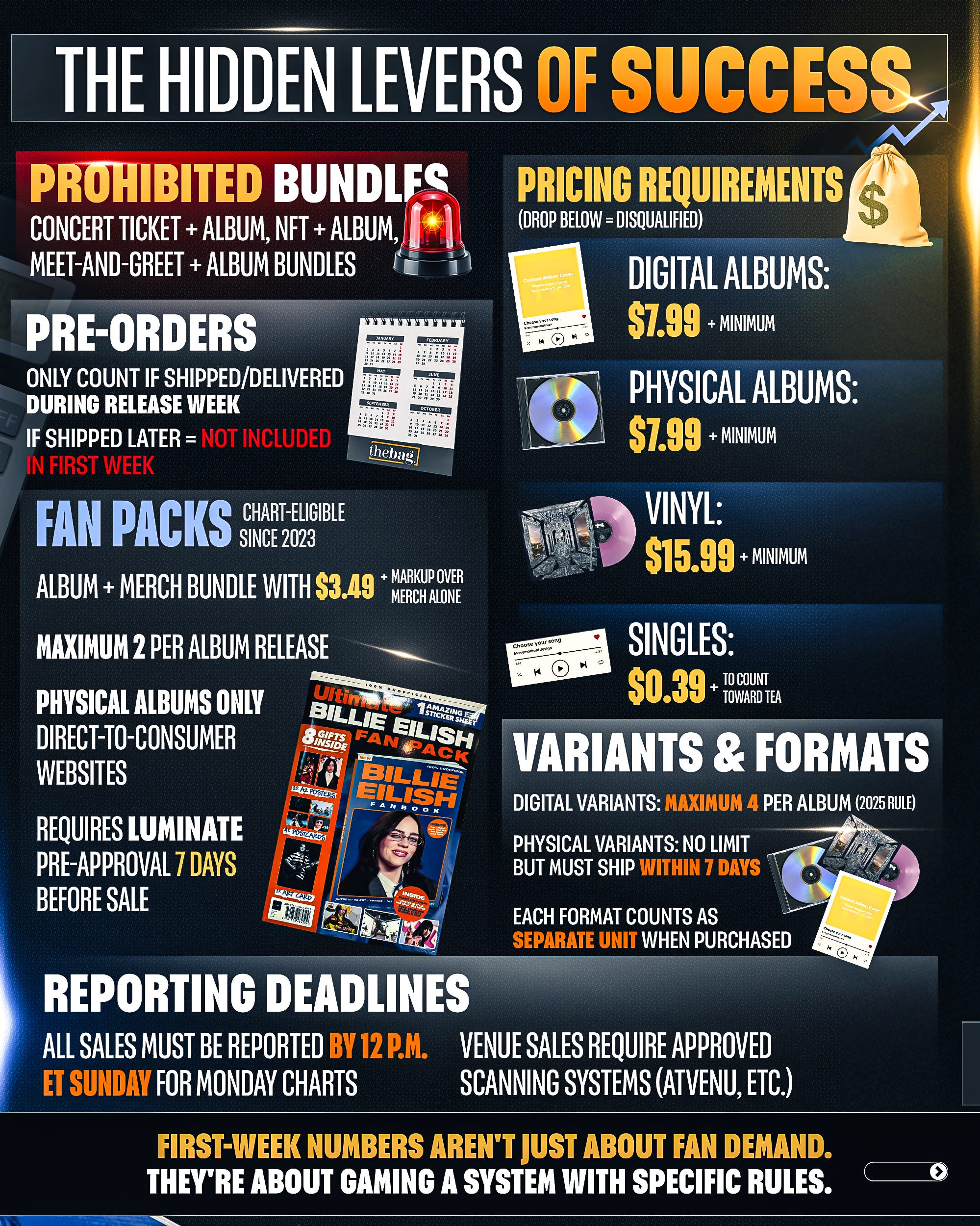
Pre-Orders
Only pre-orders shipped or delivered during release week are counted. Anything that ships later does not apply.
Pricing
Digital albums must be priced at $7.99 or higher
Physical albums and vinyl must be priced at $15.99 or higher
Singles must cost at least $0.39 to count toward TEA
Anything priced below these thresholds is disqualified
Fan Packs
Chart-eligible since 2023
Defined as an album bundled with merch that has at least a $3.49 markup over the merch alone
Maximum of two fan packs per release
Only physical albums sold direct-to-consumer qualify
Must be pre-approved by Luminate at least seven days before sale
Variants and Formats
Digital variants are capped at four per album under the 2025 rule
Physical variants have no limit but must ship within seven days of purchase
Each format purchased counts as a separate unit
Reporting Deadlines
All sales must be reported by Sunday at 12 p.m. ET to be included in Monday charts
Venue sales only count if processed through approved scanning systems like atVenu
Prohibited Bundles
Albums bundled with concert tickets, NFTs, or meet-and-greets do not qualify for chart eligibility
Why It Matters
The rules create the levers artists and labels use to boost first week numbers. Variants, fan packs, pre-orders, and formats all shape the headline but do not reflect lasting impact. First week is about playing the system. Catalog is what proves the music’s value over time.
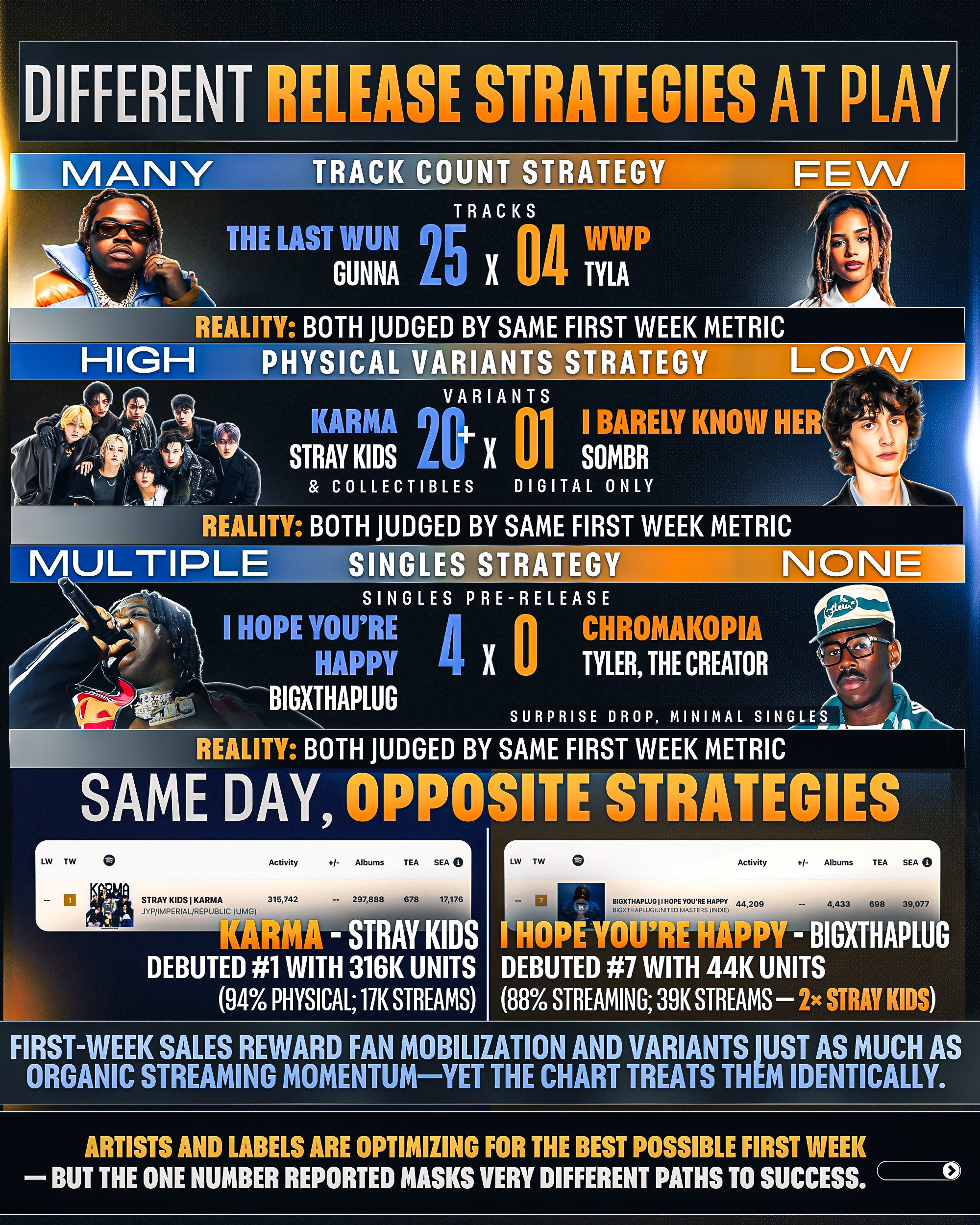
Track Count
Gunna’s The Last Wun had 25 tracks
Tyla’s WWP had 4 tracks
Both were measured by the same formula
Variants
Stray Kids’ Karma came with more than 20 physical versions
Sombr’s I Barely Know Her had a single digital version
Both were treated the same on the charts
Singles
BigXThaPlug’s I Hope You’re Happy had four singles released in advance, which meant those streams did not count toward first week
Tyler, the Creator’s Chromakopia had no advance singles
Both were judged the same way
Stray Kids vs BigXThaPlug
Both albums dropped on the same day
Stray Kids did 316k first week, with 94% of that from physical variants and only 17k from streams
BigX did 44k first week, with 88% from streams, more than double Stray Kids
Both had eleven tracks, but only six of BigX’s were new
Why It Matters
First week sales reward fan mobilization, product variants, and rollout strategy just as much as organic streaming. The charts treat them as equal, even though they measure very different kinds of momentum.
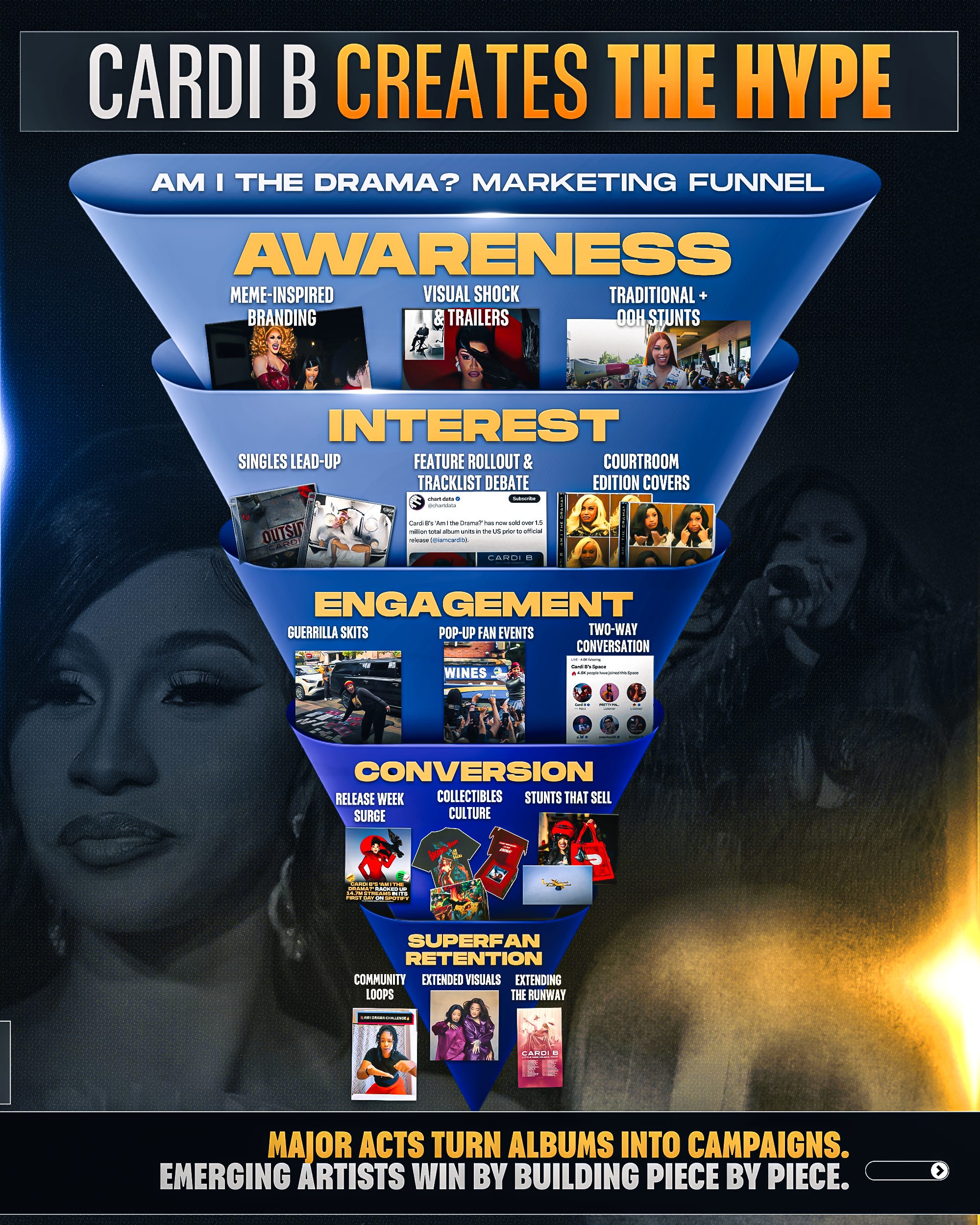
For superstars, first week is not a measure of music. It is a measure of relevance.
Cardi B had not released an album in seven years. She could not just drop music. She had to return in a way that was impossible to ignore.
Awareness came first. Meme branding tied to Scarlet Envy. A horror trailer with CGI crows. Billboards and subway announcements. She was everywhere before the music even landed.
Interest followed. Singles rolled out across the summer. Features revealed one by one. Tracklist debates after she included WAP and Up. A courtroom edition that turned her trial into merch.
Engagement kept fans active. Viral skits of her selling CDs on the street. The Bodega Baddie pop-up in Washington Heights. Twitter Spaces, Instagram Lives, and quick replies that made fans feel part of it.
Conversion showed up in the numbers. 14.7M day-one Spotify streams. Multiple variants and Drama Box sets that pushed collectors to buy again. A drone stunt with Walmart and Wing that set a Guinness record and created a viral headline.
Retention stretched beyond release week. More videos. A behind-the-scenes mini doc. TikTok challenges and streaming parties. A 2026 arena tour announcement that carried the momentum forward.
Cardi’s rollout shows the truth about first week. For superstars it is not about proving the music will last. It is about controlling the narrative and signaling that they still matter at the highest level. First week is theater. The real business comes after.
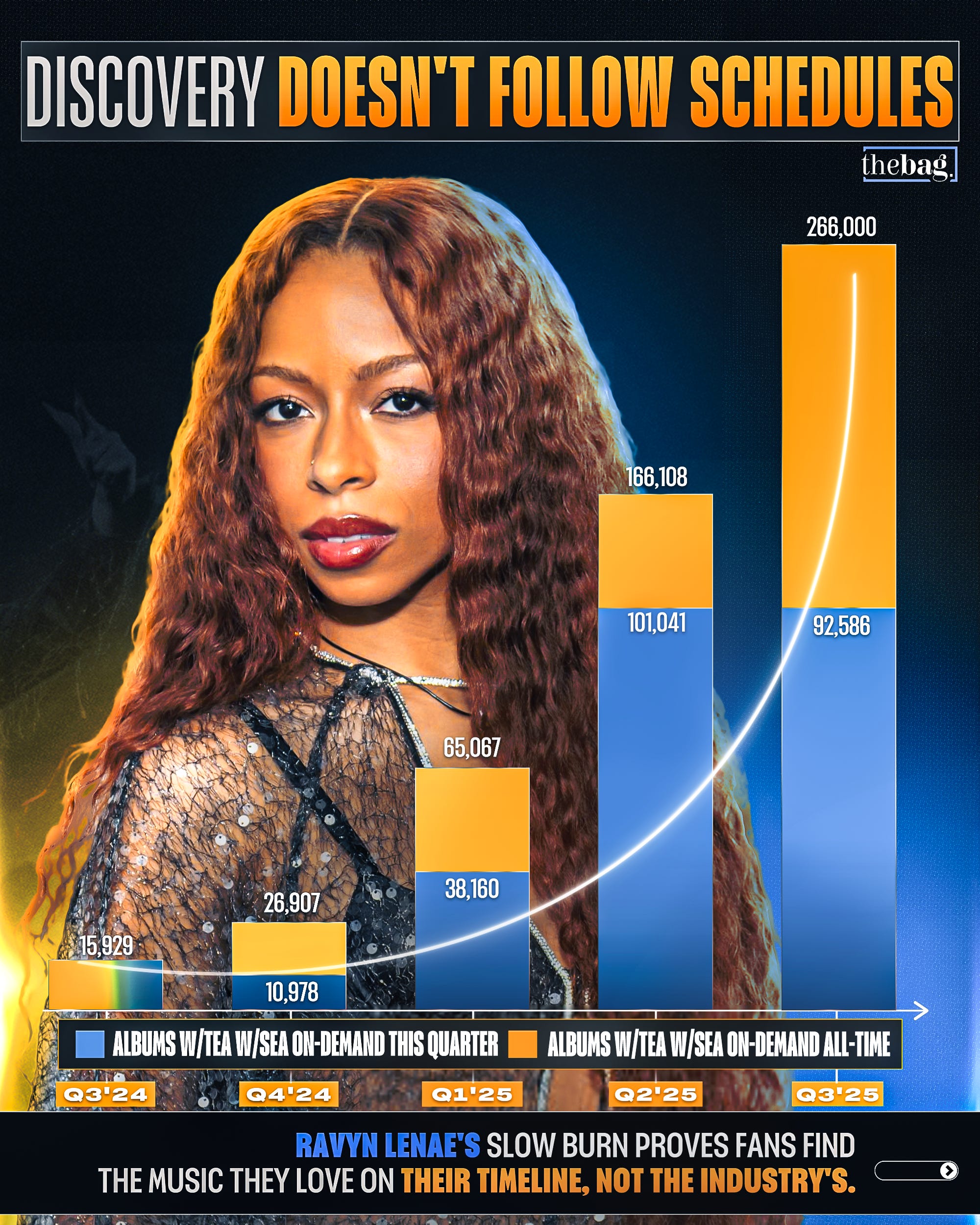
For developing artists first week means little. Ravyn Lenae released Bird’s Eye in August 2024 and it did not chart. Her single Love Me Not gained little traction until a mashup on TikTok in 2025. The song cracked the Billboard Hot 100 and drove the album to 266k units. Ninety percent of its consumption came the year after its release.
If you judged by first week alone she looked like a flop. In reality she became a platinum artist with momentum still building.
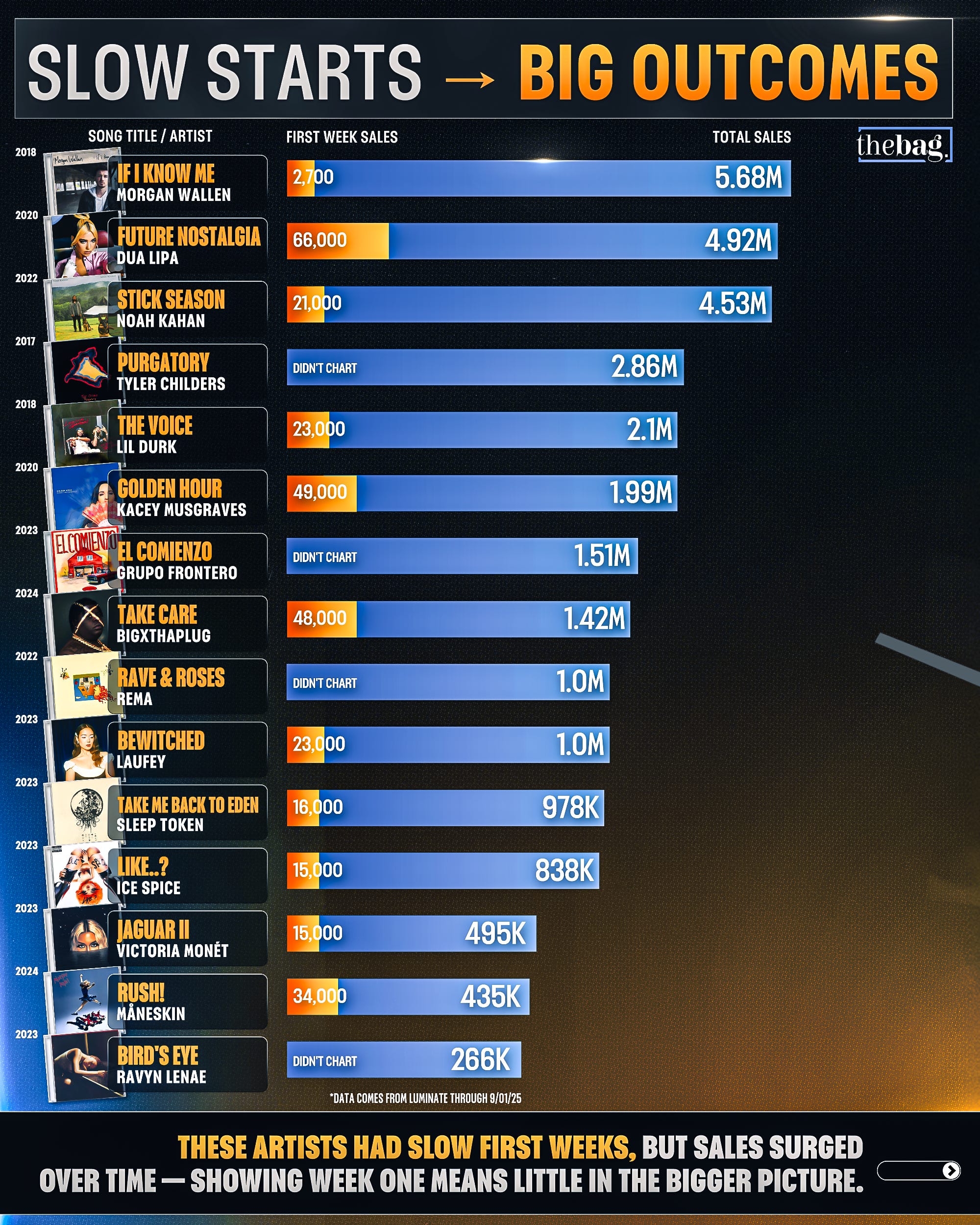
The industry is full of slow starts that grew into massive wins, no matter the genre of music.
Morgan Wallen If I Know Me – 2.7k to 5.68M
Dua Lipa Future Nostalgia – 66k to 4.92M
Noah Kahan Stick Season – 21k to 4.53M
Tyler Childers Purgatory – Did not chart to 2.86M
Lil Durk The Voice – 23k to 2.1M
Kacey Musgraves Golden Hour – 49k to 1.99M
Grupo Frontero El Comienzo – Did not chart to 1.51M
Rema Raves & Roses – Did not chart to 1M
Laufey Bewitched – 23k to 1M
Sleep Token Take Me Back To Eden – 16k to 978k
Ice Spice Like..? – 15k to 838k
Victoria Monét Jaguar II – 15k to 495k
Måneskin Rush! – 34k to 435k
Ravyn Lenae Bird’s Eye - Did not chart to 266k
These projects show that slow starts can lead to major outcomes.
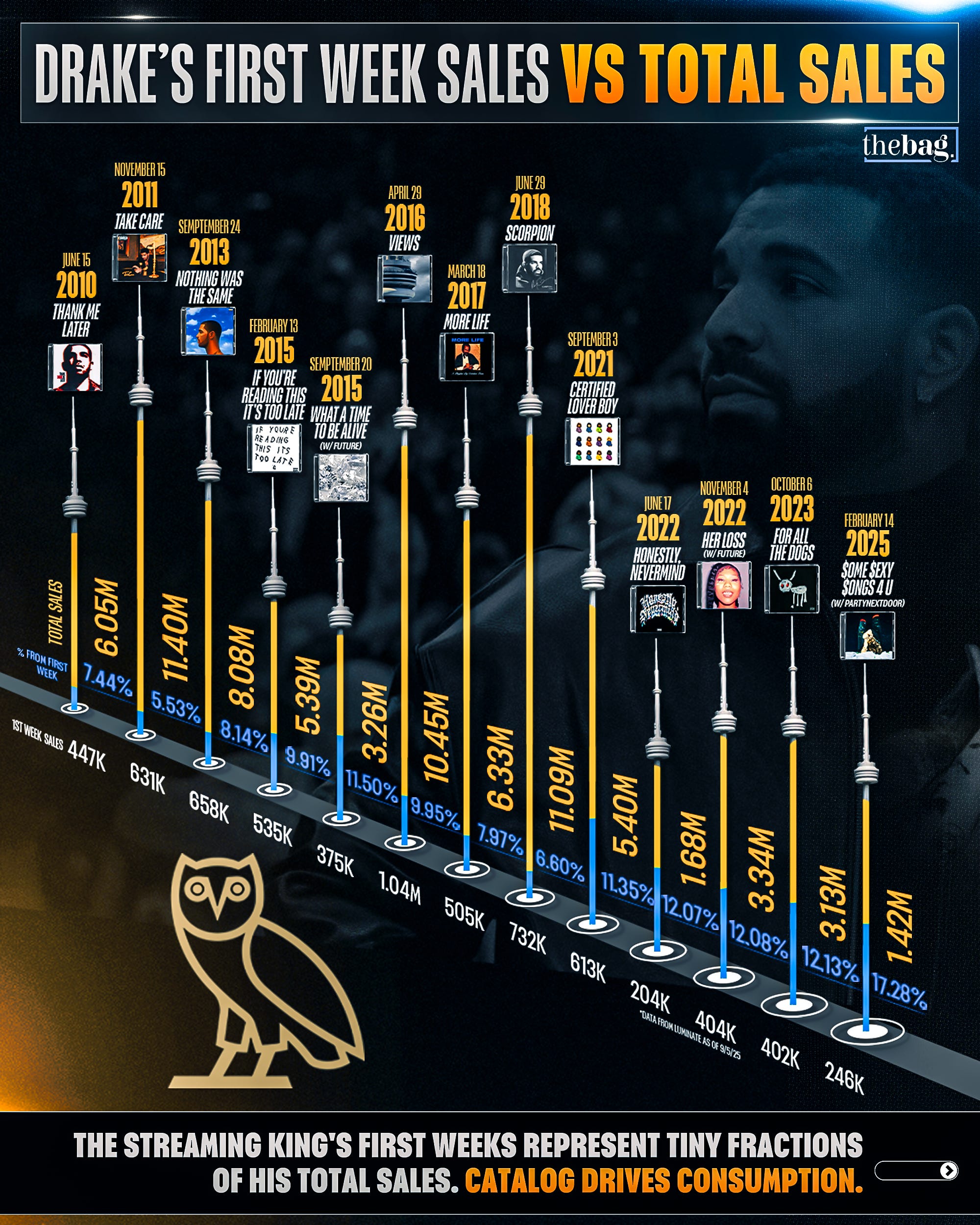
Drake is the biggest streaming artist of all time. His first weeks are massive but they are still only a fraction of his totals. Select examples:
Take Care – 631k first week, 11.4M total, 5.5% from week one
Nothing Was The Same – 658k first week, 8.08M total, 8.1%
Views – 1.04M first week, 10.45M total, 9.9%
Scorpion – 732k first week, 11.09M total, 6.6%
Certified Lover Boy – 613k first week, 5.4M total, 11.3%
For All The Dogs – 402k first week, 3.13M total, 12.1%
The pattern repeats. Even for the biggest artist in streaming history, week one barely matters. Catalog does.
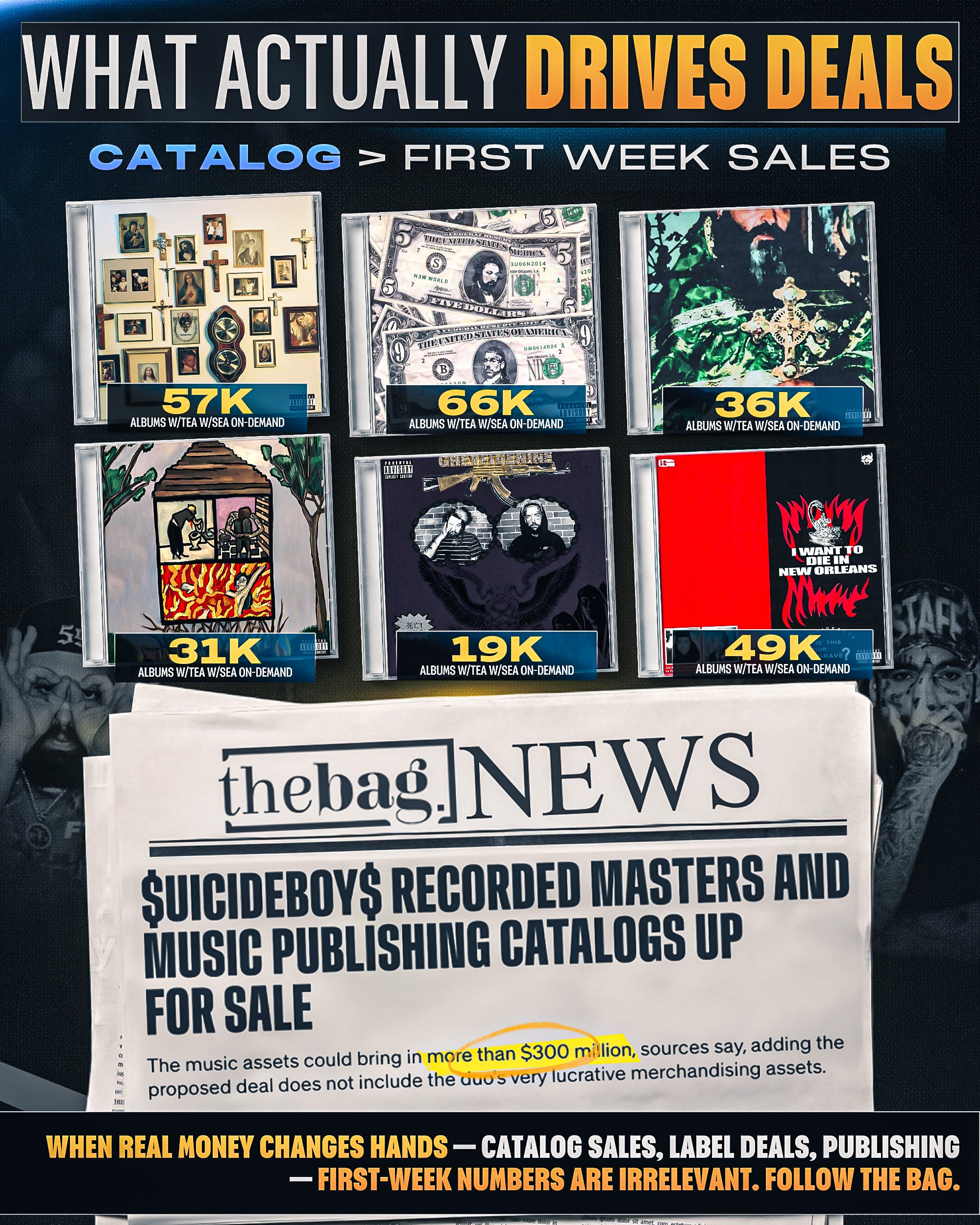
I have worked on catalog acquisitions. Not once did first week sales come up in due diligence. What matters is staying power. How the music performs year after year. How it stacks against others from the same era and genre. Whether one hit carries the load or the whole catalog performs.
That is what labels, publishers, funds, and investors pay for. The full picture. Not a headline that can be gamed.
First week sales are noise. Catalog is the business.
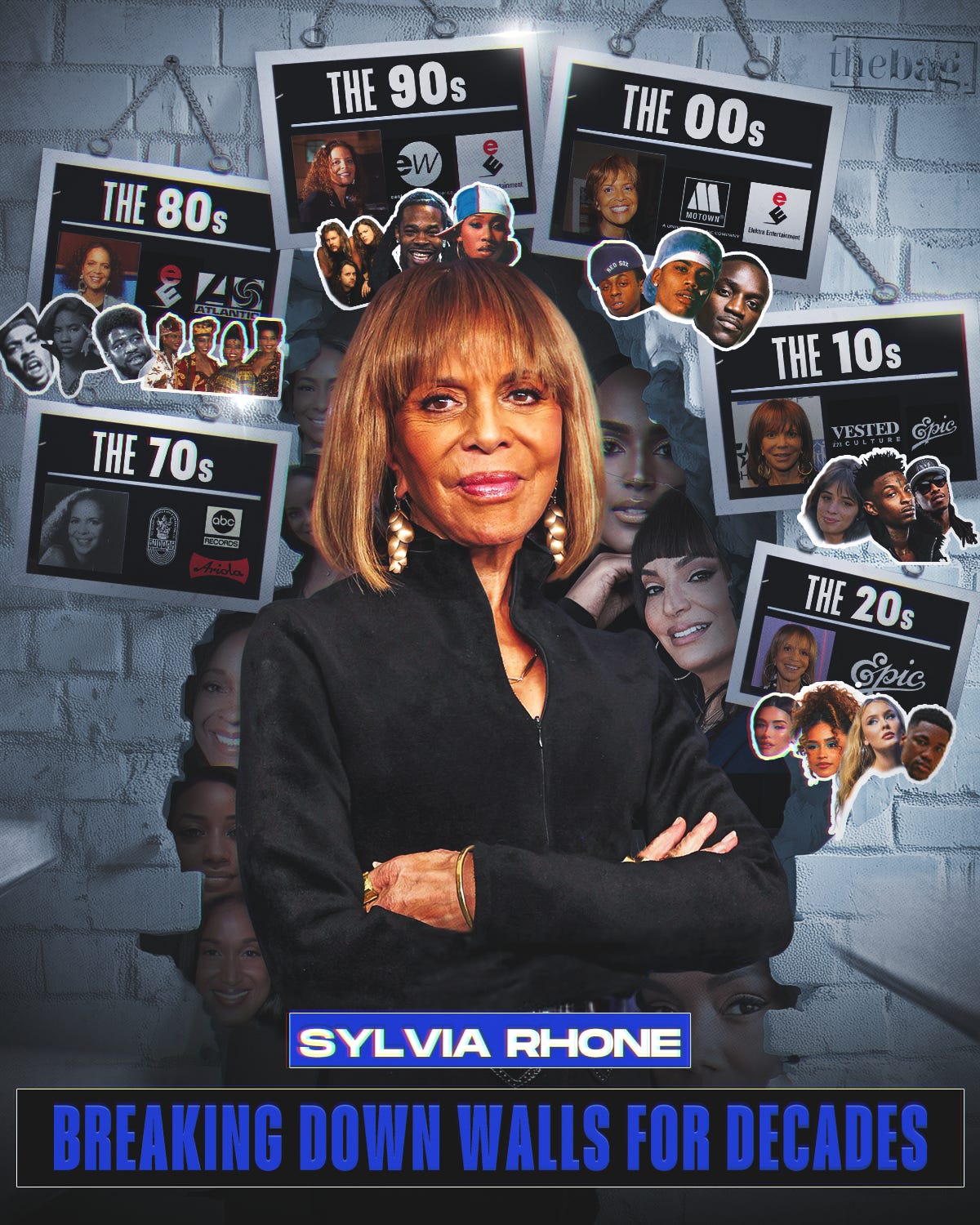
Last week, Sylvia Rhone stepped down as CEO of Epic Records. One graphic or newsletter can’t do her career justice, but we have to pause to recognize her impact.
Warren Buffett once said, “The best thing I ever did was pick the right heroes.” In a business obsessed with attention, who you choose to follow shapes who you become. Sylvia Rhone is exactly the kind of hero worth emulating.
Her story is defined by fearless determination. Early in her career, she walked away from a banking job after being told pants weren’t acceptable for women. She went on to become one of the first Black women executives at a major label, breaking into rooms where few thought she belonged.
At Atlantic, she saw hip-hop’s potential before the industry did. Over the years she worked across every genre, from Metallica to Missy Elliott, Tracy Chapman to Future. In 1994 she became the first Black woman chairwoman and CEO of a major label at Elektra, driving $300M in incremental revenue.
At Epic, she built one of the most diverse leadership teams in the business, with staff that was 57 percent diverse. While her resume is filled with iconic artists, her greater legacy may be the executives she mentored and the countless people she inspired by example.
Time and again, the industry set limits. Time and again, Sylvia Rhone broke through them. She proved that some walls are meant to be shattered, and in doing so she opened doors for the next generation.
Her decision to step down is more than the close of a legendary chapter. It is also part of a bigger story.
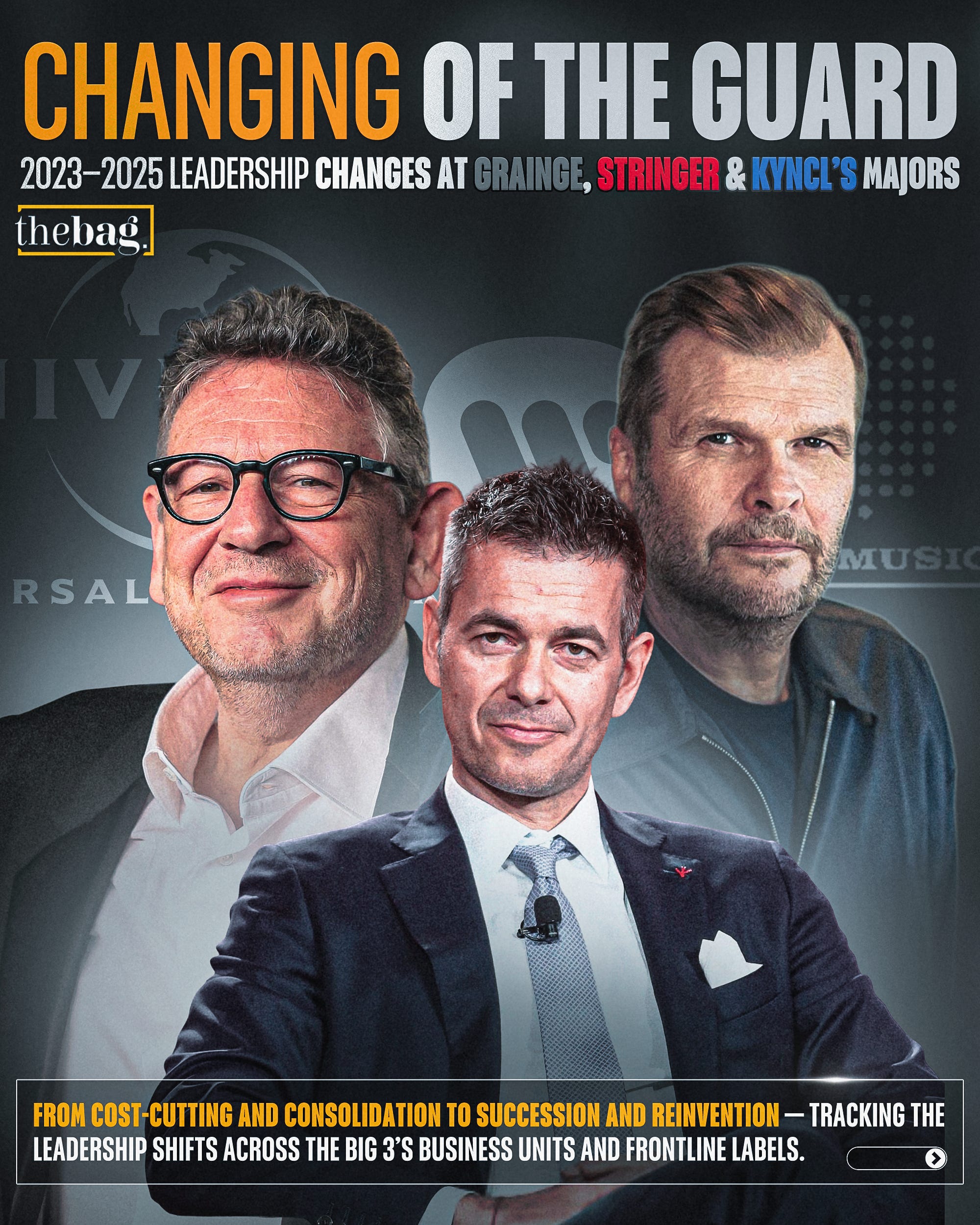
Newsweek recently reported that American companies are seeing record levels of CEO exits in 2025, with 1,358 departures so far — the highest since tracking began in 2002. Analysts point to economic pressure, technological change, and shifting priorities as boards demand adaptability at the top.
The same forces are visible in music. Sylvia Rhone’s exit from Epic Records comes amid a wave of changes over the past year: Julie Greenwald stepping away from Atlantic, Kevin Liles at 300 Elektra, Max Lousada at Warner Recorded Music, and Craig Kallman at Atlantic.
Over the past few years, the majors have been transformed. Business units merged. Scopes expanded. Long tenures ended. New leaders elevated. Some of this is generational succession. Some is restructuring for efficiency and scale. Some is positioning for digital and AI. Some is about a business increasingly driven by catalog rather than frontline releases. Some is about streaming growth slowing and the search for new revenue streams. And some is simply the weight of shareholder pressure.
This is the backdrop for the graphics that follow. A closer look at how Grainge, Stringer, and Kyncl have reshaped their organizations since the start of 2023. The charts focus on heads of labels and business units — the positions that directly shape strategy and creative output.
This is not an exhaustive record of every leadership move worldwide. Titles, dates, and scopes are based on public reporting and company announcements, but it is possible that details have shifted or additional moves occurred. The spirit is to look at these changes through the lens of how the majors are positioning themselves for the future — and whether the moves are beginning to show up in results.
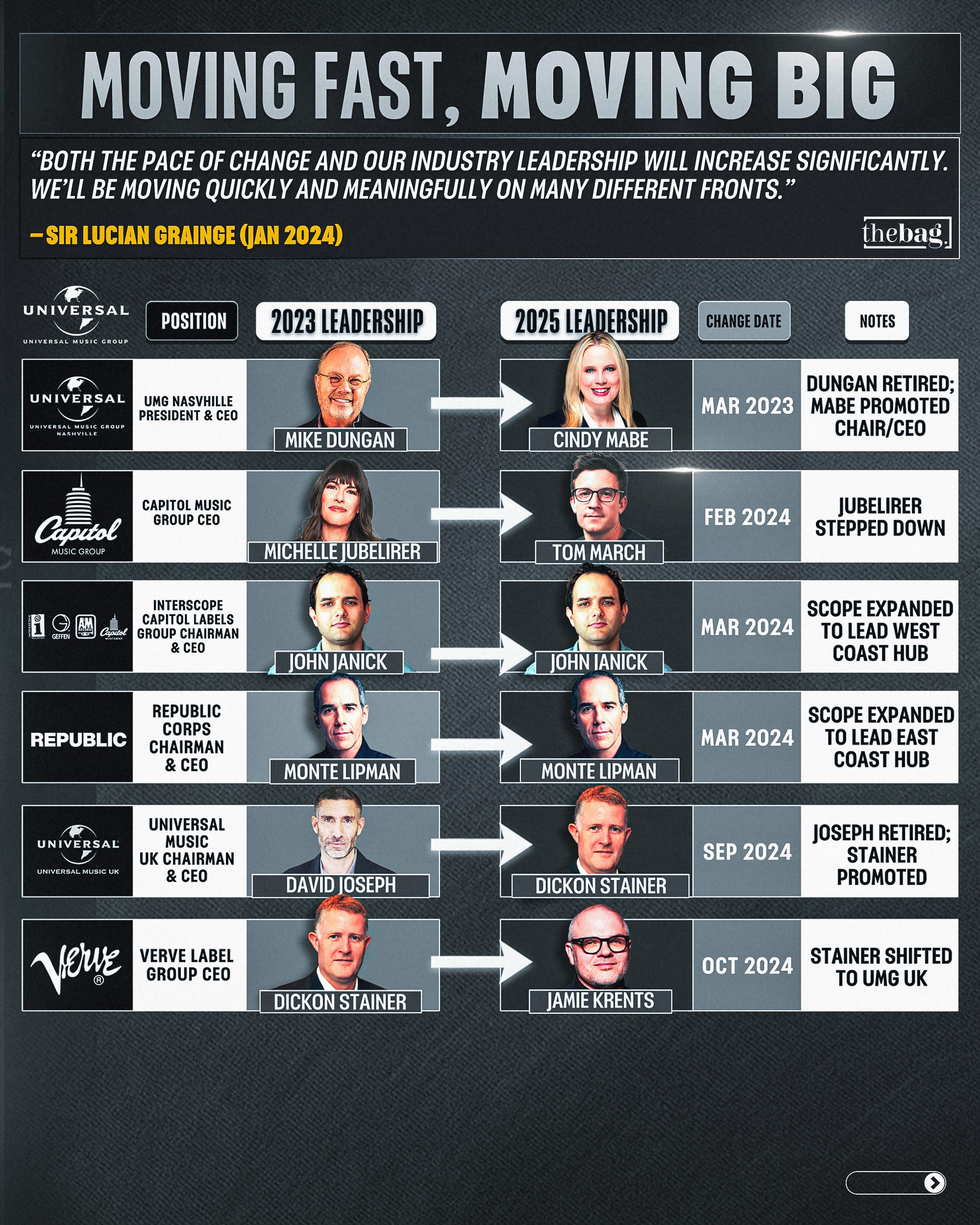
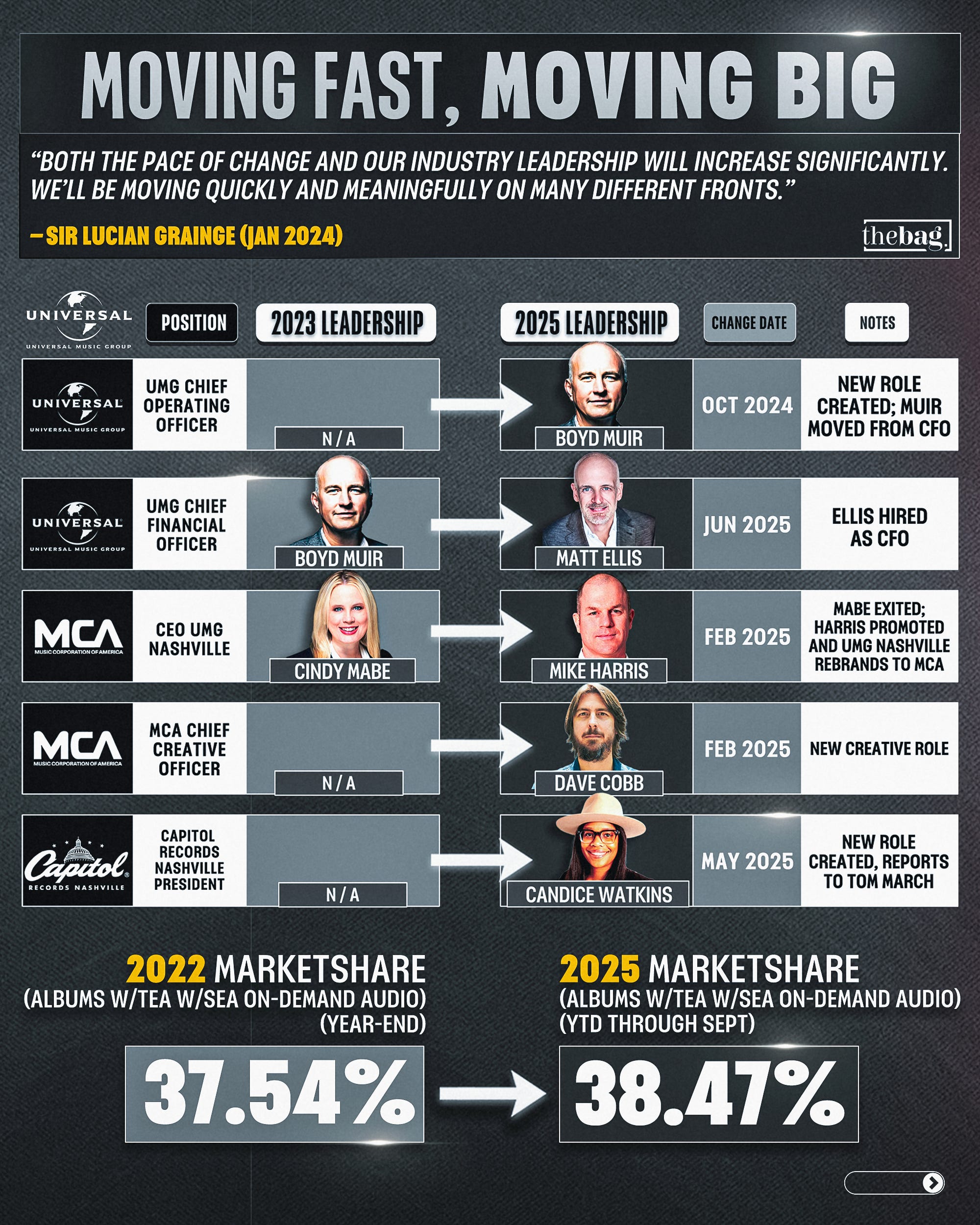
Sir Lucian Grainge has emphasized both speed and long-term focus. In January 2024 he told investors, “Both the pace of change and our industry leadership will increase significantly. We’ll be moving quickly and meaningfully on many different fronts.” By mid-year, he underlined his positioning with shareholders: “The shareholders, the investors, the board — what you get with me is long-term strategy. That’s who I am. That’s what I stand for.”
Since 2023, UMG has consolidated leadership on both the East Coast and West Coast, expanded the scope of its biggest frontline labels, and managed succession in markets like Nashville and the UK. The moves reflect both Grainge’s long grip on the company and his effort to position UMG for scale in catalog, publishing, and global growth.
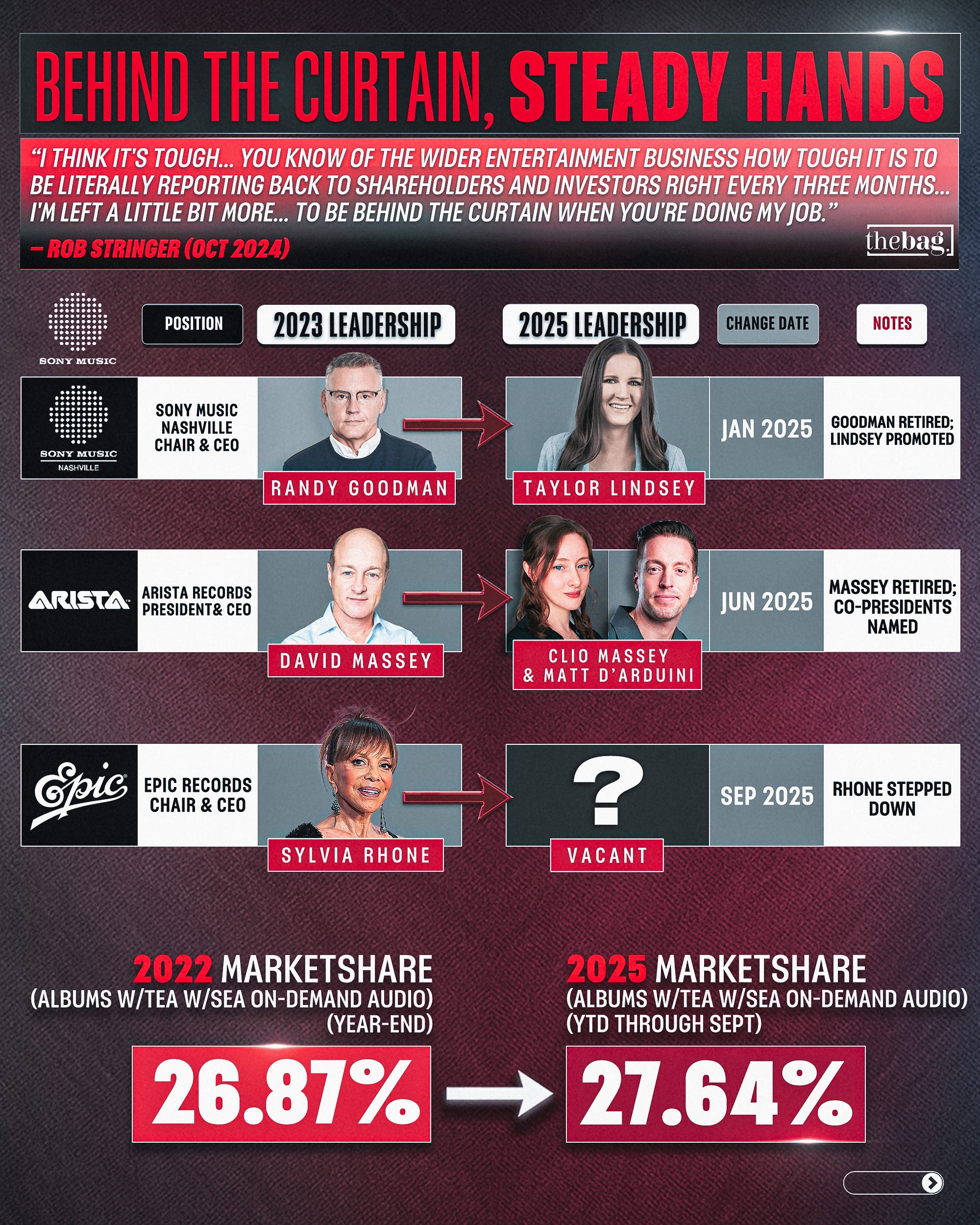
Rob Stringer has been candid about the advantages of Sony’s structure. In October 2024 he noted, “I think it’s tough… you know of the wider entertainment business how tough it is to be literally reporting back to shareholders and investors every three months… I’m left a little bit more… to be behind the curtain when you’re doing my job.” Unlike Warner or Universal, Sony Music does not have to report its results every quarter on a standalone basis. That gives Stringer room to operate with less short-term pressure.
Sony has made fewer leadership changes than its rivals, but its strategy has been no less aggressive. The company has leaned into global expansion, building up The Orchard as a powerhouse distribution and services platform. It has also been one of the most acquisitive players in the business, with more than 60 acquisitions and investments worth over $2.5 billion in the past year alone. These moves cut across frontline labels, catalog, creative ventures, and services, giving Sony a diversified portfolio that stretches far beyond its three flagship labels.
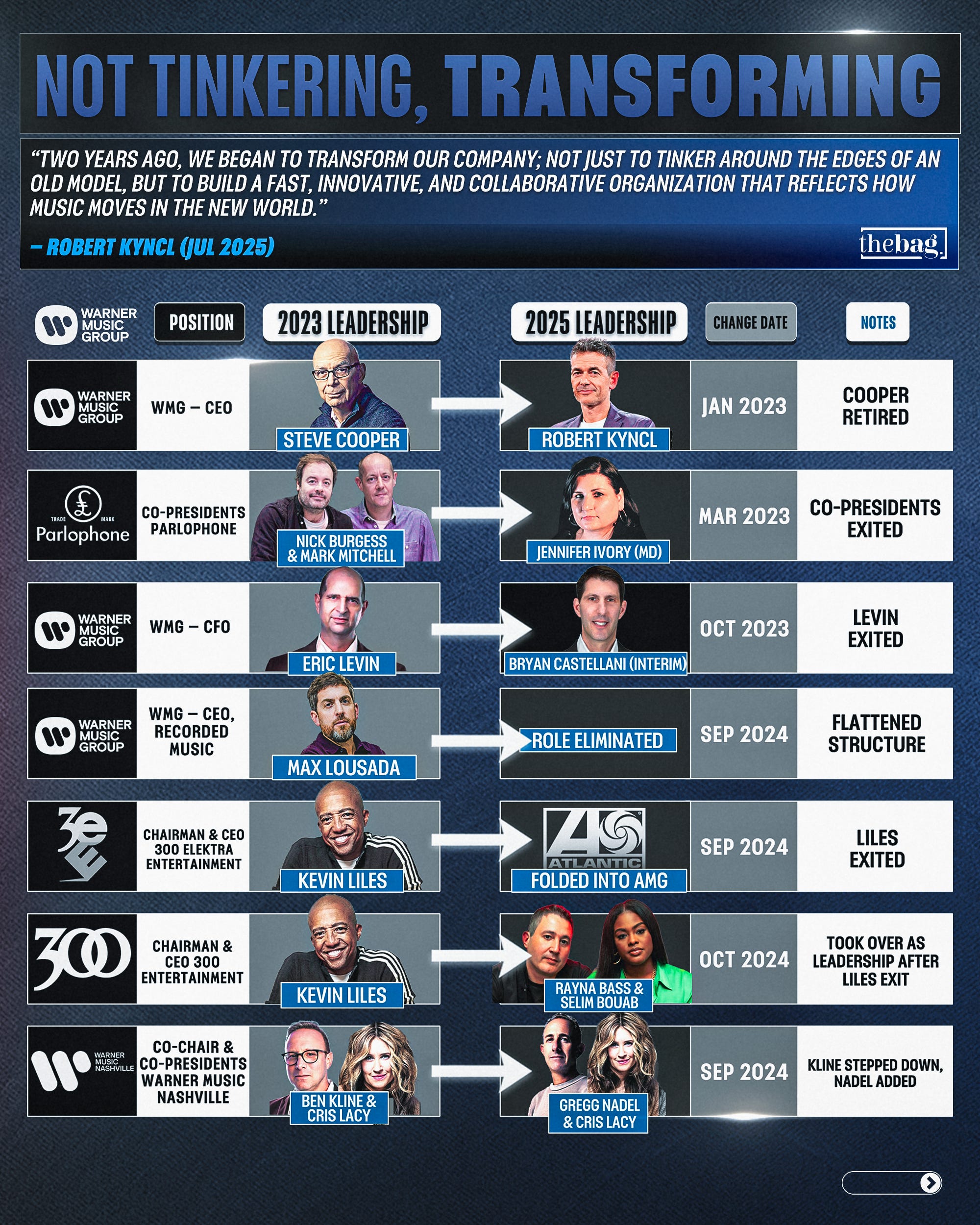
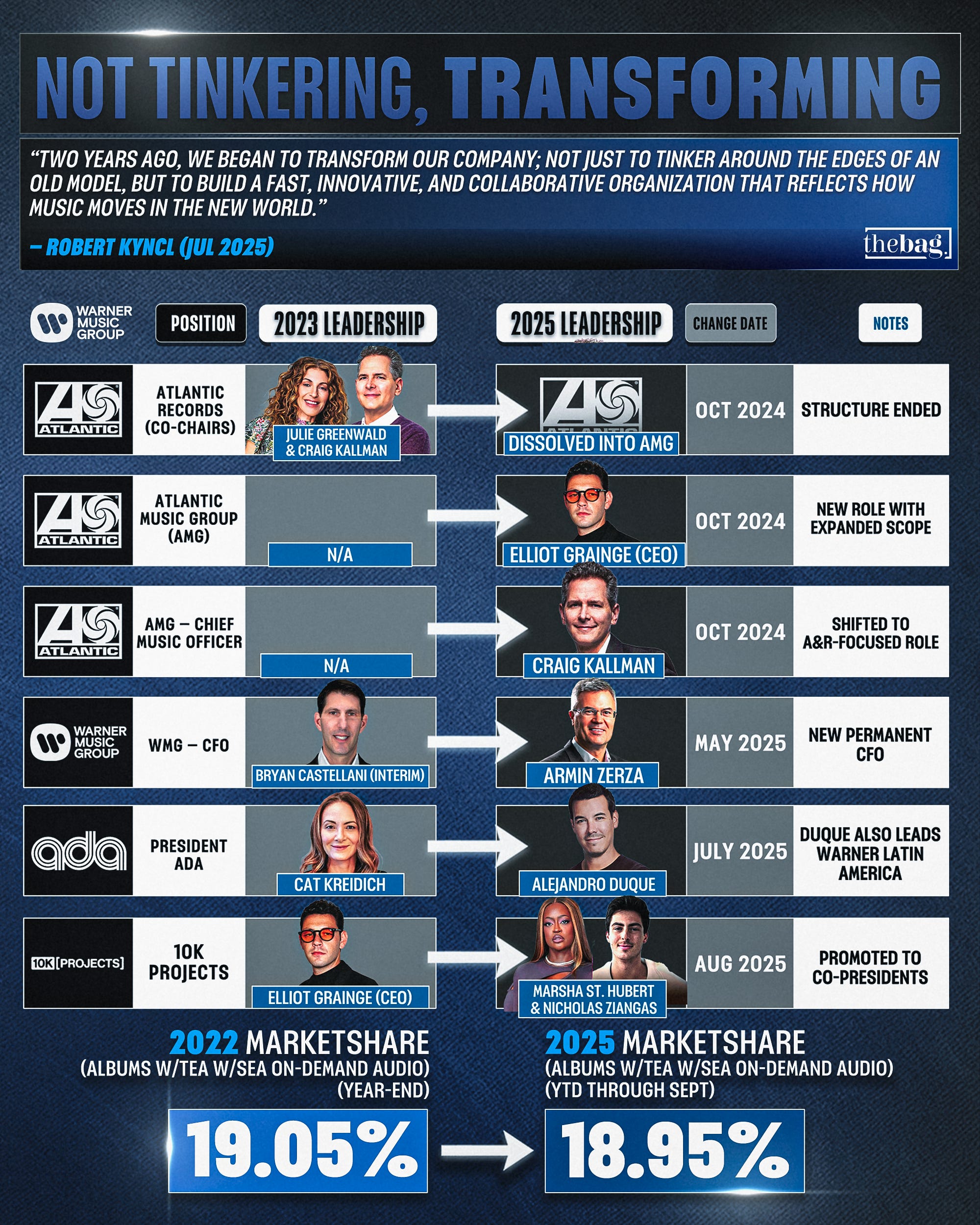
Robert Kyncl has made transformation his core theme since arriving. In 2024 he declared, “I’m calling 2024 ‘The Year of the Next 10’ — the year when we move at velocity to set ourselves up for a winning decade in the new world.” A year later he told staff, “Two years ago, we began to transform our company; not just to tinker around the edges of an old model, but to build a fast, innovative, and collaborative organization that reflects how music moves in the new world.”
That language has been backed by sweeping changes. Warner has reshaped its Recorded Music division, elevated new executives, and parted ways with long-time leaders. But the impact has not stopped at the top of the org chart. Since 2023 Warner has gone through four rounds of layoffs, eliminating more than 2,000 jobs. The company estimates $560 million in annual savings, money it has tied directly to catalog acquisitions through a $1.2 billion joint venture with Bain Capital.

The picture at Warner is clear. The company is cutting staff and streamlining operations, while doubling down on catalog as a long-term bet. Kyncl has positioned Warner as the “destination of choice for preeminent catalogs,” pointing to recent acquisitions like Tempo Music and the Red Hot Chili Peppers catalog for more than $300 million.
The Warner example shows how leadership changes ripple down the entire organization. Efficiency measures, restructuring, and resource shifts are felt not only at the executive level but across thousands of employees.

Leadership transitions in music show how different executives respond to pressure. Grainge has emphasized speed and long-term strategy. Kyncl has pushed Warner into transformation mode. Stringer has leaned on stability under Sony’s structure.
In film and television, David Ellison is taking a different approach. Since acquiring Paramount through Skydance, he has acted less like a peacetime CEO and more like a wartime one. Ben Horowitz once wrote that peacetime leaders focus on optimization and market expansion, while wartime leaders move urgently, make tough calls, and bet big in moments of turbulence.
Ellison has moved with wartime urgency. He has announced more than $9 billion in deals, launched a $1.2 billion slate financing partnership with Domain Capital, and locked in a $1.5 billion South Park mega-renewal. He has restructured CBS News, settled regulatory lawsuits, consolidated Paramount’s TV and studio assets, and lined up UFC, UEFA, and Zuffa rights for Paramount+. Alongside those bets, the company is preparing for an estimated 3,000 layoffs — the kind of cuts designed to free capital for bold moves but which reshape the workforce.
Thus far, Ellison’s playbook is clear. Efficiency at the bottom. Consolidation at the top. Bold bets on growth markets in the middle.Ellison is showing what wartime leadership looks like in film and television, just as music executives have been redefining leadership in their own ways.
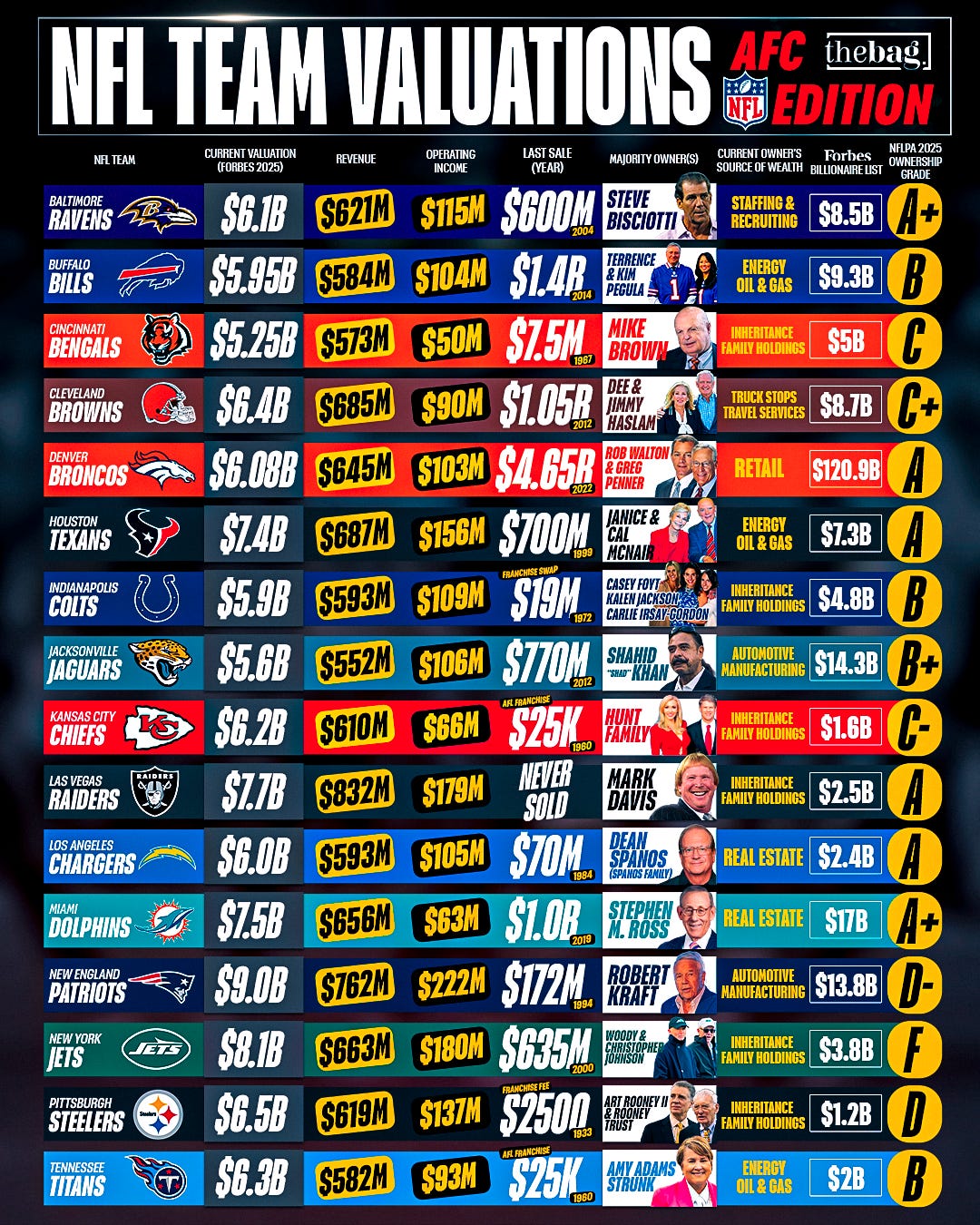
When I relaunched The Bag, I said we’d expand the scope beyond music to cover sports and entertainment too. There are plenty of graphics online showing NFL team valuations. What’s more interesting is where the current owners got their wealth and how the players themselves grade that ownership.
The numbers are staggering. Let’s start with the AFC.
The Patriots are valued at $9 billion. The Chiefs, fresh off another Super Bowl run, are now at $6.2 billion. The Jaguars, once considered one of the league’s weaker franchises, are worth $5.6 billion. In many cases, these teams have been turned into thriving businesses under the current owners. But the path into ownership often started with inherited family wealth or fortunes in real estate, energy, and finance.
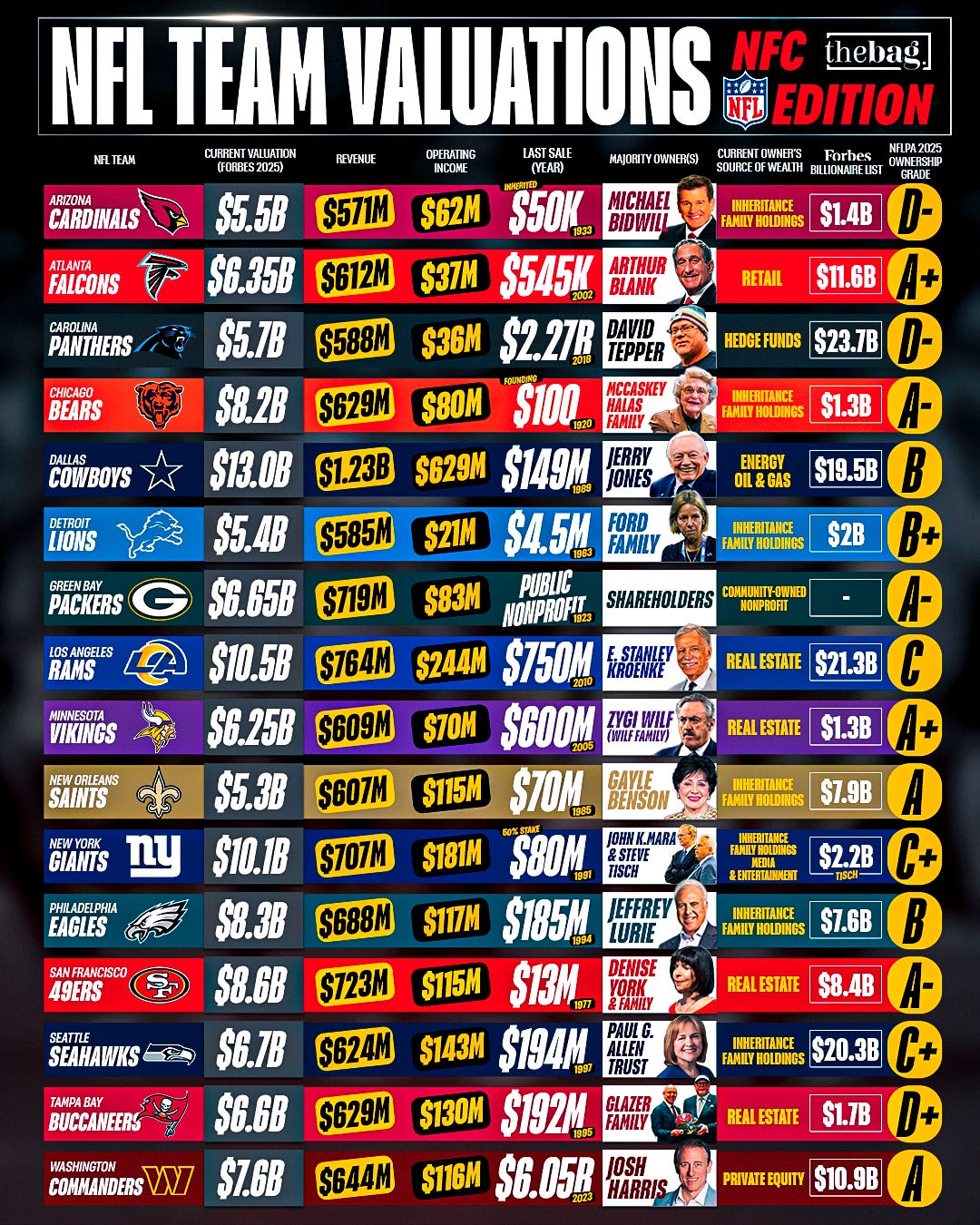
Now let’s look at the NFC.
The Cowboys top the list as the world’s most valuable sports franchise at $13 billion. The 49ers are now worth $8.6 billion. Even smaller-market teams like the Packers and Vikings are over $6 billion. Many of these owners have built valuable organizations, but ownership often traces back to family wealth or legacy businesses.
The other layer here is the NFL Players Association. Every year it surveys players about ownership and publishes grades. It is one of the few places where billionaires are judged not just on balance sheets but by the people who work under them.
Imagine if artists were asked to grade their labels and the executives who run them.
No posts
Comments
Nothing yet. Say the first thing.
Sign in to join the conversation.