
Couldn’t get away from my edit desk. A rocker’s autobiography and a podcaster on the opioid crisis had me glued to Protools. Two books I’ll have more to say about when they drop.
But now I'm sitting with my coffee and digging into this week's audiobook news.
Two things happened that are worth paying attention to. Together they say something concrete about where this industry is going.
Spotify’s earnings are a good magic eight ball to help us see where the industry might be headed.
Audiobooks are a direct contributor to that margin number. The catalog now sits at over 700,000 titles across 22 markets. This is becoming a bigger driver in their earnings.
Here’s what should get your attention: Spotify has seen 36% year-over-year growth in individuals starting an audiobook, and 37% growth in listening hours. For context, Spotify’s overall user base grew 12% in the same period. Audiobook listeners are growing at three times the rate of the platform itself.
Much of that growth is coming from first-time audiobook listeners. Spotify is bringing new people into the format entirely - not just taking existing demand from Audible. Converting music and podcast users who never considered themselves audiobook listeners is good news for the audiobook industry.
Spotify also launched Audiobook Charts in the U.S. and U.K. this quarter. Weekly rankings based on actual listening behavior, not sales. They’ve since expanded charts to Germany and introduced a dedicated kids and family chart. This is the same playbook they ran with music and podcasts: build the chart infrastructure, let discovery follow, let the algorithm do the conversion work at scale.
Here is the implication for publishers and producers: U.K. publisher Bloomsbury reported that audio sales grew 57% in their 2025 fiscal year, citing their commercial relationship with Spotify as a key contributor. HarperCollins said audiobook sales rose 13% in Q4 2024 year over year, with News Corp pointing to Spotify’s entrance into the market as a catalyst.
What is your platform of choice right now and why?
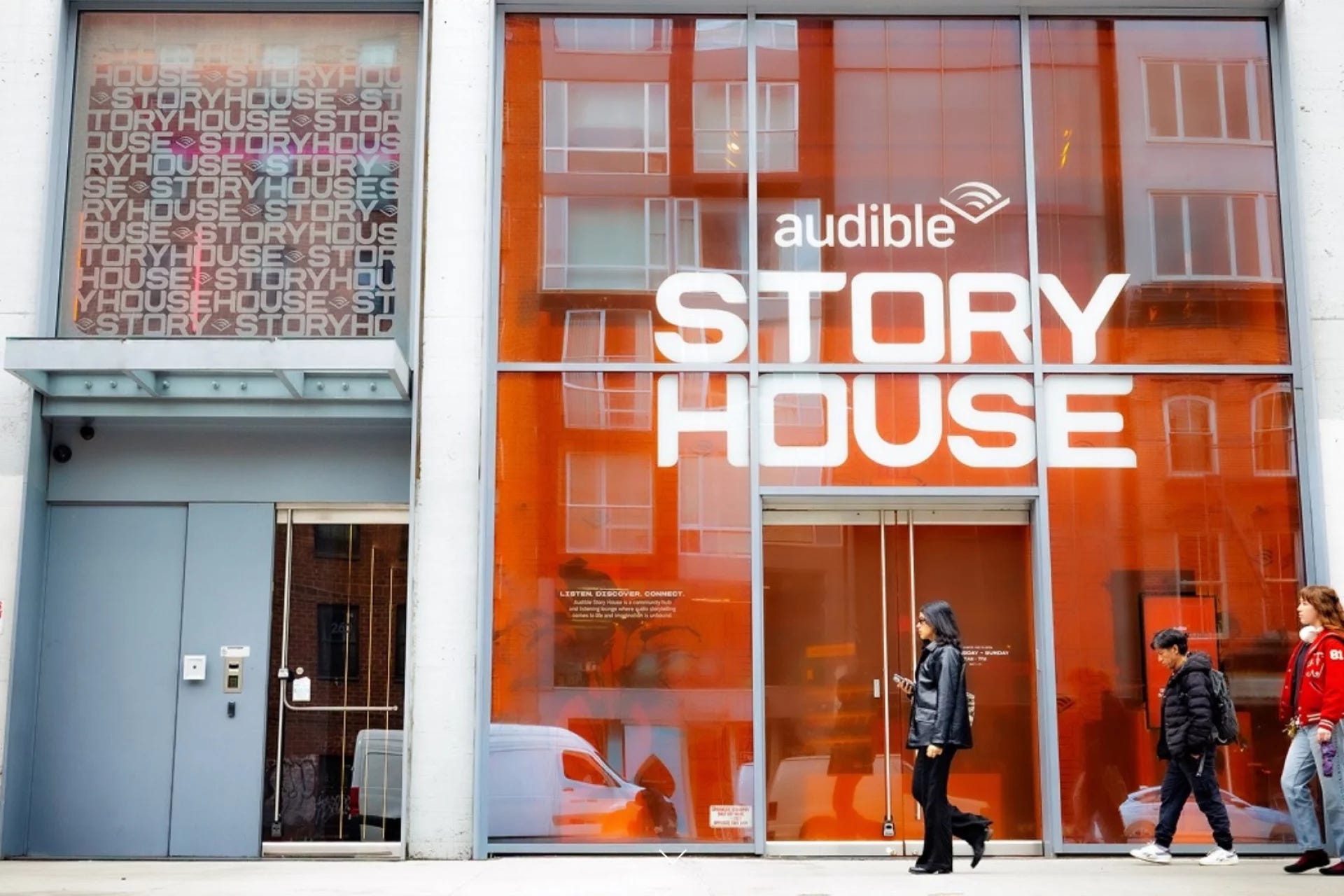
On May 1st, Audible opened a 6,000 square foot listening lounge on the Lower East Side in Manhattan. Free to enter. Open through the end of the month. No books anywhere.
Instead of shelves, there are “Story Tiles.” Physical representations of audiobooks that you take to a listening station, or tap on your phone to stream directly. Six distinct spaces across three floors, including a Dolby Atmos lounge, a Listening Bar with staff who guide you toward your next title, live programming, and a café.
Audible CEO Bob Carrigan’s framing: “what does a bookstore look like without any books?”
Audible is doing this because audiobook discovery is still a real problem, and they’re testing whether a physical, social, tactile experience can solve it in a way that an app cannot.
Audiobook sales in the United States reached $2.22 billion in 2024, nearly doubling over five years. The format is not struggling. But the ceiling on growth is discovery. Most people who might love audiobooks haven’t found the right one yet. That’s what this space is actually about.
The “Story Tender” concept is the part that jumps out to me. It’s a human recommender in a physical space. The exact opposite of an algorithm. Audible is betting that the way you convert a casual browser into a habitual listener is through a person who actually knows the catalog.
One more data point worth noting. Amazon posted Q1 2026 earnings on April 29th. $181.5 billion in revenue. $2.78 EPS. Beat expectations.
The Story House isn't a Hail Mary from a division under pressure. It's a brand experiment inside a company with plenty of room to spend. Audible didn't get a mention in the earnings call, which tells you it's not a problem they're worried about.
It also means they're not under pressure to justify it yet, nor are they setting expectations. That's actually more interesting. They're spending on category building because they can, not because they have to.
If this physical space works, expect more of these. If it doesn’t, it’s still nice to see them trying to bring people back into the physical world and build community.
Have you been to the Audible Story House yet? If you’re in New York, it’s worth a trip. Let us know what you think in the comments.
Spotify isn't winning yet. But Audible hears the footsteps. And what they've done in response is interesting. They're not trying to beat Spotify at its own game. Instead they built something Spotify can't replicate yet: a physical space, a community, a reason to show up in person. Soulless discoverability is Spotify's lane. Audible is trying to own something different.
I like this move. Whether it's enough is a different question.
As much as I'm for using every platform available, watching these two giants go at it for our ears is going to be genuinely interesting. The hope is that the competition forces both of them to put more money into the pockets of the authors and producers actually making the content worth fighting over.
If this week’s breakdown made you think about your own project differently, let’s talk. The difference between a title that holds and one that disappears is almost always a production decision made early. If you’re at that stage and want a second set of ears, DM me!
No posts
Comments
Nothing yet. Say the first thing.
Sign in to join the conversation.