

Been stuck in a lot of edits, and just got back from Disney World with the kids for the first time. Worth every minute. Now I'm catching up on two weeks of audiobook news, and predictably, the industry did not slow down while I was gone.
First, I’m so sick of reading clickbait headlines asking whether audiobooks count as reading? If you are asking this question you need to get a hobby and stop judging people for something they enjoy. People who listen to audiobooks are curious about the world around them. Thus why they want to hear stories. And curiousity about others is a good thing. It will make for a better world.
Anyway, onto the bigger stories from the last couple of weeks. More AI... I know. I’m over talking about it too.
Spotify is sinking deeper into AI audiobook creation muck. Narrators are suing Google over voice use in AI training. And YouTube is still full of pirated, AI-narrated audiobooks that are apparently easy enough to monetize that the problem keeps spreading
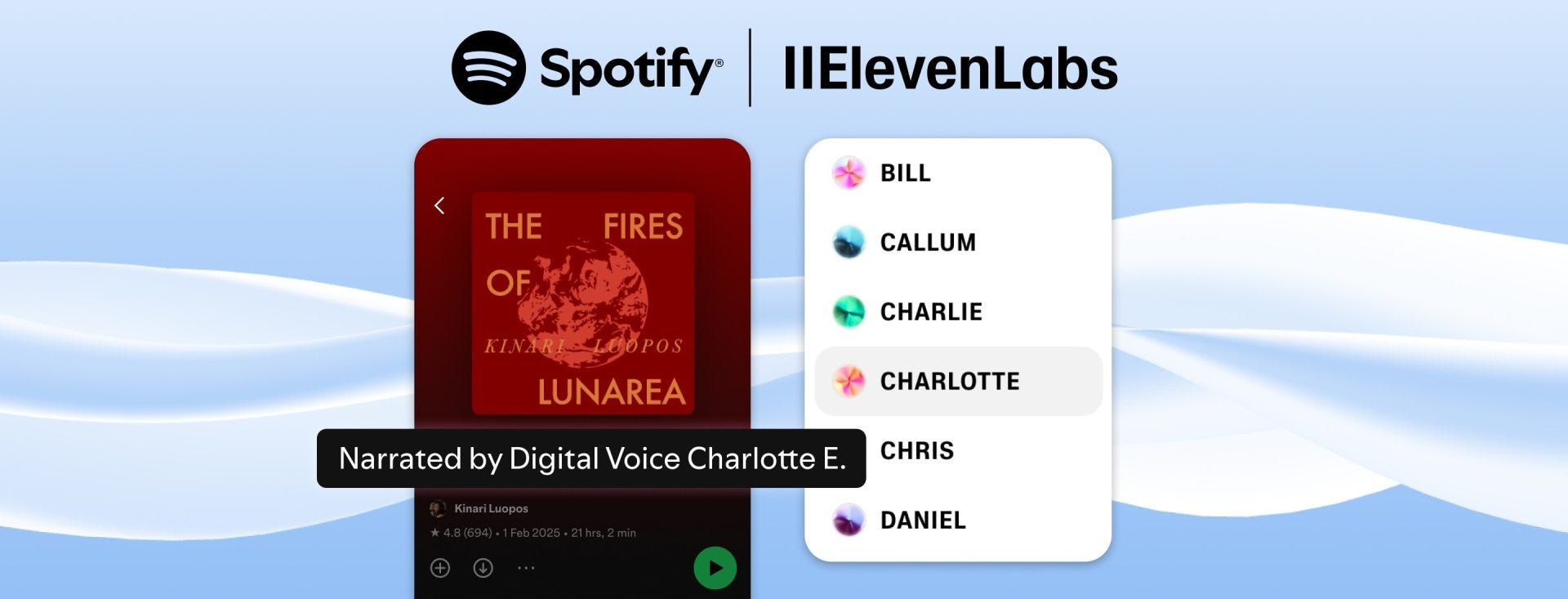
Spotify has officially announced that it now has an ElevenLabs-powered audiobook creation tool inside Spotify for Authors, with an invite-only English beta expected in June. The company says the generated audiobooks won’t lock authors into exclusivity, but the direction is clear: the platform wants to make AI narration feel like a normal part of publishing infrastructure.
Spotify has done this before, but the difference now is where it lives.
The company already supported AI-narrated audiobooks through Findaway Voices and its earlier ElevenLabs setup. This time, though, the tool is built right into Spotify for Authors. That turns AI narration from something the platform merely accepts into something it actively pushing authors toward.
That is not a small shift. It means Spotify is not just opening the door to synthetic audio, it is helping set the expectation that this is a normal part of publishing now.
The more frictionless AI narration becomes, the more it starts to look like the default option for independent authors who are trying to move fast, save money, or get a title out without a full human production budget.
That sounds like access. But it also puts pressure on narrators. Human voice performance starts having to compete with something cheaper, faster, and easier to scale. That is good for the people building the tools and very good for the platforms taking a cut. It is not automatically good for the people doing the work.’
And this is why things like the current Google lawsuit matter. Because it brings the AI debate past the abstract and into the real world of the labor needed to create audiobooks.
The plaintiffs are a group of journalists, podcasters, and audiobook narrators who say Google scraped recordings of their voices from the internet and used them, without consent, to train the company’s voice AI systems.
That lands especially hard in audiobooks because narration is not decoration.
For a lot of titles, the narrator is the performance. The voice carries the tone, the pace, the emotional shape of the book, and the interpretation that helps a listener connect with it. If a company can absorb that work without consent, it is extracting value from the people who built it.
According to Reuters, the complaint alleges Google ingested hundreds of thousands of hours of human speech and extracted biometric voiceprints from those recordings to power products like Gemini Live, NotebookLM Audio Overviews, YouTube auto-dubbing, Google Assistant, and Google Cloud Text-to-Speech.
Once voice gets treated as something a model can copy cheaply, the pressure spreads. It reaches casting decisions, union leverage, rates, and reuse. It also gives buyers a new excuse to say the human version should cost less because the synthetic version exists. That is how “innovation” turns into downward pressure on labor.
If narrators do not push back now, the industry risks normalizing a system where human performance becomes the premium upgrade instead of the creative standard.

Then there is the New York Times story on pirated AI audiobooks on YouTube, which is where all of this starts to look especially cynical. The Times reported that unauthorized AI-narrated copies of major titles, including John Grisham’s The Widow, were drawing tens of thousands of listeners on YouTube.
Platforms are happy to lead creators toward AI tools and train listeners to accept AI voices when it helps growth, lowers costs, or expands output. But when the same tools are used to mass-produce unauthorized audiobooks and make money off them, suddenly they claim there is nothing they can do to stop it and then it becomes a piracy problem.
They cannot really have it both ways. If synthetic voices are good enough to sell as a product feature, they are also good enough to be abused at scale. That is the part the industry keeps dancing around. The platforms want the upside of AI without taking responsibility for the downside.
That is why the pushback matters. Narrators, publishers, and rights holders are not just defending their own turf. They are trying to stop a market from sliding into a world where voice is cheap, labor is squeezed, and the companies building the tools and running the platforms take most of the value.
Would you choose a human-narrated audiobook over an AI-narrated one if the price were the same?
There is at least one story this week that feels like a constructive use of the medium and a strong market position. Audible is helping underrepresented romance authors through a collaboration with Audio in Color that funds first self-published audiobooks, with the current grant cycle open through June 15. That is the kind of support that can actually widen the field instead of flattening it.
If any of this has you thinking about how to make an audiobook the right way — with real production values and a human behind it — my team and I work on exactly that. From planning through final delivery, we're here for the whole process
Till next time - but also if you haven’t subscribed do so and talk next time I can get my head up above my edits!
No posts
Comments
Nothing yet. Say the first thing.
Sign in to join the conversation.