
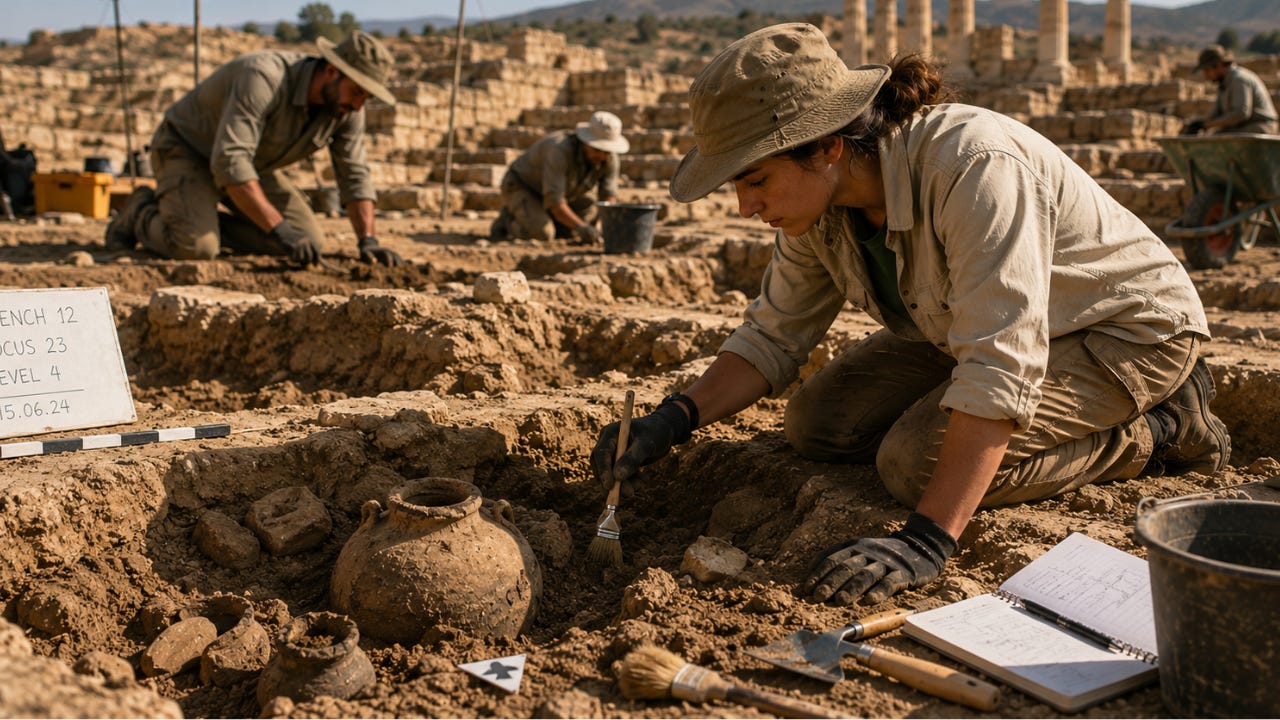
One of the biggest misconceptions about archaeology is that it can tell us everything about an ancient civilization.
While archaeology can reveal an incredible amount of information, there is still a limitation that no excavation can overcome.
Some of the most important parts of a civilization simply cannot be found beneath the ground—not in artifacts, not in ruins, and not in pottery.
Imagine that five thousand years from now, archaeologists excavate our cities. Every book, photograph, phone, laptop, hard drive, and digital record has disappeared. The internet no longer exists. There are no YouTube videos, no Instagram posts, no WhatsApp chats, no cloud storage—nothing. All that survives are our buildings, roads, coffee mugs, smartphones, and other physical objects.
From those remains, archaeologists would probably conclude that we had advanced technology, global trade, and sophisticated cities. They could study our architecture, our transportation systems, and even estimate what we ate or what diseases we suffered from.
But would they truly know us?
Would they know why millions of people spent hours mindlessly scrolling through Reels? Would they understand internet memes, online communities, or why complete strangers formed friendships through a screen? Would they know what books inspired us, what stories moved us, what music we listened to, or what ideas shaped our lives?
Probably not.
Our entire digital ecosystem—something that defines modern life—would most likely disappear over thousands of years. Future archaeologists would only have the physical remains to work with, and naturally, their conclusions would be based on those remains. They wouldn’t be wrong, but they would only be seeing one side of our civilization.
The same thing happens when we study the ancient world.
Take the Indus Valley Civilization. Archaeology tells us that its cities were remarkably well planned. They built sophisticated drainage systems, used standardized bricks, practiced long-distance trade with Mesopotamia, and developed impressive urban infrastructure. This is an extraordinary amount of knowledge, especially for a civilization that flourished more than four thousand years ago.
But archaeology cannot fully explain what an ordinary day looked like. We don’t know how people greeted each other in the morning, what conversations families had over meals, what jokes made them laugh, what songs children sang, or what values parents tried to pass on to the next generation. We cannot confidently describe what a festival felt like or how people expressed love, grief, or friendship.
In other words, archaeology can reconstruct the physical world of a civilization, but it struggles to reconstruct its social world.
This is where surviving texts become incredibly valuable. Ancient Egypt has its hieroglyphic inscriptions. Sumer left behind thousands of cuneiform tablets containing laws, myths, letters, economic records, and even personal complaints. These writings allow us to go beyond architecture and artifacts—they allow us to hear the voices of the people themselves.
The Indus script, however, remains one of archaeology’s greatest mysteries. Since we cannot yet read it, much of the civilization’s own story is still locked away.
This is also why ancient Indian literature is so important. The Vedas, Brāhmaṇas, Upaniṣads, the Rāmāyaṇa, the Mahābhārata, and other Sanskrit texts preserve far more than religious ideas.
They discuss philosophy, education, social customs, rituals, family life, ethics, governance, and the way people understood the world.
Because a civilization is never just roads, houses, and drainage systems. It is built on relationships, values, traditions, stories, knowledge, and shared experiences. It is built by people.
Even then, we should remain humble. No text can perfectly preserve everyday life, just as no archaeological excavation can uncover every thought that once existed. There will always be a part of every civilization that remains hidden from us. Perhaps that mystery is what keeps ancient history so endlessly fascinating.
Archaeology can reconstruct the skeleton of a civilization.
But without its words, much of its soul remains hidden beneath the earth.
I hope the next time you read about an ancient civilization, you’ll think not only about the cities they built, but also about the countless human stories that may never be unearthed.
If you find my work worth reading, please consider supporting me. It’s the best way to help keep this newsletter independent and reader-supported.
Click here to support me on Buy Me a Coffee.
Stay Curious
Ancient Explain
No posts
Comments
Nothing yet. Say the first thing.
Sign in to join the conversation.