
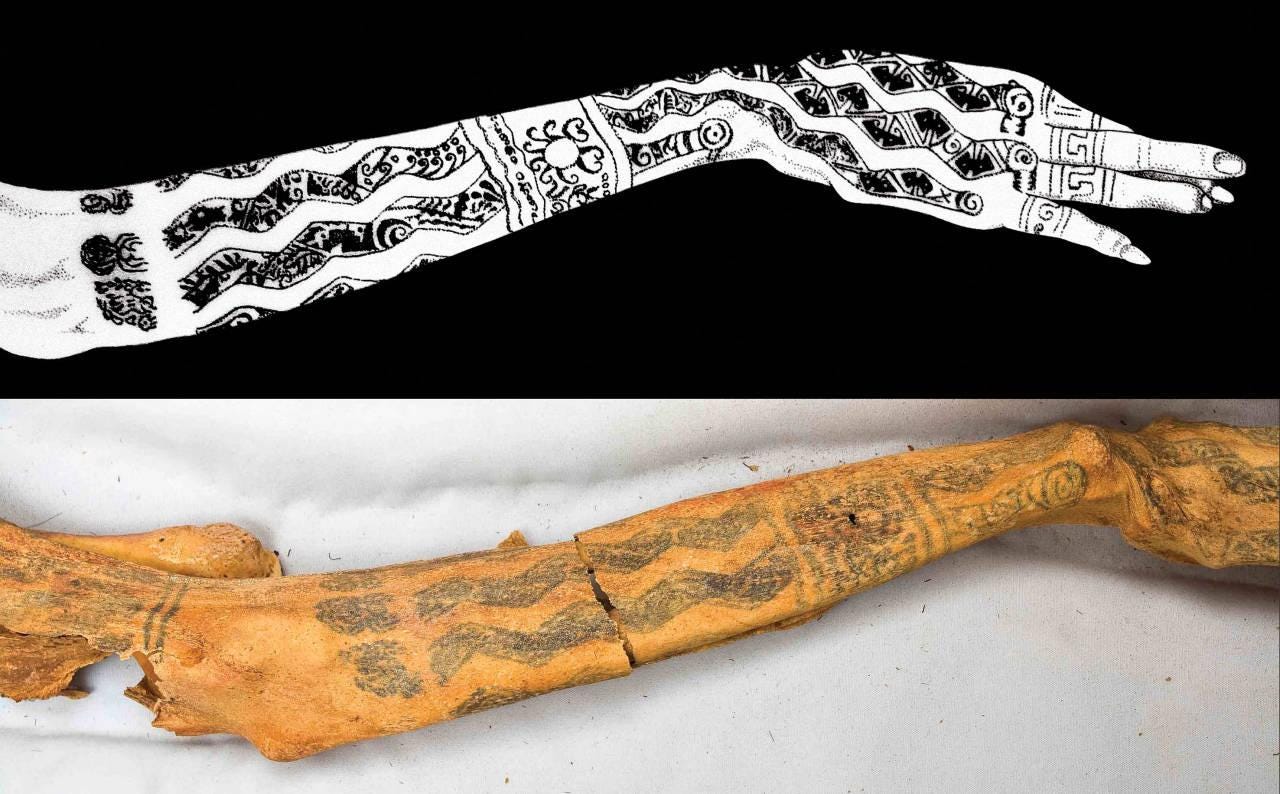
Would you believe me if I told you that archaeologists discovered a 1,600-year-old mummy bearing one of the best-preserved ancient tattoos ever found?
Hidden for centuries in Peru, this remarkable mummy is known as the Lady of Cao. Despite being over 1,500 years old, the intricate tattoos on her arms and hands are still clearly visible today.
But what makes this discovery truly fascinating isn’t just how incredibly well the tattoos have survived. It’s what they reveal. Each design is believed to carry symbolic meaning, offering clues about the beliefs, rituals, and culture of the ancient Moche civilization. As we take a closer look at these mysterious tattoos, we’ll uncover the stories they may have been telling for more than sixteen centuries.
This newsletter is reader-supported.
Become a member to support independent publishing while unlocking member-only content, and other special benefits.
Before we look at the tattoos themselves, it’s important to understand the story behind the mummy.
The Lady of Cao was discovered on the northern coast of Peru at the El Brujo archaeological complex. She belonged to the Moche civilization, which flourished between 100 CE and 800 CE. Archaeologists believe she lived around 450 CE, making the mummy nearly 1,600 years old.
In Moche society, elaborate burials were reserved for people of great importance. The richness of her tomb suggests that she was likely a ruler, priestess, or another high-ranking figure rather than an ordinary member of society.
Unlike the wrapped mummies of ancient Egypt, the Lady of Cao was buried deep inside a sealed mud-brick tomb.
The dry desert climate of northern Peru preserved her body exceptionally well, allowing even the fine details of her skin to survive for more than sixteen centuries.
Her burial contained remarkable treasures, including gold and silver jewelry, ceremonial clubs, spear throwers, finely woven textiles, crowns, and other ornaments. Archaeologists also discovered the remains of a sacrificed young woman buried nearby, further highlighting the importance of the individual laid to rest.
What makes this discovery truly extraordinary, however, is the tattoos themselves.
The tattoos appear on her forearms, hands, and fingers, featuring intricate images of snakes, spiders, crabs, geometric patterns, and supernatural figures. These were almost certainly more than simple decorations. In the Moche civilization, body art likely carried deep religious and symbolic meaning.
The snake was associated with water, fertility, agriculture, and powerful deities.
Spiders were connected with rain, weather, and agricultural cycles, making them symbols of prosperity and renewal.
Some of the other figures appear to represent mythical beings linked to the Moon or the supernatural world, suggesting divine authority and a connection with the cosmos.
Although the exact meanings remain uncertain, these symbols strongly suggest that the Lady of Cao held an important ceremonial or religious role within Moche society.
Another fascinating aspect is how these tattoos survived for nearly 1,600 years.
Many ancient cultures used plant-based pigments that gradually faded over time.
The Moche, however, appear to have used a durable mineral-based bluish-black pigment that resisted decomposition. Combined with the dry climate and the sealed burial chamber, this allowed the tattoos to remain visible in remarkable detail.
The Lady of Cao’s tattoos are far more than ancient body art.
They provide a rare window into the beliefs, symbolism, artistic skill, and social structure of the Moche civilization.
More than 1,600 years after they were created, these remarkable tattoos continue to reveal the story of a culture whose mysteries archaeologists are still working to understand.
IIf you enjoyed reading this article and would like to support what I do, I’d love to invite you to join the membership.
As a member, you’ll get access to exclusive monthly articles that explore the ancient world in far greater depth, covering fascinating discoveries, forgotten civilizations, and the stories behind history that rarely make it into textbooks.
You’ll also be able to suggest topics for future articles, ask questions about ancient history and archaeology, and help shape the content I create.
Most importantly, your support allows me to continue researching, writing, and sharing in-depth articles like this as an independent creator.
Thank you for reading and for supporting my work.
Click here to become a member and support the journey.
Stay Curious,
Ancient Explain
No posts
Comments
Nothing yet. Say the first thing.
Sign in to join the conversation.