
When we hear the term “Indus Valley Civilization,” most of us imagine a civilization that flourished only along the Indus River. For decades, this was the dominant view in archaeology.
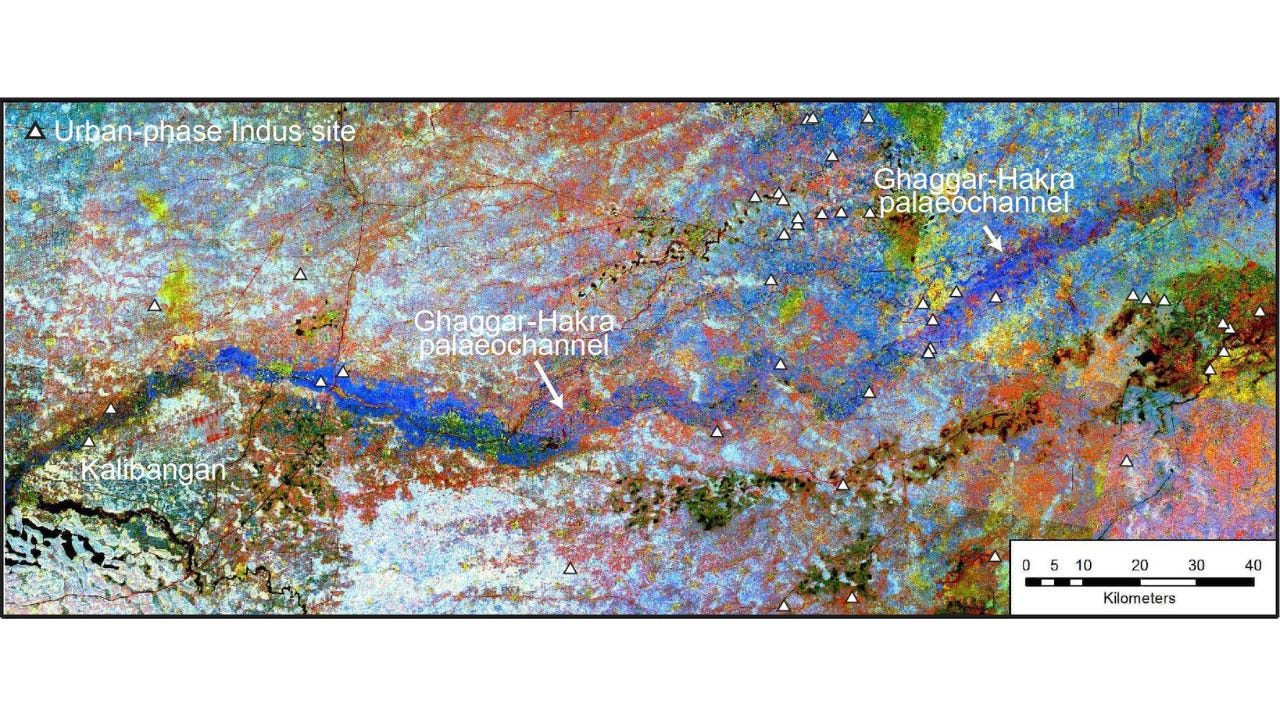
However, as more archaeological sites were discovered, an interesting pattern emerged. More than 60% of Harappan settlements were found not along the Indus itself, but across the Ghaggar-Hakra river system—a region that many researchers associate with the ancient Saraswati.
This raised an important question:
Was there once a major river flowing through this region?
For thousands of years, ancient Indian texts had spoken of a mighty river called Saraswati. Yet many scholars considered it mythical because no such large river exists there today.
Recent scientific research has changed the discussion.
The Saraswati River is mentioned repeatedly in ancient Indian texts, particularly the Rigveda.
One famous verse describes Saraswati as:
“Ambitame naditame devitame Saraswati”
“Best of mothers, best of rivers, best of goddesses.”
— Rigveda 2.41.16
This verse portrays Saraswati as a mighty flowing river.
Interestingly, later Vedic texts describe a different situation. The Panchavimsha Brahmana states that Saraswati disappears in the desert, suggesting that the river had begun to dry up or vanish.
For centuries, many scholars viewed these descriptions as symbolic or mythical. But modern science has uncovered evidence that points to the existence of a major ancient river system in the same region.
One of the most important breakthroughs came from satellite imagery.
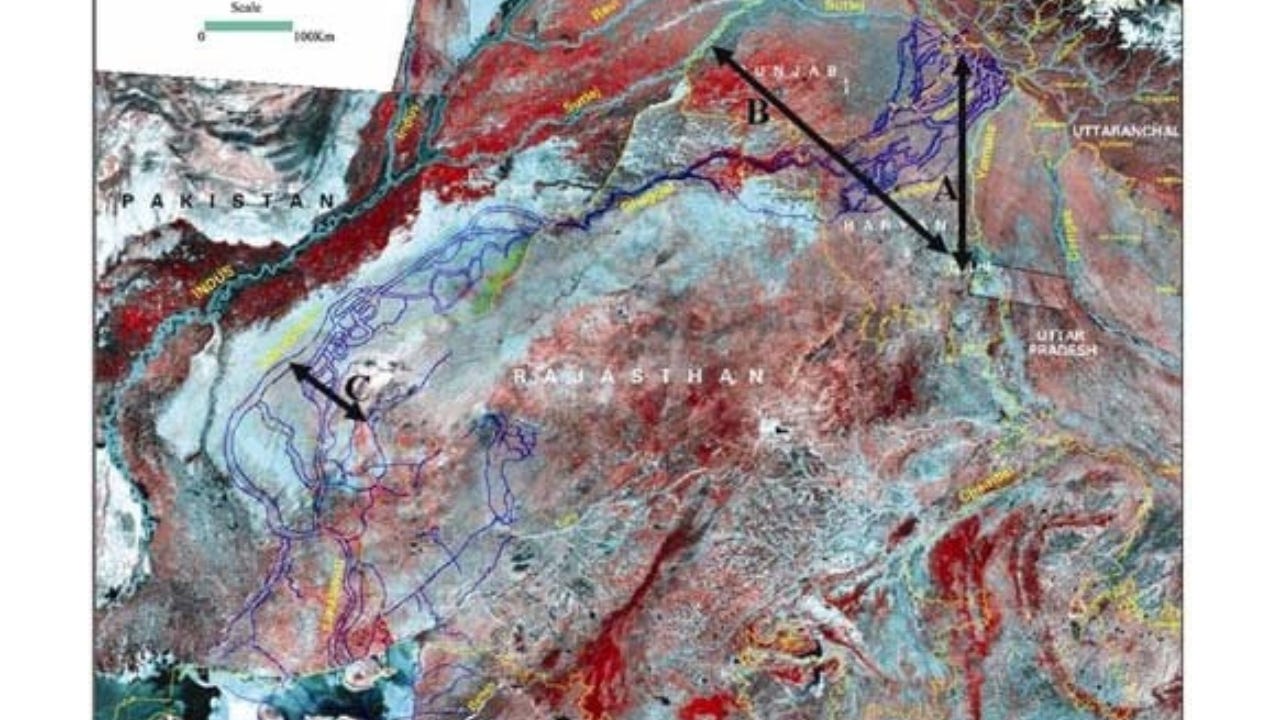
Using remote sensing technology, scientists identified vast buried river channels stretching across Haryana, Rajasthan, and into Pakistan. These ancient channels, known as paleochannels, are the remains of rivers that flowed thousands of years ago.
What surprised researchers was their size. In many places, these channels were several kilometers wide—far larger than the small seasonal streams found in the region today.
The discovery suggested that a major river once flowed through this landscape.
Satellite images alone were not enough. Scientists needed to determine what kind of river had created these channels.
Researchers drilled into the paleochannels and collected sediment samples consisting of sand, silt, and mud deposited by flowing water.
The results were remarkable.
Minerals and isotopic signatures within these sediments matched rocks found in the Himalayas. This indicates that water flowing through the ancient channel once carried Himalayan material over long distances.
Scientists also used radiocarbon and luminescence dating techniques to determine when these sediments were deposited. The findings showed substantial river activity in the region during different periods of the past.
Together, the satellite and sediment evidence provide strong scientific support for the existence of a major ancient river system in northwestern India.
Geological studies suggest that changes in river courses, tectonic activity, and long-term climate shifts gradually reduced the river’s flow.
Around 4,200 years ago, a major climatic event affected large parts of the Old World, weakening monsoon systems across the region. As water supplies declined, many settlements were abandoned or shifted toward more reliable rivers such as the Ganga and Yamuna.
By the later phases of the Harappan civilization, the once-powerful river system had largely disappeared.
The significance of these discoveries goes beyond the existence of a single river.
Satellite imagery, geological investigations, and sediment analysis have shown that ancient texts preserve memories of real landscapes and environmental changes that occurred thousands of years ago.
The story of the Saraswati reminds us that history is constantly evolving. As new evidence emerges, our understanding of the ancient world continues to grow.
If you enjoy our work and would like to support independent archaeology and history research, consider becoming a member.
Membership is the best way to support this publication and helps us continue creating in-depth articles like this one.
As a member, you’ll also receive exclusive perks, including:
• Monthly members-only articles (straight to your inbox)
• Monthly Q&A sessions
• The ability to vote on future topics
• Discounts on guides and other shop items
Click here to become a member.
Click here to Preview Member Content.
Your support helps us uncover, research, and share the stories of the ancient world.
Stay Curious
Ancient Explain
No posts
Comments
Nothing yet. Say the first thing.
Sign in to join the conversation.