
What you need to know
High-speed rail cannot have level crossings. Every farm lane in the corridor becomes a binary decision: build a structure, or extinguish the access.
France and Germany settled this by law. Farmers sit on a body that can compulsorily redraw the farms and the farm tracks together, the proponent pays, and there is a right of appeal. Canada has no equivalent mechanism at all.
Nobody has decided who maintains the crossings. Alto says the approach is "still being developed." France needed a decade of litigation and an Act of Parliament to answer the same question.
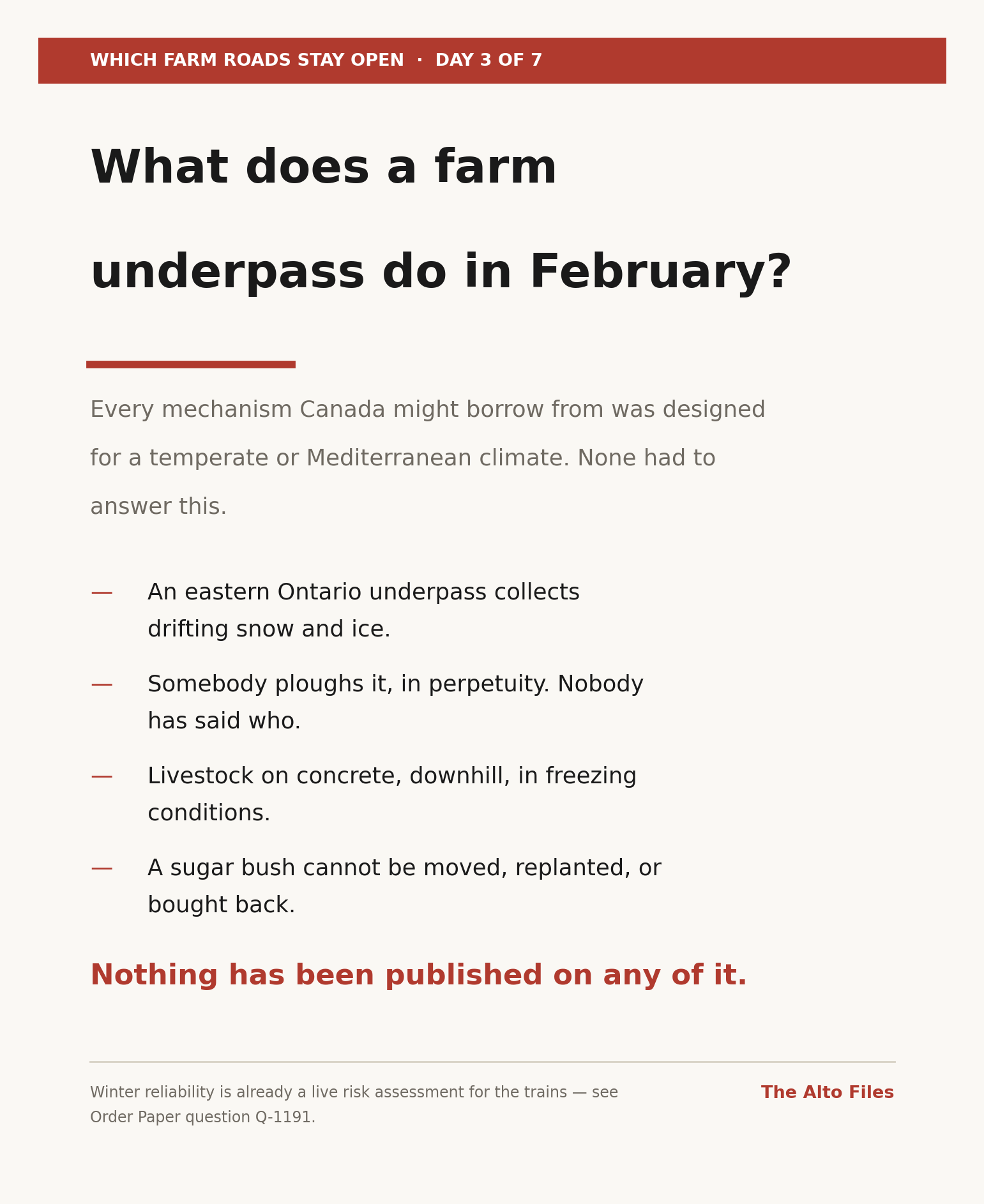
Livestock crossings and machinery crossings are different structures. A standard cattle underpass is about 2.1 m high; a modern combine or grain cart needs 4 m or more.
Closing crossings puts farm equipment on public roads. The OFA's own figure: slow-moving vehicles are 3.8 to 4.8 times more likely to be in a fatal collision per kilometre.
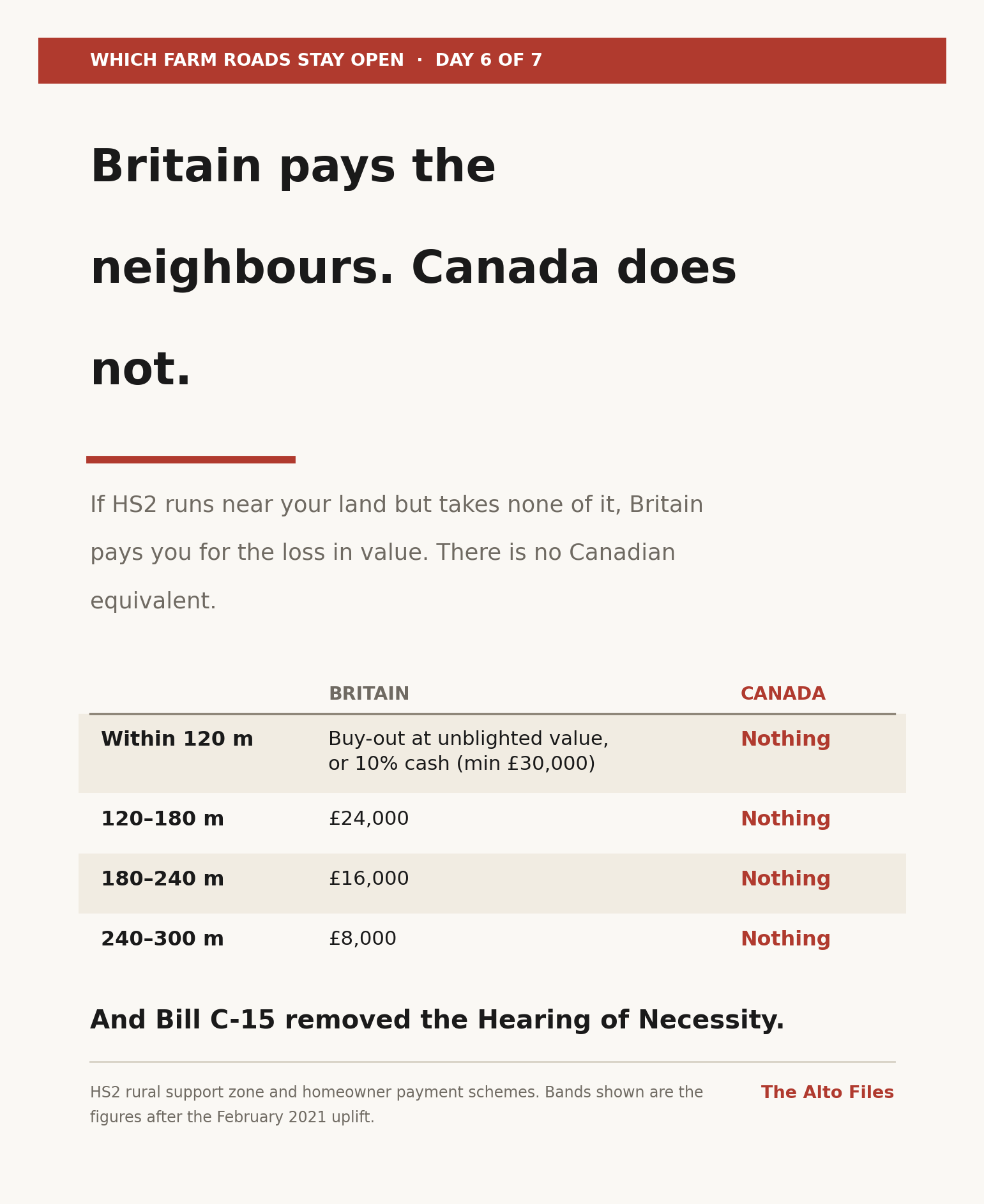
Britain pays neighbours who lose value but no land. Canada offers nothing — and Bill C-15 also removed the Hearing of Necessity.
Alto's agricultural pages did not exist until March–May 2026 — the month its surveyors started knocking on doors.
The greenfield corridor was the bidders' idea. A Privy Council Office note shows the government went to market for a 200 km/h project on mostly existing rights-of-way. The consortia proposed new ones. They won.
What a corridor community receives comes in three tiers. Only one is compensation in any meaningful sense.
Tier 1 — For those whose land is taken
Every jurisdiction has this, and Alto has developed it. But it reaches only people who lose land — a minority of those actually affected.
Tier 2 — For neighbours who lose only value
Here Britain did something Canada has not.
Rural Support Zone — typically out to 120 metres from the centre line in rural areas: voluntary purchase at unblighted market value, or a cash offer of 10% of unblighted open-market value with a £30,000 minimum — staying put and being paid for the blight.
Homeowner Payment — roughly 120 to 300 metres, banded by distance: £22,500, £15,000 and £7,500 as announced in July 2014, later £24,000, £16,000 and £8,000. The rationale is the one to put to Alto: the scheme aims to share the economic benefits of HS2 with homeowners who might not benefit because they do not live close to a station.
Need to Sell and Rent Back schemes.
Britain conceded in writing the exact proposition rural Ontario has been making: a line that passes through without stopping confers benefits elsewhere and costs here, and the gap should be paid for.
Canada has legislated no equivalent to any of the four. A landowner 100 metres from the right-of-way whose land is not required gets nothing.
Combined with Bill C-15 removing the Hearing of Necessity, a Canadian landowner has fewer procedural rights and no blight compensation.
Tier 3 — Community funds
HS2's are administered independently by Groundwork UK: two funds providing up to £40 million to communities demonstrably disrupted, with ceilings of £75,000 per community project.
Sufficient? No.
After seven years they had allocated a little over £16 million across 285 projects — on a railway costing tens of billions — with an average award under £75,000 of £48,701 in 2018/19.
The typical output is equivalent to the cost of a single community hall roof.
The money does not go to the people bearing the loss, the amounts are not anywhere near the same order as the harm.
Grants end while severance does not.
Alto's version
Alto's Community Partnerships Program caps first-year grants at $50,000, does not fund multi-year partnerships, and reserves the right to award less than requested.
The people most affected cannot apply. The exclusions bar individuals and for-profit companies. A farm is a for-profit business; a farmer is an individual. The constituency bearing the largest permanent loss is categorically ineligible for the only community benefit programme Alto operates.
The criteria are marketing criteria. The published list includes "Visibility for the Corporation" and "Opportunity for the Corporation to engage directly with the community (activation)". "Activation" is sponsorship vocabulary.
A community benefits mechanism does not score applications on the proponent's exposure. There is no published total, no independent administrator, no project map, no annual review, and no insight into the decision making process.
The framework that was never built
On 25 November 2024 HICC issued an RFP under HICC-LICC 2024-2025 PS5612, "Community Benefits Agreements in the Context of High Frequency Rail (HFR) Phase II," seeking a consultant to advise on integrating CBAs, refine the policy intent and understand delivery options — expressly "within the limitations of the project's maturity."
HICC was asking what a CBA framework might look like only when the procurement was over and the switch to higher speeds was determined. No binding framework existed during the procurement, and the report commissioned has never been released. I requested it and received it entirely redacted.
Britain legislated its property schemes and announced £40 million before construction.
Canada has announced nothing at all. There is no legislation or published standards.
What is missing nationally
Alto's commitments are a proponent's commitments. It changes with their website updates.
That is the problem, and it is a problem of Canadian law or the government's approach to this project. From the beginning the government told industry that it would not have significant constraints.
1. No land reallocation mechanism exists in Canadian law
No statutory body with farmer members that can redraw parcels so each operation ends up on one side. No mechanism to spread land loss so no single farm is destroyed. Severance is resolved one farm at a time, as a valuation dispute between a farmer and a Crown corporation. Germany decided that was unacceptable in 1953. Canada hasn’t even discussed if such a system could or should be available here.
2. Nobody has decided who maintains the crossings
Alto's page states that the approach to long-term maintenance of grade-separated structures is still being developed. France needed a decade of litigation and an Act of Parliament. Canada apparently plans to build hundreds or thousands of these structures with the issue not legislated. Corridor municipalities should ask now whether they inherit a bridge liability in 2075 — and demand the answer in statute, not a statement posted on a website by Alto that could change at any time.
3. Farmers are consulted; they do not have status
Every verb is a proponent verb. Crossings could be designed. Access identified where possible. Alto notes that additional crossings may require additional land — a farmer wanting a second crossing may be asked to give up more acreage for it. The OFA has been explicit that dividing properties without maintaining full access is unacceptable. In France or Germany these organisations would hold a seat at the table and an independent body decides.
4. No appeal on the access question
If Alto decides a farm gets one crossing rather than two, or 4.0 metres of headroom rather than 5.5, there is no tribunal. Compensation can be disputed. Design cannot.
5. No Canadian clearance standard
Alto promises crossings adapted to large equipment. So far as I have established, no published Canadian standard exists for agricultural crossing dimensions for a railway.
A self-propelled sprayer or loaded grain cart with the auger folded runs roughly 4.0–4.5 metres tall; folding corn heads push transport widths past 4.3 metres. A structure at highway clearance sounds generous and may still exclude part of a modern fleet. Ireland's cattle-underpass norm of 2.1 m internal height, by contrast, shows how far apart the livestock and machinery cases are.
6. Dairy is the complicated Canadian case
A nutrient management plan ties manure volume to accessible spreadable acres; severance may push an operation out of regulatory compliance, not merely out of profit. Quota is not portable. Alto's compensation examples engage the cattle case thoughtfully; they do not engage the regulatory dimension at all. There are no laws to protect dairy farmers here.
Questions this raises
Will Canada establish a scheme for affected owners whose land is not acquired, equivalent to HS2's rural support zone, homeowner payment, need-to-sell and rent-back? If not, why is a Canadian landowner entitled to less than a British one?
What is the total annual budget of the Community Partnerships Program, and what has been distributed by the name of each community and not for profit? What did those communities and not for profits agree to do for Alto in exchange for the money?
Why are individuals and for-profit businesses — farmers and rural businesses — excluded?
Why does the rubric score visibility for Alto and “activation” if it's supposed to be about benefits to the community?
Why isn’t the programme externally administered and publicly reported, as HS2's funds are?
Release the consultant report under HICC-LICC 2024-2025 PS5612.
How many agricultural crossings are contemplated in the Ottawa–Montréal segment, and by what method is the number determined? Where is the law or government standard?
No posts
Comments
Nothing yet. Say the first thing.
Sign in to join the conversation.