
The rules Alto wants rewritten
The Grade Crossings Regulations, SOR/2014-275, made under the Railway Safety Act, do something no Alto webpage does: they actually impose reciprocal, enforceable information obligations between the railway company and the road authority. It is one of the few tools municipalities have in dealing with Alto on the matters at issue in this series.
Section 4 requires a railway company to provide the road authority, in writing, with specified information about a public grade crossing. Sections 12 to 14 run the obligation the other way — written details of changes, and at least 60 days' written notice before an increase in road crossing design speed. Neither party gets to hold information while the other plans around it. It is the thing corridor municipalities have been asking Alto for and being offered only under a non-disclosure agreement.
The Regulations distinguish public from private crossings, and private crossings receive a reduced subset of the requirements. Farm crossings sit in the weaker category even before anyone changes anything.
What the 2023 briefing deck shows
The deck prepared for Alto's incoming chief executive in 2023, released under A-2025-00027, contains a grade crossings slide revised across successive drafts.
The first version states the position as regulation: Transport Canada requires grade separation above 177 km/h (110 mph); the current maximum operating speed through crossings is 100 mph; Transport Canada has no standards addressing all areas of safety above 95 mph.
A later version softens it: crossings may be permitted subject to appropriate safety and risk analysis.
A further version retitles the slide "Grade Crossings, the key differentiator to higher speeds," and adds the line at the centre of my earlier reporting: the 2021 Business Case assumed a maximum operating speed of 109 mph to reduce capital costs.
The final version reframes the rule. Transport Canada requiring grade separation above 110 mph becomes Transport Canada allowing design speeds up to 110 mph. Two new bullets appear that were in none of the earlier drafts:
grade crossings at all speeds should be avoided in a greenfield corridor; and
most regulations are based on historical industry standards dating back over a century, written for existing railroads rather than new construction, and heavily influenced by freight railroads.
That second bullet is an argument — the argument a proponent makes when it intends to seek different standards.
And the deck sets out the mechanism
The Implementation Plan slide in Part 2 of the same disclosure: an application to the Minister for assessment of the project's standards, ministerial approval within 60 days, and only Transport Canada oversight thereafter for compliance.
The question France put to a commission with farmers on it, and Germany to a specialist court, Canada's proponent proposes to route through a ministerial approval on a 60-day clock, against standards Alto gets to draft. There is no farmer in that process. There is no road authority, municipality or independent decision maker in it either.
The High-Speed Rail Network Act does not abolish the crossing regime. Bill C-15 removes the section 98 approval under the Canada Transportation Act — the Agency's approval of a new line's location — on the rationale that it would duplicate Cabinet's route approval.
The finding
The existing Regulations give road authorities a statutory right to information and a statutory role. Alto's internal materials characterise them as century-old, freight-derived and unsuited to new construction, and set out a path to replacing them with project standards approved by the Minister in only 60 days.
Meanwhile the corporation offers municipalities information under NDA, and offered farm organisations a collaboration agreement five of them declined because signing would constrain talking to their own members.
The law requires sharing. The proponent requires silence — and proposes to rewrite the law that requires the sharing.
Nobody voted for the greenfield corridor. The bidders proposed it.
Severance is a direct product of the speed target. A 300 km/h line requires long curves, full grade separation and a fenced greenfield corridor. A 200 km/h upgrade can largely follow what exists with fewer impacts.
The change to high-speed rail did not happen because of a vote in Parliament. It happened during the procurement.
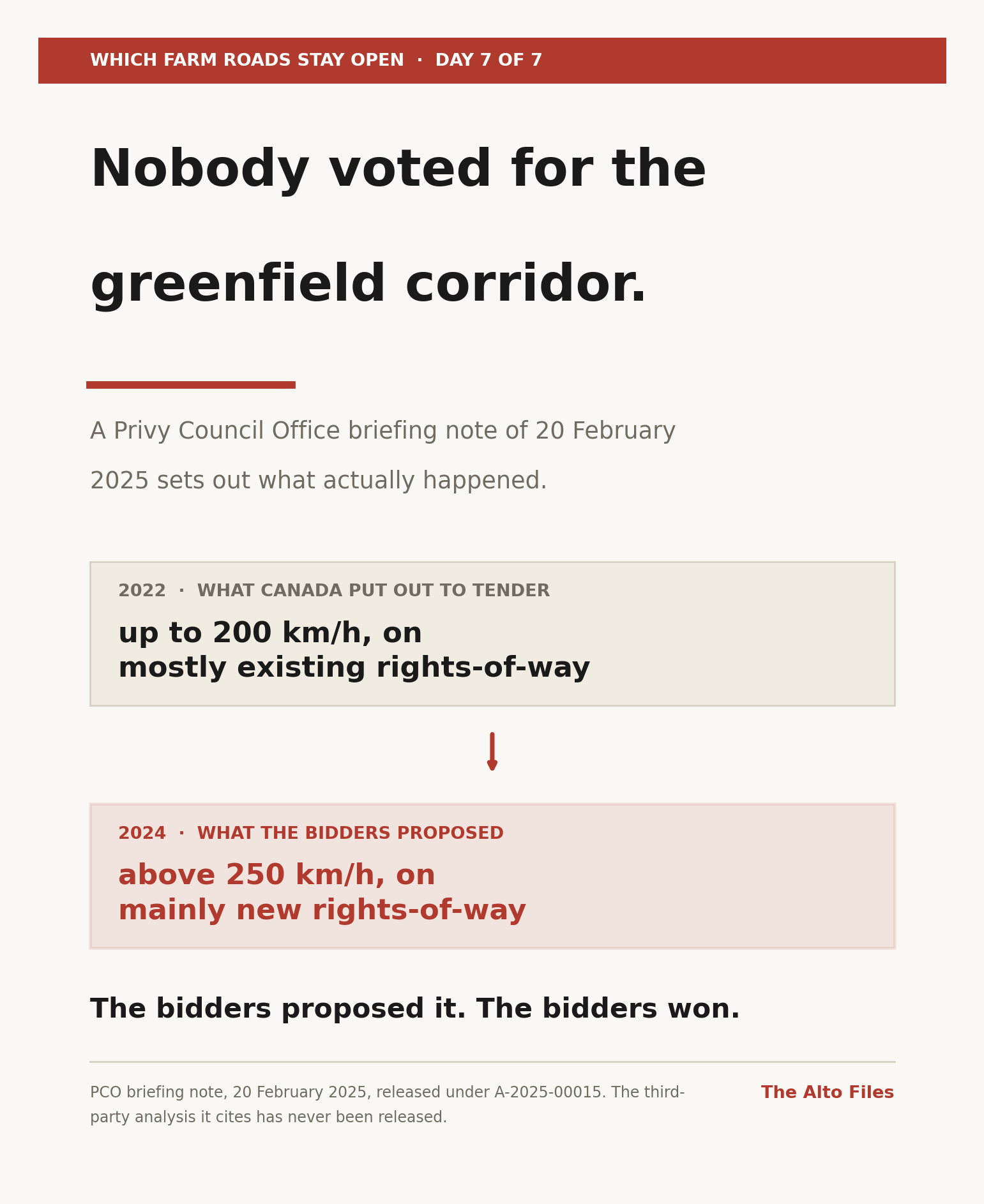
A Privy Council Office briefing note dated 20 February 2025 — the day after the announcement — sets out the sequence. It is addressed to the Quebec Lieutenant, Minister Duclos, signed by Christiane Fox as Deputy Clerk of the Privy Council, and was released under A-2025-00015.
In February 2022, PCO records, the government went to market for a project it described as a conventional high-frequency concept, with speeds up to 200 km/h, using dedicated tracks on mostly existing rights-of-way. The RFP launched in October 2023 and three consortia bid in July 2024.
Then, in PCO's own words, as the procurement evolved the bidders put forward more ambitious designs than the high-frequency concept. All of them favoured new alignments with mainly new rights-of-way, and a high-speed concept above 250 km/h. A third-party analysis of the proposals, PCO says, showed they would deliver greater benefits than the high-frequency concept. I’m still waiting to receive a copy of whatever that third-party analysis was.
Read that against everything in this series. The fenced greenfield corridor — the thing that severs the farms — was not chosen in a business case, a policy review, or Parliament. It arrived in bid submissions. Canada's procurement started from existing rights-of-way. The bidders proposed new ones, and the bidders won.
Sweden reversed course
Trafikverket's 2021 study proposed a Y-shaped 320 km/h network at SKr 295 billion with a SKr 50 billion margin of error.
In December 2022 the government stopped it. As International Railway Journal reported, Gothenburg–Borås was paused with the above-250 km/h aim abandoned and a review ordered of whether measures on the existing line could serve instead; Hässleholm–Lund was stopped outright. The reasoning: maintenance had lagged for years.
Dropping the East Link design speed from 320 to 250 km/h saved a calculated SKr 11 billion, from 65 down to 54. Sweden went from high-speed rail to upgrades. Alto went the other way.
Switzerland never started
Switzerland has one of Europe's most intensively used railways and no high-speed rail at all.
The first phase, completed 2004, was around 130 projects at roughly CHF 5.9 billion, and the one genuinely new line was the first in Switzerland permitting 200 km/h — built to hit a timetable, not a speed record.
An earlier proposal would have built roughly 120 km of new line for fast running between major cities. The Federal Council declined it as too narrowly framed, too focused on the west–east transversal, and achieving too little network-wide improvement. SBB was directed to develop a nationwide concept instead.
That is the argument corridor municipalities and farm federations are making: a fast line between big centres is not the same thing as a national benefit. In Switzerland the government agreed.
The Canadian debate
The Globe and Mail editorial board: Alto's own benefits figure, around $49 billion over 60 years, sits below the $60–90 billion construction estimate, with no detailed cost-benefit analysis released.
Andrew Coyne: a $30 billion margin of error is itself the warning sign, and a 1995 joint federal-provincial study put the corridor at roughly $9.5–10.5 billion.
Economist Werner Antweiler: Canada needs better rail but not high-speed rail.
The Hub: terminals, screening, and whether the service actually shifts travellers out of cars and planes.
A sympathetic outside-view assessment concedes the strongest argument — VIA's unreliability stems from running on infrastructure it does not control.
The farm sector's own economics: the Roy / Mercier / Filion report on viability, freight, the value of speed and who pays.
The alternative is not "do nothing." It is what Switzerland built, what Sweden retreated to, and what Canada itself first put out to tender in 2022: dedicated passenger track on mostly existing corridors, limited grade separations, restored stations, frequency rather than peak speed.
Every kilometre of new greenfield alignment is a kilometre of severance a 200 km/h upgrade could have more easily avoided.
One claim worth testing
In a sponsored piece in May 2026, Alto wrote that countries such as France and Italy, with substantial farming communities, have shown that high-speed rail and agriculture can coexist, and that this is what Alto is working to achieve here.
That is true, and it is also the strongest argument against Alto and the governmental approach.
French coexistence is not goodwill, communication or a grant programme tied to agreeing to do marketing for Alto. It is a statutory mechanism — the reallocation under L.123-24 — under which the proponent must repair the damage to the land structure, farmers sit on the commission that orders the reallocation, the proponent pays, and the outcome can be appealed to the administrative courts. Plus a 2014 Act settling who maintains the crossings.
Alto invokes France's outcome while declining France's method - or any method at all. If it wants to cite French coexistence, the fair question is whether it will accept the French mechanism — and if not, what Canadian mechanism it proposes instead.
A website is not enough.
We are not the first country to build a railway. It’s time we stop acting like this is new. Where is the government’s leadership on these issues?
Where is the legislation?
No posts
Comments
Nothing yet. Say the first thing.
Sign in to join the conversation.