
4:48 a.m. Twenty-one minutes before sunrise. Forty-three degrees. A northwest wind at two miles per hour, gusting now and then to three. Fragmented coral clouds gather in the east; elsewhere, the sky is clear and bright. Pale lavender seeps westward, then the east turns molten as the sun lifts over the New Hampshire hills, an epochal flare that lingers only a moment.
Flowers keep their own calendar: Canada mayflower and false Solomon’s seal. Dandelions and coltsfoot have already gone to seed, their brief brightness now surrendered to pollination and the wind.
Still too cold for frogs this morning, though peepers chorused last night in vernal pools beyond my deck, those small woodland basins kept from the sun by the gentling shade of hemlocks.
4:32 a.m. Robins kindled the morning, singing from the roof of the shed, the crown of the garage, and the maples along the driveway’s edge. Then a hermit thrush called out from the hemlocks where the peepers sleep, summoning the day from its green hush.
4:44 a.m. Red-breasted nuthatch, somewhere in the shadows, with a small voice stitched into the dimness, as fine as a thread of dawn.
5:18 a.m. Along the roadside, an eastern wood pewee sings from the end of a white pine stub, thirty feet up and close to the trunk. Bill barely open, song shifting, directly above me. A plaintive whistle, rising and falling ... pee-ah-wee, pee-ah-wee—as if the bird offers his own name to the morning. Tail twitching. Wings flicking. A small bundle of motion, perhaps trying to warm itself. Preening and singing, singing and wing-flicking, tail bouncing.
Though I saw several pewees in Costa Rica last month, singing from the almond trees along the Caribbean, I rarely see them at home. They come late to Vermont and linger deep into summer, often singing straight through the day. Late May into September. Even the blunt heat of late summer does not silence a pewee. I stay until the bird slips quietly away, as if folded back into the green.
5:22 a.m. A northern house wren on the uppermost spruce twig, needles pointing straight up, singing far beyond its size, the whole morning tucked into so small a body.
5:29 a.m. Hairy woodpecker drums. Northern flicker cries out—a volley of bright blows ringing across the morning, hammering the day into song.
5:37 a.m. Indigo buntings, male and female, side by side in an oak. Silent. The female hops to the next branch; the male follows dutifully, the two of them moving through the leaves bound by an invisible thread. No second male making a nuisance of himself. I want to find the nest. The buntings want privacy. They lead me nowhere in particular. Slow, easy movements, branch to branch. No feeding. No preening. Only dawdling in the oak, brushed with buttery morning light.
Among the chorus, thirty-five species: mourning dove; eastern phoebe, from nearly every outbuilding on Kings Highway; red-eyed and blue-headed vireos; tufted titmouse, loud and insistent; black-capped chickadee; white-breasted nuthatch; Swainson’s thrush; American crow; blue jay; common raven; and eight warblers, the residents—ovenbird and black-throated green, both early risers, American redstart, northern parula, northern yellow, common yellowthroat, pine, chestnut-sided. Gray catbird, as vocally inventive as ever. Scarlet tanager—no longer a tanager, now considered by ornithologists to be a grosbeak. Northern cardinal. American goldfinch, zipping over the road like stray bits of sunshine. House finch. Song, chipping, and white-throated sparrows. Dark-eyed junco.
The morning’s mood is encouraging. The bird song and theatrics, thrilling. As if fine wine spilled out of the sky. No matter which way the worm turns, no matter how torqued the nation has become, at the edge of a new day, across a landscape green and lush, I find peace.
My Playful Neighbors: David lives on the west side of Hurricane Hill, where sunset lingers on his porch and first light comes late. Behind his garage, a pair of gray foxes has renovated an abandoned woodchuck burrow. They have three kits, two larger than the third. Each week, he shares images from his motion-sensitive wildlife cam, which runs day and night because the kits—small bundles of energy—and their parent are almost always in motion: roughhousing, feeding, nursing, idling in the sun or under the soft cover of darkness.
The dog family (Canidae) arose in North America 37 million years ago, crossed the Bering Land Bridge, and radiated across Eurasia. Red foxes and wolves evolved in the Eastern Hemisphere, then crossed that bridge back into North America during the most recent Ice Age. But the ancestors of the gray fox stayed home, parting from other canid lineages during the Miocene Epoch eight to twelve million years ago, and remain the oldest living branch of the family.
Gray foxes sport round pupils; red foxes, vertical ones like rattlesnakes. Gray foxes move on short legs, while red foxes stride on long ones. Gray foxes climb trees; red foxes don’t. Gray foxes wear salt-and-pepper coats with russet collars and white throats, their fur coarse beneath the hand. Red foxes are most often red, though sometimes black or cross. Their fur is soft, their legs black, and their tails end in a white-tipped flourish. Gray foxes favor the shelter of thick woods, the denser the better. Red foxes haunt the Arctic tundra, meadows, and open woodlands—landscapes so often altered by us.
Mammalogists classify the gray fox, Urocyon (Greek for tailed dog) cinereoargenteus (Latin for ashy, silver), into fifteen subspecies. U. c. borealis lives in David’s backyard. Half a million years ago, as North America’s interior dried and woodlands gave way to grasslands, many deciduous-forest species, gray foxes among them, split into eastern and western lineages. Later, another pulse of glaciation pressed gray foxes into southeastern refuges. They returned to the Northeast long after the Ice Age—about a thousand years ago—during the so-called Medieval Climate Anomaly, when warmth opened the way and deciduous forests climbed north again. Then the Little Ice Age, from 1500 to 1850, together with wholesale forest clearing, drove gray foxes into remote hillside woods, into thermally sheltered forests and wooded hideaways. Their history has moved with the forests themselves, advancing and retreating with the long breathing of climate and trees.
David’s fox kits care little for genealogy. (They’ve left that to me.) What commands them is play: roughhousing, that seemingly endless, nonadversarial wrestling of tumbling, butting, checking, grabbing, yanking, chewing, dragging, and pouncing. Play is as primal as hunger, fear, and sex. Without it, the kits are socially diminished. Play-fighting, fierce as it may look, bridges the brainstem’s ancient urgencies and the finer circuits of the cerebral cortex, teaching them how to measure and respond to the world. Deprived of play, young foxes fail to read the signals of others and often fail to mate. Play-fighting is not the sharpening of combat skills, but the shaping of a life among other gray foxes. Their parents, tolerant and permissive, seem to know this in their bones.
After school, when I was a boy, I mounted my bike and slipped away with friends into the long, golden afternoon. I stayed out until dinnertime, or until my mother’s voice came threading through the neighborhood to find me. Unstructured play. Visceral fun. Americans may have forsaken unsupervised play … fox kits haven’t … can’t it be as vital as dinner? Long may the fox kits dally in the light and shadow behind David’s garage.
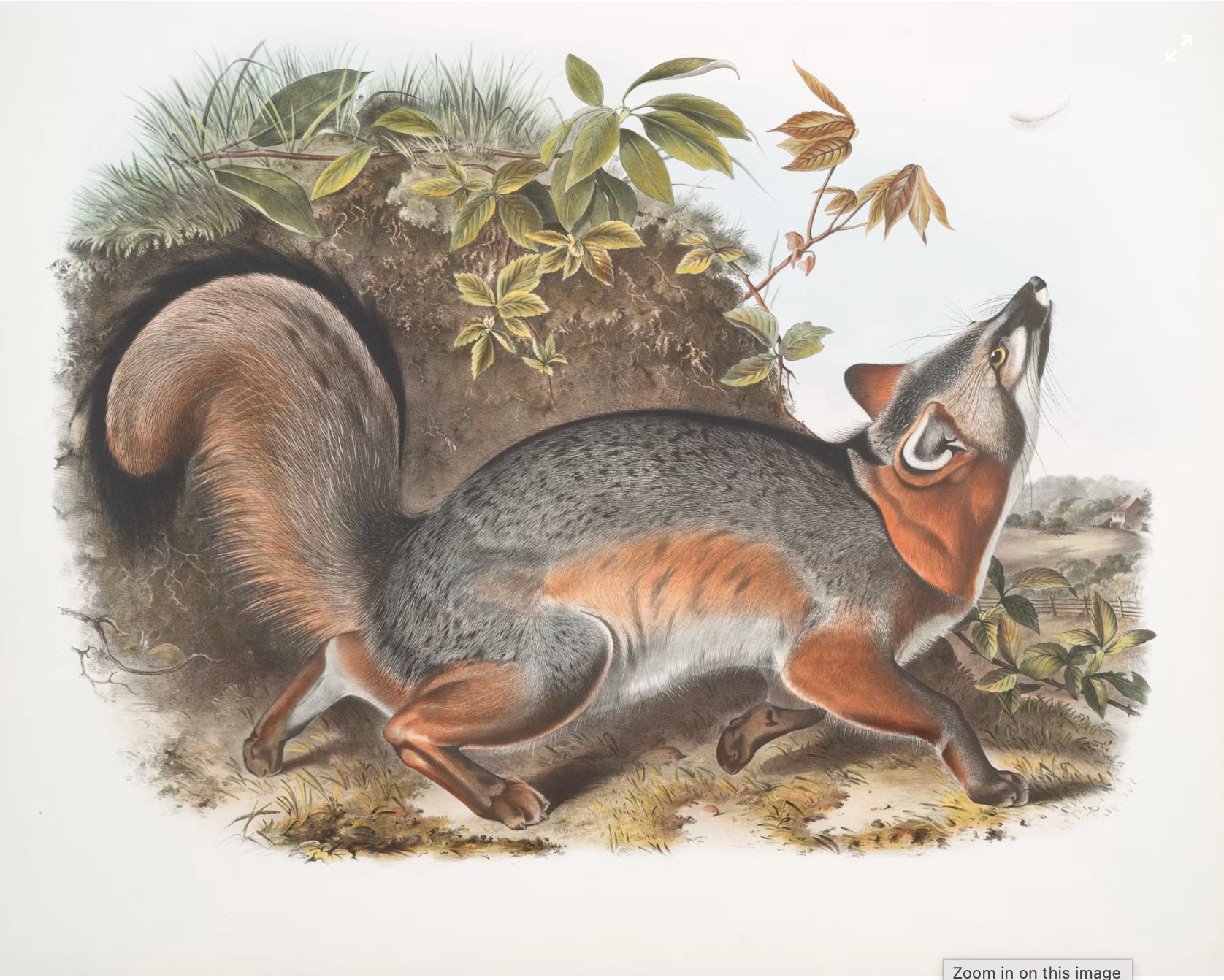
Gray fox, J.J. Audubon, from Mammals of North America
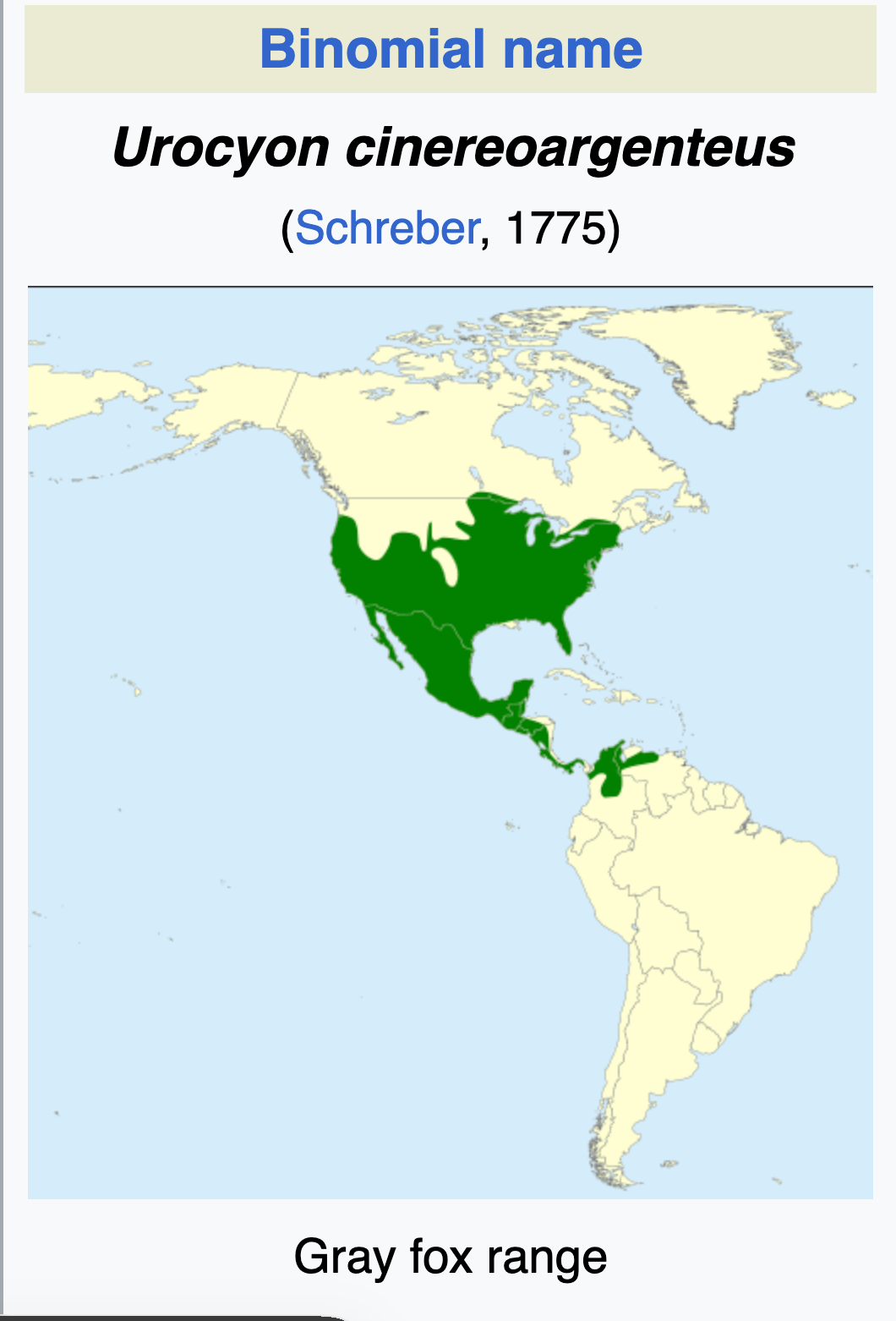
Range of the gray fox
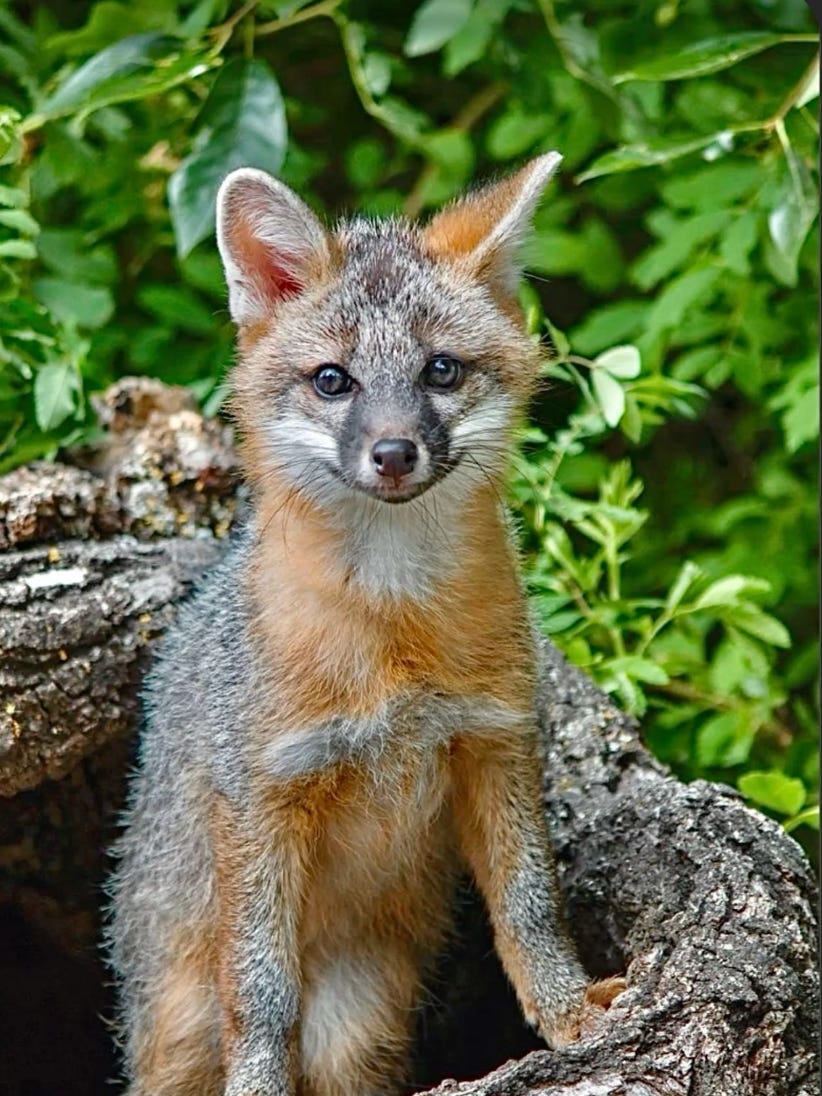
Maturing kit
Videos courtesy of David Pelliter
Serious play
More serious play
Nursing and grooming
Carrying a mole
Checked into the den by a bigger sibling
A consideration: Watching and writing are how I make my way in the world. Your support matters. Thank you all for sticking with me on this journey. Revel in the ripening of spring.
As a lifelong naturalist and Yankee fan, I follow a trail blazed by John Burroughs and John Muir, neither of whom paid much attention to baseball. My work has appeared in Houghton Mifflin’s The Best American Sports Writing, Audubon, Sierra, Sports Illustrated, National Wildlife, OnEarth, National Geographic Traveler, National Geographic Books, Yankee, The New York Times, Newsday, The Boston Globe, The Chicago Sun-Times, The Guardian, and The Daily Telegraph, among other publications and anthologies. For twenty-four years, I was a regular commentator on Vermont Public Radio, and occasionally on NPR. I am the author of Backtracking: The Way of a Naturalist (1987), Blood Brook: A Naturalist’s Home Ground (1992), and Liquid Land: A Journey Through the Florida Everglades (2003), among other works of nonfiction. I received the Burroughs Medal in 2004, the highest literary honor awarded to an American nature writer. E. O. Wilson called America’s Snake: The Rise and Fall of the Timber Rattlesnake (2016) a beautifully written book [that] demonstrates just how good nature literature can be.
Beginning on 14 March 2020, the day after I returned home from Costa Rica, at the onset of the pandemic lockdown, I started writing a daily journal—part natural history, part memoir, and part commentary—that appeared here on Substack. Since the 25 August 2021 post, I have edited the 526 entries (deleting, combining, modifying) into a new book, The Promise of Sunrise: Finding Solace in a Broken World, which Green Writers Press published on the vernal equinox of 2025.
From: Seven Days
Ted Levin, Green Writers Press, 400 pages. $21.95.
A pissed-off woodpecker flies in and screams...
When COVID-19 crashed into his life in 2020, naturalist Ted Levin began taking a walk each day at sunrise through the woods and wetlands around his home in Thetford. His walks begat a daily blog and now a lyrical book that brings to life the world of efts and otters, warblers and wrens, chickadees and coyotes. Engaging natural history lessons — loon semen and mammoth bones make an appearance — weave through the daily entries, and slowly the reader also learns the story of the author’s life.
Levin’s writing can be extraordinarily vivid: Coyotes “hurl their voices at the crescent moon”; a bobcat has a face “like a soiled, fraying softball”; chickadees are “four maestros working on a score.” Writing such as this demands to be read as one reads poetry, in small sips, to be fully savored.
—Candace Page.
No posts
Comments
Nothing yet. Say the first thing.
Sign in to join the conversation.