
4:44 a.m.—twenty-three minutes before sunrise. Forty-seven degrees; a west wind at one mile per hour, gusting to two, if my iPhone can be trusted. Feels calm and looks calm; even the leaves hang motionless. In the west, a half moon floats in a pale blue, cloudless sky. In the east, the horizon is striated, delicate orange and yellow gathering ahead of sunrise. To the north, the sky is lightly bruised, wispy blue-gray. To the south, who knows—the rising hill stifles my view. Fog hangs in the valleys, tracing the rivers. A deep, green world matures into summer.
June advances, and I can no longer see through the maples and oaks or into the crowns of the trees. Unless a bird alights in some small opening, I am left to listen. Yellow hawkweed and buttercup brighten the roadside. Strawberry flowers are pollinated. Garlic mustard in seed. Red maple keys are nearly ready to fall. Milk snakes bask in the meadow, in the barn, and on the ledgy outcrops in the morning sun. (A neighbor had one in the garage rafters, a garland of barn swallow feathers protruding from its mouth.) Fringed polygala is fading. Wild leeks have faded. Rhododendron, peaking. Azalea, gone by. Gray treefrogs and spring peepers, calling. American toads and wood frogs, eggs ripen and hatch. Green frogs and bullfrogs have yet to begin chorusing.
Snowshoe hare—the first I’ve seen in a decade—grazes along the edge of the woods—round face. Erect ears. Brown above, white below. Four long white stockings. Moves slowly, measured hops, as though it has all the time in the world, its big brown eyes fixed on me.
4:44 a.m.: Chickadees, already singing, are joined seven minutes later by red-eyed vireos and ovenbirds.
5:00 a.m.: Catbird inventive in a gray birch.
The Blended Chorus (thirty-three species): Canada goose overhead; downy woodpecker, pileated woodpecker, yellow-bellied sapsucker; eastern phoebe; eastern wood-pewee; tufted titmouse (mice, really—there were a lot of them); white-breasted and red-breasted nuthatches; American crow and common raven; blue jay with its waterpump song; American robin, surprisingly subdued; hermit thrush; wood thrush; eastern bluebird; cedar waxwing; warblers—chestnut-sided, northern yellowthroat, black-throated green, black-throated blue, American redstart, northern parula, black-and-white; scarlet tanager—how can so bold a red remain hidden in green leaves?; eastern towhee; house finch; indigo bunting; American goldfinch; song sparrow; dark-eyed junco.
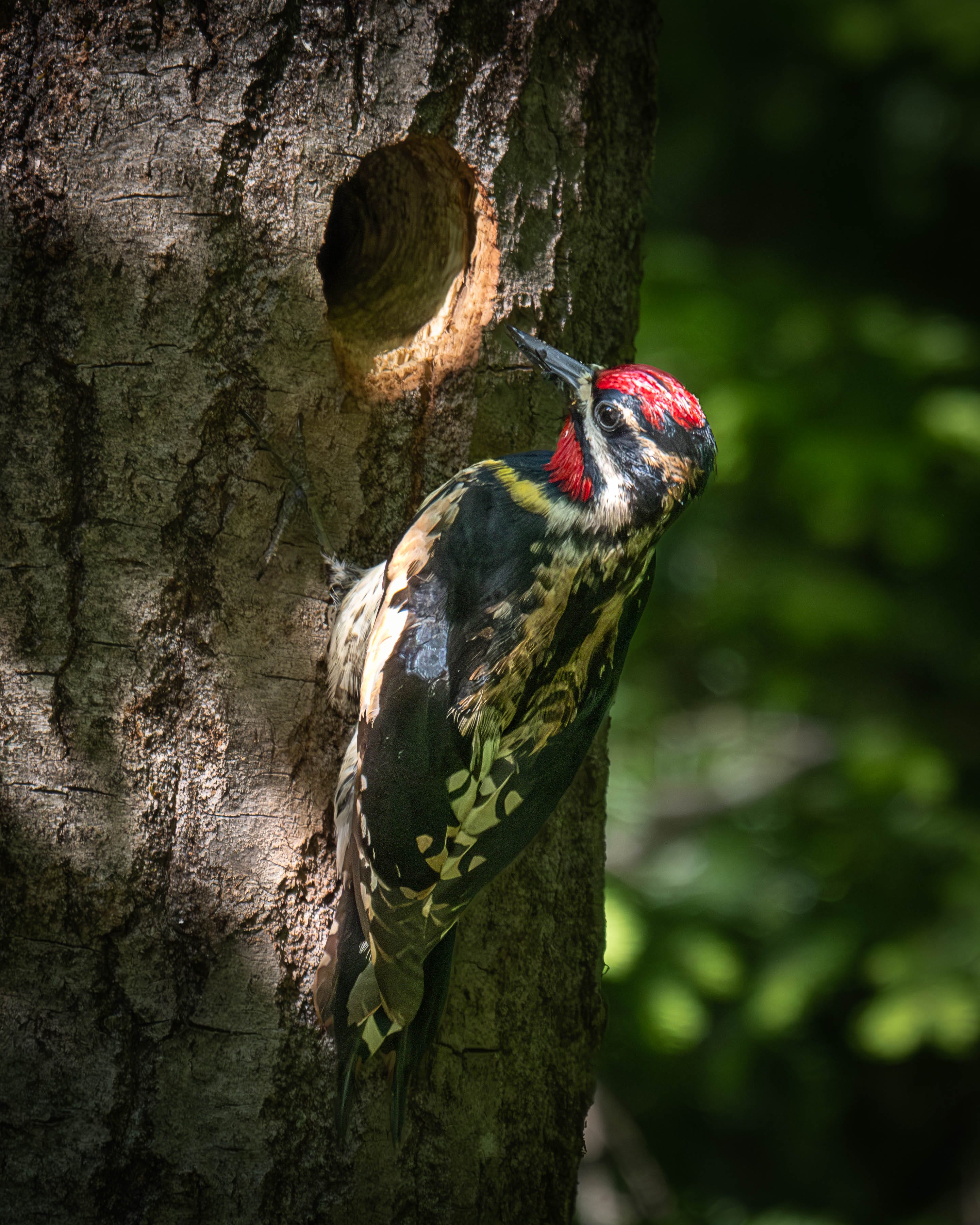
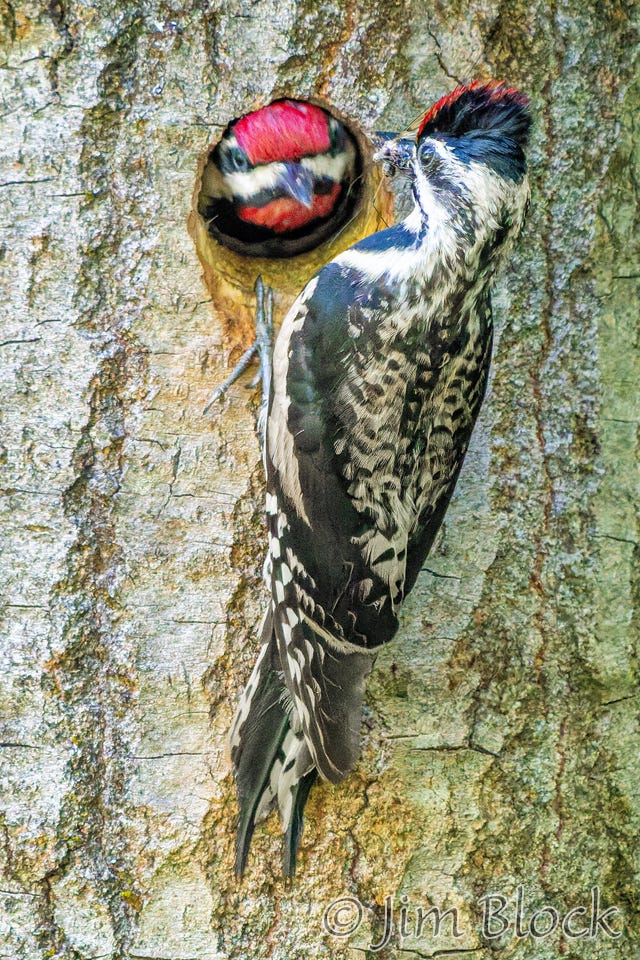
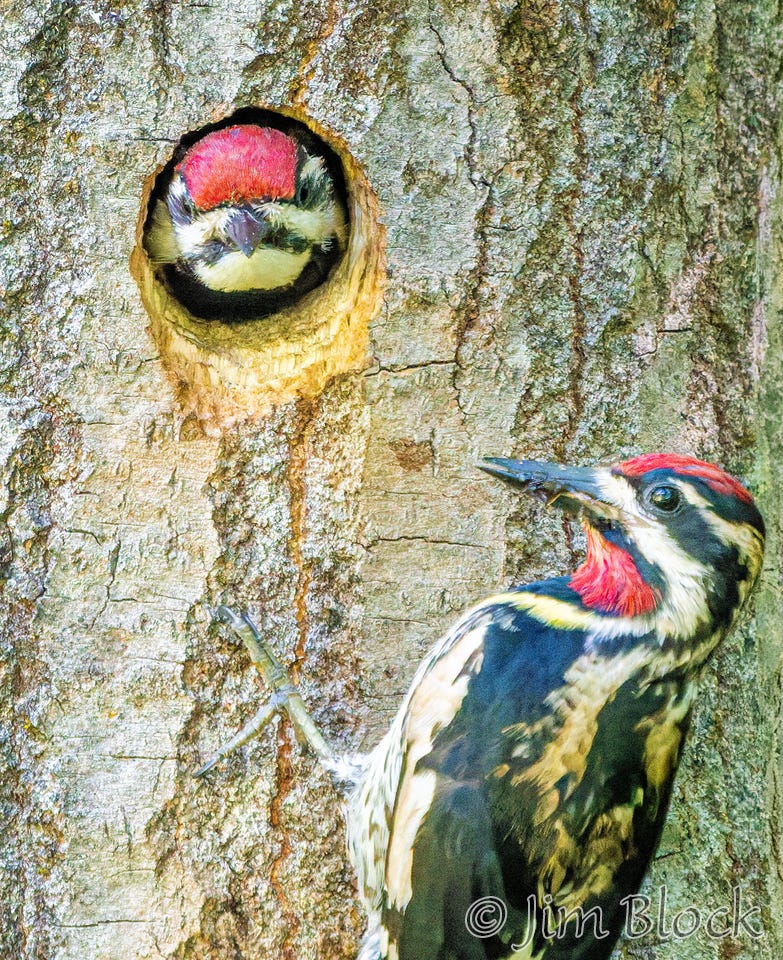
Two days ago, near the top of Hurricane Hill, late in the afternoon, on a path I’ve walked a hundred times since returning from Costa Rica in late April, a male yellow-bellied sapsucker crossed the road and lit against the trunk of an aspen with a soft thud. He looked at me and waited while the female slipped from a neat, round cavity, perhaps an inch and a half across. Then he hitched himself upward and disappeared inside. From within, chicks still too small to be seen began to murmur—soft, almost lost beneath the day, a sound I might have missed if the wind had been any stronger.
I’ve been visiting the sapsuckers ever since ... always at a respectful distance.
5:12 a.m.: A hairy woodpecker, early to rise, drums on a weathered oak stub across from the sapsuckers’ nest.
5:13 a.m.: The female sapsucker, roosting in a nearby hemlock, calls. Three minutes later, she flies to the nest tree, calls again—more softly now—and slips into the cavity.
5:17 a.m.: The male emerges, skimming low over the road, nearly brushing me, fecal sacs packed in his bill. He lands on a red oak just behind me, tucks the sacs into a fissure in the bark, wipes his bill on lichen, and vanishes into the woods, as if the morning simply folds him back into itself.
The sapsucker’s nest cavity—the view unobstructed—is in a quaking aspen, facing southwest, ten feet from the road and seven feet up. Dark in the morning; bathed in afternoon light. The wood along the rim is polished and bright, worn smooth by busy, scuffing feet. The aspen is big and old and dying. Shelf fungus grows from the trunk, a sign that the tree’s heartwood is softening, having made it easier for sapsuckers to excavate. Several of the highest branches are already leafless and dead. Three feet directly above the nest cavity, last year’s nest (I assume) faces the same way. In the absence of woodpeckers, its rim has darkened and weathered; the cavity remains unused. A woodpecker artifact, available rent-free: a small abandoned doorway looking out over rural Vermont.
Unraveling a keystone species, a neighborhood bird: yellow-bellied sapsucker, Sphyrapicus varius (sphyra, Greek for hammer; pikos, Greek for woodpecker). Varius is Latin for “variety,” once a nod to the sapsucker’s varied coloring. Pale yellow breast, two F-stops overexposed; about as close to white as you can get and still call it yellow. Red breast. Red nape. Then, in 1983, ornithologists split the yellow-breasted sapsucker into three species: yellow-breasted, red-naped, and red-breasted—what taxonomists call a superspecies, or sister group. Three species with a very recent common ancestor: in this case, the Pleistocene. Likely, enormous lobes of continental ice separated the sapsuckers into three distinct populations. When the glaciers withdrew, one species had diverged into three, each mostly keeping to itself: red-breasted in the Pacific Northwest, red-naped in the Rocky Mountains, and yellow-breasted from southeast Alaska to New England. A fourth sapsucker, Williamson’s, diverged from the others in the Pliocene, about three million years ago, and overlaps the range of the red-naped. Members of the superspecies interbreed where their ranges meet.
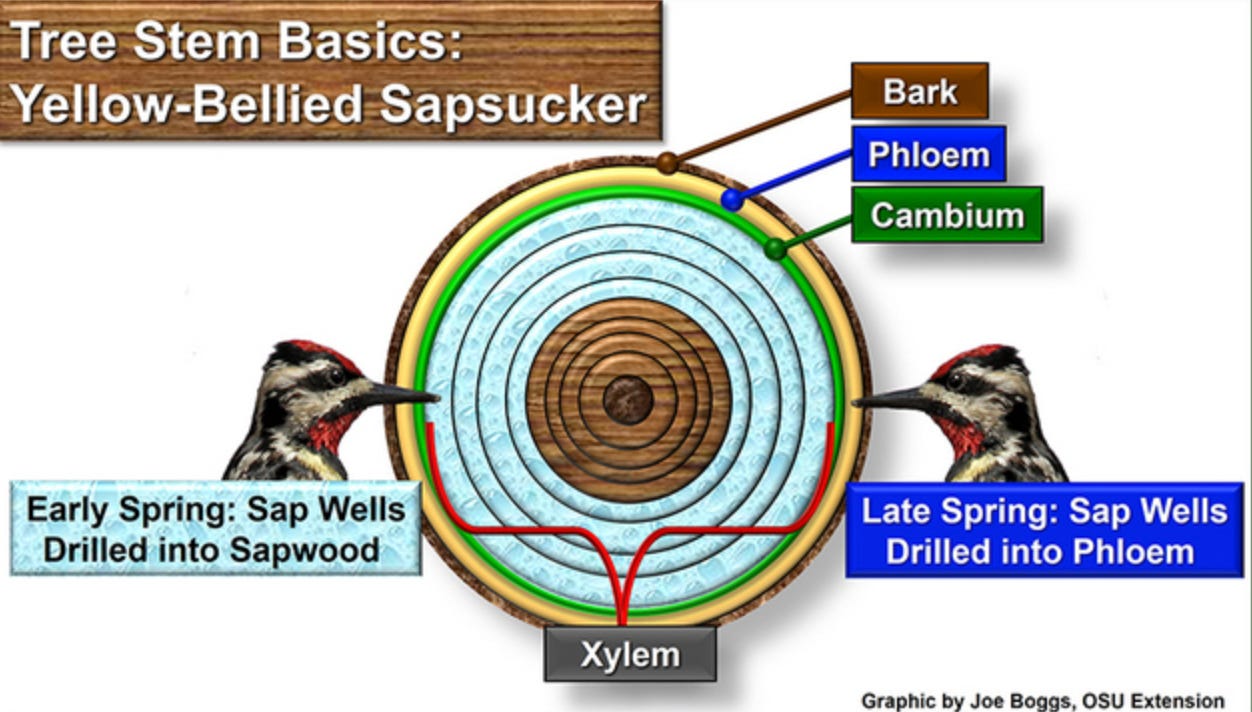
Sapsuckers are called sapsuckers because they imbibe sap. In truth, they lap it with brushy tongues … saplapper had too much alliteration. Yellow-bellied sapsuckers arrived this spring in mid-April, just as roots began lifting sap back up the trunk and out through the branches, twigs, and swelling buds. That rising sap moves through the xylem, the inner conduits of a tree’s pumping system, through wood that no longer lives. Xylem sap is mostly water, carrying only two or three percent sugar. It rarely clogs. Sapsuckers tap into that upward flow, drilling neat, round holes that often ring the tree. As the current slackens, they begin a second row just above the first. Row above row above row, woodland hieroglyphics written in living bark. A pair of sapsuckers may drill up to three thousand holes in a year. Active holes ooze, darkening the bark beneath them.
Once trees leaf out, and nutrient-infused sap flows from the leaves back toward the roots, sapsuckers drill shallow holes in the outer portion of the vascular bundle, called the phloem. Phloem sap is ten to twenty percent sugar, similar to the concentrations of flower nectar. Phloem sap is prone to clogging, and the holes must be maintained. Sapsuckers constantly widen phloem sapwells (xylem holes rarely clog), collectively forming a rectangular pattern rather than circling the trunk. To the touch, a sticky woodland braille.
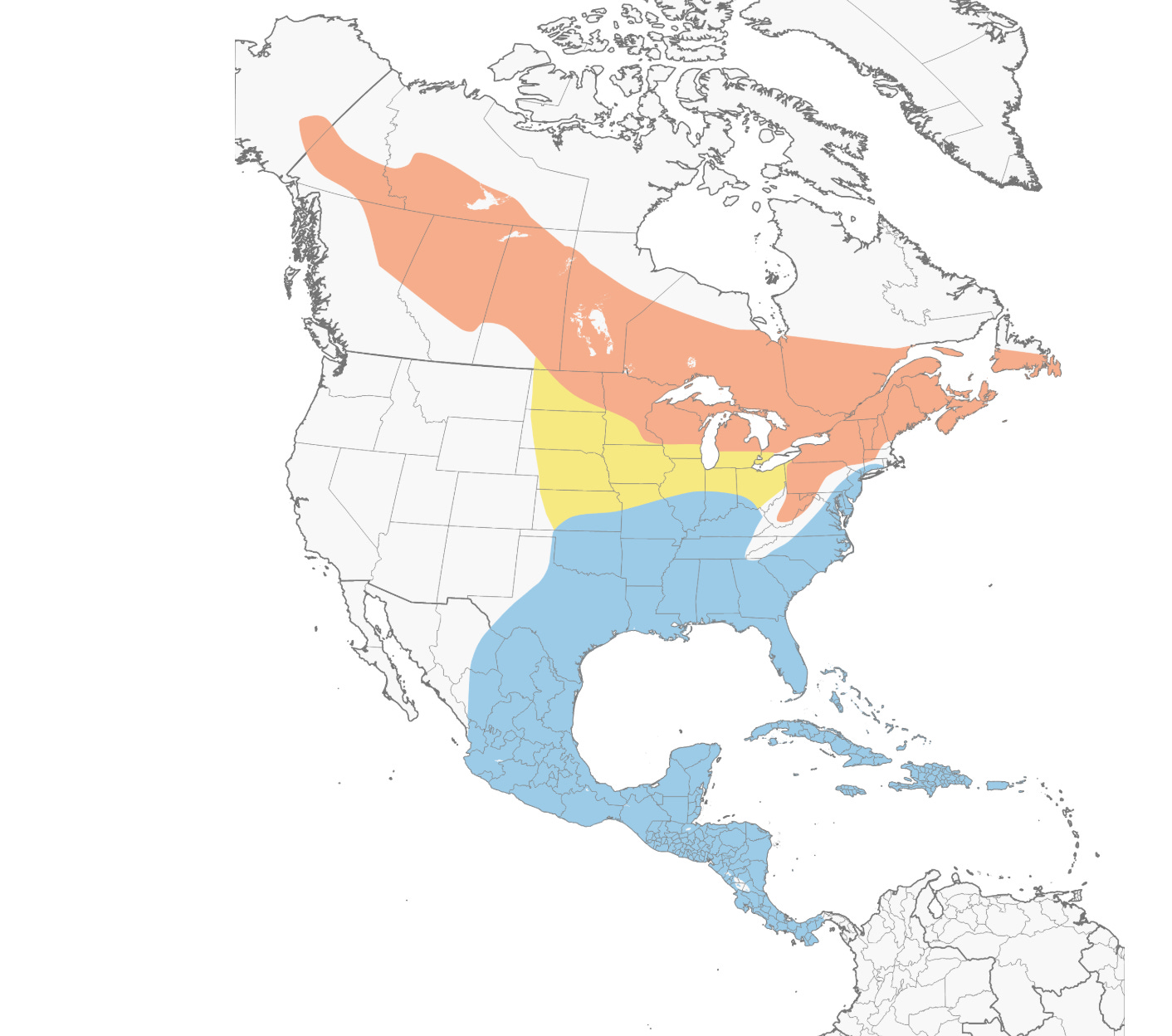
To reach actively growing trees, sapsuckers are so dependent on sap that they migrate in winter, a rarity among woodpeckers. An international woodpecker, wintering as far south as Costa Rica and Panama. What makes sapsuckers—all four species—keystone species in a healthy ecosystem is the presence of other animals that visit their sapwells. Some depend on them entirely. Ruby-throated hummingbirds’ northern range almost completely overlaps that of the yellow-bellied sapsucker. In late April, when hummingbirds arrive in Vermont, there are very few flowers to tap. So dependent are they on sapsuckers that they follow them through the woods, defending their provider against other interloping hummingbirds.
Thirty-five species of birds visit sapwells, including Cape May, yellow-rumped, and black-throated warblers, the ruby-crowned kinglet, and the downy woodpecker. Chipmunks, white-footed mice, and red squirrels lap the sap. Even porcupines and black bears come for a lick. Butterflies, moths, bees, wasps, flies, and beetles gather there as well. Flycatchers and bats feed on insects drawn by the sweetness. And the sapsuckers return to the wells for both sap and insects, dipping their catch in the nutritious flow—a small living fondue—before carrying it back to their chicks. By late summer, as the sap flow slows, sapsuckers turn to berries and more insects, flycatching like pewees and phoebes. (Unlike larger woodpeckers, they don’t drill into trees for grubs and larvae.)
Sapwells, the woodland candy store. A gift from a busy, emancipated woodpecker family. Dad spends the night in the nest. Mom roosts nearby, often in the same hemlock. Interchange at the nest unfolds within minutes.
3:33 p.m.: The male returns to the nest.
3:35 p.m.: The male leaves with a whitish fecal sac. He deposits it on the same red oak. He wipes his bill on the same patch of green lichen.
5:26 p.m.: The wind rises, gusting to more than twenty miles per hour. Aspen sway. The male returns. The female leaves, a fecal sac in her bill. Then, the male leaves the chicks untended (when it’s cold in the morning, someone has always been with them). Flies to a nearby gray birch and begins drumming, a muffled refrain. Three taps. A short pause. Two taps. A longer pause. Tapping and pausing. A syncopated rhythm, as if the tree itself were trying to remember a song.
There’s an unfolding story up the road, a compelling woodland dependency, but I have to return home to pack, leaving the sapsuckers to carry on without me.
Male yellow-bellied sapsucker (note red throat) photo courtesy of David Pellieter
Female delivering caterpillars, photo courtesy Jim Block
Male with beetle, photo courtesy Jim Block
Range map of the yellow-bellied sapsucker: red for breeding, yellow for migration, and blue for wintering.
A consideration: Watching and writing are how I make my way in the world. Your support matters. Thank you all for sticking with me on this journey. Revel in the ripening of spring, and report back when in a month I return from southeast Alaska and the Olympic Peninsula.
As a lifelong naturalist and Yankee fan, I follow a trail blazed by John Burroughs and John Muir, neither of whom paid much attention to baseball. My work has appeared in Houghton Mifflin’s The Best American Sports Writing, Audubon, Sierra, Sports Illustrated, National Wildlife, OnEarth, National Geographic Traveler, National Geographic Books, Yankee, The New York Times, Newsday, The Boston Globe, The Chicago Sun-Times, The Guardian, and The Daily Telegraph, among other publications and anthologies. For twenty-four years, I was a regular commentator on Vermont Public Radio, and occasionally on NPR. I am the author of Backtracking: The Way of a Naturalist (1987), Blood Brook: A Naturalist’s Home Ground (1992), and Liquid Land: A Journey Through the Florida Everglades (2003), among other works of nonfiction. I received the Burroughs Medal in 2004, the highest literary honor awarded to an American nature writer. E. O. Wilson called America’s Snake: The Rise and Fall of the Timber Rattlesnake (2016) a beautifully written book [that] demonstrates just how good nature literature can be.
Beginning on 14 March 2020, the day after I returned home from Costa Rica, at the onset of the pandemic lockdown, I started writing a daily journal—part natural history, part memoir, and part commentary—that appeared here on Substack. Since the 25 August 2021 post, I have edited the 526 entries (deleting, combining, modifying) into a new book, The Promise of Sunrise: Finding Solace in a Broken World, which Green Writers Press published on the vernal equinox of 2025.
From: Seven Days
Ted Levin, Green Writers Press, 400 pages. $21.95.
A pissed-off woodpecker flies in and screams...
When COVID-19 crashed into his life in 2020, naturalist Ted Levin began taking a walk each day at sunrise through the woods and wetlands around his home in Thetford. His walks begat a daily blog and now a lyrical book that brings to life the world of efts and otters, warblers and wrens, chickadees and coyotes. Engaging natural history lessons — loon semen and mammoth bones make an appearance — weave through the daily entries, and slowly the reader also learns the story of the author’s life.
Levin’s writing can be extraordinarily vivid: Coyotes “hurl their voices at the crescent moon”; a bobcat has a face “like a soiled, fraying softball”; chickadees are “four maestros working on a score.” Writing such as this demands to be read as one reads poetry, in small sips, to be fully savored.
—Candace Page.
No posts
Comments
Nothing yet. Say the first thing.
Sign in to join the conversation.