
The Peterson Health Technology Institute recently released a clinical AI payment landscape. Download the report below or visit their site here.
I think, largely, this report nailed the landscape and the feasible mechanisms for clinical AI payment. But what will it really take for clinical AI to become a deflationary force in healthcare? It won’t be as simple as a few new CPT codes, or suddenly substituting clinical AI for clinicians, as much as the techno-optimist sphere would like you to think so.
To understand what it would take for this budding technology to demonstrably reduce the cost of medical care, you have to step back and understand the various stakeholders constantly engaged in a vicious tug of war in the American healthcare system.
Ask a room of technologists where the money goes in American healthcare and some will say doctors. They would be wrong.
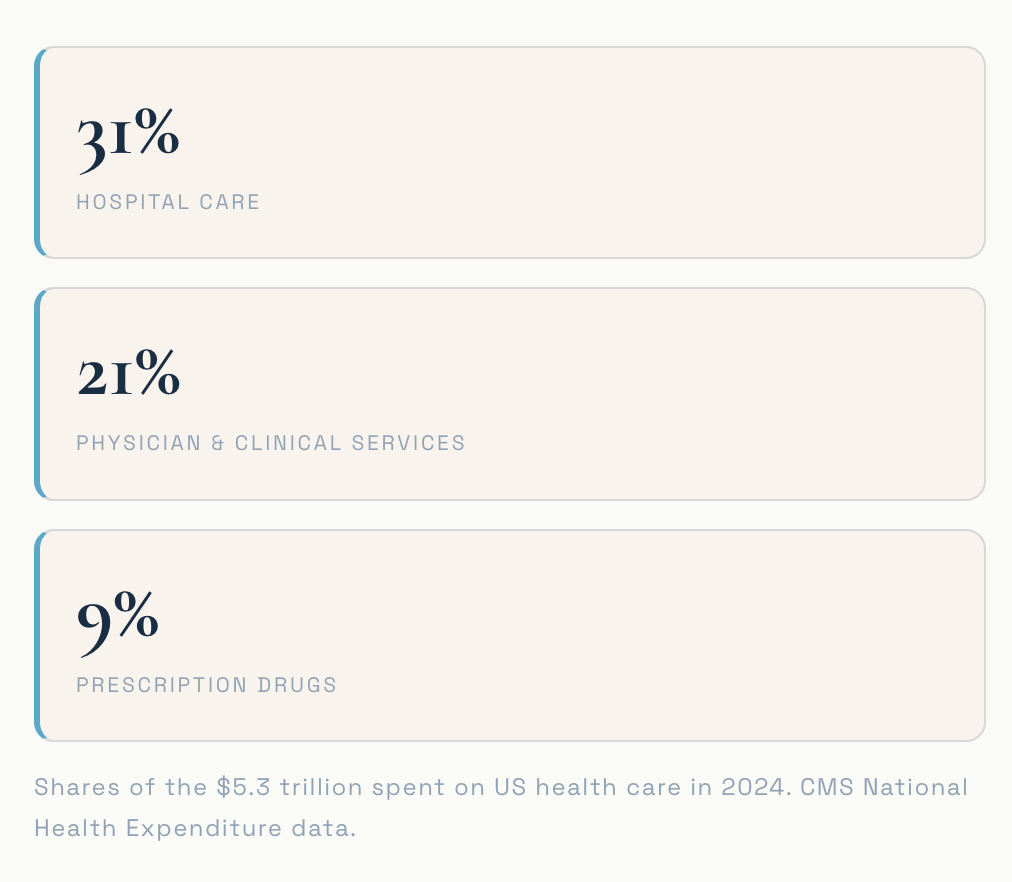
The category called “physician and clinical services” runs about 21% of the roughly $5.3 trillion the country spent on health care in 2024 (CMS National Health Expenditure data). But that line item is not physician income. It carries practice expense, clinical staff, supplies, occupancy, and the ancillary services billed under the practice. Analyses that isolate physician compensation put it closer to 8–9% of total health spending. Hospital care, by comparison, is about 31%.
So the clamoring for clinical AI to “replace doctors” is not just short-sighted, it’s also not our most fiscally sensible lever when it comes to deflating costs. You are proposing to fight the most organized, most credentialed and most regulated stakeholder in the system over a single digit of the spend.
This is also why I’m not a fan of cutting hip and knee replacement payments without a commensurate opportunity to incentivize outcomes for specialists. CMS has proposed work RVU reductions of up to roughly 21% for joint replacement in the CY2027 fee schedule, on top of the roughly 7% decline hip and knee arthroplasty already absorbed in CY2026. The American Association of Hip and Knee Surgeons notes that Medicare reimbursement for total hip and knee replacement has fallen more than 55% between 2005 and 2025. You can’t cut your way to value in a category that is already the most price-compressed line item on the bill.
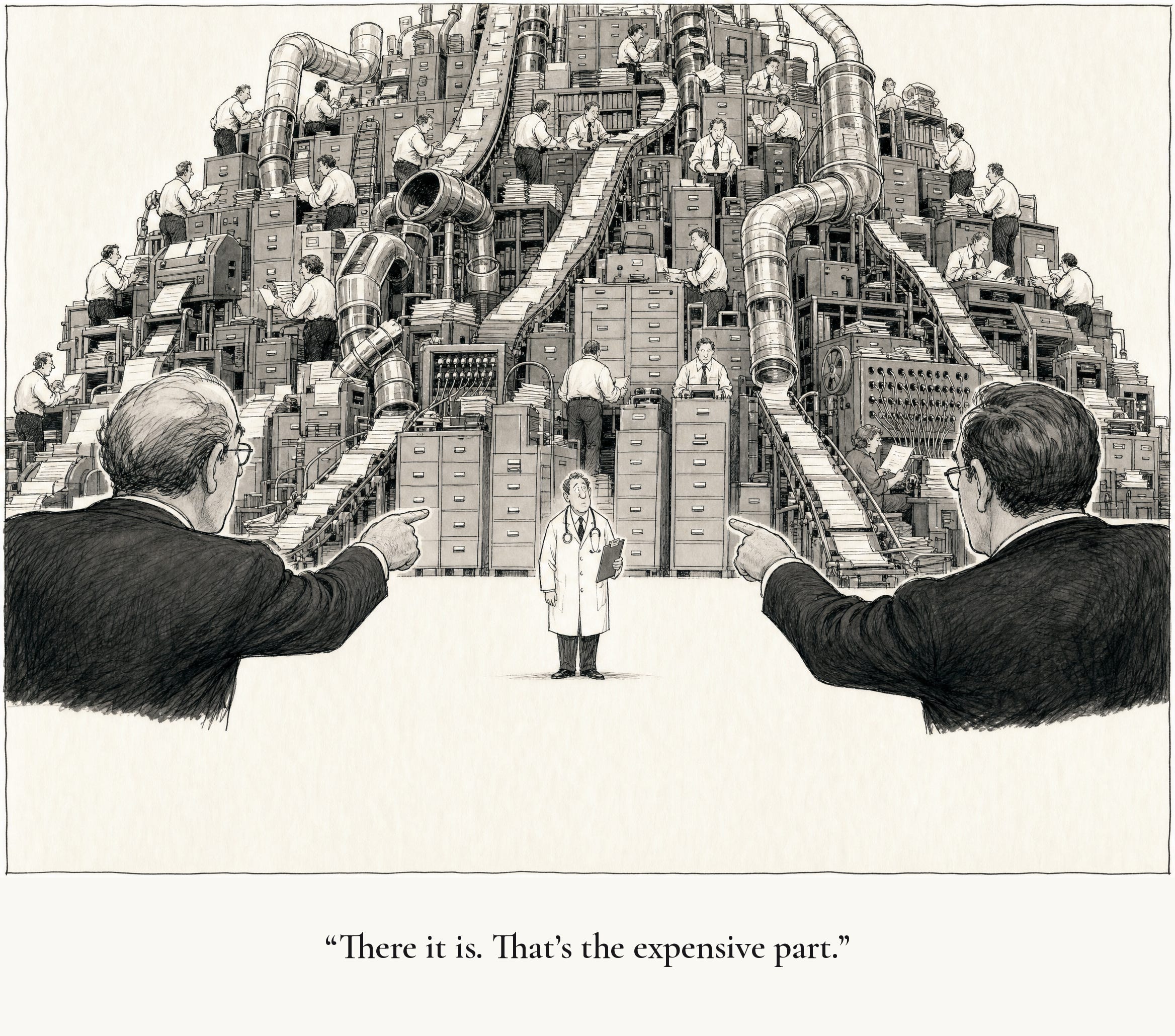
The expensive thing in American medicine isn’t physician cognition. It is the fragmented, Kafkaesque machinery we built around physician cognition because we couldn’t scale it.
Looking at the numbers, the substitution opportunity isn’t in the physician services themselves. If you build an AI that shaves ten minutes off a physician’s day, you optimized one small part of the spend. And although the pitch to save time in order to create visits (the pitch AI vendors like me will make to you) might generate revenue for a physician or a hospital, but that doesn’t necessarily translate to improved outcomes. It may in fact prove to be an inflationary force driving up utilization. PHTI says the same thing more tactfully: if AI reduces the time a clinician spends per encounter without a proportional decline in the rate, providers see more patients with less effort at the same payment per service, and aggregate spending goes up.
What about the administrative spend? Let’s get rid of prior authorization with a brilliant shiny new AI system. Surely that’s a good idea.
I think a magic AI wand to zap away prior authorization sounds wonderful. The counterpoint is that the friction and abrasion of prior authorization is itself a method of curbing utilization. Remove the friction without replacing the function and you haven’t saved money so much as deregulated demand.
CMS appears to have reached the same conclusion from the opposite direction. Its WISeR model (Wasteful and Inappropriate Service Reduction) launched January 1, 2026 in six states, applying AI and machine learning with human clinical review to prior authorization for a set of Part B services considered vulnerable to waste. Note the payment design: technology participants earn a share of the savings generated by averted care. A vendor paid on denials (Kafkaesque indeed…).
I raise this point not to litigate WISeR but because it makes a valid point on incentive structure. The moment you attach a payment mechanism to an AI system, the mechanism determines the behavior. Pay for throughput and you get throughput. Pay for denials and you get denials. Which is why the mechanism of payment is just as important as the care model.
I’m a fan of outcomes-based care. ACOs have been effective in many ways. But to date, value-based care has largely rewarded financial engineering and clinical documentation integrity hacks more than it has rewarded care redesign.
Even in capitated and full-risk settings, where incentives are most aligned, adoption of new technology has been slower than expected. A national survey of 276 ACO-contracting organizations found only about a third had adopted digital health technology for a high-priority chronic condition, and those that did used it to complement rather than replace traditional care (PHTI, Payment for Clinical AI, July 2026).
So value-based care is not a solved problem into which we can simply drop clinical AI and wait for savings. It is a partially built railroad, and the train could quickly run off the tracks.
Capability vs. Accountability… I think we are conflating the two in the health AI discourse.
On capability: for narrow, well-instrumented, high-frequency tasks with validated outcome measures, for example, titrating an antihypertensive against home blood pressure readings, triaging a post-operative message, flagging a deteriorating patient, the evidence is beginning to demonstrate that clinical AI will reach parity with physicians and eventually exceed it. Randomized trials already show clinical decision support improving guideline adherence and supporting blood pressure reduction in hypertension (Samal et al., JAMA Internal Medicine, 2024).
On accountability: we still haven’t answered who is liable when clinical AI falls short, who approves treatment, and who keeps the savings. No amount of model capability or compute mashing resolves those questions. PHTI noted bluntly that today’s payment models offer few mechanisms to reimburse services delivered by AI at all, which leaves developers and operators without a direct pathway to be paid.
I would argue we should start with the coordination chaos, the documentation disaster, the access abomination and the follow-up fiasco. Go after the other four-fifths of healthcare spend where there is far less resistance and considerably better evidence.
“I hope we move beyond assistive AI because it just ends up dropping more work on clinicians. It is tough to manage remote data and recommendations between visits, especially when the extra time could be used for a higher-impact — and billable — patient visit.”
— Clinician, quoted in the PHTI workshop
If we design AI that only generates more clinician review, we will have built a really expensive way to make clinicians busier.
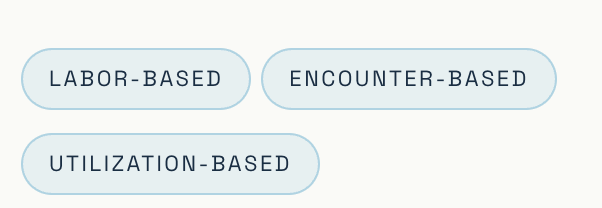
Fee-for-service pays for three inputs: clinician labor, the encounter, and the volume of services. Clinical AI addresses all three in ways that don’t conform to our usual cost structure in healthcare. AI produces clinical output without consuming proportional clinician time. It delivers care continuously rather than in discrete visits. At scale, its marginal cost should approach the cost of tokens.
With these dynamics of clinical intelligence in abundance, a fee-for-service model breaks fairly quickly. Cheap software can manufacture expensive, billable work at a scale no clinic could previously reach. Reimbursement grows far faster than the true cost of delivering the care. You get a taxi meter bolted to a driverless car, and then a thousand of them drive onto the highway billing for each mile traveled rather than for reaching the destination.
1. Pay only when the technology beats the real-world comparator. Not an idealized benchmark, but what the system would have achieved without the tool, at the population level.
2. Tie payment to results, and build in safeguards against volume. Withheld back-end payments, and simple but not eye-gouging price ratcheting. If payment is per-use and not tied to value, scale becomes a liability.
3. Start rates high enough to pull in capital, then ratchet down…but only to a sustainable level. As evidence accumulates and marginal cost falls, some price compression should occur, with scope expansion for additional payment following behind it. And continue to pay clinicians for the work that remains: oversight, escalation, quality assurance, and accountability for AI-generated output.
CMS’s ACCESS model is the most concrete manifestation of this so far. Ten years, outcome-aligned, roughly half the payment up front with the remainder withheld pending results, and musculoskeletal is one of its four clinical tracks. An investor quoted in the PHTI workshop noted that capital flees uncertainty and that investors want stability in payment model design. A ten-year model is a capital formation instrument as much as a payment reform. The payment amounts may be too low to incentivize appropriately, but I believe the structure will prove durable and will spread quickly.
One constraint is that outcome-based payment needs outcomes that are measurable, validated, and attributable to the intervention. Hypertension is straightforward. Primary care, where patients carry multiple conditions and see multiple providers, is more complicated. And as currently designed, ACCESS participants cannot receive payments for their aligned beneficiaries outside model payments, which limits participation by traditional provider organizations and pushes adoption toward new entrants rather than the delivery system we already have. However, as I have written, I believe the co-management structure is a feature, not a bug.
It’s tempting to completely dismantle the existing system of incentives and fragmented healthcare payment infrastructure to make way for this new, beautiful, technology-fueled value-based way of life. I am certainly no fan of inertia and I am an innovation champion. But I think it would be misguided to focus on physician payment as the lever of financial re-engineering, and foolhardy to try to completely restructure incentives that have been in place for decades.
Rather, we should use these existing incentive structures to modify behavior — to tackle administrative bloat, and yes, to realign stakeholders as well as clinician and patient expectations.
Clinical AI will pay for itself when we stop paying for it like a clinician and start paying for it like an outcome. That’s a contracting constraint rather than a technology conundrum.
The PHTI playbook and all four condition toolkits are fantastic. Next I want to dive into what performance based contracting looks like, and our experience at RevelAi Health. Why clawbacks failed and what replaced them. And the musculoskeletal case — including what it looks like to withhold payment until CJR-X reconciliation, and how to build a bone health pathway that pays on patient reported outcomes and claims-based fracture rate two years out.
The best part of this newsletter isn’t the tips. It’s the people reading them. Subscribers here have teamed up on projects, swapped workflows, and pushed each other’s work forward. I’ve collaborated with several of you myself.
If something here has saved you time or sparked an idea, share it with one person who’d benefit. That’s it! One person. Group subscriptions get a discount, and the button below does the rest.
Comments
Nothing yet. Say the first thing.
Sign in to join the conversation.