
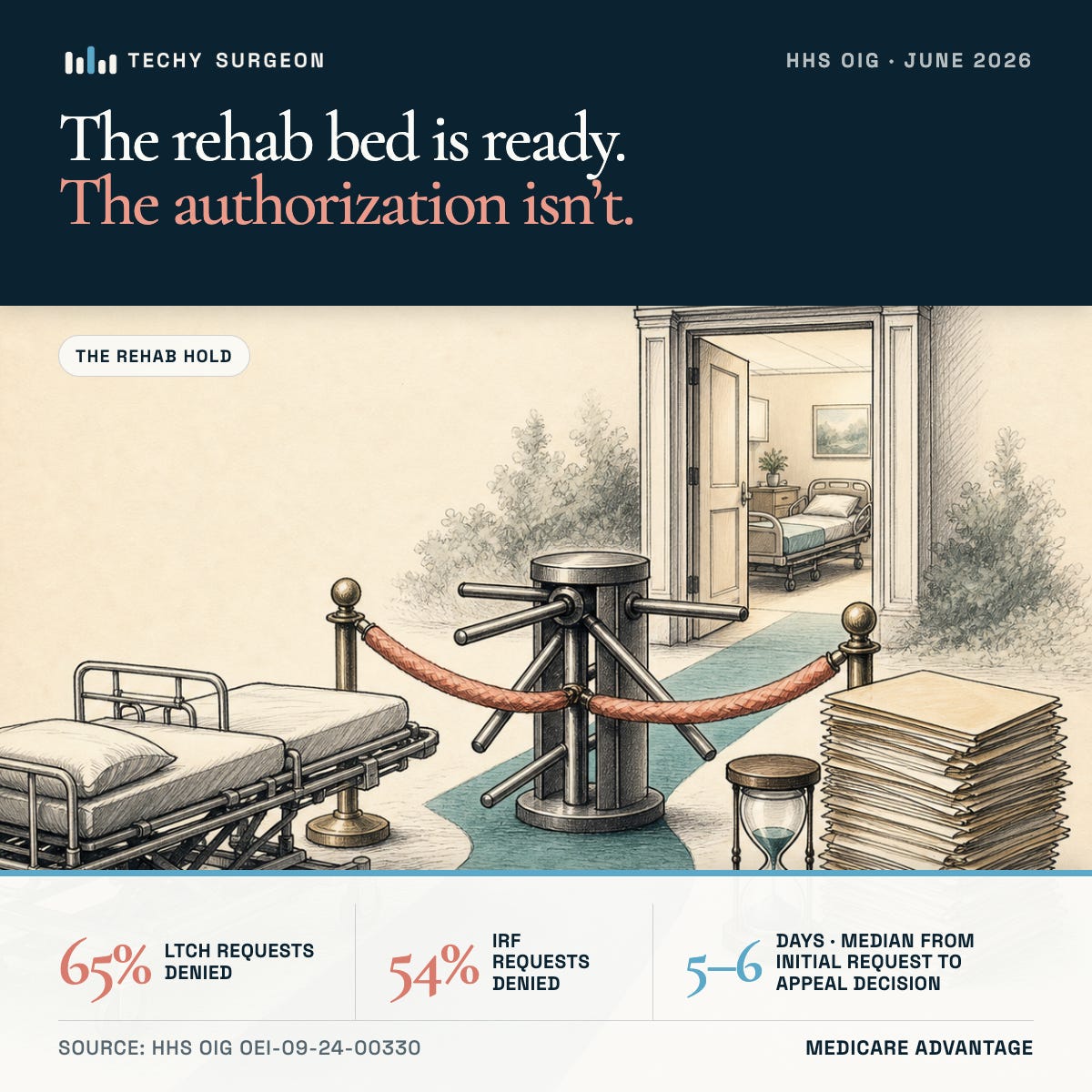
If you run a hospital, you know the scene. The operation is over. The patient is medically stable. Physical therapy has documented the need for post-acute rehabilitation. A facility may even have a bed ready.
Then the patient waits…and waits….and your case managers are pulling their hair out as denials and patient complaints ping back and forth for days or sometimes weeks.
The delay can look administrative from a distance: a request, a denial, another note, a peer-to-peer call, an appeal. At the bedside, the patient is asking why the plan they paid for will not authorize the next step in recovery. On the hospital side, there is an acute-care bed occupied by someone who no longer needs acute care.
The Department of Health and Human Services Office of Inspector General in its June 2026 data brief examined prior authorization requests for admission to long-term care hospitals and inpatient rehabilitation facilities across 19 Medicare Advantage organizations. Those organizations covered 29.3 million people, or 86 percent of Medicare Advantage enrollment at the time (June 2024).1
The OIG analyzed roughly 3,200 requests for long-term care hospital admission and 19,400 requests for inpatient rehabilitation. Medicare Advantage organizations denied 65 percent of the long-term care hospital requests and 54 percent of the inpatient rehabilitation requests.1
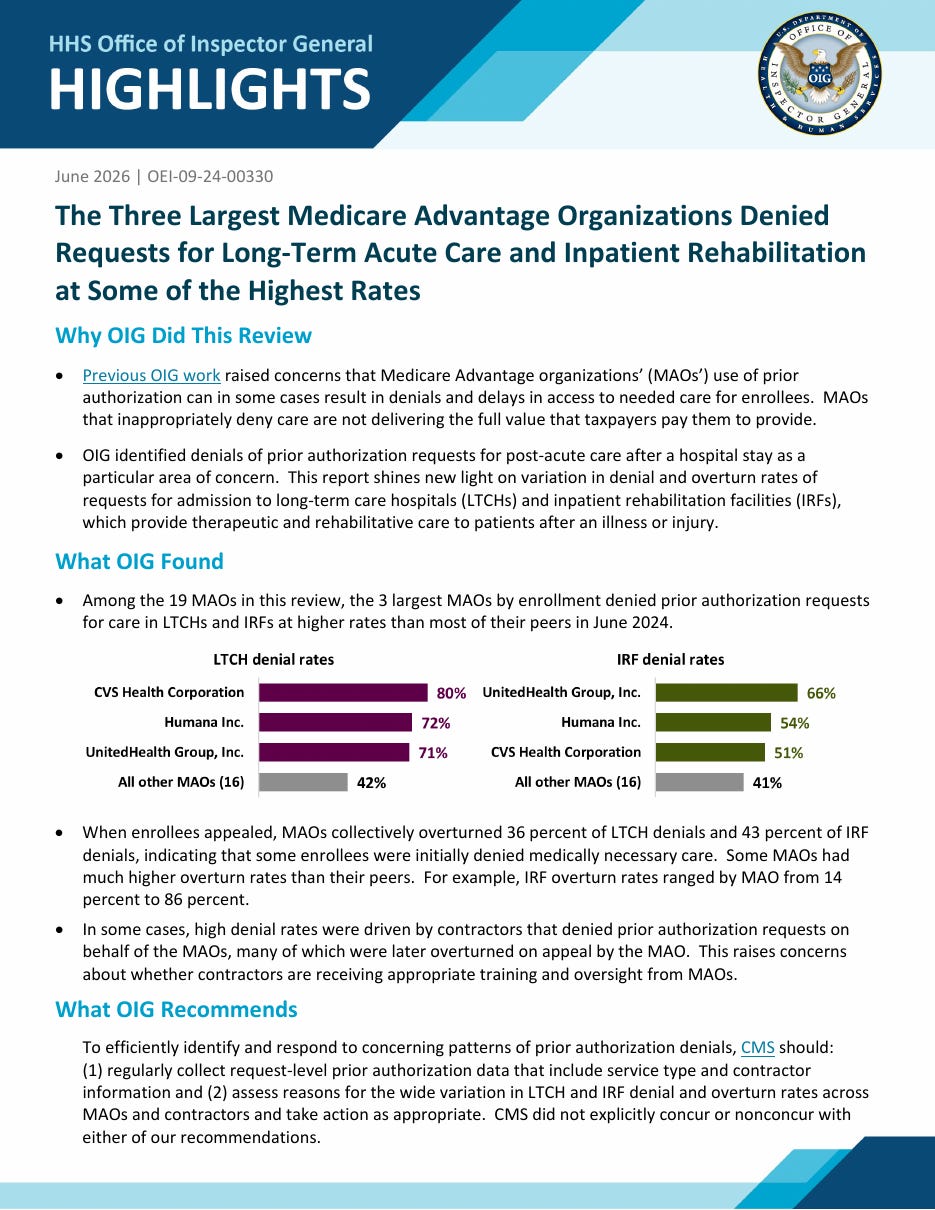
The three largest organizations by enrollment were UnitedHealth Group, Humana, and CVS Health. Together they covered nearly 20 million people. Each denied more than 70 percent of long-term care hospital requests and more than half of inpatient rehabilitation requests in the OIG dataset.1
A review rule inside one large organization can shape the discharge path for millions of beneficiaries and the operating reality of hospitals across the country.
Medicare Advantage organizations overturned 36 percent of appealed long-term care hospital denials and 43 percent of appealed inpatient rehabilitation denials.1
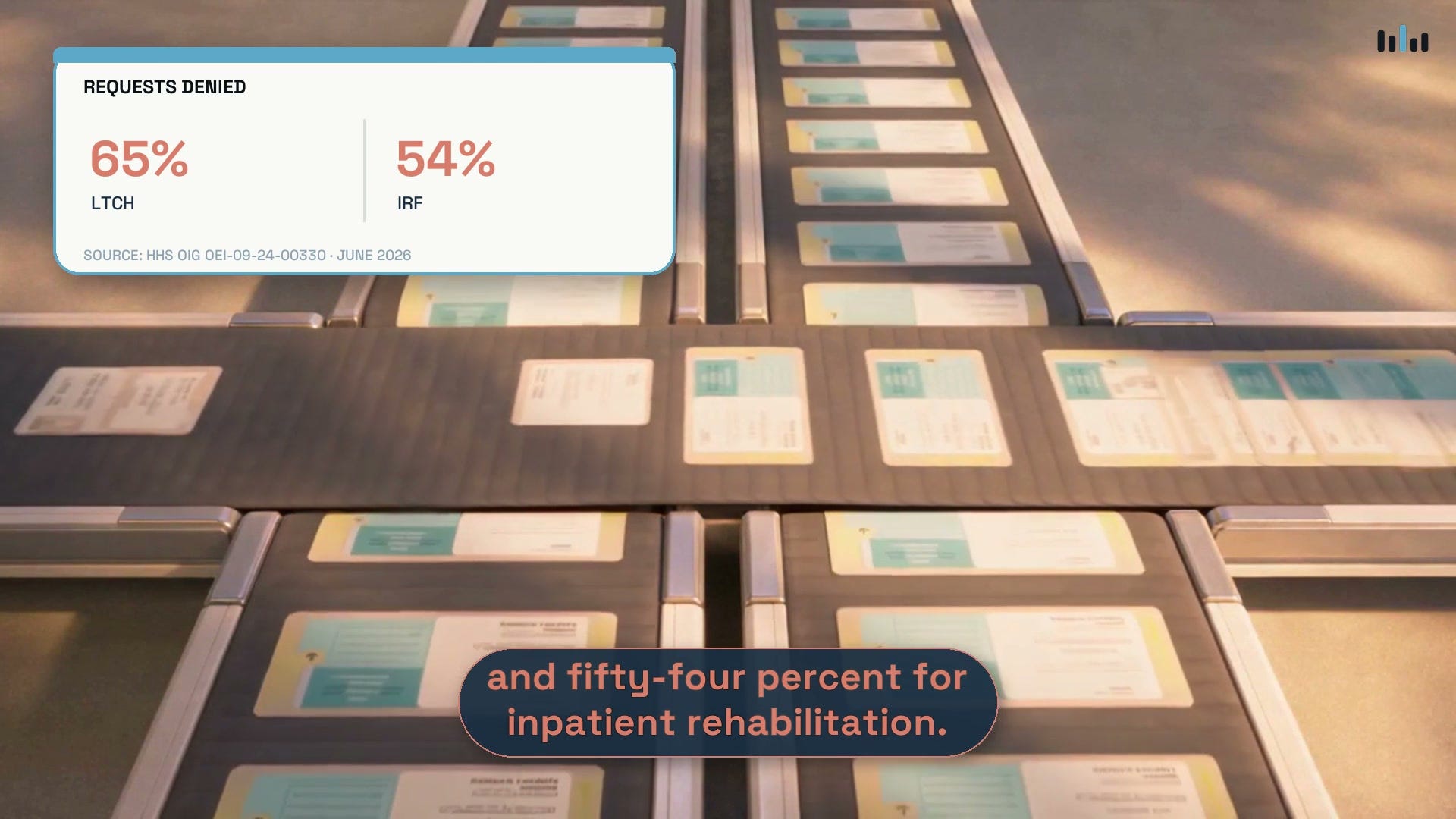

Clinically and operationally, this friction is expensive and draconian. Someone had to recognize the denial, assemble the record, make the call, file the appeal, and wait for a new decision.
The median time from the initial request to the appeal decision was six days for long-term care hospital requests and five days for inpatient rehabilitation requests. Sixteen percent of long-term care hospital appeals and 8 percent of inpatient rehabilitation appeals took at least ten days.1
During that interval, patients requesting post-acute care are usually still in an acute-care hospital. The OIG notes that delayed access to rehabilitation can carry clinical consequences, while extra hospital days can increase exposure to hospital-acquired complications and create costs that are not separately reimbursed.1 Not only can delayed transfer cause harm, but an authorization queue becomes a clinical and capacity problem as well.
Only 36 percent of long-term care hospital denials and 31 percent of inpatient rehabilitation denials were appealed. For patients whose denials were not appealed, the OIG says they may have received a lower level of care, paid out of pocket, or gone without post-acute care.1 That missing outcome data warrants further investigation.

For-profit Medicare Advantage contracts denied 67.2 percent of long-term care hospital requests, compared with 38.7 percent for nonprofit contracts. For inpatient rehabilitation, the rates were 55.2 percent and 43.9 percent, respectively.1
The OIG’s wording is appropriately cautious: financial incentives may be partially driving higher denial rates among some organizations. Sure, contract tax status doesn’t prove why a particular request was denied.
Still, the incentive structure is troubling. Post-acute facilities are expensive. Original Medicare data cited by the OIG put average 2023 costs at about $49,000 for a long-term care hospital stay and $24,000 for inpatient rehabilitation, compared with $16,000 for skilled nursing and $6,000 for home health.1 A plan that moves a patient to a less intensive setting can reduce spending. Sometimes this could be the clinically appropriate decision, but the rate of successful appeal overturns suggest the friction might be a cost-containment measure rather than a quality initiative.
Contractors processed about half of the long-term care hospital and inpatient rehabilitation requests in the review. One contractor, naviHealth, handled more than one-third of all requests submitted to the 19 organizations.1
naviHealth denied 73.5 percent of long-term care hospital requests and 67.9 percent of inpatient rehabilitation requests. Requests processed internally by Medicare Advantage organizations were denied at rates of 64.2 percent and 46.0 percent. Other contractors denied 51.0 percent and 47.4 percent.1
Different reviewers may have received different clinical mixes. The rates nonetheless make contractor identity worth tracking.
The OIG found that existing aggregate reporting didn’t consistently identify service type or the contractor associated with a request. A voluntary CMS data pilot was underway, but its draft requirements still lacked a standardized service-type variable for all services and the name of the reviewing contractor.1

If the regulator can’t reliably identify the service requested or the entity that reviewed it, broad utilization statistics won’t explain the bottleneck.
The OIG review is a one-month snapshot from June 2024. It covers two post-acute settings: long-term care hospitals and inpatient rehabilitation facilities. It uses aggregate request and appeal data, not clinical case files. you can’t really determine how many individual denials failed Medicare coverage rules.1
The report doesn’t support a claim that every denial was wrong or that one month describes every plan’s performance in every market. But most can draw logical and concerning conclusions from this data.
The OIG has announced a separate in-depth review of case files to examine how Medicare Advantage organizations review post-acute prior authorization requests. The hope is this helps differentiate a strict but accurate process from a noisy one that requires appeals to correct avoidable errors.1
Hospitals don’t need to wait for the next federal dataset to manage their side of the queue.
Measure authorization latency as a patient-flow metric.Track the time from complete submission to initial decision, appeal, final decision, and transfer. Report the median and the tail numbers. A six-day median can hide a group of patients waiting much longer.
Segment the data by pathway.Cut the queue by requested setting, Medicare Advantage organization, contract, reviewer, and denial reason. A hospital-wide denial rate is too blunt.
Treat overturned denials as upstream quality signals.Identify the documentation gap, interpretation difference, or reviewer pattern that made the appeal necessary.
Preserve the patient outcome. Record whether the person reached the requested setting, accepted a lower-acuity placement, went home without the planned support, paid privately, or remained in the hospital. Tracking “excess days attributable to authorization” should be a new metric for hospital quality committees to track.
None of these steps substitutes for payer accountability. But a defensible record of where days accumulate, which decisions reverse, and which patients absorb the cost could fuel policy changes that protect patients.
The OIG recommended that CMS regularly collect request-level prior authorization data with standardized service-type and contractor information, then assess the reasons for variation across organizations and reviewers.1
Every authorization request should have a service, a reviewer, a timestamp, a decision, a reason, an appeal, and an outcome.
For hospital administrators who felt the rehab pathway getting slower, the OIG report provides validation.
Comments
Nothing yet. Say the first thing.
Sign in to join the conversation.