
Digital health raised $7.4 billion in the first half of 2026 and nearly half of it went to nineteen companies. I ad a great opportunity to connect with Nevin Ramanujan of InnovateHealth Ventures on what actually gets an early health AI company funded.
I raised our last round at RevelAi Health, so I asked Nevin Ramanujan the question I really wanted answered: What makes you close the deck and say “No”? He runs seed investing at InnovateHealth Ventures as General Partner, writes $250,000 to $1 million checks, and is frequently the first institutional money in.1 Before that he ran M&A and corporate development at Elevance Health, where he worked on the Aspire Health and Beacon Health Options acquisitions that built out Carelon.1 He has sat on the side of the table that most founders spend years trying to reach.
U.S. digital health companies raised $7.4 billion across 244 deals in the first half of 2026, up about a billion over the same period in 2025 on roughly the same deal count.2 That reads like a rebound. One layer down it reads differently. Mega-deals of $100 million or more absorbed 45% of all capital deployed, and those rounds went to 19 companies.2 Median deal size moved from $12 million to $14 million.3
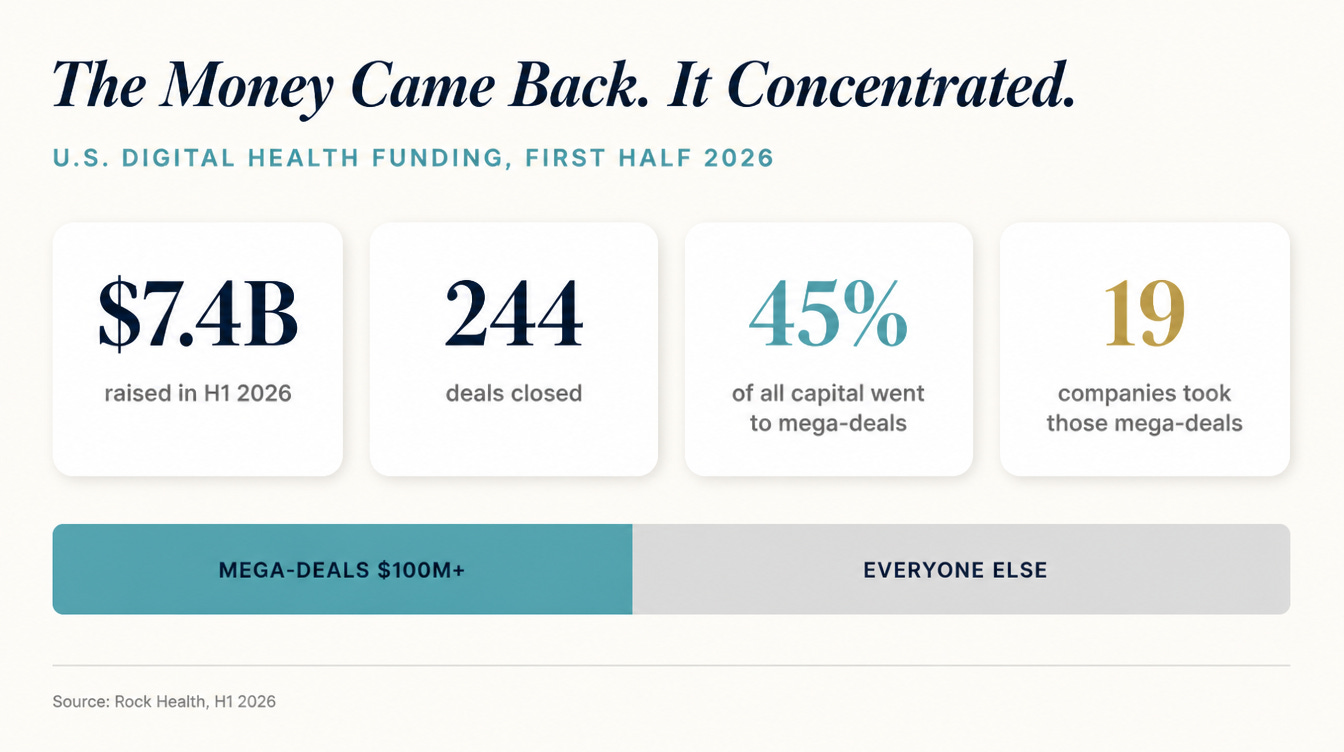
If you are pre-seed or seed, that top-line number is not really where you live. Your market is the looong tail underneath it unfortunately. We have all been anchored by the zero-to-a-hundred-million hockey sticks. Health AI largely doesn’t follow the same trajectory, and the investors who understand the sector are not underwriting as though it does.
I asked Nevin what makes him lean into company. His answer had nothing to do with market size.
“The thing that gets me the most excited is when they’re solving an incredibly specific problem that I thought was already solved. Because that means they know this area inside and out.”Nevin Ramanujan, InnovateHealth Ventures
The inverse is the fastest way to lose him. His phrase for it was a business model that “could just be ChatGPT’d.” Plenty of people treat healthcare as a fad, know the huge problems, and go straight at them. The founders he backs have spent enough time inside the work to be chasing something the market hasn’t noticed yet.
OpenAI made Health in ChatGPT broadly available to U.S. users on July 23, letting people connect Apple Health and medical records from Epic and Oracle Health, with more than 300 million people already bringing health questions to the product weekly.4 If your differentiation is a frontier model wrapped around a well-known problem, that wrapper has a short shelf life.
“If you focus too much on the AI aspect, you lose what makes healthcare really important. Healthcare is deeply local. How healthcare is done in LA is completely different from how healthcare is done in Kansas City.”
-Nevin Ramanujan
He wants to know whether your platform changes how stakeholders interact, not whether it makes someone’s day marginally more efficient. Are you connecting a primary care physician to a specialist, to a health plan, in a way that did not exist before? Are you becoming a de facto network among your clients? That is the moat. We are all told to say platform, not point solution. The mechanism underneath the slogan is the network.
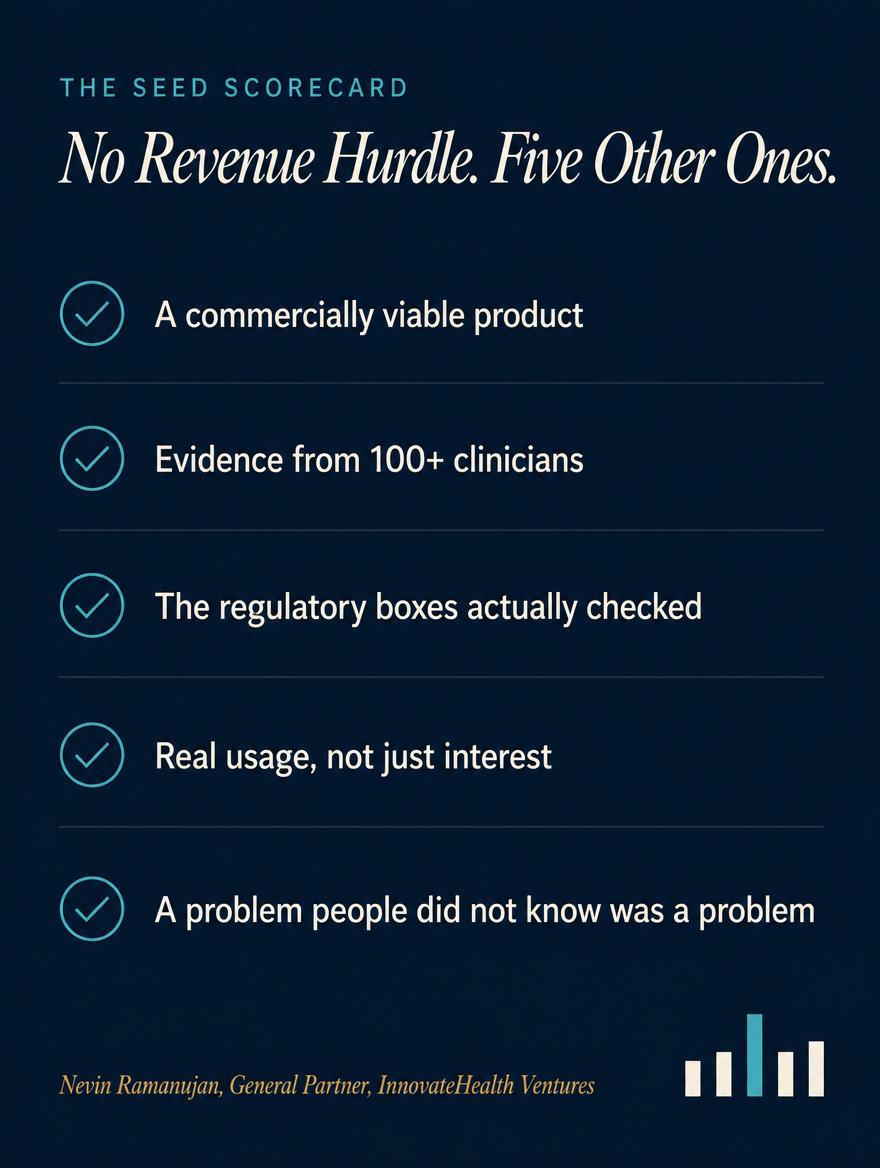
Nevin says he doesn’t push a revenue hurdle at seed. He carries five other things: a commercially viable product; usage rather than interest; evidence you have talked to a hundred or more clinicians through market research or real product use; and the regulatory boxes checked, which he called the most important item on the list.
Getting in front of clinicians at volume is a grind. If you are a clinician founder, this is where your unfair advantage becomes measurable.
The payer contract is the thing every health tech founder wants, but very few can describe the path into that world. Nevin’s view is that the barrier is deliberate and appropriate. A health plan carries millions of lives, often as one of only two or three plans in a region. “If you break things, people die,” he said. “And that’s why healthcare is different.”
Then he offered some actionable advice. Rather than going at the health plan directly, start with provider groups already in value-based arrangements. Those groups have built teams that mirror payer functions, so they are a faster first customer, and they know which person on the plan side can sign. You get the population-level case study a plan needs in order to consider you, and you get the org chart. Even inside a health plan, he noted, the right contact is often unclear, because some functions are centralized and some are distributed by market.
Someone in the chat asked how pre-seed founders balance a current role with building. I live through my version of the answer tot he question everyday! Nevin’s answer was blunt and well taken.
“It’s pure hell to launch a company while practicing. You only make the calculated decision to not practice when the product is helping more lives the more time you spend on it than you are practicing.”
-Nevin Ramanujan
Building an MVP part-time makes sense to him, and the clinical work often informs the product directly. Once you take institutional money the math changes. A $2.5 to $5 million round starts an 18 to 24 month clock, and that window disappears fast: six to eight months to raise it, a hundred days to game-plan, three to four months to get in front of enterprise buyers, six more to convert one. You are raising again long before you are near a month of runway.
My own view, which he agreed with: bootstrap longer than feels comfortable. A full-time co-founder offsets some of the challenges. Nothing offsets the glaring “are you still a practicing clinician?” question like traction. If you are still seeing patients and clearing every milestone anyway, the investors who pass on you are the ones who look foolish later.
Nevin’s advice optimizes for surviving the health enterprise sales cycle. Some of the most interesting things being built right now should never take venture money. It has never been cheaper to spin up a prototype and get it in front of real users. Take the check only when you’re ready to start the timer to milestones.
I asked Nevin what the most overhyped and underhyped part of Health IAI are. He said the belief that AI means we need fewer doctors is wrong. He rejected it outright. AI expands what a clinician can access and how they can reason over it.
The underhyped part, in his words, is “deeply focused, low-powered ways of utilizing AI effectively.” Lower cost, more clinical reasoning, better partnerships. The unglamorous winners are often the most durable.
The Operator’s Cut
Stop benchmarking against the headline. The $7.4 billion is 19 companies plus a long tail. Pull your comps from the tail, not the top.2
Lead with the problem nobody knows exists. Open the pitch with the specific thing you found that the market assumes is already solved, or the one they haven’t heard of but you’re deep in the weeds on.
Count your clinicians. Get to 100+ in market research or real usage before you raise. Track it as a metric, put it on a slide.
Do the regulatory work before the fundraise. He called this the most important checkbox. Showing up without it reads as not respecting the industry.
Route to the payer through a value-based provider group. Faster first customer, a real population-level case study, and a map of who to call on the plan side.
Delay the check until traction makes your role a non-issue. Once you take it, the clock is 18 to 24 months, and it moves faster than that.
Nevin is open to being reached on LinkedIn or by email, and said mentioning this conversation gets you a reply! (Very kind). Do reach out and check out Innovate Health Partners. Thanks for joining us Nevin!
Every figure in this piece links to its primary source. Verified 7 August 2026.
InnovateHealth Ventures — firm criteria, check size ($250k–$1M), and team bios including Nevin Ramanujan’s tenure at Elevance Health corporate development (Aspire Health, Beacon Health Options, Carelon).
Rock Health, “H1 2026 funding and market overview: Durable roots, shifting routes” — $7.4B across 244 deals; mega-deals ($100M+) = 45% of capital; 19 companies raised 20 mega-deals.
Healthcare Dive, “Large funding rounds help boost digital health investment in H1” (July 2026) — median deal size $14M in H1 2026, up from $12M in 2025; H1 2025 comparison of $6.4B.
OpenAI, “Launching Health in ChatGPT” — U.S. rollout beginning 23 July 2026; Apple Health, Epic and Oracle Health record connections; 300M+ weekly health-related conversations.
Nevin Ramanujan, LinkedIn. All quotations are from the Techy Surgeon live Substack session, lightly edited for length and clarity.
Techy Surgeon · Health policy and technology, from the operating room to the boardroom. Written by Christian Peán, MD, MS.
Available for iOS and Android
Comments
Nothing yet. Say the first thing.
Sign in to join the conversation.