
The global semiconductor landscape is no stranger to legal warfare, but the latest U.S. International Trade Commission (ITC) probe (Investigation No. 337-TA-1443) targeting Taiwan Semiconductor Manufacturing Co. (TSMC) has elevated a standard intellectual property dispute into a high-stakes geopolitical drama. Driven by intensifying political pressure—including a recent letter from four Republican lawmakers demanding an outright import ban on chips violating U.S. patents—the market is on edge as an administrative law judge prepares a preliminary ruling.
The stakes are massive, targeting TSMC’s 7nm and smaller process nodes—the foundational silicon powering modern AI accelerators, smartphones, and PCs—and naming industry titans like Apple, Qualcomm, and Broadcom as respondents. Yet, beneath the political theater lies a complex legal framework. For the plaintiffs, securing a victory against the world’s leading chipmaker remains an incredibly steep uphill battle.
In the United States, patent holders looking to protect their intellectual property generally choose between two primary battlefields: U.S. Federal District Courts or the U.S. International Trade Commission (ITC), under Section 337 of the Tariff Act.
While district courts can award massive monetary damages, the ITC possesses a unique, double-edged weapon that keeps tech executives awake at night:
Blistering Speed: Unlike traditional litigation that can drag on for years, the ITC moves at a breakneck pace, typically delivering a final ruling within 15 to 18 months.
The Nuclear Option: Instead of financial compensation, the ITC issues Exclusion Orders. If infringement is found, U.S. Customs is ordered to stop the infringing products at the border, blocking them from entering the American market entirely.
For the fast-moving electronics industry, where product lifecycles are measured in months, an exclusion order is a catastrophic supply-chain disruption. It creates immense time pressure, often forcing defendants to settle regardless of the case's merits.
Despite the terrifying leverage an ITC injunction offers, the tribunal is not a rubber stamp for every patent holder. To successfully secure an import ban, a plaintiff must clear a massive, distinct legal hurdle: The Domestic Industry (DI) requirement.
An ITC plaintiff cannot simply sit on a portfolio of American patents and collect royalties. They must prove that an actual economic or technical infrastructure tied to those patents exists within the borders of the United States.
This is precisely where the current lawsuit against TSMC faces heavy skepticism. The claims are spearheaded by Longitude Licensing and Marlin Semiconductor—two Dublin-registered subsidiaries of IPValue Management, which has been owned by the San Francisco private equity firm Vector Capital since 2014. In legal parlance, these are Non-Practicing Entities (NPEs), frequently referred to as “patent trolls”.
In recent years, the ITC has significantly tightened its scrutiny of NPEs. The commission routinely dismisses “predatory licensing” suits in which patents are leveraged solely for legal extortion rather than to foster genuine domestic industry. Unless IPValue can prove a tangible, systemic U.S. economic footprint tied to these specific patents, their case may be dead on arrival.
Longitude and Marlin do not manufacture products, leaving TSMC without infringement counterclaims to negotiate with, while the complainants are primarily seeking licensing fees. Any exclusion order issued by the Commission in October would still be subject to a 60-day presidential review before becoming effective.
The most compelling plot twist in this legal drama is the origin of the dispute. The five asserted U.S. patents weaponized by these private-equity-backed entities (Patents US9,093,473 and US9,184,292) were actually acquired from United Microelectronics Corporation (UMC)—TSMC’s long-time Taiwanese foundry rival—in 2021. UMC essentially sold off its legacy intellectual property, which is now being used by a proxy to attack TSMC’s crown jewel: its advanced 7nm and smaller nodes.
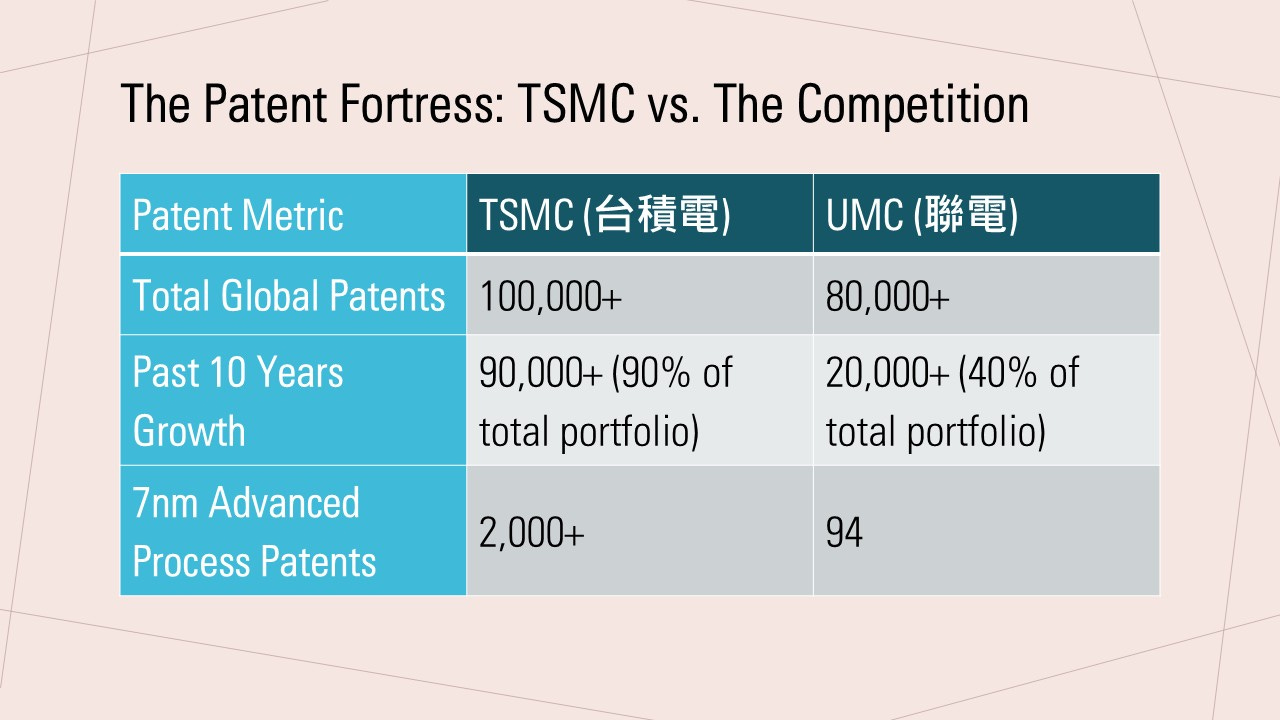
However, attempting to out-maneuver TSMC in a patent war ignores the sheer scale of the giant’s modern intellectual property fortress. A look at TSMC’s patent strategy over the last decade reveals why using UMC’s old patents as ammunition is an uphill battle:
TSMC’s patent accumulation charts a staggering, near-vertical trajectory. By generating 90% of its massive portfolio within the last decade, TSMC has effectively ring-fenced its technological innovations.
The contrast in advanced nodes is even more stark. In the highly critical 7nm process—the very battleground of this ITC investigation—TSMC holds over 2,000 patents compared to UMC’s 94. This isn’t just a statistical gap; it is an insurmountable wall of modern R&D dominance. TSMC can aggressively countersue, argue lack of infringement, or challenge the validity of UMC’s older patents, making it incredibly difficult for the plaintiffs to extract a forced settlement.
It is no surprise that Taiwan’s Ministry of Economic Affairs has publicly signaled strong confidence in TSMC’s legal compliance. While U.S. lawmakers use the ITC probe to score political points or highlight domestic supply chain anxieties, the legal realities of Section 337 favor the prepared.
With a multi-layered defense strategy, a strict ITC gatekeeper blocking exploitative patent trolls, and a fortress of 70,000 global patents, TSMC is well-positioned to weather the political storm. This case is a stark reminder that in the semiconductor industry, real power isn’t just about manufacturing the chips—it’s about owning the ideas behind them, and building a moat so wide that even imported ammunition can’t cross it.

Correction: We apologize and have corrected the following information: “The contrast in advanced nodes is even more stark. In the highly critical 7nm process—the very battleground of this ITC investigation—TSMC holds over 2,000 patents compared to UMC’s “94” (previously, “2”, the result was provided by https://tiponet.tipo.gov.tw/gpss3/gpsskmc/gpssbekm?@@0.580086922012002). The data in the table were also corrected.
Comments
Nothing yet. Say the first thing.
Sign in to join the conversation.