
Hello, sapiens! Today we’ve got a short essay featuring some of my recent musings on AI.
As it so happens, this week Substack also announced its new “AI detection tool,” which allows you to scan any post (using, um, AI) for evidence that AI was used to write it. Here, for example, is what it looks like for this post:
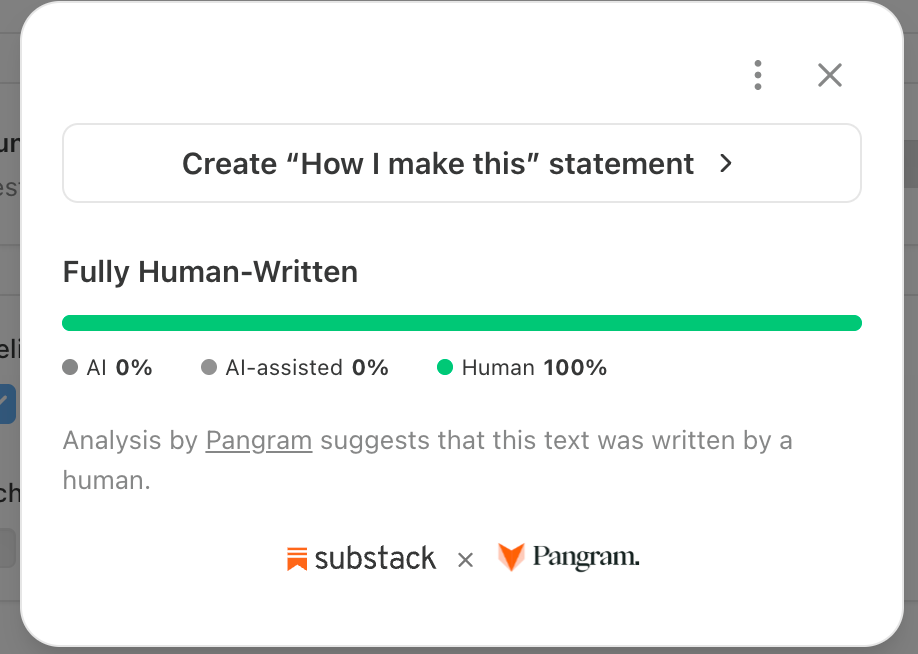
Substack also now gives writers the option to create a “How I make this” statement. So, now seems a good time to share with you all that I make this newsletter by: sitting down at my laptop, thinking of an idea, and writing it down. This probably goes without saying, but I don’t use AI to do that. I sometimes use AI to help with research or proofreading, although, as my human editor (aka my husband) can confirm, I often ignore grammar and wording suggestions because I stubbornly insist I know better.
Anyway, I’m pleased to see the Substack-Pangram-AI gods have deemed my writing 100% human this time. Going forward, though, if those gods assign me a lower percentage, I do not plan to make edits to sound more human because: (1) that makes no sense, and (2) then the machines really have won.
Okay! Now back to our regularly scheduled programming. Thanks for being here and being human, sapiens.✌️
6 min read
My two-year-old was thrilled with the Father’s Day craft he made in preschool this year. After carefully selecting a palm-sized rock, he washed off the dirt and painted it in overlapping pinks, yellows, and blues. On it, his teachers wrote in black Sharpie: “My dad rocks.”
When Father’s Day came around, he proudly unveiled his gift. Then, pointing to the Sharpie’d text, he announced: “My dad loves rocks!”
It has been over a month. The rock remains prominently displayed on the windowsill above our kitchen sink—now resting on a paper towel after an unfortunate discovery that the paint was washable. We have gently informed my son that it actually says “My dad rocks.” I’ve tried to explain that this is another way of saying “My dad is cool” or “My dad is great”—and also, it’s a real rock, so that’s kind of the joke?
My son then stares for a minute, eyebrows furrowed, eyes darting from my face to the rock and announces, again, My dad loves rocks!12
*****
At age two, children generally have not yet developed abstract thought. To be fair, it’s an advanced skill: the ability to understand concepts that we cannot physically experience, to see patterns and connect them to larger ideas, to understand that one thing can be a symbol for another.
My son can easily grasp the tangible concepts of: (1) a rock and (2) his dad. What his two-year-old brain cannot yet wrap itself around is the idea that a rock might represent something else: a play on words, and even more than that, a symbol of love for his dad.
Abstract thinking is such an advanced skill, in fact, that it is one of the very things that makes us human. It requires a particular cognitive architecture—some extra prefrontal cortex here, some more connectivity in the Default Mode Network there—that scientists think we evolved about 100,000 years ago and which separates us from our non-human ancestors.
One of the most powerful downstream effects of abstract thinking is something that you likely haven’t thought much about since roughly fifth grade, but which profoundly impacts our day-to-day experience of the world.
That something is the use of metaphor. I’ve been thinking a lot about metaphors lately3—yes, yes I know, my academia is showing, but stick with me—because I’ve come to believe they’re harming our relationship to technology.
*****
What is a metaphor? You likely learned in that fifth-grade writing lesson that it is a figure of speech comparing one thing to another. In psychology, though, the use of metaphor represents something bigger.
Metaphors allow us to take a concept that is totally abstract, something that exists only in our minds, and to understand that concept by relating it to something tangible. Take, for example, the most famous of all metaphors: Life is like a box of chocolates.4 This, even more so than Tom Hanks’ Forrest Gump accent, is actually an extraordinary human achievement.
To get there, we need to use our brains to conjure up an understanding of the vaguest of concepts (“life”) with enough complexity and detail to find a similarity in something concrete (“a box of chocolates”). We have never directly experienced a situation in which life is, in fact, a box of chocolates: it exists only in our heads. This requires imagination. It requires abstract thought. It requires being human.
And boy, do we humans love our metaphors. We don’t just strive for them in classic ‘90s movies that perfectly blend epic period drama with romantic tragedy—we rely on them instinctively to make sense of all kinds of abstract concepts. DNA is the body’s instruction manual, for example. Light is like a wave. Time is money.
Now, here’s the most important part: because metaphors are one of our primary tools for making sense of things we cannot directly observe, they profoundly shape our understanding of the world around us. They become the lens through which we see.
They exist only in our minds, but they quickly become our reality.
*****
New technologies are, by definition, tools we have never seen before. They are rife with abstract concepts requiring concrete analogies if we hope to make any sense of them. Our views of the Internet have ranged from an “information superhighway” to a highly interconnected “web” to a physical “cyberspace.” Now, with the ubiquity of AI, things have gotten even more complicated—and more personal.
Our most fundamental metaphor for AI is baked right into the name: intelligence. We imagine systems made up of neural networks, which have conversations with us, and when things go wrong, hallucinate. We tell the models to think harder, and they engage in deep learning—all human concepts our imagining brains have dreamed up as metaphors.
Our metaphors go the other way, too. Not just human to machine, but machine back to human. We describe our brains as computer systems—we process and encode and store information.
This is all, maybe, fine when we remember that these metaphors are an abstraction. The problem is when we start to see those abstractions as reality. When we start to believe our machines are just like us because, after all, they are intelligent, and can think, and can learn and, hey, we’re all just information-processing machines that happen to walk on two legs, right?
Our metaphors shape how we answer complex questions, and we’ve got some especially tricky ones coming down the pike. What are, actually, the differences between our brains and computers? Could AI models become conscious, or some version of it?
Are we humans really so different from the intelligent machines we’ve created?
Science writer Michael Pollan’s latest book A World Appears tackles the (highly abstract!) concept of consciousness. When asked whether AI could become conscious in a recent interview he said:
“I spent a lot of time looking at this question of could AI, artificial intelligence, become conscious? I’m from the Bay Area in California in the heart of Silicon Valley. And I have to tell you the consensus among people in Silicon Valley is that yes, either it will emerge spontaneously as these machines get more and more intelligent or it can be created. I think they’re wrong…The belief that AI can be conscious is based on a idea called computational functionalism that is essentially saying that the that the brain is a kind of computer…but it’s a faulty metaphor and it’s pretty easy to show that.”
He goes on to highlight some of the problems with the “brain as computer” metaphor. The most fundamental problem is that computers must differentiate between hardware and software, whereas brains inherently do not. The same computer software can be run interchangeably on various hardware systems. The brain’s hardware is its software.
Our brains are shaped by our experiences, and we cannot simply extract one brain’s software (in this case, consciousness) and run it on another processor. He notes, also, a long history of faulty brain metaphors, each lining up conspicuously with the latest technology of the day: looms, engines, calculators, control rooms, and more.
*****
Our ability to think abstractly, to dream up metaphors of all kinds, is fundamental to what makes us human. Isn’t it strange, then, that this same ability is what has led us to question who we really are in the face of new technology?
Most of us cannot see the inner workings of an AI model; we have only the roughest understanding of what truly makes up our machines. Same goes for our brains. So, we rely on a time-tested strategy: comparing that which we cannot see to something more tangible, more concrete.
We fill in the details—and in doing so, in convincing ourselves we’re seeing things more clearly, we create new blindspots.
We are increasingly interconnected with our technologies. They’re in our pockets and our ears and our glasses. They’re our assistants, our employees, our confidants—and this interconnectedness is only accelerating. As we enter this new era of intelligent machines, and as we tackle the many tricky questions that come along with it, it’s worth revisiting our metaphors.
They can, by some miraculous evolution of our cognitive architecture, tell us what something is like. But they cannot tell us what that something, whether human or machine, really is.
❤️ If you liked this post, give it a ❤️ so others can find it, too
📧 If you know someone who might like Techno Sapiens, forward this email along
🔓If you’re enjoying the newsletter, please consider upgrading to a paid subscription
What did you think of this week’s Techno Sapiens? Your feedback helps me make this better. Thank you!
The Best | Great | Good | Meh | The Worst
Can confirm that, having known my husband for 16 years and spent many hours with him in nature, he likes rocks an average amount. He’s not against them! “Loves” is maybe too strong a word, though.
There is, of course, a name for people who love rocks: a “rockhound”! And they have their own Reddit community! Honestly, some amazing rock photos on here. Am I, actually, a rockhound?
Might I suggest that if anyone ever begins a conversation with “I’ve been thinking a lot about metaphors lately,” you run?
I know this one will absolutely not get past you all, so let me get ahead of it: yes, this is technically a simile. When you learned about metaphors in fifth grade, you likely learned that a simile compares two things using “like” or “as,” whereas a metaphor does not use “like” or “as.” However, some argue that “metaphor” is an umbrella category of any phrase comparing two things, with “simile” being one specific type under that umbrella. If you disagree with this assessment, I hear you, I am sorry, and please take this as further evidence that a human did, in fact, write this post.
No posts
Comments
Nothing yet. Say the first thing.
Sign in to join the conversation.