
Welcome to Techno Sapiens! I’m Jacqueline Nesi, a psychologist, professor, and mom of three who feels especially human when reflecting on her children’s dinners over the past week. (How many chicken fingers are, actually, too many? Definitely not going to ask AI to answer that.)1
6 min read
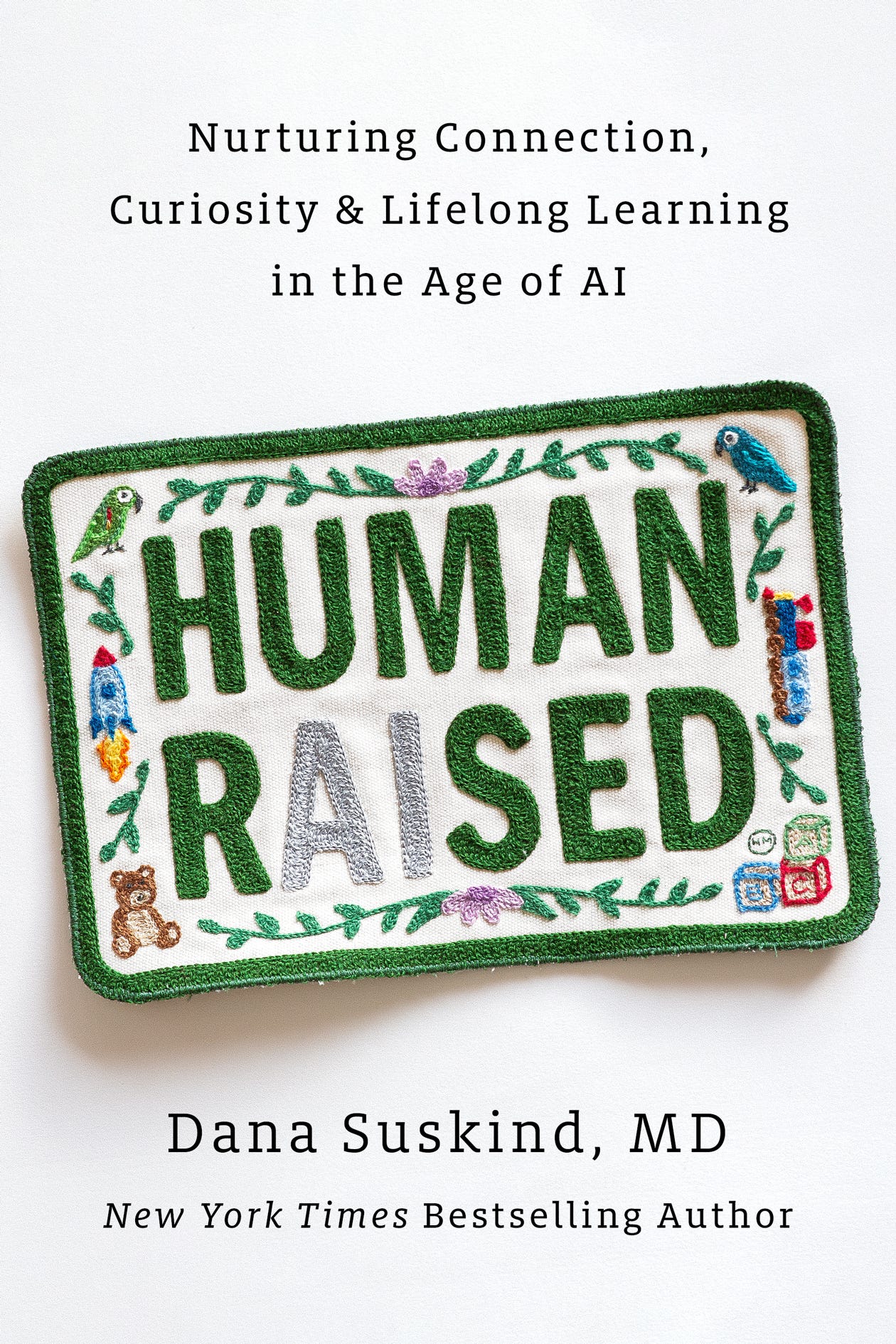
If you’re here at Techno Sapiens, my guess is that you have spent at least a little bit of time thinking about how to raise kids in the age of AI. You’ve likely gathered that I spend a fair number (maybe too many) of my waking hours thinking about it, too. So, you can imagine how excited I was to see Dr. Dana Suskind’s new book: Human Raised: Nurturing Connection, Curiosity & Lifelong Learning in the Age of AI.
As I got to reading it, I was even more excited to share it with you all. It ticks all the Techno Sapiens boxes: a discussion of humans and technology! Non-alarmist, nuanced views of new tech! A call for imperfect parenting! A useful, four-part framework accompanied by—wait for it—an acronym! Sapiens, it’s like this book was written just for us.
Anyway, Dana was kind enough to give us a sneak peek into some of these ideas today (thank you, Dana!), but for more, make sure to grab your own copy of Human Raised right here.
I’m a pediatric cochlear implant surgeon and a social scientist, and for more than two decades now my work has focused on one central question: What do children need in order to reach their full potential? Through my clinical work and my research at the TMW Center for Early Learning + Public Health, I’ve come to understand that the answer is human connection. Children’s brains are literally built through relationships—through back-and-forth conversations, play, shared attention, and responsive caregiving.
So when generative AI started to enter childhood, I was fascinated by its potential, but also wary of what it might replace. I was also struck by how quickly the conversation focused on what AI can do for children—smart cribs, chatbot plushies, that kind of thing—rather than what we need to protect for children, so that they can thrive. Those are very different questions.
I wanted to write Human Raised to offer more guidance to parents than a binary “adopt AI” or “reject AI.” AI is one of the most powerful technologies humanity has ever created, and it will almost certainly improve our lives in countless ways. But every technological revolution changes us as well. My concern is that if we aren’t intentional, AI could slowly replace the human interactions I’ve spent the last few decades studying, the ones that science tells us are so critical because they build curiosity, empathy, resilience, and lifelong learning.
So my goal with this book is to help parents use AI thoughtfully, embracing its incredible benefits while protecting the childhood experiences that no technology can replace.
I didn’t want to give parents a list of apps that are good or bad. Technology changes too quickly for that, and individual families’ needs and values vary too much for that. What I feel strongly that we need is a framework grounded in developmental science that helps us ask the right questions. That’s what I hope the HOPE framework can be.
H is for Human Connection is Irreplaceable. AI can simulate conversation, but children build their brains through real relationships. The serve-and-return interactions between a child and a caring adult aren’t just nice to have, they’re biologically essential.
O is for Own the Imperfections. AI promises lightning-fast answers, endless dialogue, even optimized parenting. But children don’t need perfect parents. They need real ones. They grow through watching us make and repair mistakes, struggle, laugh, and learn alongside them. Those imperfect moments teach resilience and emotional security.
P is for Protect the Early Years. The first five years are a once-in-a-lifetime window of brain development. During that period, children need rich human interaction far more than they need sophisticated technology. AI should never replace the conversations, play, and caregiving that build the developing brain.
E is for Enhance, Don’t Replace Adult-Child Interaction. AI can be an extraordinary tool, as long as it’s amplifying human capacities instead of substituting for them. If it helps a teacher spend more time connecting with students or frees a parent to be more present with their child, that’s technology serving humanity rather than replacing it.
Ultimately, HOPE is about making sure that as technology becomes more capable, we become even more intentional about protecting what makes us human.
This is actually my favorite question! I meet so many parents who are exhausted by trying to optimize every moment of childhood. Every activity needs to be educational. Every decision feels like it carries lifelong consequences. AI has the potential to amplify that pressure by constantly offering better schedules, smarter lesson plans, personalized tutoring, instant answers to every parenting question.
But that approach misunderstands how children actually develop. The research is remarkably reassuring. Children don’t thrive because every interaction is perfect. They thrive because they experience thousands upon thousands of warm, responsive, ordinary moments with the people who love them. Reading together. Having a conversation in the car. Playing pretend. Solving a disagreement after an argument. These aren’t interruptions to learning; they are the learning.
One of the ideas I emphasize in the book is that we should optimize for connection, not perfection.
If AI reduces your mental load so you can spend more meaningful time with your family, wonderful. But if it convinces you that there’s always a better way to parent, another milestone to reach, another skill to accelerate, it risks pulling us away from the very thing children need most: a present, responsive, imperfect human being.
Prioritize one period each day when you’re fully present with your child—no multitasking, no phone in your hand, no AI between the two of you.
Even fifteen or twenty minutes of genuine back-and-forth interaction can be incredibly powerful. Follow your child’s lead. Ask open-ended questions. Read together. Build something. Cook dinner. Take a walk. Let them be bored enough to invent a game. The activity doesn’t matter as much as the quality of the interaction.
And I just want to emphasize that I hope parents feel empowered by this conversation, rather than overwhelmed. “Good enough” parenting is actually very beneficial to your child, developmentally. They need you to be imperfect. They need friction and little missteps. They need to see that humans can make mistakes and bounce back from them. They need to see that relationships can rupture and repair. That’s how they develop resilience and empathy and all sorts of important skills.
Ironically, as AI becomes increasingly capable, our greatest advantage won’t be acting more like machines. It will be becoming more deeply human. And that’s something every parent can begin nurturing today.
Make sure to grab your copy of Human Raised right here.
What did you think of this week’s Techno Sapiens? Your feedback helps me make this better. Thank you!
The Best | Great | Good | Meh | The Worst
I asked ChatGPT (I couldn’t help myself). It said: “For most children, I'd be comfortable with one or two chicken-finger meals per week as part of an overall varied diet” and suggested I try to “alternate between breaded chicken and plain grilled or baked chicken.” Baked chicken?! If that’s not evidence that AI will never replace human parents, I don’t know what is.
No posts
Comments
Nothing yet. Say the first thing.
Sign in to join the conversation.