
5 min read
Happy August, sapiens! Here’s a quick BTS (that’s “behind the scenes” for those of us in ~show business~)1 of how Techno Sapiens gets made:
I have an Apple Note that syncs across my phone and laptop. It is called Techno Sapiens Ideas. Throughout the week, I jot down research, news articles, ideas, and stories that I want to remember to share. Once they make it into the newsletter, I delete them. Sapiens, the Note is currently coming in at just under 10,000 words.2
So, today let’s make a small dent in that list and round up the latest news, notes, and research. And away we go!
This new study published in JAMA Network Open is making the rounds, including in this widely shared WaPo piece: “New study links ADHD symptoms in boys and addictive social media use.”
So, what’s the deal? This new paper is based on data from the Adolescent Brain Cognitive Development (ABCD) Study, an ongoing, nationwide project that’s been following thousands of kids over the past decade. For this particular paper, researchers analyzed data from over 112,000 kids across 5 years, starting when the kids were 10 or 11 years old. Kids completed measures of “addictive social media use” (e.g., having difficulty stopping use, feeling upset when they cannot use it). They and their parents also completed separate measures of the kids’ ADHD symptoms.
Here is precisely what they found:
At times 4 and 5 only, higher levels of addictive social media use (compared to a kids’ typical use) were associated with later parent-reported ADHD symptoms.
This seemed especially true for boys.
At time 4 only, the reverse direction of effects (ADHD symptoms associated with later addictive social media use) was also present.
All of these effects were small.
The same pattern did not emerge when looking at kids’ own reports of their ADHD symptoms.
My take: Is it possible that excessive use of social media can contribute to worsening ADHD symptoms in kids? Of course. Is it possible that ADHD symptoms make it harder to regulate the use of screens? Definitely.
That said, the results of this study are not straightforward. Why would these associations only show up at certain time points? Why only in boys? Why only with parent-reported symptoms? In my opinion, there is likely some association between problematic media use and ADHD symptoms, and we should be aware of that. My concern is that the conversation around this study implies that too much social media use is causing children to develop ADHD—that’s neither accurate nor helpful for parents.
I love this new report from Hopelab and Harvard’s Center for Digital Thriving, in which researchers interviewed young people about when and why they might use AI for emotional support. Reasons include: not wanting to burden friends, feeling that AI is less judgmental, and knowing that AI is always available.
Some fascinating quotes in here. For example:
“If I’m having mental health issues or something like that, then I’ll go to AI because you don’t want to trauma dump all over your friends, obviously. Some things are best dealt with on your own.”
“It’s just me and a chatbot, so I don’t feel like there’s any judgment there.”
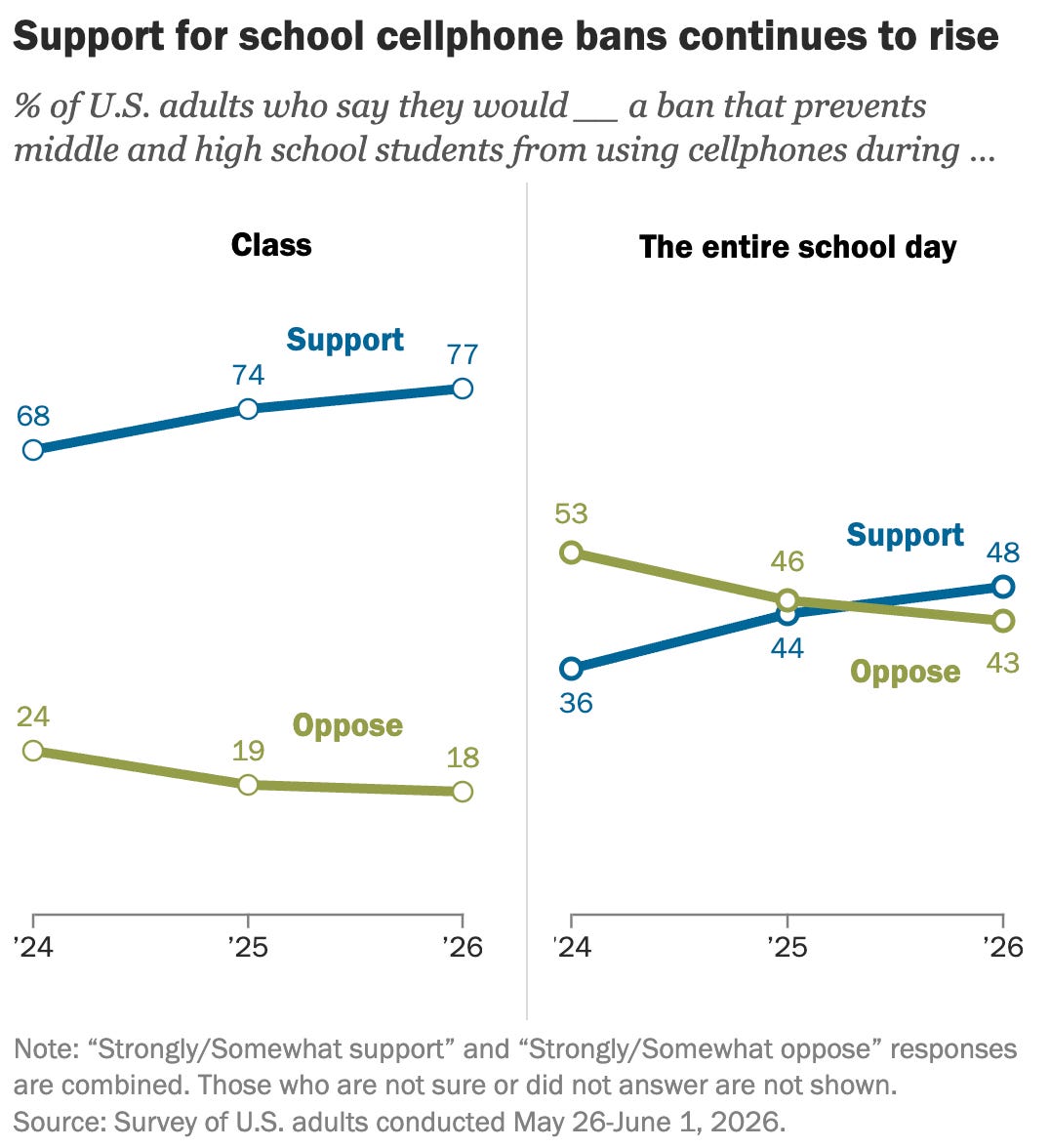
Wouldn’t be a roundup without a quick check-in with our friends at Pew, am I right?3 According to their new data, support for school cell phone bans has inched up over the past two years.
Now, 77% of U.S. adults “strongly” or “somewhat” support a ban that prevents middle and high school students from using cell phones during class, and 48% support a ban for the full school day (i.e., “bell-to-bell”).
Not often that a piece about AI makes me tear up, but this one, titled Please Use AI, did the trick.
A brief excerpt:
And be sure to use AI when your next child
gets married, so that you can write them
the perfect toast or poem or speech or song
because no one wants to hear your
words, the actual poorly written words
of a parent (you) who changed
hundreds of diapers for said child or fed
them in the middle of the
night from your actual body. Or cried
when they were late home because
you were positive they were dead. We don’t
want those words—we’d prefer the sterile
words of a machine that never lived, never
had an original thought, never felt
the pain of miscarriage or broken
relationships or the joy of a friendship restored
or of seeing spring’s first
robin dancing on frost.”
Psychologists Off the Clock podcast. I got to team up with Dr. Tracy Dennis-Tiwary and Melinda Wenner Moyer to chat with host Emily Edlynn all about how parenting science is discussed in the media. From the summary: “If you’d appreciate a reassuring, reality-based sanity check on modern parenting so you can tune out the fear and focus on what actually works for your family, tune in.”
“Parents know more than they think they do.” I talked to Jennifer Heifferon for the California Partners Project’s Tech/Life Balance Substack all about parenting and tech. We talked about: how I got into this work, why kids’ beliefs about technology matter, and how to model healthy (not perfect!) tech habits.
“High Resolution” video podcast. If you prefer to watch, rather than read, here’s my conversation with Rotem Rozental from the Byte Size Substack. From Rotem: “I got to hear from her about…what happens when chatbots replace real social friction, how to discuss AI use with your kids, and what we might be getting wrong in how we treat technology. According to Dr. Nesi, we still have much to be optimistic about.”
A screenshot I discovered in that “Techno Sapiens Ideas” Apple Note. Truly, never know what I’ll find in there.
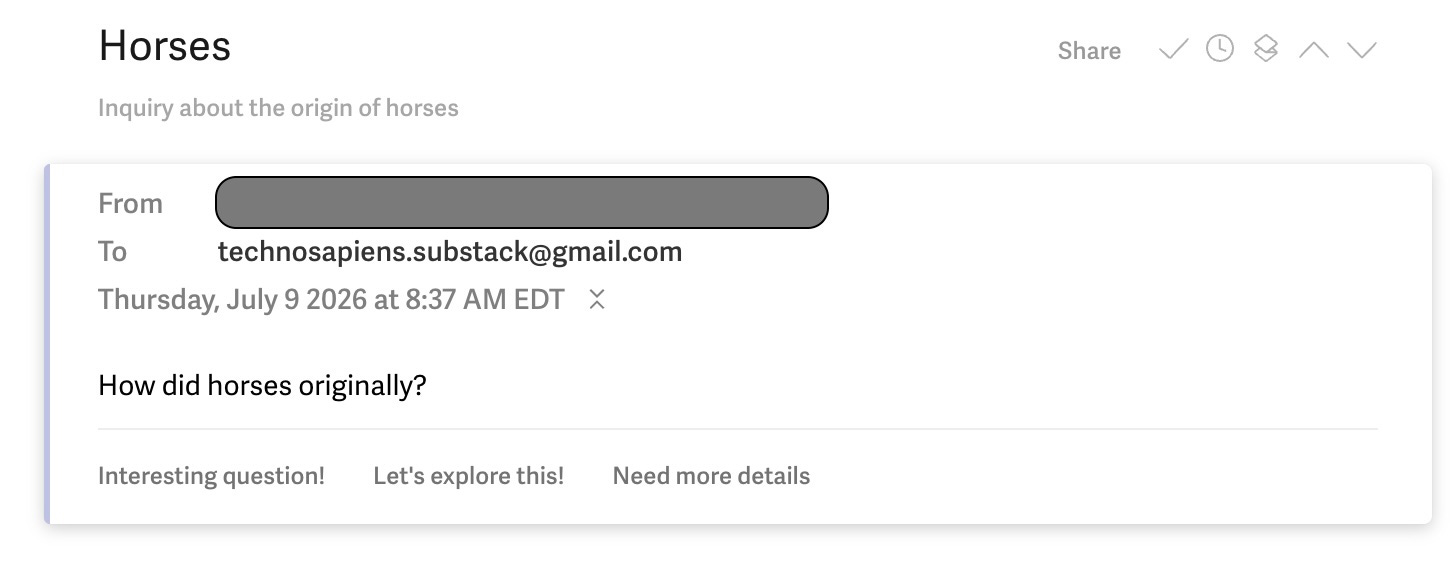
(Also, if you were the one who sent this email, please know that I know nothing about horses, but loved receiving it all the same.)
❤️ If you liked this post, give it a ❤️ so others can find it, too
📧 If you know someone who might like Techno Sapiens, forward this email along
🔓If you’re enjoying the newsletter, please consider upgrading to a paid subscription
What did you think of this week’s Techno Sapiens? Your feedback helps me make this better. Thank you!
The Best | Great | Good | Meh | The Worst
I am not, in fact, in show business.
I only really use the top few bullet points on the “Techno Sapiens Ideas” list, as those are the most recent, so I fear about 9,000 of those words are going to languish in that Apple Note forever.
And by “our friends at Pew,” I simply mean the Pew Research Center, where surely there is by now a company Slack thread where employees wonder aloud why that woman at Techno Sapiens keeps calling them her “friends”…
No posts
Comments
Nothing yet. Say the first thing.
Sign in to join the conversation.