
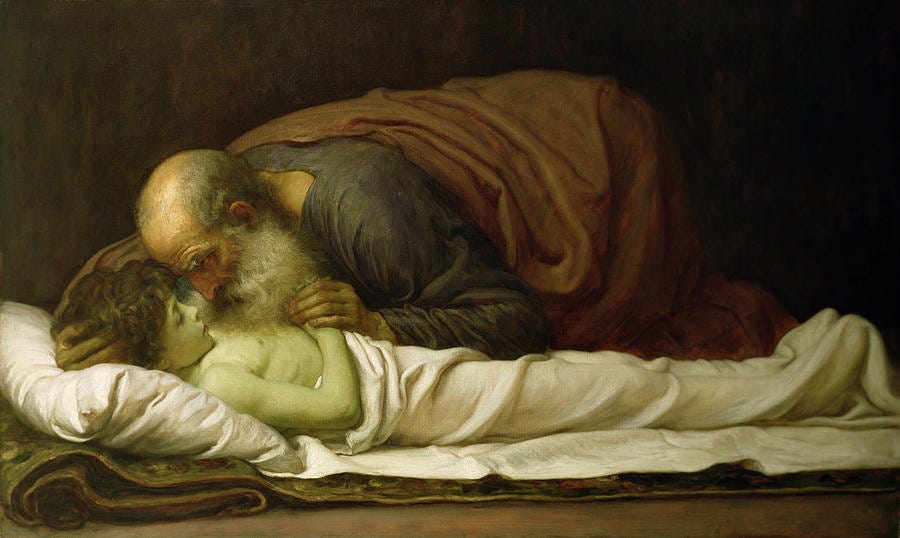
The readings for the 13th Sunday in Ordinary Time (Year A) begin with 2 Kings 4:8-11, 14-16a. You’ll notice that there is a gap, with verses 12 & 13 being omitted, and that we only hear the first half of verse 16 at the end.
There is a reason for that, I’m sure. The truncated version of the story of Elisha and the Shunamite woman that we hear at Mass today focuses more on the hospitality given to the prophet by the Shunamite, which ties nicely into the gospel’s message: “Whoever receives a prophet because he is a prophet will receive a prophet’s reward, and whoever receives a righteous man because he is a righteous man will receive a righteous man’s reward” (Mt 10:41). More on that later.
But I find the full account of the story of Elisha and the Shunamite woman fascinating. The story begins in verse 8, where we are told of a “woman of influence” offering meals and, eventually, a place to stay for the prophet, making for him a little guest room of sorts to serve as a waystation whenever he passed through the area.
In thanksgiving for all she has done for him, Elisha desired to do something for her in return. Initially, she is reluctant to accept any sort of recompense for her kindness. In the omitted verses (v. 12-13), Elisha offers to put in a good word for her to the king or the army commander. Her response is merely, “I am living among my own people.” In other words, “I’m fine.”
But Elisha presses and eventually his servant points out to him that the woman has no son and that her husband is old (implying that she will be utterly on her own after her husband’s death). So Elisha tells her, “This time next year you will be cradling a baby son.” This is the first half of verse 16, that we hear at Mass today. That’s good news! And so our story seemingly ends on a high note.
But listen to the second half of that verse, that we don’t hear. The Shunamite woman’s response to this seemingly good news from the prophet (whom she trusts a great deal, remember), is “My lord, you are a man of God; do not deceive your servant.” She’s afraid she’s being lied to.
Have you ever wanted something so much for so long without having it that you eventually acquiesced to life without, and given up hope? This must have been her position. Despite longing for a child, she must have buried any hope of ever becoming a mother so deep down inside that she was afraid of even admitting to it herself. And now here comes the prophet causing that buried desire to resurface. It must have felt like opening an old wound. No wonder she said, “Don’t lie to me.”
And that’s just the beginning of the story. If we read the rest of chapter 4 we discover that she did indeed have a son, just as Elisha foretold, and that he initially was healthy. But while still a young boy, he took ill and died. She lays her dead son’s body out on the prophet’s own guest bed and then immediately seeks out Elisha on Mount Carmel. When she finds him, she tells him (accuses him, really), “Did I ask my lord for a son? Did I not say, ‘Do not mislead me’?” (2 Kgs 4:28).
We can only imagine her anguish, frustration, and sense of betrayal. How dare God grant her this gift of a son, which she didn’t dare ask for on her own, only to take him away so suddenly?
But Elisha rushes to her home, sprawls himself out over the dead boy’s body, mouth to mouth, eye to eye, hands to hands, and prays. After doing so, the boy is miraculously brought back to life. What are we to make of all of this? Why would God grant this woman her deepest longing, which she herself dared not hope for, only to take it away, and give it back again? Who knows? This is indeed a hard thing, but so is much of life.
I am reminded of Job 2:10. We receive good things from God and also bad. The Lord giveth and the Lord taketh away. Blessed be the name of the Lord.
But the story ends with resurrection, and that, I believe is the point. There will be hardships in life. There will be tragedies. There will be ups and downs. But what God desires for us all in the end is life. This helps us to make sense of what Jesus says to us in the gospel reading today.
“Whoever loves father or mother more than me is not worthy of me, and whoever loves son or daughter more than me is not worthy of me; and whoever does not take up his cross and follow after me is not worthy of me. Whoever finds his life will lose it, and whoever loses his life for my sake will find it” (Mt 10:37-39).
Jesus isn’t saying we need to hate our own parents or love them any less than we do. But we need to love him more. That is, we need to be faithful to him first and above all. Why? Because he is the resurrection and the life (Jn 11:25). Our parents will die. Our children will die. Everyone else in our life can and will disappoint us in time, if all our hopes for happiness and fulfillment rest upon them. But not Jesus. He has conquered death for us and through his death brings us to resurrection.
This is why we must take up our cross and follow him. This is why Paul reminds us in the second reading today that to be baptized into Christ is to be baptized into his death (Rom 6:3). Because it is only through His death that we have true and everlasting life.
I mentioned above that one possible reason the Church may provide a truncated version of the story of Elisha and the Shunamite woman in the first reading is to focus our attention on the virtue of hospitality, and that this aligns with some of what we hear Jesus saying in the gospel passage for this Sunday. That is true enough, as it goes.
But in reading what our Lord says about being hospitable, I couldn’t help but make an observation.
First, let us recall that in this section of Matthew’s gospel, Jesus is speaking in particular to the Twelve Apostles. In other words, he is not addressing the crowds at large. Matthew 10 begins with his calling of the Twelve and then commissioning them to go to the “lost sheep of the house of Israel” to proclaim that the kingdom of heaven is at hand (Mt 10:6-7). He warns them that they would face persecution, and then, in the section we read from today, speaks to them of the conditions of discipleship, i.e. taking up the cross and following him.
The part that deals with hospitality begins, “Whoever receives you, receives me, and whoever receives me receives the one who sent me” (Mt 10:40). In other words, he is not — at least not in this passage — speaking to his followers about the need to be hospitable to others. Rather, he is speaking to his chosen Twelve in particular about their need to rely on the hospitality of others, telling them that those who welcome them will be blessed, because by welcoming them, they are, in fact, welcoming the Lord. This all lines up with his earlier instructions that they are not to take provisions on their missionary journey, but to rely on what God would provide through the hospitality of others (cf. Mt 10:9-10).
It is in this context that Jesus says, “Whoever receives a prophet because he is a prophet will receive a prophet’s reward, and whoever receives a righteous man because he is righteous will receive a righteous man’s reward” (Mt 10:41, emphasis mine). In other words, this is not a verse about helping those in need, or welcoming the stranger in a general sense. Don’t get me wrong, there are plenty of other scripture passages to support those works of mercy. That’s just not what this passage is about. In this passage, Jesus is speaking specifically of the rewards that accompany hospitality shown to holy and righteous people.
And lest we may be tempted to think he has only the Apostles in mind, our Lord concludes his discourse by saying, “And whoever gives only a cup of cold water to one of these little ones to drink because he is a disciple — amen, I say to you, he will surely not lose his reward” (Mt 10:42). So any act of kindness, even one as small as offering a drink of water, given to a disciple of Christ because he is a disciple of Christ will be rewarded by God.
Again, please do not get me wrong. I am not saying that it is not a good and holy, and indeed morally praiseworthy thing to offer hospitality to strangers and aid to the poor. I am just saying that this isn’t what this passage is about. I point that out because my sense is that many priests and deacons this Sunday will use these readings as an occasion to preach about the virtue of hospitality in general. And that’s fine. That’s a message that needs to be preached. And there certainly is a tie-in with the readings for today. But we cannot ignore the actual words that Jesus is speaking here and the implications that it has for how we ought to treat our fellow Christians in particular.
Something very similar can be said when it comes to the famous passage in Matthew 25 where Jesus speaks of the judgment of the nations, when the Son of Man will come in glory and separate out the sheep from the goats. All the nations will be assembled before him (Mt 25:32) and we will be judged according to whether or not we fed the hungry, clothes the naked, cared for the ill, and visited the imprisoned (see Mt 25:31-46). Clearly a call to minister to the needs of the poor, correct? This is how this passage is always preached, after all.
But Jesus speaks particularly about giving aid to “these least brothers of mine” (Mt 25:40), not people in general. So who are these "brothers” of Jesus? One interpretation is that anyone in need is a “brother” of Jesus because of their need. But a traditional understanding of this text is that the “brothers” of Jesus are Christian disciples who suffer for the gospel. This understanding lines up especially well with what we hear in today’s reading from Matthew 10.
Again, please do not misunderstand me. I’m not saying that it is not good to help those in need generally. There is plenty in the gospels, and in the scriptures more broadly, lauding people who minister to those in need. We absolutely should be doing that. But it is also clear that there is something distinctive about giving aid to our fellow Christian disciples.
I don’t really have a point to make other than to draw attention to what the gospel text actually says. It is certainly something to reflect upon. Perhaps it is the spiritual unity we are meant to have in Christ that gives our need to assist those who suffer for the faith more urgency.
Comments
Nothing yet. Say the first thing.
Sign in to join the conversation.