
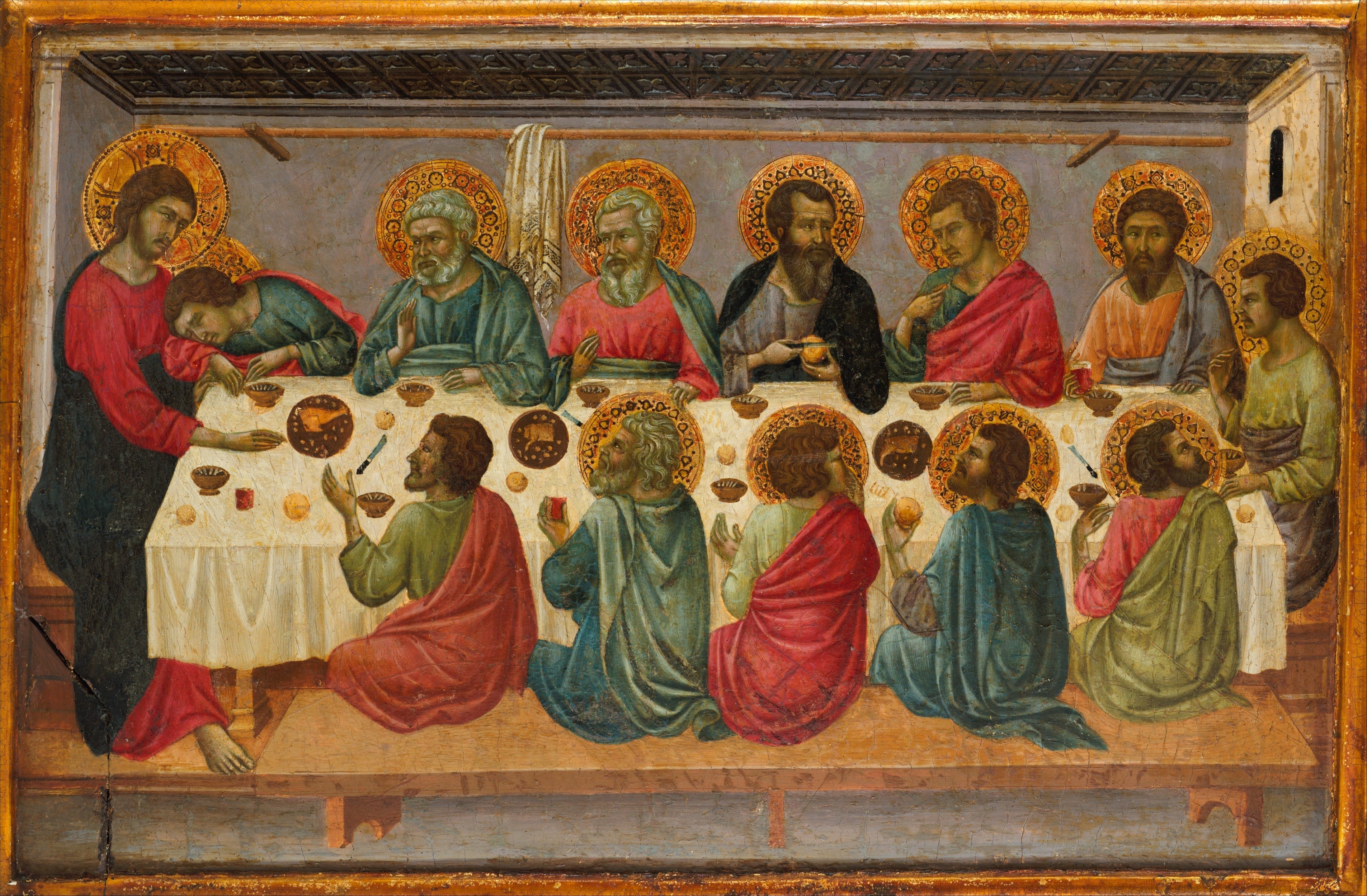
The cup of blessing that we bless, is it not a participation in the blood of Christ? The bread that we break, is it not a participation in the body of Christ (1 Cor 10:16)?
Is the Mass a sacrifice or a meal? That is a trick question, because the correct answer is that it is both. According to the Catechism, “The Mass is at the same time, and inseparably, the sacrificial memorial in which the sacrifice of the cross is perpetuated and the sacred banquet of communion with the Lord’s body and blood” (CCC 1382).
The reason people sometimes get confused on this point and think that it must be either one or the other is due to an assumption that these two things — sacrifice and meal — are two distinct concepts that the Church is somehow trying to bring together into one act of worship, and we don’t quite know how they fit. But if you study the Old Testament, you discover that sacrifices and meals went hand in hand when it came to giving worship to God.
When the people of ancient Israel offered a sacrifice to God, the animal they sacrificed was not just left to rot. It was eaten. In fact, the consummation of the sacrificial victim was understood to be an integral part of the sacrifice. The sacrifice had to be eaten, not just by the priest who offered the sacrifice but also by the people. That was how the people participated in the act of sacrifice. They ate the sacrifice. The best example of this, and the one we are probably most familiar with, is the Passover. Jesus instituted the Eucharist at a Passover meal. But if you remember the origin of Passover, it was in conjunction with the tenth and final plague God inflicted upon Egypt when he liberated Israel, the death of the first-born. For the angel of death to pass over the Hebrew families, not only did they need to sacrifice a lamb and mark their doors with its blood, but everyone in the family had to eat the flesh of the lamb. That was their participation in the sacrifice.
The practice of eating sacrificial animals wasn’t unique to ancient Israel but happened in many ancient cultures. In fact, it was probably the norm. If you went anywhere in ancient Greece or Rome you would find animals being sacrificed to various gods and goddesses in temples dedicated to them. And attached to the temple would be places kind of like restaurants, where people would go and be served meat from the animals that had been offered to the gods. Eating the meat was considered a participation in the sacrificial offering. That’s why if you read the Acts of the Apostles, or the letters of St. Paul, you find the issue coming up of whether Christians could eat meat that had been sacrificed to idols.
You see, for many ancient peoples, especially those living in cities, this would have been the normal way to get meat in your diet; you’d go to the temple, like we might go to Haywood Smokehouse, only the brisket or the pulled pork would have come from an animal sacrificed to Zeus or Aphrodite. So Christians rightly wondered, is it OK to eat this meat? Or is that a form of idol worship, since eating the flesh of the sacrificial animal was considered a participation in the sacrifice?
St. Paul addresses this in 1 Corinthians. The Christians in Corinth reasoned that since the pagan gods are false, it doesn’t really matter if we eat meat sacrificed to them. So they’d share in the Eucharist on Sundays, but then on other days they would enjoy meals at the pagan temples. St. Paul points out the scandal of this. Even if eating the meat itself might not be wrong, other people would assume that by eating the meat, these Christians were joining in the pagan sacrifice. It would lead others to believe that you can worship Jesus, and at the same time continue to worship pagan gods. So to avoid scandal, Christians should avoid eating meat sacrificed to idols.
It is in this part of 1 Corinthians that St. Paul reminds them of what the Mass is all about. “The cup of blessing that we bless, is it not a participation in the blood of Christ?” (1 Cor 10:16). What is the cup of blessing? Some of you may know that in the Passover meal, there were multiple cups of wine that were involved, each with its own place in the liturgy. The third cup of wine was called the “cup of blessing.” This was the cup that was served as the lamb was being eaten; and it was this cup that Jesus took into his hands at the Last Supper when he instituted the Eucharist, saying, “This is the cup of my blood, the blood of the new and eternal covenant.” There was no lamb being eaten at this time, of course, because Jesus himself was the lamb, and he had just offered them his body to eat for the first time in the Eucharist.
I go into all of this because it helps us to see how the Mass can be and must be both a sacrifice and a meal. And more importantly, it helps us to see how it is that we, as Christians, participate in the one unique sacrifice offered by Jesus Christ. Catholics and Protestants agree that the sacrifice of Jesus on the cross is unique. His sacrifice alone atones for the sins of mankind and reconciles us to the Father. All Christians agree on this. What we disagree on is how we participate in that sacrifice.
The Protestant answer is that we just need to believe in Jesus. But to the ancient mind, the way you participate in a sacrifice is by eating the sacrifice. So the Catholic understanding is and always has been that we participate in Jesus’ sacrifice through the Eucharist. In fact Jesus instituted the Eucharist precisely so that we might be able to participate in his sacrifice, to consume the Lamb of God who takes away the sins of the world, and thereby pass over from death into life.
How else are we to understand what Jesus says in today’s gospel? “[U]nless you eat the flesh of the Son of Man and drink his blood, you do not have life within you. Whoever eats my flesh and drinks my blood has eternal life, and I will raise him on the last day” (Jn 6:53-54). That sounds crazy unless we understand that Jesus intended to offer himself as a sacrifice, and sacrificial victims were meant to be consumed. That’s how the people participated in the sacrifice.
But still, the idea of eating human flesh was just as shocking in the first century as it is for us today. John tells us, “The Jews quarreled among themselves, saying, “How can this man give us [his] flesh to eat?” (Jn 6:52). Jesus gives us the answer when he says, “I am the living bread come down from heaven” (Jn 6:51). “Bread from heaven” is a reference to the manna God sent to sustain his people in the wilderness on their way to the Promised Land. Earlier in this passage in John, the people, who had followed Jesus out into the wilderness because of the signs they saw him perform, which ought to make us think of the Exodus. There, they asked Jesus to perform another sign. They wanted him to give them manna like Moses did (see Jn 6:30-31). Jesus corrected them, saying that it wasn’t Moses who gave them bread from heaven, but “my Father gives true bread from heaven . . . which gives life to the world” (Jn 6:32, 33). When they say, “give us this bread,” Jesus tells them, “I am the bread of life” (Jn 6:34, 35).
When Jesus says, “I am the living bread that came down from heaven” (Jn 6:51) and “my flesh is true food” (Jn 5:55), he combines both of these things into one in his person. He is what the manna and the Passover lamb were both pointing to. He is both the bread given from God as nourishment, and the sacrifice given to God as offering.
This is what makes the sacrifice of Christ unique. All other sacrifices are sacrifices given by man to God. In Jesus Christ uniquely, the gift of perfect, sinless humanity is offered to God — a spotless lamb — and the gift of divinity is offered to man. And in the Eucharist, we share in that gift and in all the benefits it affords, including the benefit of eternal life. “The bread that we break, is it not a participation in the body of Christ” (1 Cor 10:16)? Is it not a participation in his sacrifice?
This is the Eucharist. This is why the Mass can be nothing other than both a sacrifice and a meal. The meal is our participation in the perfect sacrificial offering of Jesus Christ to our heavenly Father in atonement for our sins and those of the whole world. Jesus is the lamb of God, and the bread from heaven, giving eternal life to all who share in his Eucharistic feast.
Comments
Nothing yet. Say the first thing.
Sign in to join the conversation.