
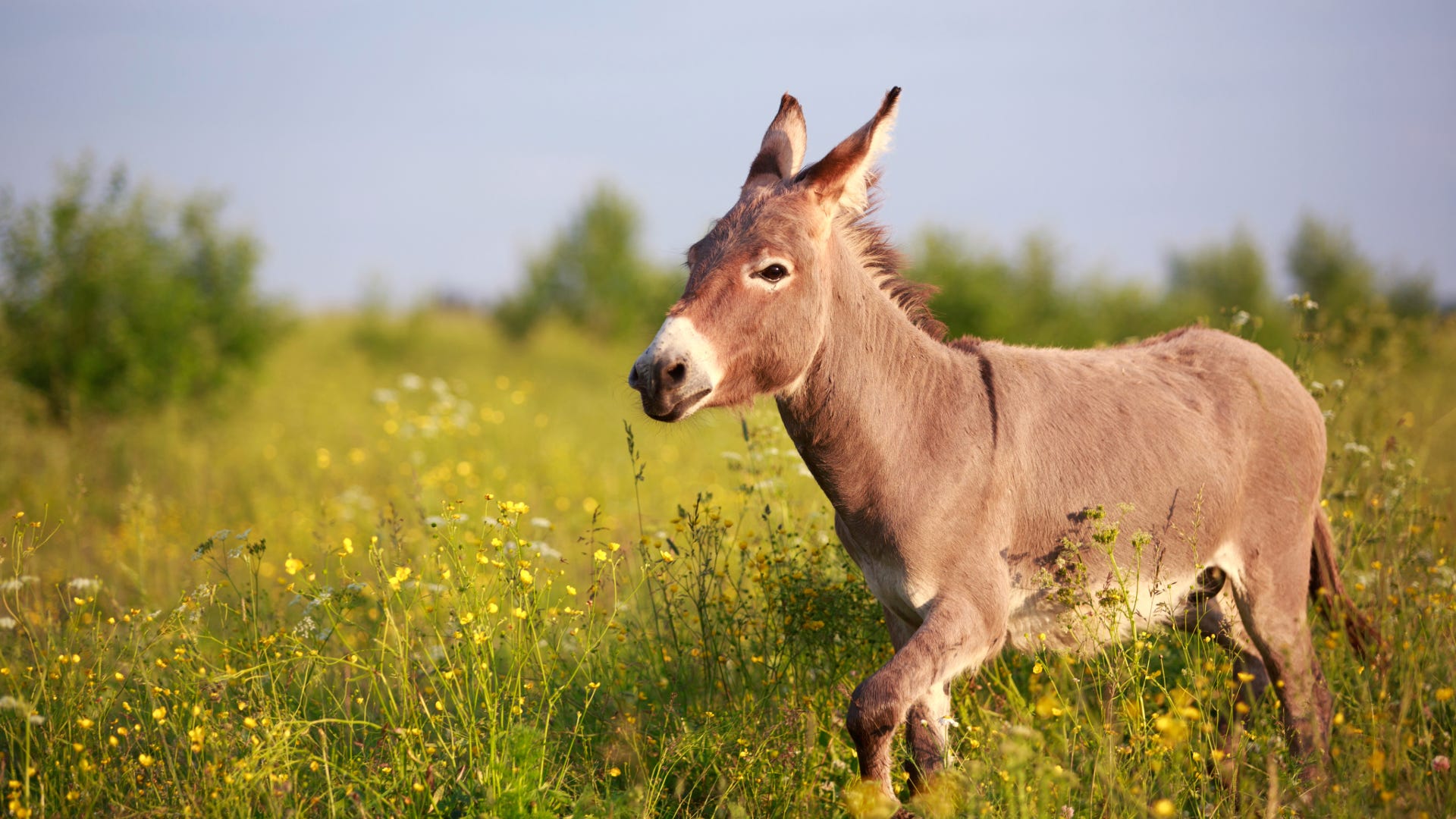
“Rejoice heartily, O daughter Zion, shout for joy, O daughter Jerusalem! See, your king shall come to you; a just savior is he, meek, and riding on an ass, on a colt, the foal of an ass” (Zechariah 9:9).
Some of you may know that my family and I have a pet donkey at home. Her name is Lucy. She’s a sweet old girl, who likes apples, being brushed, and rolling in the grass. The reason we have her is because we also have sheep and donkeys have traditionally been used as guardian animals for livestock because they’ll chase away wolves and coyotes and the like. If you pay attention when you are driving through farm country and pass a field with cows or goats or sheep in it, you’ll often see a donkey among the herd.
And I have a confession I want to make. No offense to any horse lovers in the congregation, but I’ve come to like donkeys better than horses. There’s nothing wrong with horses. I totally get why people love them so much. They are beautiful, noble, majestic creatures! But that’s actually why I don’t like them as much as donkeys. Whenever I’m around a horse I always get the impression that the horse thinks he’s better than me! I never feel that way around donkeys. With their goofy faces and oversized rabbit ears, they embody humility. Horses are so aristocratic; it’s no wonder horses have always been associated with royalty.
But not in Israel. In ancient Israel, the royal steed was actually the donkey. King David rode a donkey. If you remember the story of when David was nearing the end of his reign and one of his sons was trying to usurp the throne from Solomon, whom he had chosen as his heir, David ordered that Solomon be placed on his royal donkey and processed through Jerusalem, and that’s how people would know Solomon was his successor.
It is interesting that the donkey was associated with kings in Israel. As far as I know, Israel was unique in this. Any other king would be mounted on a powerful war horse. But not Israel. Israel’s kings were meant to be more like the donkey; humble, gentle protectors: not arrogant, not amassing riches or glory for themselves, not relying on their own strength, but on the strength of God.
I go into all this about about donkeys because, believe it or not, it helps us to understand what Jesus is talking about in today’s gospel when he says, “I give praise to you, Father, Lord of heaven and earth, for although you have hidden these things from the wise and the learned you have revealed them to little ones” (Mt 11:25). That’s kind of a strange verse to begin a reading with. What are “these things” that Jesus is talking about? The Church kind of assumes that we’ll know the context.
But if you don’t, and you say, OK, I’ll just go back a few verses to see what Jesus is talking about here, this is what you’ll read. This is Matthew 11:21-24, the three verses that immediately precede our gospel reading today.
“Woe to you, Chorazin! Woe to you, Bethsaida! For if the mighty deeds done in your midst had been done in Tyre and Sidon, they would long ago have repented in sackcloth and ashes. But I tell you, it will be more tolerable for Tyre and Sidon on the day of judgment than for you. And as for you, Capernaum: ‘Will you be exalted to heaven? You will go down to the netherworld.’ For if the mighty deeds done in your midst had been done in Sodom, it would have remained until this day. But I tell you, it will be more tolerable for the land of Sodom on the day of judgment than for you.”
And then we read, “At that time, Jesus exclaimed . . .” that God has hidden these things from the wise but revealed them to little ones. But what things? We still don’t know the answer to that question. Jesus condemns the towns of Chorazin, Bethsaida and Capernaum because they didn’t repent, but what was it that they missed, exactly?
This is where the donkey comes in. In Zechariah’s prophecy that we heard in the first reading, he tells Jerusalem to rejoice because, “your king shall come to you; a just savior is he, meek, and riding on an ass” (Zech 9:9). Zechariah is prophesying in the days after the second temple had been constructed. The first temple had been destroyed during the Babylonian conquest, when Judah was sent into exile. But if you recall from the books of Ezra and Nehemiah, King Cyrus of Persia had permitted the Jews to return and even gave them money and resources to rebuild Jerusalem, including the temple. So now the temple was rebuilt, and sacrifices were once more being offered on its altars; and the people were waiting.
What were they waiting for? They were waiting for the glory of God to return. The glory of God, the shekinah in Hebrew, had dwelled in the temple, in the holy of holies, where the Ark of the Covenant was kept. It left when the temple was destroyed, but now that the temple was rebuilt, the people were hopeful that it would come back, and that the kingdom of Israel would be restored. Those two things, the glory of God and the restoration of the kingdom, went hand in hand in the Jewish mind. And this is what they were waiting for. They were waiting and waiting, and nothing seemed to be happening. And so they struggled with doubt and despair, as we may well imagine.
This is when Zechariah comes in and tells them not to worry, but to rejoice, assuring them that their king and savior would indeed come, and they would recognize him because he would be riding on a donkey. And when he comes, he will banish the chariot from Ephraim and the warhorse from Jerusalem. He would proclaim peace not just to Judah, but to all the nations, and his dominion would not just include Israel, but all the ends of the earth. They just needed to wait.
They waited for 500 years, under the Persians, under the Greeks, under the Romans. Worldly empires came and went. And they waited. But what should they do while they waited? There were different ways of answering that question. This is when the various Jewish factions we read about in the gospels came into being. The Sadducees said, “Well, we have the temple. We can worship God. Even though we’re under Roman rule, we have ‘religious freedom,’” to use a modern term for it. And that’s not too bad. So we should just accept the status quo and learn to get along with the worldly powers that be. And there is a certain wisdom to that.
The Pharisees, on the other hand, figured that since God permitted Israel’s destruction because of their unfaithfulness to the covenant, maybe God would return and restore Israel if the people were faithful enough. So their focus was on being hyper-vigilant in keeping all aspects of the Mosaic law and teaching others how to keep the law. And there is a certain wisdom to that, too.
Then you have the party called the Zealots. These Jews were tired of waiting. They said, “We need to do something! We need to take up arms, to start a rebellion against the Romans to kick them out, just like our ancestors did to the Greeks during the Maccabean revolt.” And there is a certain wisdom to that way of thinking, as well. After all, it had worked for the Maccabeans.
So there is a certain logic and a certain wisdom to all three of these approaches, but also clearly some faults. But I’m willing to bet that if you asked anyone from any of these three groups, they would have told you that they were doing the will of God; that they were the ones being faithful, and the others were wrong-headed.
Now you may be thinking, I remember Jesus admonishing the Sadducees and the Pharisees on multiple occasions in the gospels, but he never says anything against the Zealots. Except that he does, and we’ve missed it. You see, the Zealot party was centered up in the Galilee region, and there were three towns in particular where they gathered most of their recruits. Any guesses as to which three towns? Chorazin, Bethsaida, and Capernaum.
The people in these towns were ripe for the Messiah to come. Any day now, they expected their savior to come riding in on a war horse, and they were ready to take up arms and follow him into battle. So when Jesus came proclaiming the kingdom of God is at hand, that got people’s attention. But he said strange things, like how the kingdom belonged to peacemakers, and how to enter God’s kingdom you needed to love your enemies, pray for those who persecute you, and turn the other cheek. He said if someone presses you into service for one mile, which was a thing Roman soldiers often did, that you should give them two. These don’t sound like words of wisdom. Jesus did not sound to them like a warhorse. He sounded like an ass.
This is what was hidden from the wise and the learned, but revealed to the little ones. This is why the crowds that waved palms and shouted “Hosannah!” to welcome their king on Palm Sunday abandoned him when he was arrested and crucified. They forgot the reason why Israel’s kings rode on donkeys. They were never meant to be like other kings, because the kingdom of God is not like other kingdoms.
In God’s kingdom, humility is stronger than pride. In God’s kingdom, mercy matters more than might. In God’s kingdom, victory comes through forgiveness, not violence. In God’s kingdom, the mighty are cast down and the lowly are raised up, and authority is used to serve others, not oppress them. As we celebrate 250 years of independence for our great nation, let us not forget that if we want our country to be a Godly country, this is what that looks like. And if we want to be good citizens, these are the virtues we must practice.
This is not to say we have to all put on our birkenstocks and strum guitars and sing, “Give Peace a Chance.” Yes, there are times when it is right and just to take up arms and fight — in defense of the innocent, in defense of our God-given human rights, in accord with the Church’s teachings on just war. As long as we live in a fallen world, this will always be the sad and necessary truth. But let us be careful never to put our hope in our own self-righteousness, our own political power, or military strength, lest we share the fate of Chorizin, Bethsaida and Capernaum. In the end, the chariot, the warhorse, and the spear will be banished from God’s kingdom, because that kingdom is a place of compassion, of peace, and of rest. That rest can be ours even now, if we yoke ourselves to the donkey-riding king who is meek and humble of heart, and imitate his example of humility in all the circumstances of our lives.
Comments
Nothing yet. Say the first thing.
Sign in to join the conversation.