
According to my extensive research (aka, a quick Google search I just did a few minutes ago), the plant with the smallest seed is the orchid, varieties of which typically have seeds ranging from 0.1 mm to 0.05 mm, or about the size of a speck of dust.
According to similar extensive research, the largest plant in the world by volume is a sequoia tree in California’s Sequoia National Park called General Sherman, estimated to have a trunk volume of 1487 square meters. The largest plant by area, on the other hand, is an underwater seagrass called Posidonia australis in Shark Bay, Western Australia, which spans some 77 square miles.
What does this have to do with anything?
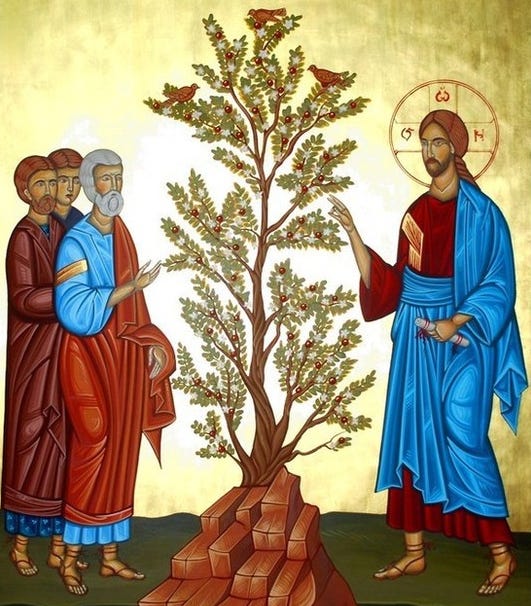
Well, if you were paying attention to the gospel this past Sunday, you’d think the title for smallest seed in the world and largest plant in the world both belong to the mustard plant. After all, Jesus clearly says:
The kingdom of heaven is like a mustard seed that a person took and sowed in a field. It is the smallest of all the seeds, yet when full-grown it is the largest of plants (Mt 13:31-32a).
So do we have to choose between believing Jesus or Google? We don’t need to rely on a Google search. Mustard plants typically get no more than six feet high or so. Just take a walk in the woods and you’ll see with your own eyes plenty of plants much larger.
So is Jesus just wrong? Has he never seen a tree? Or perhaps the gospel writers are wrong about what Jesus said? Either way, it seems there is a problem. The Church teaches the Bible is inerrant, which means it has no errors. But there is clearly an error here. That means the Bible must be untrustworthy. What else might the gospel writers have gotten wrong? The virgin birth? The crucifixion? The resurrection? Why should we trust anything the scriptures say?
This is the sort of conundrum one gets into when one assumes every word of scripture must be literally true. Thankfully, the Church does not teach us to read the Bible this way.
The confusion is understandable. The Church does teach the scriptures to be inerrant, and that can certainly sound to the average ear to mean “literally true.” But Church teaching is actually more nuanced.
The Catholic Church teaches that God inspired the human authors of sacred scripture in such a way that, while they used their own human powers and faculties, they were guided by the Holy Spirit to write what God wished them to write to convey truth for the sake of our salvation (Catechism of the Catholic Church 106).
As described by the Second Vatican Council’s Constitution on Divine Revelation, Dei Verbum, and quoted in the Catechism:
Since therefore all that the inspired authors or sacred writers affirm should be regarded as affirmed by the Holy Spirit, we must acknowledge that the books of Scripture firmly, faithfully, and without error teach that truth which God, for the sake of our salvation, wished to see confided to the Sacred Scriptures (Dei Verbum 11, qtd. in CCC 107).
In other words, the Holy Spirit affirms what the sacred writers wished to affirm with their text. So the question becomes, do the writers of sacred scripture always wish to affirm the literal meaning of each and every word they write? The Catechism (and all of Christian tradition) would say no.
In order to discover the sacred authors’ intention, the reader must take into account the conditions of their time and culture, the literary genres in use at that time, and the modes of feeling, speaking, and narrating then current. For the fact is that truth is differently presented and expressed in the various types of historical writing, in prophetical and poetical texts, and in other forms of literary expression (CCC 110).
This just makes sense. Truth is not always conveyed by use of straightforward, literal meaning. If I am writing a scientific analysis of experiments performed in a chemistry lab, the language I use will be very exact and precise. On the other hand, if I am writing a poem to express devotion to my beloved, the language I use will be flowery and symbolic. Both express truth.
Even in everyday speech, we often employ words and phrases to convey truth that goes beyond the literal meaning of the words. A common example is if I said it were “raining cats and dogs.” The literal meaning of these words suggests that felines and canines are falling from the sky, but that is not at all the truth I mean to affirm. The truth I mean to affirm is that it is raining very hard. We understand this, because we understand the idiom. The problem when reading texts written millennia ago is that the idioms are often unfamiliar to us. Knowledge of the culture and traditions of the time is therefore essential to any kind of scriptural exegesis.
This doesn’t mean we need to all be historians and anthropologists to understand the Bible. Often we just need to employ some common sense. Let’s look again at what Jesus says about mustard seeds in Matthew 13:31-32.
In this part of Matthew’s gospel, Jesus employs various parables to describe the kingdom of heaven. He describes it as seed sown in different types of soil (Mt 13:18-23), as a field where wheat and weeds grow together (Mt 13:24-30), and as yeast leavening bread (Mt 13:33). His purpose is to convey “knowledge of the mysteries of the kingdom of heaven” (Mt 13:11) — not to teach the disciples about farming or baking.
So when Jesus says the kingdom of heaven is like a mustard seed we must ask, what is the truth he means to affirm? Is he making a point about botany? No. This text is not asserting a truth about the relative sizes of plants, but about the kingdom of heaven, and it is that truth, conveyed by means of simile and metaphor, that the Church teaches is inerrant.
We must remember that the scripture writers, while inspired by the Holy Spirit, still use human language and modes of speech; and that involves not only simile and metaphor, but also exaggeration and hyperbole. We use these forms of expression so commonly, in fact, that we often take them for granted.
For example, I remember describing my experience of seeing the Grand Canyon for the first time. I said, “It’s the biggest thing I’ve ever seen!” Well, that’s not literally true, is it? Every time I watch a sunrise or sunset, I’m looking at a burning ball of gas some 865,000 miles in diameter. But when I say the Grand Canyon is the biggest thing I’ve ever seen, if someone corrects me by pointing out that I’ve seen the sun, we’d think they were being a pedantic jerk!
Similarly, if I said to a newborn baby, “You’re just the tiniest thing!” it should be clear to anyone that I’m not meaning to assert that this baby is the smallest thing in the universe, only that she is quite small.
So when Jesus talks about mustard seeds, there is no need for us to take his words hyper-literally. He’s not making a point about the relative size of plants. He’s asserting a truth about the kingdom of heaven by comparing it to a seed that, while being very small, grows into something much larger, just like the tiny yeast performs its hidden work to produce an outsized effect in a loaf of bread.
So is this passage true? Is the kingdom of heaven like a small seed that grows into a large plant? Two thousand years later, we see that the Church, which began with a handful of disciples, now includes members from every nation on earth. Christ is indeed the seed that has fallen to the ground and died, only to rise and produce a great harvest (cf. Jn 12:24).
Those who have ears ought to hear.
Comments
Nothing yet. Say the first thing.
Sign in to join the conversation.