
Why would someone generate fanfiction using AI? Isn’t the point of fanfiction to be a purely personal, noncommercial creative exercise, something you do with your friends for fun because you want to? Fics aren’t school essays or work copywriting assignments. There’s no obligation, no compensation. Plus, with how much animosity creative fandom communities have towards AI these days, there are serious social consequences for being caught out using ChatGPT to even just help with your grammar!
And yet across the fandom landscape, accusations and exposures and cancellations based on AI use are an everyday occurrence. The biggest one yet recently rocked the Heated Rivalry fandom1 when an anonymous group of fans released an extensive document, proving that not only had then found a foolproof way to prove that an author had used Claude (a telltale tag in the HTML left over from when an author copy-pasted directly from Claude’s output into the AO3 composer) but that they’d found dozens of popular fics across different fandoms which included this tell.
Included in the release was an AO3 skin that users could load into their accounts that would make the screen flash bright red whenever a fic’s source code included these signs of AI use.
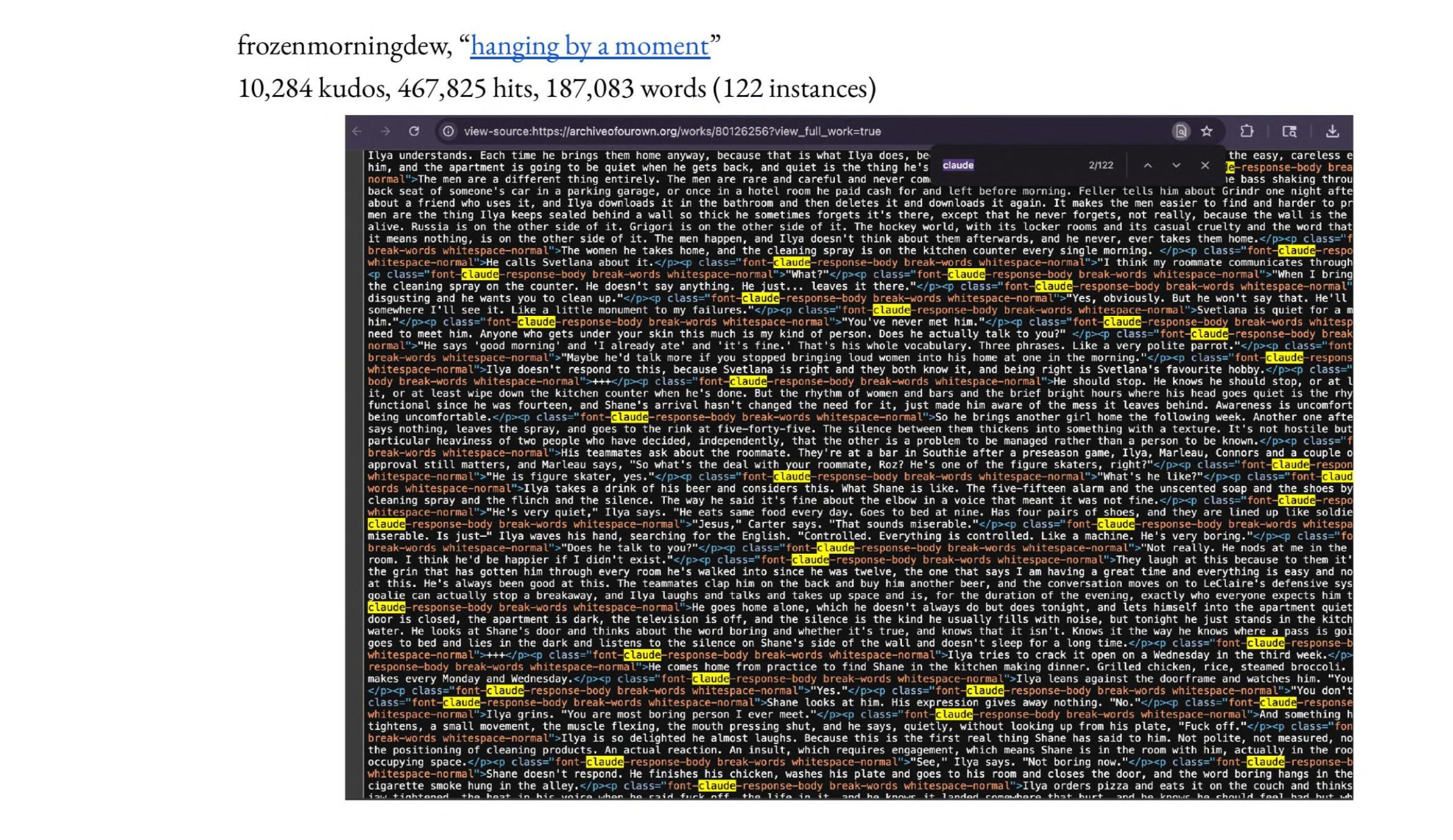
Responses from exposed authors ranged from apologetic to defensive to denying. Fans observed, and kept track, of which authors leapt to hastily scrub their fics of the telltale signs. Anecdotally speaking (I have not done a super deep dive here) the most morally outraged readers seem to be found on X and Tumblr, while on Threads and Reddit there was some degree of defense of, and deference to, the authors caught in the Claude crossfire. If I personally loved reading their story, the plea went, what does it matter what tools they used to correct their grammar/brainstorm ideas/write a few sentences here and there?
Though the Claude exposé and the accompanying AO3 skin was fandom-agnostic, the document was mainly targeted at the Heated Rivalry fandom. That’s because, in case you’ve been living under a rock since November, HR is by far the most dominant slash fandom at the moment. Since early January over 35,000 fics (an unbelievable number!!!!!) have been added to its main ship tag. Let me tell you, that’s a LOT. I would not hesitate to say it is the most dominant transformative media fandom possibly ever??????
At a time when it seems like fanfic culture might be to some degree in decline amongst new generations of fans, in the face of a nationwide decline in literacy alongside the rise of other forms of more algorithm-friendly fan practices like fan video editing, Heated Rivalry is bucking the trend.
Its origin in the muddled overlap between AO3 fanfiction, BookTok-beloved selfpub romance, and mainstream streaming television is pretty unique. Because it’s based on a book series which in itself started on AO3, there is an embedded “readership” aspect to its fanbase which is not necessarily echoed in other communities around TV shows.
This perhaps contributes to the absolutely bonkers amount of fic its fandom churns out. Also not to be ignored is HR’s status as the fandom to be in right now if you want a shot at having a fic more popular than most novels published in the US, and even perhaps a chance at becoming the next Rachel Reid yourself.
This element is a major contributor to the atmosphere of competition and commercialism that many fans have observed running rampant in the community:
I hate how big hr has gotten because it’s attracting the wrong kinds of fic writers and the fact that they wanted to file the serial numbers off and turn this into a published work in such a new fandom space is very telling to me. clout is a disease — @chibibinch
The fan-writer to pro-writer pipeline has existed basically since the birth of modern fandom in the tiny science-fiction communities of 1930s America and Britain. In the 1970s many popular Star Trek fanwriters were given opportunities to write official tie-in novels. Since then too many genre authors to count have gotten their start in fandom, or participated in fan communities in parallel with their pro careers. BNFs (Big Name Fans), and the jockeying for social status within fandom that they engender, has been a thing forever.
I always recommend Bertha Chin’s excellent book chapter “It’s About Who You Know: Social Capital, Hierarchies, and Fandom” in A Companion to Media Fandom and Fan Studies (Wiley Blackwell, 2018) for a primer on how fan spaces, like all subcultures, run on status games.
“For fans who participate in ‘textual productivity,’” Chin writes, “fan cultural capital is presented in the form of the written word: ‘high quality’ fanfiction that adheres to the canon, or one that presents a unique understanding of the characters, ‘bringing them to life’ in the readers’ eyes.”
Fan cultural capital accumulated in this way leads to the acquisition of sufficient fan symbolic capital— “recognition and reputation,” according to Chin—to bring about the state of BNF-dom, elevating fans into mini celebrities within their own fandoms.
Transformative media fandom is one of the few cultural spaces remaining where “high quality” writing (as perceived by an engaged readership) is socially valued enough to be the driving force of this level of relative status. This is notable; Heated Rivalry in turn is the latest and biggest in a series of massive fic-writing fandoms sporting the kind of reader numbers that have sent commercial publishers, anxious about the future of their industry, scrambling their jets. It makes sense that publishers would be seeking out these last lingering oases of dedicated readers online and urgently trying to hammer together pipelines to transport the seemingly endlessly renewable flow of goods back to sites of commercial production and reproduction.
There is a great deal of anxiety among fans about the future of their communities in the face of the dual and connected pressures of AI & commercial exploitation. What will become of the 60-year-old lifestyle of fanfiction for fanfiction’s sake, if new generations discovering it are doing so alongside expectations that writing The Most Popular Fic, by whatever means necessary, is something that will get them not only clout in their own community but nationwide publishing industry success and career status?
Gen Z and Gen Alpha all want to grow up to be influencers. For young people today, the most valuable thing you could be is influential in an online community of people parasocially obsessed with you, who you can sell various products to. And not only is the wannabe-BNF mindset vastly more common today than in the 2000s, but the platforms that fandom culture is conducted on, out of necessity, are designed to encourage it.
Yes there have always been BNFs. But modern social media has reshaped fandom into a place where clout is rapidly becoming the only way to connect with community. — @r0cketpeach
All of this really does not bode well for fandom, which even before the Web 2.0 era was a volatile petri dish of petty squabbles, status jockeying, flamewars and sockpuppetting. The idea that someone like Cassie Claire, legendary cliquey queen of the Harry Potter BNFs over 20 years ago and plagiarist extraordinaire, wouldn’t have resorted to Claude if she could have, is laughable. Of course she would have, lol.
Because of these social pressures, unfortunately there is no world in which the use of generative AI in fanfiction goes away completely. But for fans who want to know how to spot it, avoid it, and fight against it, the most important thing to do is to learn what it looks like.
The authors exposed by the Claude source code flaw were only getting away with it for as long as they did because many of their readers were not adequately equipped to notice the deficiencies of generated text. Fans’ own strong ethical stances against AI use in fanfiction, in a kind of vicious cycle, prevent them from using the tools themselves or actively becoming familiar with the kind of text they tend to generate.
An AI-generated Heated Rivalry fic called “Rose Colored Glasses” was recently published alongside extensive annotations noting specific AI tells. In my current fandom, which is tiny and obscure and absolutely zero publishers are scouring for their next bestseller, there are still a number of fics I’ve been able to pick out AI use in in thanks to those annotations (as well other helpful tips on social media).
The problem is widespread and without one single cause to point to. For every fan who doesn’t see any harm in using Claude as a beta, or running their problem paragraphs through ChatGPT to polish, there’s one for whom learning that their favorite story was even partially written by an AI would be a massive betrayal.
Since the beginning of 2026, the HR fandom in particular has been affected by waves of discourse and drama around the use of generative AI in fanfiction. An extensive rundown can be found on this Fanlore.org page which also has lots of great insight into HR as a classic “baby’s first fandom” situation full of feral newcomers who don’t know how to act.
No posts
Comments
Nothing yet. Say the first thing.
Sign in to join the conversation.