
Hi! I’m Allegra, a fandom expert with a book out next year about the history of fan culture, from Lord Byron to Beatlemania and beyond. Follow me on X, TikTok, Instagram, and LinkedIn for more commentary on fan trends, cult media, and pop-culture phenomena.
Last week I guested on New York Magazine’s Dinner Party newsletter with a follow-up piece about the AI scandal in Heated Rivalry fandom — you can check that out here.
Apparently, fans of My Chemical Romance have known for some time that frontman Gerard Way has a vomit fetish, thanks to the fact that he has made tweets to that extent before. But last week, the talk of the algorithmic town was a Usenet thread from 1998 that fans dug up which featured a 21-year-old Gerard discussing in detail, on alt.fondle.vomit, his love of watching girls puke—preferably clothed.
I have no parasocial attachment to this man or his music so have no feelings one way or another about his kink… But what I did find incredibly interesting was the variety of ways in which young fans comprehended the environment that Way was posting in.
I saw some fans calling the posts “leaked emails” and others referring to the forums as “AOL.” Some were seemingly under the impression it was some kind of instant messaging service. Still other fans referred to it as “Google Groups” — which, yes, that is the interface through which the posts are preserved today, but certainly not their original home.
Are you one of these young people slightly confused about where exactly Gerard and his bandmates were posting? Let me clear it up for you.
Usenet was a distributed message board service that first became popular in the 1980s. It was divided into a hierarchy of newsgroups, which were essentially text-based forums, grouped by interest. The “big 8” categories included “humanities” “comp” “sci” and “soc” for top-level interests; new subforums had to go through a lengthy formal voting process to be approved and added to the hierarchy. Then there were the “alt” groups, collectively known as the alternet. Pretty much anyone could spin up an “alt” group like the one that Way’s puke posting fell under.
Early on, it was more common to access Usenet directly via the command line/terminal interface of a personal computer; by the late 1990s, subscriptions to ISPs like AOL and EarthLink provided direct access to Usenet through their bundled software. You could also read & write to Usenet with independent reader software like Agent, or email programs like Microsoft Outlook.
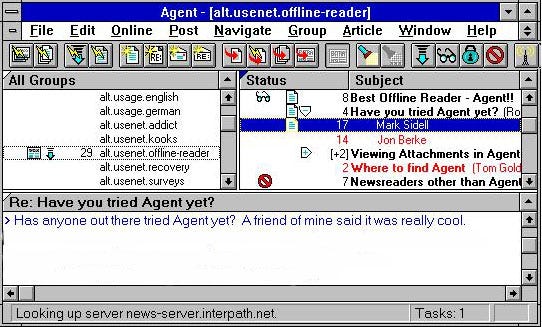
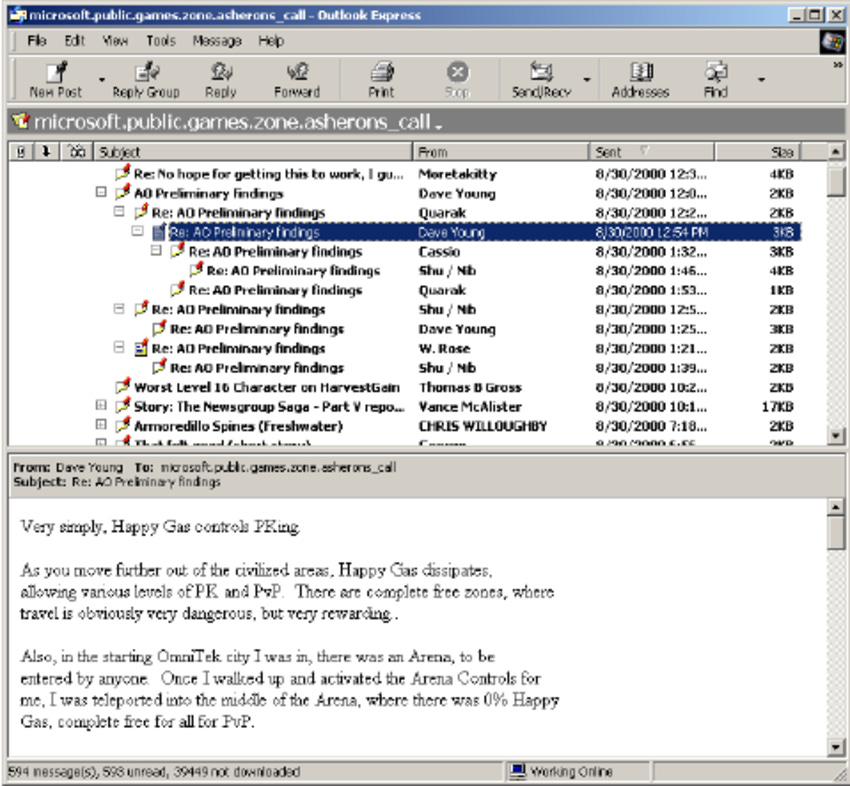
The MCR guys might have been using any of these options: the point of Usenet was its easy accessibility and wide reach.
The software architecture that made it accessible, however, also made it difficult to archive. Because of the distributed way it operated, with messages being propagated throughout the system from server to server, clients/users might receive different versions of newsfeeds, depending on how they were accessing it.
There is no one canonical version of Usenet’s history. For many years, users had the comfort of knowing that their posts were not being archived—depending on the server you used and data costs, your posts would be gone days or weeks after you made them. When a company called Deja News announced in 1995 that it had developed a searchable archive of the last few years of Usenet postings, and would be archiving posts going forward, there was widespread outcry: under pressure from users, Deja introduced ways to retroactively delete or “nuke” one’s own posts from the archive, as well as methods to prevent new posts from being archived at all.
The reason we can read Gerard Way’s vomit fetish posts today, and other historically important Usenet posts (like Steven Moffat’s fanboy posts in rec.arts.drwho) is thanks to services like Deja News, various academic archivists, and later, Google, which acquired Deja, plus a scattering of other incomplete archives, to form a searchable Usenet interface as part of Google Groups in 2001. In 2024 Google sunsetted the ability to post to Usenet via its Groups interface, but the existing archive going back to 1981 remains searchable.
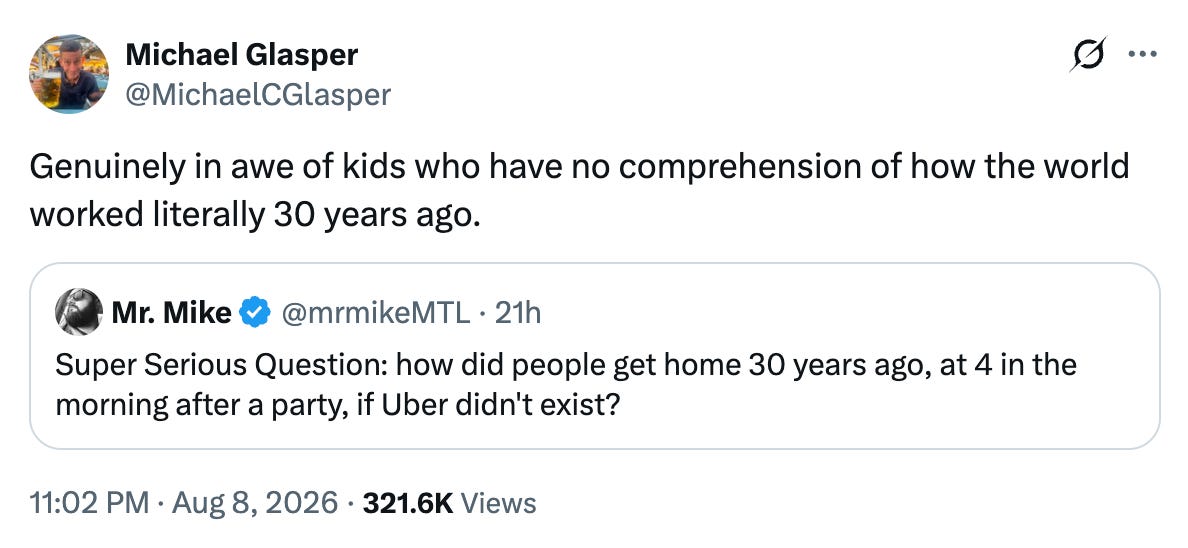
Reading fanfiction that is supposed to be set in the 2000s, I often see references to characters using Uber, Google Maps, GrubHub, YouTube, and other mundane features of contemporary technological life that were not available, let alone ubiquitous, until years later. I’m fascinated by these slip-ups from Gen Z fans and what they reveal about the generation currently coming of age as creatives.
Apart from groundbreaking advances in AI, our digital landscape has changed so little since the mid-2010s that people who have grown up entirely within the social media/app era seem to sometimes have a hard time imagining the subtle differences of A Time Before.
Is this a symptom of stuck culture? Or does every generation struggle with this kind of imaginative backwards-projection? Does it even really matter at all that zoomers don’t know what Usenet is, or that there were no apps on phones before the iPhone? Is this just pure pedantry on my part disguised as snooty disapproval? I’m pretty sure it’s the latter. Every generation goes through something like this, but it’s happening to me for the first time so I can’t help but find it interesting.
The internet circa the late 90s and early 2000s is now Historical with a capital H. The way it is getting remembered—with once-popular services like Usenet being almost totally memoryholed—speaks to the fleeting nature of that transitional period and its uneven impact on cultural memory as it exists downstream of popular media.
As young people start being interested in stories about the era that immediately preceded the one they live in, they will begin exploring those eras in their art, and what they get wrong versus what they get right will say more about how we live now than how we lived then. Gen Z might have seen Hackers, The Matrix, and You’ve Got Mail; but they don’t remember Usenet or MUDs or how expensive texting used to be. This stuff is interesting/relevant to a vanishingly small number of people; I am an outlier who should not be counted.
Another outlier is Kane Parsons, whose Backrooms stood out as a loving study of the early 90s as a long-gone historical era by someone who had never actually lived through it. Though its plot and mythology relied on the analog horror of a terrifying physical space, with the 1990s internet not appearing at all in the film, Parsons’ fascination with the aesthetics and technological trappings of that era are on clear display.
Interpreted as a critique of AI by many viewers, Backrooms (and to an even larger degree Parsons’ other works on his YouTube channel including The Longest View and People Still Live Here) deals with memory, technology, and the sensory realities of a bygone era. Parsons seems to have a clear-eyed understanding of how the seeds of the technologies that are tearing up our social fabric in the 2020s were planted during the optimistic 1990s, by characters like Mark Duplass’s Phil, an employee of the shadowy company Async, who seems to know as little about the mechanics of the place as the clueless protagonists but is eager to continue exploring and exploiting them.
As proven by the wealth of hilarious and heartwarming posts dug up by online MCRchivists, Usenet—and Google’s persistent searchable archive of it—is a valuable resource for students of the culture of a bygone era, and will only continue to be more and more valuable as that era recedes into the distance.
But metaphorical representations of technology like the Backrooms (and like the Matrix, and the lightscape from Tron, and the upcoming retrofuturistic cyberspace from Apple TV’s upcoming adaptation of Neuromancer) will by their nature have much more of a lasting impact in future generations’ collective consciousness than the actual interfaces and short-lived digital curiosities that users gathered on during the all-too-quick adolescence of the internet.
Speaking of early 2000s aesthetics…
If you’re up in Edinburgh for the festival, please come check out one or (preferably) all of the amazing shows I’m involved with this year: The Passion of Mr. Cardboard, Hudson Hughes: At Your Service, and of course Stamptown!
No posts
Comments
Nothing yet. Say the first thing.
Sign in to join the conversation.