
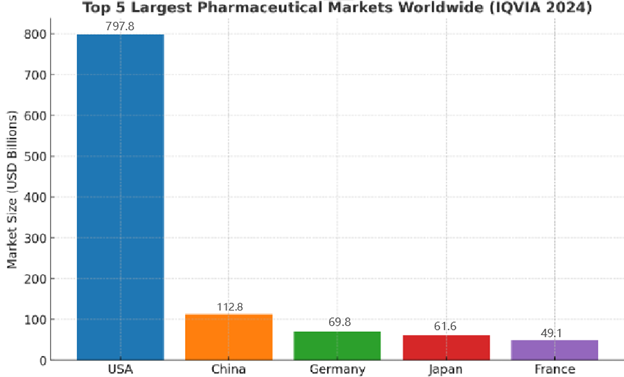
Source: IQVIA
On September 26, 2025, U.S. President Donald Trump used a social media post to announce a sweeping tariff package that includes a 100% duty on branded or patented pharmaceutical imports effective October 1 unless companies can demonstrate they are building U.S. manufacturing capacity.
Shares of pharmaceutical giants such as Eli Lilly, AstraZeneca, and GSK rose slightly despite the potential impact on the world’s largest pharmaceutical market valued at $797.8 billion. They have all announced plans to build in the U.S. in recent months. A Wall Street Journal calculation of domestic investment pledges from roughly a dozen drug companies covering manufacturing, research, and development is estimated at $350 billion.
U.S. President Donald Trump’s 62-word announcement contained few details, as have his other tariff announcements. Since then, Pfizer has secured a three-year grace period on pharmaceutical imports by committing to pricing any new medications in the U.S. at a most favored nation (MFN) cost point aligned with prices in other key developed markets, while the company spends an additional $70 billion on onshore production and R&D “in the next few years.” This could be a ‘roadmap’ to follow for other pharmaceutical giants.
Meanwhile, John Crowley, the CEO of industry group Biotechnology Innovation Organization, highlighted that the directive to have “shovels in the ground” by Oct. 1 would “devastate” over 3,000 U.S. small and medium-sized biotech companies. These companies’ upcoming innovative drug launches within the U.S. might also be affected, as most of them do not have access to the significant capital needed to immediately establish domestic manufacturing.
Amid the ongoing uncertainty, this move has immediate implications for how PR teams should frame their companies’ or clients’ responses in the upcoming weeks and months. It is likely to be a stress test of supply-chain narratives, reputational capital, and the credibility of investment claims. Below are pre-emptive and actionable steps to protect reputation and preserve market access.
Frame the narrative before others do
Media are likely to instinctively frame the story as “world’s largest pharmaceutical market access in return for domestic jobs” or “Pharma greed vs. patient access.” Pharmaceutical companies should prioritise telling a different and emotionally resonant story: one that places patients first, highlights collaborative investments in local capacity, and connects R&D partnerships to public-health outcomes. Use the Five Ws to frame this story: Who benefits (patients, hospitals), What is at stake (continuity of supply), Where investment is happening (U.S., EU, APAC sites), Why the company chooses on-shoring or partnerships, and How patient safety and affordability will be preserved.
It is also a great idea to anticipate and draft responses for predictable accusations: “circumventing tariffs,” “price arbitrage,” and even nationalist rhetoric. Train spokespeople to pivot to patients, investment, cost-quality-innovation considerations based on the refreshed narrative as indicated above. As far as possible, avoid defensiveness and use evidence and empathy.
Numbers, cadence and actions
As this story progresses, journalists are likely to fact-check promises, starting with the pharmaceutical giants. If a pharmaceutical company says, “we’re building in the U.S.,” have verifiable proof ready: permits, timelines, capital expenditure, contractor names, and local community commitments. Publish a concise data pack, with job projections, third-party audit summaries, and put it on a public microsite. Empty pledges are probably worse than silence.
If a firm decides to accelerate U.S. capacity or R&D centers, announce in measured stages: announce in measured stages: memorandum of understanding → permitting milestone → ground-breaking → hiring targets. Providing numbers, maintaining cadence and sustained actions help build a track record. The stakes are high because your competitors, such as mid-sized pharmaceutical companies, are likely to join pharmaceutical giants in building in the U.S. This investment spree is not only a market signal but also a reputational benchmark: if a pharmaceutical company is not visibly committing, it risks being labeled as a laggard or an opportunist.
Plan licensing and partnership PR, not just IR
Though Chinese biotech innovators rely on licensing deals rather than direct exports, it’s too soon to breathe easy. Chinese drugmakers have begun rolling out experimental therapies and inking multibillion-dollar licensing agreements to take the products worldwide. From 2021 to 2024, those deals nearly quadrupled.
A slew of regulatory risks from Washington persists for an industry that simultaneously enjoys a deeply interdependent relationship with its American partners while also being seen as an existential threat. These Chinese biotech innovators should expect increased scrutiny of cross-border licensing clauses and pricing terms, and proactively craft partner-friendly messages that go beyond IR-centric messaging to highlight alignment with local communities, pricing expectations and health system goals.
Final thoughts
In the meantime, avoid exaggerated claims about your company or client’s “U.S. supply chain” unless you can prove it. PR that prioritizes short-term headlines over long-term trust will cost more than any tariff. Commit to transparency, measure impact honestly, and document progress. Do that well, and you can reframe a protectionist shock into credibility gains. The alternative is reactive defensiveness, and that’s a narrative no company wins.
About the author
JX (Jaxon) Tan founded Momentum AI Communications, a boutique PR consultancy based in Singapore, with a mission to simplify science and spark engagement. He was previously based in China, where he led international communications for BGI Genomics and was head of content (APAC) for PR Newswire. Reach him on LinkedIn.
Comments
Nothing yet. Say the first thing.
Sign in to join the conversation.