
Several readers have suggested that I write about Norges Bank’s interest rate decisions. To interpret those decisions, it helps first to understand the framework within which they are made. Norway’s monetary policy framework is conventional in its broad objectives but distinctive in several important respects. This post reviews that framework. In a future post I will examine how the Bank applies it in practice.
Norway adopted inflation targeting in March 2001, replacing its previous exchange-rate-based monetary regime. At the same time, the government introduced the fiscal rule governing the use of petroleum revenues. Together, the two reforms established the macroeconomic framework that still exists today. Fiscal policy would smooth the use of oil wealth over time, while monetary policy would maintain low and stable inflation.
The original inflation target was 2.5%, but in March 2018 it was reduced to 2%, bringing Norway into line with most other advanced economies. Switzerland remains an exception, with an inflation objective of 0–2%. The target applies to headline consumer price inflation.
In practice, however, Norges Bank places considerable weight on CPI-ATE, a measure of underlying inflation that excludes changes in energy prices and adjusts for changes in indirect taxes. Because electricity prices are highly volatile in Norway, headline inflation can fluctuate sharply even when underlying inflationary pressures have changed little. Financial markets therefore focus primarily on CPI-ATE.
Like most inflation-targeting central banks, Norges Bank sets policy on the basis of forecasts rather than current inflation alone. A distinctive feature of its framework is that it publishes its own projected path for the policy rate. This provides unusually transparent guidance about how the Bank expects policy to evolve if the economy develops broadly as anticipated and helps shape market expectations.
The figure below provides an overview of the macroeconomic environment since inflation targeting was introduced. Inflation has fluctuated widely, particularly during and after the pandemic, while the policy rate has ranged from 7% to zero and subsequently risen above 4%. Unemployment has generally remained low by international standards, although it has increased during periods of weaker economic activity. The figure gives a sense of the conditions under which Norges Bank has conducted monetary policy over the past quarter century.
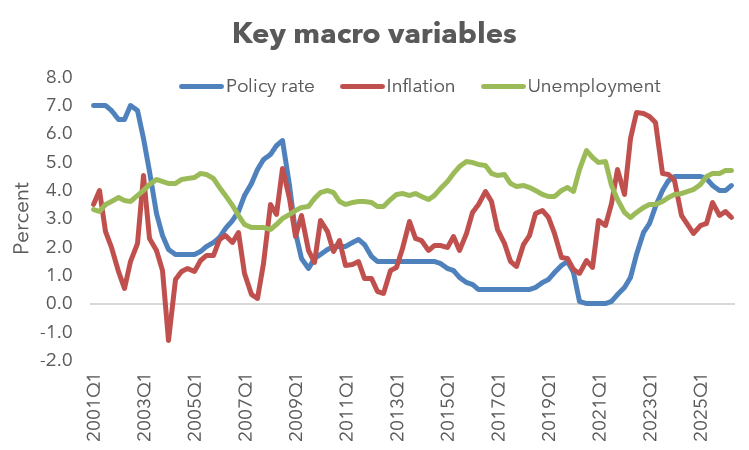
Sources: Norges Bank and Statistics Norway.
Price stability is not, however, the Bank’s only objective. Its mandate also requires monetary policy to contribute to high and stable employment and to counter the build-up of financial imbalances that could threaten economic stability. These objectives do not always point in the same direction. As a result, Norges Bank does not seek to return inflation to target as quickly as possible in every circumstance. Instead, it allows the pace of disinflation to depend on conditions in the labour market and the broader economy.
Employment therefore plays an important role in the Bank’s deliberations. Although monetary policy cannot permanently increase employment above its sustainable level, it can reduce cyclical fluctuations and limit the lasting damage caused by deep recessions.
Financial stability also enters the policy discussion. Macroprudential regulation remains the first line of defence against financial risks, but Norges Bank recognises that prolonged periods of very low interest rates can encourage excessive borrowing and rising asset prices. Monetary policy therefore has a supporting role in safeguarding financial stability.
The Bank has also been cautious about unconventional monetary policies. It has repeatedly argued that negative policy rates involve significant costs and should be reserved for exceptional circumstances. Similarly, it sees only a limited role for large-scale asset purchases or foreign exchange intervention under normal market conditions. The policy rate remains its primary instrument, supported by forward guidance and transparent communication.
Overall, Norges Bank’s framework is conventional in its objectives but pragmatic in its implementation. Inflation is the primary goal, but the Bank explicitly recognises that the appropriate path back to target depends on the outlook for employment and financial stability.
The framework, however, tells us only part of the story. The more interesting question is how the Bank interprets and applies it in practice. That is the subject of a future post.
The views expressed are my own. The work presented is preliminary and may contain errors. It should not be construed as investment advice. Readers are encouraged to seek professional investment guidance.
No posts
Comments
Nothing yet. Say the first thing.
Sign in to join the conversation.