
Summary: Higher energy prices have pushed up headline inflation, but there is little evidence so far that they have spilled over into broader inflation. Until that changes, central banks are likely to remain cautious about tightening monetary policy.
To judge the outlook for monetary policy, it is important to recognise that while higher energy prices have pushed up headline inflation, they have had only a limited impact on inflation excluding energy.
The standard case for central banks responding to higher energy prices rests on two channels. The first is indirect effects, which arise when higher energy costs feed through into the prices of other goods and services, for example, by raising the cost of heating or cooling restaurants they can lead to higher menu prices. The second is second-round effects, which occur when higher energy prices trigger stronger wage growth that, in turn, pushes up broader inflation.
Both channels should be visible in measures of inflation excluding energy. Interestingly, the data from several economies I follow provide little evidence that this is happening. It is, of course, too early for second-round effects driven by wages to have emerged, so the focus at present is on indirect effects.
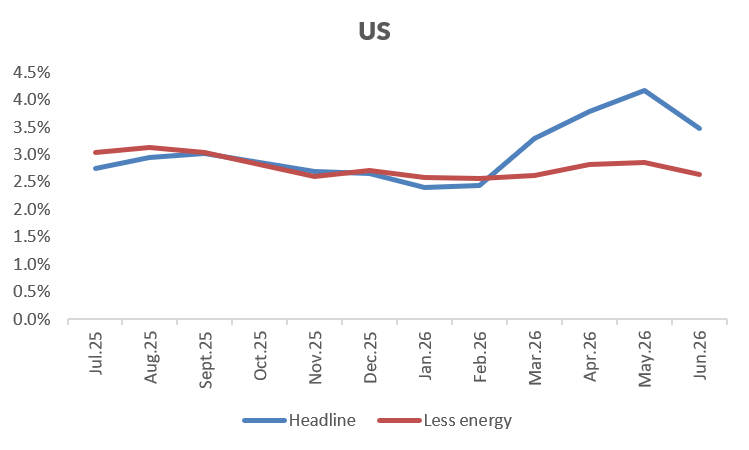
The graph below shows US headline CPI inflation and CPI inflation excluding energy. Headline inflation stands at 3.5%, while inflation excluding energy is 2.6%. Although the latter remains above the Federal Reserve’s objective, it shows little sign of having been affected by the recent rise in energy prices.
Source: FRED
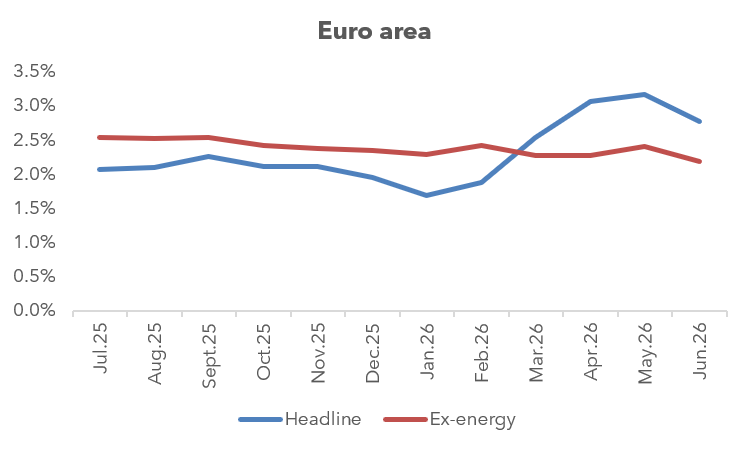
The same is true in the euro area. Headline HICP inflation is 2.8%, while inflation excluding energy is 2.2%, close to the ECB’s 2% objective.
Source: ECB
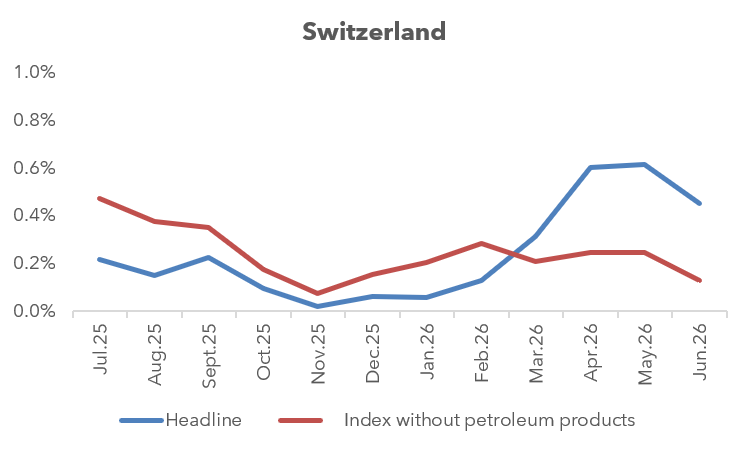
For Switzerland, CPI inflation excluding petroleum products stood at just 0.1% in June, well below headline inflation of 0.5%.
Source: BfS
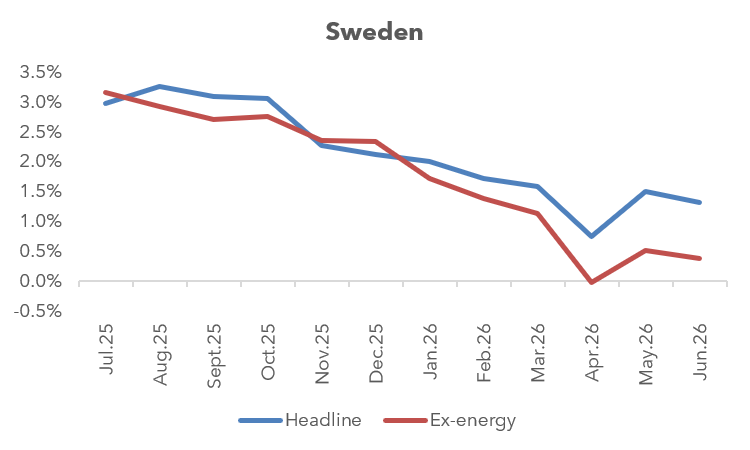
Finally, in Sweden, headline CPIF inflation was 1.3% in June, while CPIF excluding energy was only 0.4%.
Source: SCB
The evidence from this simple comparison is clear. It is entirely possible, and perhaps even likely, that indirect and second-round effects will emerge over time. Nevertheless, until there is evidence that higher energy prices are feeding through into broader inflation, I suspect central banks will be reluctant to tighten monetary policy. I think many policymakers would agree that it is one thing to respond to observed inflation, and quite another to tighten policy in anticipation of inflationary pressures that may never materialise.
The views expressed are my own. The work presented is preliminary and may contain errors. It should not be construed as investment advice. Readers are encouraged to seek professional investment guidance.
No posts
Comments
Nothing yet. Say the first thing.
Sign in to join the conversation.