
Summary: A simple reaction function suggests that Norges Bank adjusts interest rates in response to both the real interest rate and labour market conditions, but changes are implemented gradually. The average equilibrium real interest rate in Norway is close to zero, implying a neutral nominal policy rate of around 2% when inflation is on target.
In an earlier post, I reviewed Norges Bank’s monetary policy framework. The natural next question is how the Bank sets interest rates. Which macroeconomic variables matter? How quickly does it respond to changes in the economy? And what level of the real policy rate appears to be consistent with stable inflation over the longer run?
To answer these questions, I estimate a simple reaction function. The model reflects four key features of Norges Bank’s policy framework. The policy instrument is the policy rate. Inflation is measured by the CPI-ATE, the Bank’s preferred measure of underlying inflation, while labour market conditions are captured by the unemployment rate. Finally, the model allows for the fact that Norges Bank generally changes interest rates gradually.
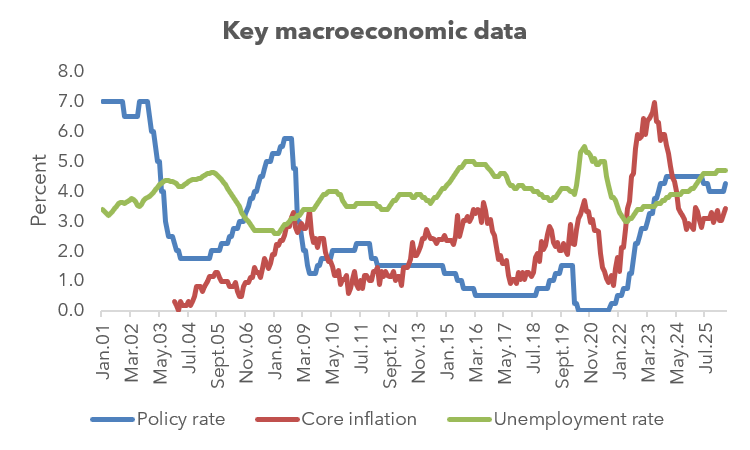
The graph below shows the policy rate, core inflation (available from December 2003 onwards) and the unemployment rate.
Sources: Norges Bank and Statistics Norway
The data reveal several monetary policy cycles before the current episode. The tightening of the mid-2000s was followed by aggressive easing during the global financial crisis. Rates were then raised again before the collapse in oil prices between 2014 and 2016—from around USD 110 to USD 30 per barrel—led to another round of cuts, which was followed by the pandemic, when the policy rate was reduced to zero.
The current cycle is different. Core inflation rose to around 7% in 2023, the highest level since inflation targeting was introduced, prompting the largest and steepest tightening cycle Norges Bank has undertaken under the current monetary policy regime.
Inflation has since fallen substantially but remains above the 2% target adopted in 2018. At the same time, unemployment has risen to its highest sustained level outside the pandemic, suggesting that the labour market is now bearing an increasing share of the adjustment.
Next, I turn to the reaction function, which summarises how Norges Bank adjusts the policy rate in response to economic conditions. The model assumes that changes in the policy rate depend on the level of the real policy rate, labour market slack and the previous policy rate change, which captures gradual interest rate adjustment. Formally, letting i denote the nominal policy rate, r the real policy rate (the nominal rate less core inflation), u the unemployment rate measured relative to its sample average, and z the change in the policy rate at the previous policy meeting, the estimated reaction function is
Δi(t) = a + b·r(t-1) + g·u(t-1) + h·z(t) + v(t)
The equilibrium real interest rate is given by:
r* = -a/b
The equation is estimated using data from months in which Norges Bank held a monetary policy meeting. The sample begins in 2010, since the relationship appears unstable during the global financial crisis, and ends in June 2026.1
The reaction function summarises Norges Bank’s average behaviour over this period. As such, it provides a useful benchmark for understanding the Bank’s policy decisions rather than a mechanical rule for predicting future interest-rate changes.
As a first step, I estimated separate coefficients on the lagged nominal policy rate and lagged core inflation. The estimates are almost identical in magnitude, opposite in sign and both highly significant. This strongly suggests that it is the lagged real policy rate, rather than its two components separately, that influences policy decisions.
The estimated coefficients are as follows: the constant is −0.003, the coefficient on the lagged real policy rate is −0.032, the coefficient on unemployment is −0.104, and the coefficient on the previous policy rate change is 0.175. All coefficients except the constant are highly statistically significant.
The implied estimate of the equilibrium real interest rate is 0.120%, with a standard error of 0.387 percentage points. Although the estimate is imprecise, it suggests that Norway’s equilibrium real interest rate is close to zero.
Overall, these results suggest that Norges Bank behaves as its monetary policy framework would lead one to expect. Interest rate changes are influenced by inflation and labour market conditions, but interest rates are adjusted only gradually from one meeting to the next. The estimated equilibrium real policy rate is close to zero, implying that a nominal policy rate of around 2% would be consistent with inflation at target over the longer run. This estimate is uncertain but provides a useful benchmark for assessing whether policy is broadly expansionary, neutral or contractionary.
The views expressed are my own. The work presented is preliminary and may contain errors. It should not be construed as investment advice. Readers are encouraged to seek professional investment guidance.
I drop the observations for Dec 2011 and March 2020 where there are large outliers.
No posts
Comments
Nothing yet. Say the first thing.
Sign in to join the conversation.