
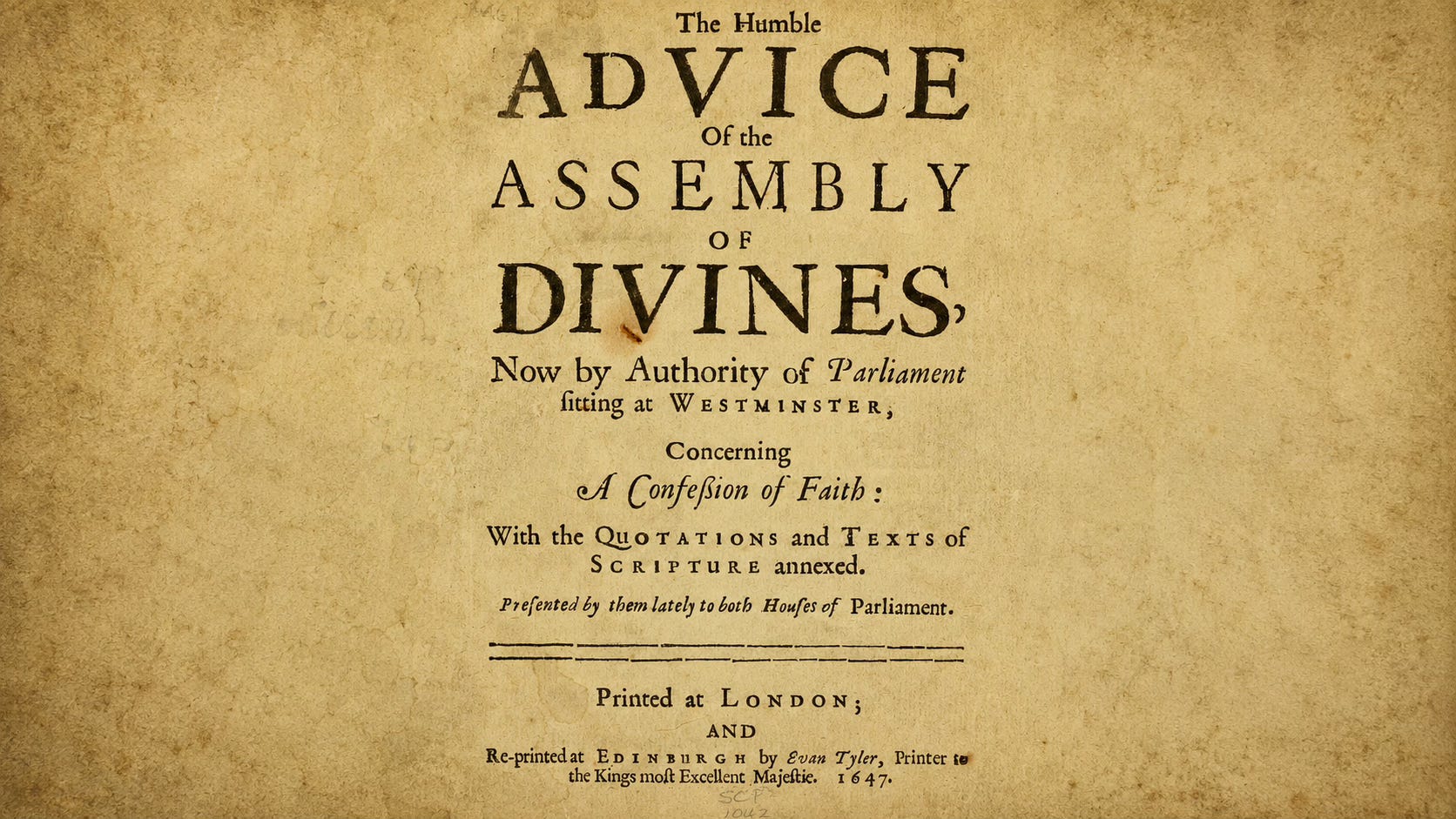
The Presbyterian Church in America’s (PCA) Ad Interim Committee on Christian Nationalism was given a narrow mandate: define the constitutional boundaries, offer pastoral guidance, and let the courts of the church do the rest.
The result is a careful, fair, and genuinely pastoral document. The committee drew a constitutional line between positions compatible with the PCA’s 1788 Westminster Standards and those that aren’t, distinguished among the spectrum of views traveling under the “Christian Nationalism” label, and offered gracious guidance for pastors navigating charged conversations. It did its job well.
But a report on the quest for power that never names the driving impulse leaves the anthropological root untouched. The committee identified symptoms with care. The disease runs deeper.
The committee distinguishes several positions along the Christian Nationalism spectrum. At one end sits the “General Influence” position — Christians engaging in civic life, voting according to conscience, advocating for policies consonant with natural law. Fully constitutional. No exception required.
At the other end sits the “Establishment” position — the view that the civil magistrate has a duty to suppress heresies, establish true religion by law, reform the church when it falls into corruption, and call ecclesiastical synods. This was the dominant position of the Westminster Divines in 1646. Calvin held it. Knox held it. Rutherford and Gillespie held it.
The American Presbyterians of 1788 rejected it. Their revised Confession states that the magistrate may not “in the least, interfere in matters of faith.” The PCA subscribes to the 1788 text. An officer who holds the Establishment position is out of accord with the Standards and must declare it.
The committee carefully notes that the 1646 position is not heterodox, not sub-Christian, not outside the Reformed tradition. It’s simply incompatible with what PCA officers vow to uphold.
Stephen Wolfe’s The Case for Christian Nationalism (2022) is the most prominent recent defense of the Establishment position — arguing for a confessional Christian state grounded in ethnic and cultural affinity. The PCA report, without naming Wolfe directly, draws constitutional lines that exclude the core of his argument.
The committee’s mandate was constitutional and pastoral, not anthropological. But one question lingers: why does the drive to coerce religious conformity through civil power keep recurring across centuries and traditions? Why does the church, in season and out, reach for the magistrate’s sword?
Augustine named it in the fifth century. In City of God, he called it the libido dominandi — the lust to dominate. The earthly city is constituted by love of self and contempt of God; its defining characteristic is the love of ruling. The heavenly city advances not through coercion but through witness, service, and sacrifice.
The Establishment position, whatever its theological pedigree, maps neatly onto the earthly city’s operating logic: we know what true religion is, we have access to the levers of civil power, therefore we are obligated to use them. The argument sounds like fidelity. It is rooted in pride.
Tim Alberta documented this dynamic in The Kingdom, the Power, and the Glory (2023) — a journalist’s portrait of libido dominandi without the Augustinian vocabulary. He found evangelical leaders who convinced their congregations that preserving Christian values required abandoning them. Russell Moore saw it from closer range, driven out of the Southern Baptist Convention for declining to perform the required rituals of partisan loyalty. His prescription in Losing Our Religion (2023): lean into the church’s strangeness, make no compromises for political influence, trust that people can tell the difference between an invitation to know Christ and just another group vying for earthly power.
Both books are valuable. What neither quite supplies is an answer to the deeper question: why does it work? Why do people formed by Scripture, steeped in the theology of the cross, find raw coercive power so irresistible?
Augustine had the answer. The lust for power tempts followers as well as rulers — with the false confidence that a Goliath is on their side, a fierce combatant who takes off the gloves. The PCA report’s own Pastoral Letter names “cruelty, belittling and disrespectful speech, contempt for those with whom we may differ” as violations of Christian witness. Robert Jeffress, pastor of First Baptist Dallas and one of Trump's most prominent evangelical supporters, made the logic explicit in a 2016 NPR interview: "I don't want some meek and mild leader or somebody who's going to turn the other cheek. I've said I want the meanest, toughest SOB I can find to protect this nation."
When a candidate’s appeal rests substantially on his eagerness to humiliate opponents, his contempt for weakness, and his explicit promises to wield power against his enemies — and a large share of his most enthusiastic supporters identify as evangelical Christians — something ugly is at work. Christians who had credible alternatives available nonetheless returned to the same choice, justifying it in pragmatic terms: he fights, he gets things done, he’s not afraid of them. Augustine would recognize the rationalization. The earthly city always prefers strength to virtue when the two come apart. What’s striking is how many citizens of the heavenly city made the same calculation, and how rarely the church named it for what it was.
But we were warned. From Eden, where Satan promised “ye shall be as gods,” to the wilderness, where he offered Christ dominion over every kingdom on earth, the pattern is consistent: the enemy’s preferred weapon is the promise of power. The Psalmist was direct: “Some trust in chariots, and some in horses; but we will remember the name of the Lord our God” (Psalm 20:7). Zechariah heard the same word from God: “Not by might, nor by power, but by My Spirit, says the Lord of hosts” (Zechariah 4:6). The lesson ought to be that whenever someone shows up promising Christians power, we should run for the hills. Many of our brothers and sisters found it hard to resist.
There is a practical problem with the Establishment position that its proponents rarely address with sufficient candor: if the civil magistrate is to enforce true religion, someone must first determine what true religion is. That determination requires an authority higher than the magistrate himself. History offers no encouraging examples of what happens next.
The Westminster Divines who wrote the 1646 Confession were Presbyterians. The Anglicans who rejected their work had their own establishment and their own magistrate to enforce it. The Puritans who fled Anglican coercion to New England promptly banished Roger Williams, executed Mary Dyer, and drove the Baptists out of Massachusetts Bay. Calvin’s Geneva was not Luther’s Wittenberg. Every Christian establishment in history has resolved the “which orthodoxy?” problem the same way: whoever wields the sword names the terms.
Wolfe anticipates this objection and answers with an appeal to “mere Christianity” — a broad moral consensus that can underwrite civil order without requiring the magistrate to adjudicate denominational disputes. In practice, “mere Christianity” has never stayed mere for long. The boundaries of acceptable belief contract reliably toward the convictions of whoever holds power. This is not a contingent historical observation. It follows from what Augustine understood about fallen human nature: the man wielding the sword of orthodoxy is subject to the same libido dominandi as any other ruler, amplified now by the conviction that God is on his side.
Calvin himself saw it clearly. Writing in the Institutes (4.8.1): “If we concede unreservedly to men all the power which they think proper to assume, it is easy to see how soon it will degenerate into a tyranny which is altogether alien from the Church of Christ.” He argued that church authority belongs to the office, not the person — it is Christ’s, mediated through His Word. If that principle guards against tyranny within the church, how much more dangerous is the same unchecked authority wielded by the state on behalf of the church? The magistrate enforcing orthodoxy answers to no Scripture. He answers to his own judgment about what Scripture requires.
The Establishment position requires a degree of certainty about one’s own theological correctness that ought to give any serious Christian pause. Confirmation bias, the tendency to exaggerate our own wisdom, the well-documented human capacity to mistake our preferences for divine mandate — these are not errors that afflict other people. They are structural features of fallen minds, including Reformed ones. The man confident enough to summon the magistrate’s authority against heresy has, by definition, stopped asking whether he might be wrong.
That’s not confessional fidelity. It’s pride in a Geneva gown.
The committee’s report has one conspicuous absence: the wilderness temptation.
In Matthew 4 and Luke 4, the devil offers Jesus the kingdoms of the world — the ultimate Establishment proposition. Jesus refused. He had come to accomplish restoration through submission and humility, not domination. The cross, not the throne. Not yet.
This is the paradigm. The Son of God, to whom all authority in heaven and on earth would ultimately be given, refused the shortcut. God’s way is the opposite of Satan’s. Jesus chose the slow, costly, apparently foolish path of service, suffering, and sacrifice — and changed the world more thoroughly than all of history’s emperors combined.
Our fallen impulse is impatience with God's way. We imagine His plan needs our help, then reach for exactly the tools He warned us against. The PCA report closes with Psalm 146:3: “Put not your trust in princes, in whom there is no salvation.” The committee meant it as a caution against political over-investment. It applies with equal force to the Establishment position itself.
The committee’s Pastoral Letter calls the church to “heartfelt grief and repentance for our worldliness and many divisions” and a “fresh endowment of the Holy Spirit.” That’s not a constitutional observation. It’s a plea for humility — and it’s the proper remedy.
The early church had no magistrates, no establishment, no coercive power. It heeded the heavenly call to love its neighbors, care for the poor, honor women and children in a culture that didn’t, and die with dignity when required. Within three centuries it had revolutionized the Roman Empire — not by conquering it but by transforming it. It only took a handful of humble Galileans to change the world.
The libido dominandi promises cultural restoration, but it delivers tyranny. Humility leads to genuine transformation— slowly, invisibly, without the satisfactions of dominance, and on a timeline we don’t control. The Kingdom of God, brought to earth.
The sickness is pride. The committee drew the constitutional lines correctly. The cure is humility, for His strength is made perfect through our weakness.
It is the only way.
Thanks for reading The Mind's Mirror! This post is public so feel free to share it.
Steven J. Willing, MD, is a neuroradiologist and the author of Superbia: The Perils of Pride, The Power of Humility.
No posts
Comments
Nothing yet. Say the first thing.
Sign in to join the conversation.