

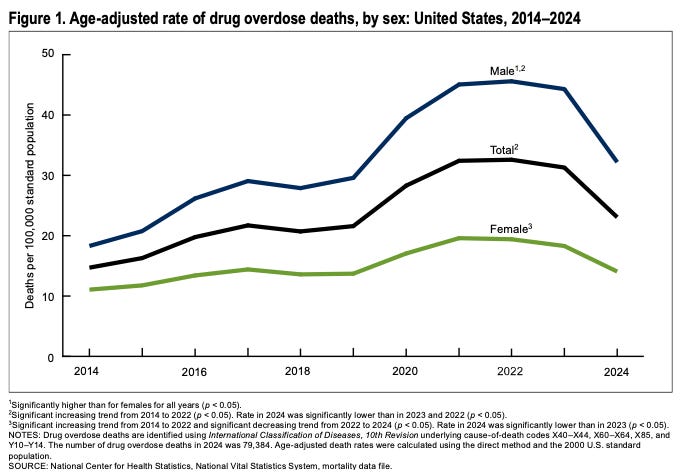
America is still living with the wreckage of an opiate epidemic. Nearly 80,000 Americans died from drug overdoses in 2024 alone—more than quadruple the rate in 1999.¹ And that’s still down from the 2021 peak. The drugs have migrated since the crisis first captured national attention, the center of gravity moving from prescription pills to illicit fentanyl, but the underlying story hasn’t changed: a catastrophic failure of belief, dressed up as medicine.
The tragic arc of that failure was documented by investigative journalist Sam Quinones in his 2015 work Dreamland: The True Tale of America’s Opiate Epidemic.² The cast includes Mexican laborers, suburban housewives, and executives of multinational pharmaceutical corporations. But the most sobering element is this: the American medical community bears substantial responsibility for what happened. Physicians—trained, credentialed, and well-intentioned—erred communally, at scale, with lethal results.
This is a story about four forces that can corrupt belief even among the educated: information cascade, confirmation bias, moral grandstanding, and economic self-interest. The opioid crisis didn’t just kill people. It illustrated, in the starkest possible terms, what happens when we confuse consensus for truth.
For most of medical history, the received wisdom was straightforward: opiates are addictive. Use them carefully.
That began to change in the early 1990s, when a movement to treat pain more aggressively gained traction in academic medicine. Driving it was a powerful new claim—that addiction from prescribed opiates was, in fact, quite rare. The problem is that there was never any real evidence for this. What there was, instead, was a five-sentence letter to the editor.
Published in the New England Journal of Medicine in 1980, the letter noted that new addictions seemed rare among hospitalized patients receiving low doses under direct supervision with no prior history of addiction.³ That’s a very narrow observation. It was not a clinical study. It was not a controlled trial. It was a letter.
Yet it was cited. Then those citations were cited. Then those were cited. By early 2017, over 400 scientific papers had referenced this letter as evidence that addiction from prescribed opiates was rare.⁴ Physicians were not evaluating the evidence; they were deferring to what other experts said, who were themselves deferring to earlier opinions, which ultimately traced back to a paragraph in a journal’s correspondence section.
Information cascade: When experts think like dominos
This is an information cascade: a self-reinforcing chain of authority, mistaken for evidence. Almost no one, it seems, had actually read the original source. Between 1999 and 2017, approximately 218,000 Americans died from prescription opioids, while the annual fatality rate rose 400 percent.⁵
During my training and early years of practice, the prevailing view was still cautious: narcotics carry real addiction risk; prescribe accordingly. That wasn’t based on hard data. But the steady stream of addicts cycling through the healthcare system left little room for doubt.
Then the paradigm shifted—and frankly, many found it liberating. Liberal prescribing took less time. Patients left satisfied. The new consensus removed the burden of restraint.
But how to justify it scientifically? Confirmation bias did the work. If a physician wanted permission to prescribe freely, the proliferating literature—however circular its origins—provided the cover. Faulty evidence, if a person genuinely wants to believe it, functions as adequate evidence.
Confirmation bias: “All the evidence is on my side”
Disconfirmation bias: “Since I know I’m right, your evidence is bunk”
What about all the addicts? Disconfirmation bias handled that. The argument emerged that opiates didn’t cause addiction; rather, people already predisposed to addiction simply sought out the opiates. It was a false dilemma between two partial truths—which is precisely what made it so persuasive. It wasn’t obviously wrong. It just happened to be convenient.
The ideological fuel for the epidemic was a moral reframing: too many patients were suffering unnecessarily. If addiction was rare and narcotics were safe, then withholding them wasn’t caution—it was cruelty.
Interns and residents were taught that these drugs were now not addictive, that doctors thus had a mission, a duty, to use them.⁶
Once framed as a duty, the stage was set for what might be called competitive compassion. Health systems and physicians began signaling their commitment to pain relief. By 1998, over a thousand multidisciplinary pain clinics had been established.⁷ They disappeared nearly as quickly, rendered obsolete when narcotics alone were deemed sufficient. Accreditation agencies began requiring documentation that pain was being adequately treated—which, in practice, meant more prescriptions.
The virtuous consensus had metastasized into institutional pressure.
At the center of the prescription drug crisis was a single product: OxyContin, a slow-release oxycodone preparation developed by Purdue Pharma and owned by the Sackler family.
Upon its release in 1996, Purdue launched an aggressive marketing campaign promoting OxyContin as both effective and essentially safe.⁸ Eleven years later, Purdue Pharma pled guilty to misrepresenting the drug’s abuse potential and was fined over $600 million.⁹
Then there were the complicit physicians—running prescription mills in communities with few other options, trading safety for revenue. In April 2019, a federal crackdown charged sixty healthcare providers in rural Appalachia with illegal narcotics distribution.¹⁰ Thirty-two million pain pills. At least five patient deaths.
Some will say: what does belief have to do with people who simply chose profit over patients? Perhaps nothing, in the case of genuine sociopaths. But that is a one-dimensional reading of human nature. Most of us are not capable of sustained, conscious evil—we require a plausible narrative first. Inside each of us is a highly efficient excuse factory, manufacturing beliefs that align with our interests. The ancient observation holds:
Every way of a man is right in his own eyes. — Proverbs 21:2 (KJV)
Most of the people who caused this probably believed, in some functional sense, that they were not doing wrong.
The specific drug has changed. Illicit fentanyl has largely displaced prescription opioids as the primary driver of overdose deaths. The crisis has moved into a different phase. But none of that touches the argument, because the argument was never about OxyContin—it was about how intelligent, credentialed people can build a catastrophic false consensus and then defend it against all evidence.
The warning signs are not subtle, in retrospect: emotional investment in a particular conclusion; moral framing that makes dissent feel like cruelty; peer pressure masquerading as evidence; financial interests that benefit from belief. When all four are present, skepticism is warranted regardless of the credentials of the people involved.
Silence was complicity then. Speaking against the consensus required courage and carried professional costs. Sometimes that is still the price of intellectual honesty.
Beliefs have consequences. Wrong beliefs have worse consequences. Intellectual humility is not a sign of weakness in one’s convictions; it is the precondition for getting anything right.
After all—just because we think something doesn’t mean it’s true.
¹ Centers for Disease Control and Prevention, “Drug Overdose Deaths in the United States, 2001–2021,” NCHS Data Brief No. 457 (December 2022).
² Sam Quinones, Dreamland: The True Tale of America’s Opiate Epidemic (New York: Bloomsbury Press, 2015).
³ Jane Porter and Hershel Jick, “Addiction Rare in Patients Treated with Narcotics,” New England Journal of Medicine302, no. 123 (January 10, 1980), doi:10.1056/NEJM198001103020221.
⁴ Pamela T. M. Leung et al., “A 1980 Letter on the Risk of Opioid Addiction,” New England Journal of Medicine 376 (June 1, 2017): 2194–95, doi:10.1056/NEJMc1700150.
⁵ Centers for Disease Control and Prevention, “Opioid Overdose: Understanding the Epidemic,” last reviewed August 2023, https://www.cdc.gov/drugoverdose/epidemic/index.html.
⁶ Quinones, Dreamland, 95.
⁷ Quinones, 109.
⁸ Quinones, 127.
⁹ Barry Meier, “Origins of an Epidemic: Purdue Pharma Knew Its Opioids Were Widely Abused,” New York Times, May 29, 2018.
¹⁰ Terry DeMio, Dan Horn, and Kevin Grasha, “Ohio, Kentucky Doctors among 60 Charged in Pain Pill Bust,” Cincinnati Enquirer, April 17, 2019.
Thanks for reading The Mind's Mirror! This post is public so feel free to share it.
No posts
Comments
Nothing yet. Say the first thing.
Sign in to join the conversation.