
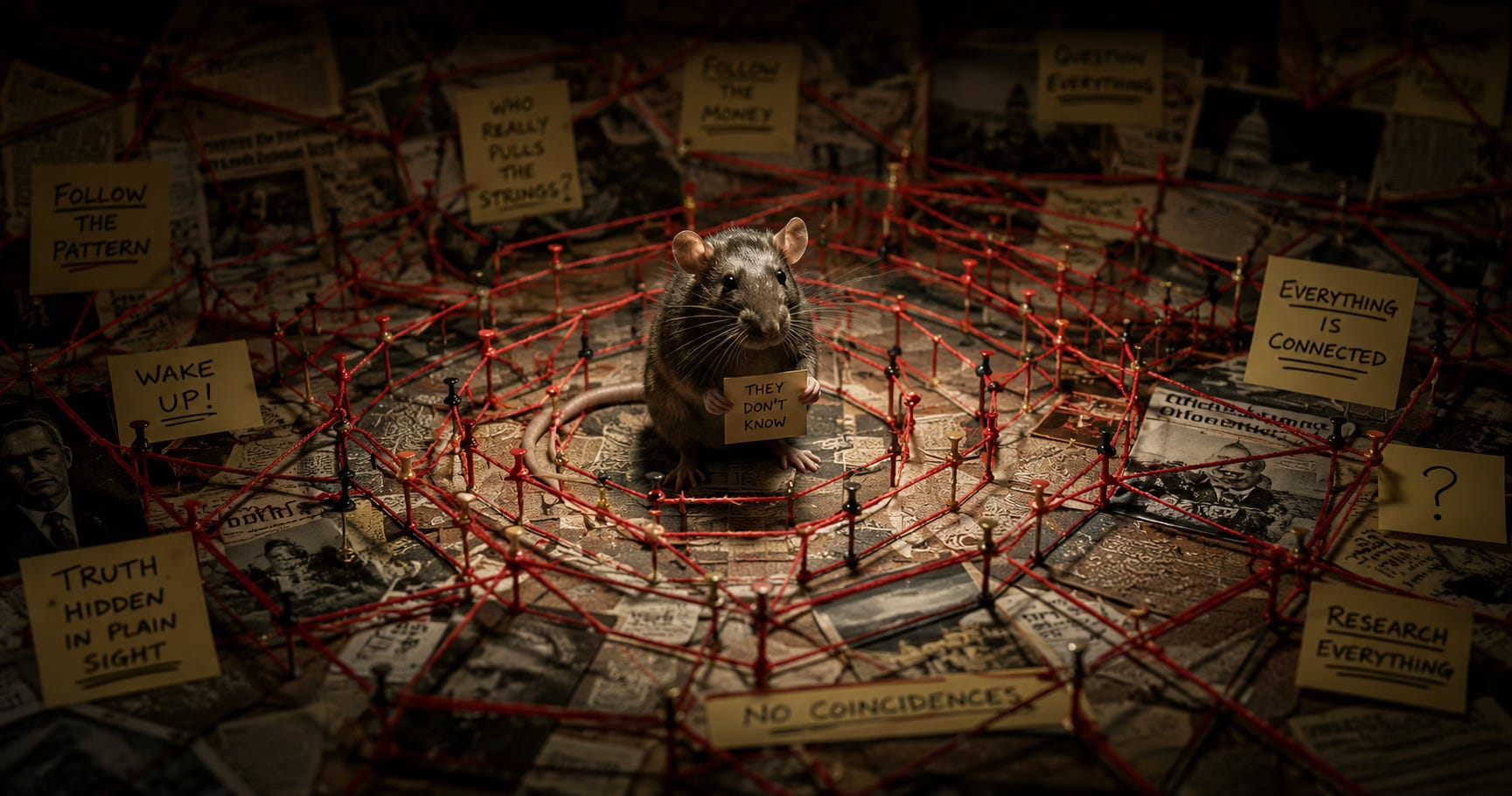
“You can’t handle the truth!”
Colonel Jessup’s famous witness-stand eruption became a rallying cry for a certain kind of person — the one who believes he alone has the courage to face what others refuse to see. Delivered with ferocious conviction by Jack Nicholson, it hammers a wedge between truth and comfortable illusion. And of course we all know which side we’re on.
What most people overlook is that Colonel Jessup was lying — to the court, to the camera, and most fatally, to himself. He was a courageous officer with a distinguished career. He was also a vindictive bully who moved heaven and earth to suppress the truth about his own culpability in a man’s death.
The fall of humanity began with an assault on truth. It sometimes feels that assault has never been more relentless. Among followers of Christ, this should be obvious: we watch the secular culture deny the humanity of the unborn, the biological reality of sex, the plain facts of history. Our reaction might range from despair to compassion to mockery, but too often we forget these are lost souls under the dominion of dark spiritual forces.
So what’s our excuse?
Why do so many of our brothers and sisters in Christ commit the same denial of reality they mock in unbelievers?
A disturbing number of professing Christians have been captured by QAnon, anti-vaccination hysteria, unprovable claims of stolen elections, or baroque fantasies about the machinations of tech billionaires. These form a main staple of Facebook comment sections.
Much has been written over the past few years attempting to address this — articles refuting specific conspiracies, others cataloguing the moral implications. Both serve a purpose, and both largely miss the point. Those most captivated by conspiracy theories are the least likely to read the rebuttals, and when they do, they’re looking for ammunition rather than correction.
The real problem isn’t what people believe. It’s why.
Conspiracy theories are not, incidentally, a new problem. After the resurrection, the chief priests conspired with Roman guards to spread the story that the disciples had stolen the body — Matthew 28:11-15. A real conspiracy, manufacturing a fake conspiracy theory about the innocent party. The mechanics haven’t changed much.
This is more nuanced than simply condemning conspiracy theorists as gullible. Many are. But several forces in our mental architecture push all of us in that direction, and intellectual honesty requires acknowledging them.
Curiosity is a gift that can be hijacked. God designed us to seek explanations. The same impulse that drove centuries of scientific discovery also drives us to want to understand why things happen and why people do what they do. Serious inquiry — sociology, forensics, investigative journalism — satisfies that impulse responsibly. Conspiracy theories offer a shortcut into a dead end. They are cocaine for the curious mind. A hundred hours of YouTube videos cannot substitute for years of genuine expertise, but they can produce a convincing feeling of certainty. They may be wildly wrong about the destination, but as a means of “solving” the puzzle, they work — and sometimes provide more emotional satisfaction than the boring truth.
Entertainment recalibrates our sense of the plausible. Over the course of a lifetime, we consume thousands of hours of drama in which some dark conspiracy is almost always underfoot. Kahneman’s “System 2” thinking — slow, deliberate, reflective — might acknowledge these are rare in reality. But we do most of our living in System 1, which is heuristic, fast, and powerfully influenced by what’s easiest to recall. Feed a mind a steady diet of conspiracy narratives and they begin to seem normal. This is not an accident of culture; it’s a predictable consequence of how attention is captured and held.
The information environment is deliberately weaponized. The internet eliminated every old barrier to publication and distribution. Platform algorithms — not designed for deception, but optimized for engagement — discovered that outrage and novelty outperform nuance. They are extraordinarily efficient at delivering more of whatever you already believe, surrounded by others who believe it too. The result is epistemic monocultures that mistake consensus for truth.
And real conspiracies do happen. This is the concession that grants the whole project a veneer of legitimacy. True conspiracies are rare, they seldom hold together long, and they have identifiable signatures that distinguish them from fabrications. But the existence of any real conspiracy provides the believer a kind of moral license to believe in ones that are entirely fictional.
Not all of what draws us toward conspiracy theories is innocent. Some of it is ugly.
Conspiracies feed the ego. The sense of superiority that comes from being “in the know” is intoxicating. Proponents imagine themselves — like Neo swallowing the red pill — escaping the blinders that keep everyone else docile, becoming the hero of their own story. The act of embracing a lie in order to become something greater was precisely the offense of Adam. In this, we are truly his offspring.
Conspiracies justify prejudice. Perhaps the most enduring, bloodiest, and most contemptible body of conspiracy theory in human history has targeted the Jewish people — blamed for the Black Death in the 14th century, accused of treason in 19th-century France, cast as the architects of a shadowy global cabal into the present day. Six million died in consequence of those lies under the Third Reich. Antisemitism appeals to the worst of human impulses: the desire to feel superior, to rationalize failure, to assign blame for one’s own shortcomings to someone else. Hitler rose to power by making the Jews responsible for every grievance in post-WWI Germany.
Anti-vaccination activists, as a class, presume that virtually every physician on earth, including the ones who vaccinate their own children, is either incompetent or corrupt. Righteous people do not believe such things.
We are the demand side. There is a well-supplied industry on the other side.
The anti-vaccination movement traces directly to Andrew Wakefield, a British physician who published a fraudulent study in The Lancet in 1998 claiming a link between the MMR vaccine and autism. Subsequent investigation established that the data were fabricated, that Wakefield had to have known, and that he stood to profit handsomely from litigation against vaccine manufacturers. Alex Jones built his media empire on the claim that 9/11 was an inside job, then spent years insisting the Sandy Hook massacre was staged and its grieving parents were actors. The families eventually won in court. Whether Jones believed any of it was never the point; the audience did, and that was enough.
State actors deserve their own category. Russian social media operations in Western democracies are well-documented, and their strategy has been more sophisticated than most narratives suggest — they have not been promoting any single political agenda but stoking every extreme simultaneously, accelerating polarization and eroding shared reality. The results have been impressive by any measure.
For those who take Scripture seriously, there is a dimension to all of this that no amount of media literacy training will address. The spiritual entities at war with God are consistently characterized in Scripture as attractive and deceptive. If we believe Scripture, then the battle for truth is not merely about flawed people who are easily misled. It’s spiritual warfare that must be fought with spiritual weapons. Jesus didn’t cast out demons with superior arguments or by instructing their victims in critical thinking.
“Put on the whole armor of God, that you may be able to stand against the wiles of the devil. For we do not wrestle against flesh and blood, but against principalities, against powers, against the rulers of the darkness of this age, against spiritual hosts of wickedness in the heavenly places.”
— Ephesians 6:11-12, NKJV
Conspiracy enthusiasts routinely describe themselves as having “done their research.” What this means in practice is watching hours of ideologically curated video and reading polemics produced by and for believers. None of that makes one an expert, but it can produce a convincing feeling of expertise — particularly for someone with no clear sense of how much they don’t know. It requires almost no effort to assert a claim and an extraordinary amount to refute it. Posting a list of thirty unverified claims on social media takes thirty seconds. Tracking down each one and identifying the specific error can take days.
Brandolini’s Law — coined by Italian programmer Alberto Brandolini in 2013 and sometimes called the “asymmetry principle” — holds that refuting a false claim requires an order of magnitude more effort than making one. The original formulation is more colorful than I can print here, but the point is airtight. Organizations like the Christian Medical & Dental Associations have been doing that work faithfully. It is, as they’ve discovered, a never-ending game of whack-a-mole.
Entertaining these deceptions is not a private matter. The consequences extend outward.
Corrupted character. Conspiratorial thinking runs on pride and nourishes it in turn. It takes genuine arrogance to claim superior insight over the people who have spent decades building expertise in a field. (I have been accused of arrogance in return, and the charge isn’t entirely without merit — pride is the one sin that exempts no one.) In this context, however, humility means submitting to the judgment of a qualified consensus, not imagining oneself the lone voice against it. The love of truth is a fruit of the Spirit (Ephesians 5:9).
Lost credibility. When significant portions of the Body of Christ become associated with disinformation — whatever the specific topic — we forfeit our standing on the things that matter most. The secular observer will reason, not unreasonably, that if we’ve gone off the rails on one subject, the rest may come as a package. We have an obligation to our neighbors, and an accountability to God, to guard our witness. (1 Peter 2:12)
Slander. Trafficking in false accusations against identifiable groups is slander. It violates the ninth commandment. The Church cannot remain faithful to Christ while tolerating it, and it should never be what we are known for.
The Faustian bargain. Scripture leaves little ambiguity about the origin and character of deception.
“You are of your father the devil, and the desires of your father you want to do. He was a murderer from the beginning, and does not stand in the truth, because there is no truth in him. When he speaks a lie, he speaks from his own resources, for he is a liar and the father of it.”
— John 8:44, NKJV
There is no neutral ground in this conflict, and no DMZ. If we are not standing on the side of truth, we are standing somewhere else — and that somewhere has a name.
The conviction that we own the truth has its own dangers. The only safe path is to acknowledge our limitations honestly and hold our conclusions with the humility appropriate to creatures who see in part. We should not consult pastors on questions of virology, nor scientists on questions of theology, nor social media on questions of health.
The struggle against misinformation is daunting for anyone who loves truth. Two principles are worth holding onto. First: examine yourself before examining others (Matthew 7:5). Second: we are, in fact, our brother’s keeper. The Church cannot be passive here and remain faithful. We must understand why people are drawn to these things if we hope to address the roots rather than the symptoms.
It is, finally, a spiritual battle. But we have not been left unarmed (Ephesians 6:10-18).
Thanks for reading The Mind's Mirror! This post is public so feel free to share it.
No posts
Comments
Nothing yet. Say the first thing.
Sign in to join the conversation.