
This strategy project of mine started with a conflict. It could have ended after the first session.
But I managed to turn the conflict into productive cooperation and friendship. It also became a great example of how important it is to segment customers the right way.
It’s August—time for quiet strategic reflection and a bit of rest. We’ll dive into practical strategy tools in September. This month, I want to give Club members some food for thought on strategy as a concept.

I worked with a leadership team to build their strategy. They supply attachments for heavy construction machinery.
B2B market. A solid, profitable business. A stable economy. The CEO who founded the company 14 years ago hired me to boost business growth.
I flew in to run a kick-off strategy session. Normally, I start with an audit, but the CEO asked me to change the order. “We need to win their buy-in for strategy first,” he said.
In total, we planned four on-site sessions, a three-day audit, fieldwork between sessions with my remote support, and weekly check-in calls. Learn more about how I work with clients.
The first session went well. Not everyone was fluent in English, but an HR colleague volunteered to help. We went through the core elements of the Customer-Axis Framework, dug into the company’s business model, and identified its weaknesses.
The team embraced the approach, but one executive – the Head of Sales (HoS) – was visibly sceptical. Yet whenever I asked him directly, he kept saying everything was fine.
I’m a certified coach with a background in psychology, and a former CEO. I can always tell genuine engagement from lip service. I shared my concerns with the CEO, but he didn’t think there would be any problems.
At the end of the session, we agreed on the homework the team needed to complete before our next meeting, and I flew home.
The next day, the CEO messaged me with a problem. Most of the team was on board, but the Head of Sales refused to move forward. Because he had significant influence in the company, this put our entire project at risk.
I scheduled a one-to-one video call with the HoS. This time, he spoke openly. “I believe that what you’re telling us to do – customer needs, client feedback, and all – is not strategy,” he said. “It’s marketing.”
He thought customer research was only good for routine marketing tasks. Writing an advert, for example.
I asked him how he defined strategy. He thought for a second and gave me his list:
Analysing markets and watching competitors.
Finding empty niches.
Keeping up with new tech and launching high-tech products.
Building aggressive action plans for the sales team.
He agreed that business is about meeting customer needs. But he believed a company should create those needs (which, as you know, is impossible) rather than identify them.
I thanked him for being so open.
The next day, I called the CEO and proposed an experiment. The next stage involved customer interviews, and I believed the company should conduct them anyway, even if we discontinued the project.
But I suggested that we send the HoS to interview clients he had never worked with directly. As a senior executive, he usually dealt only with top-tier accounts. So I proposed sending him to speak with the smallest ones.

The HoS wasn’t very happy about the idea, but he agreed. We decided that if the interviews didn’t change his mind, we would discontinue the project.
I ran a short training session for the team, and the interviews began.
A week later, the CEO messaged me: “The Head of Sales has agreed to continue the project. What’s more, there is an unexpected benefit.”
At the end of the article, you will find the results of our previous vote. Very interesting, so make sure to read all the way through.
The company had always segmented its clients by industry – building contractors, road builders, bridge builders, and so on.
In each segment, the company had both large and small clients, but treated them identically. For instance, they made no distinction between large building contractors and small ones.
The interviews brought a clear insight: large and small businesses in the same industry are two completely different animals. Large building contractors and small local builders had entirely different needs. The same was true for large and small road builders, bridge builders, and so on.
For instance, large building contractors wanted attachments delivered precisely on schedule. If their timetable called for equipment on site on Tuesday the 24th, they did not want it arriving on Monday or Wednesday.
Small local builders needed flexibility. They might call your office at 4 pm and ask you to deliver attachments by 8 am the next day.
What’s more, large building contractors had far more in common with large road builders than with small building contractors, even though they worked in different industries.
The Head of Sales was the first to notice this. Talking to the clients he never worked with made him realise he knew little about them. “We segmented our clients the wrong way,” he admitted. “We didn’t know their needs.”
If you segment your customers the wrong way, you can’t adjust your products to their different needs. Yet many companies still rely on demographics in B2C and industry sectors in B2B.
If you want to create your own customers—or at least grow steadily—segment your clients by their needs.
A segment is a group of customers with similar needs.
During our project, the company overhauled its segmentation. Today, it has more segments than before, and clients are grouped strictly by their needs.
Are you sure you segment your customers the right way?
Are all the segments satisfied with the product you tailored to them?
Do you segment your customers by their needs?
Is your segmentation deep enough?
Customer interviews did not just improve segmentation. They delivered valuable insights that became the foundation of the strategy.
The Head of Sales acknowledged that the customer interviews helped us build the new strategy. We became friends. He calls me from time to time when he has a question I can help with.
Segmenting customers by their needs doesn’t just help a company tailor its products and services to each group. It also answers the most critical strategic question in The Customer-Axis Framework: which segments to focus on—and which to avoid.
Next week, we will discuss what you should do to plan for 2027—and what you shouldn't. Stay tuned!
Here’s a new poll, followed by the results of the previous one. The more you vote, the better you will know what other club members—CEOs from all over the world—think! No one can see how you vote, and I can’t see it as well.
If your leadership team is facing a similar challenge with customer segmentation, simply reply to this email and describe your situation in two sentences. I will reply personally and let you know if this can be resolved through an express audit or if you need a different type of expertise.
If you like this newsletter and would like to support my work, just forward this email to other CEOs who would find it useful to join this club. And if you are the CEO someone shared this with, you can subscribe for free here:
Last week’s poll results:
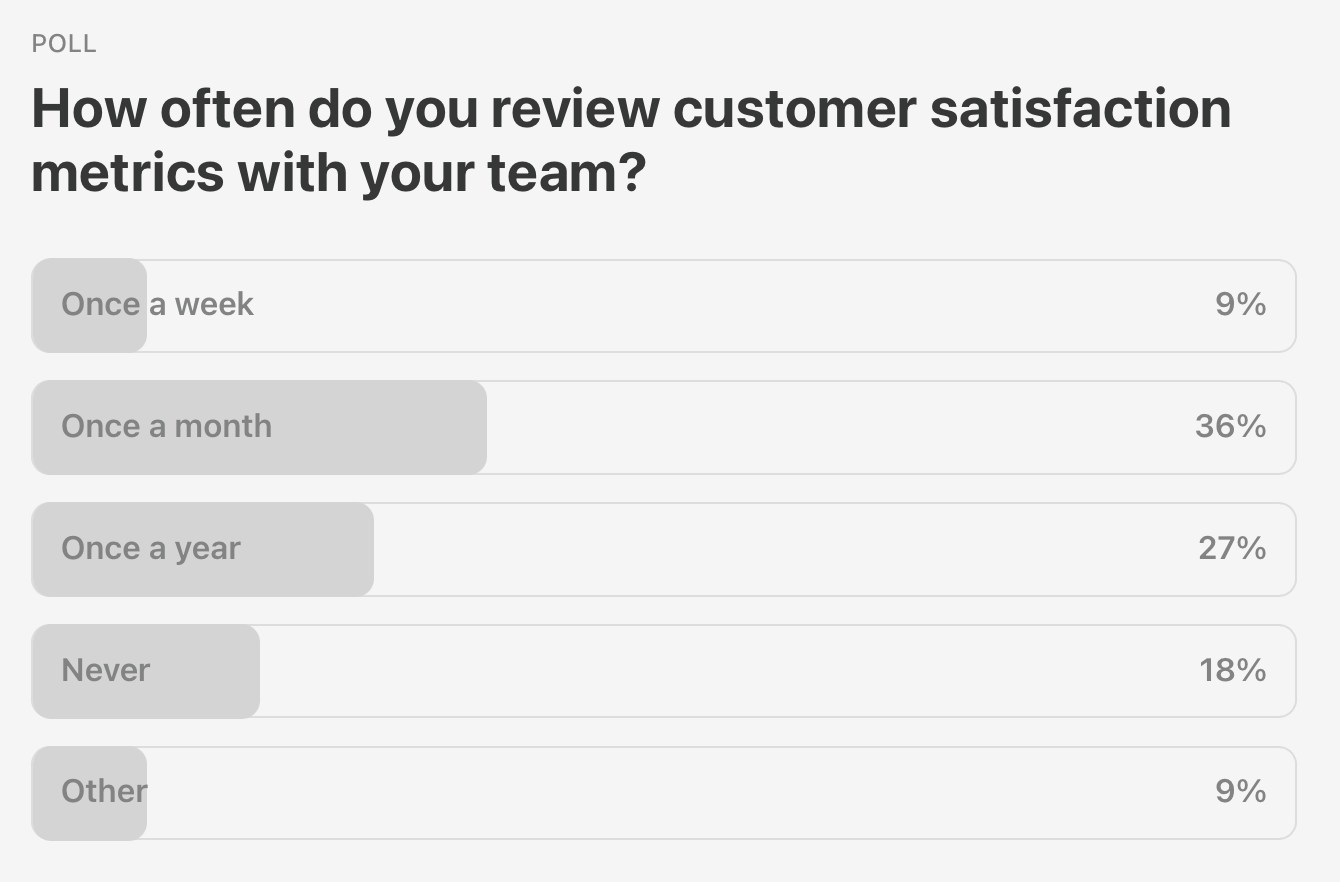
This time, I agree with the majority. For most businesses, once a month looks like a perfectly acceptable cadence. However, 27% answered “once a year”, and that is alarming—it is clearly not enough.
If you have questions you would like me to address in this newsletter, simply reply to this email. I always answer such emails personally.
Comments
Nothing yet. Say the first thing.
Sign in to join the conversation.